Invoice for Purchase Order: A Practical Matching Guide
In this article
Tuesday morning, the AP inbox is already crowded. A supplier has sent an invoice for a purchase order, the warehouse receipt hasn't posted yet, and month-end is close enough that every unresolved item feels urgent. One invoice may have the wrong quantity, another may reference an old PO revision, and a third may be perfectly valid but still unable to pass an inflexible system rule.
Matching isn't a clerical ritual. It connects the buyer's commitment, the supplier's claim, and evidence that the goods or services were delivered. The practical standard is a record that shows why payment was approved, what happened when the documents differed, and who made the decision.
Table of Contents
Why Invoice and Purchase Order Matching Matters
On a busy payment run, a familiar supplier name is not enough to release an invoice. AP needs a traceable connection between the supplier's claim and the buyer's approved commitment. The PO number usually provides that connection, while procurement systems preserve the purchase order's line-level history, including creation, changes, invoicing, and cancellation. SAP's procurement transaction guidance describes this history as a step-by-step record of a purchase order through processing and invoicing.
That record gives AP more than a way to approve payment. It supports checks for duplicate invoices, agreed pricing, missing receipts, and changes to the original commitment. Finance can connect the approved liability to the budget record. Procurement can explain which PO revision applied. An auditor can follow the transaction without depending on memory or an incomplete email thread.
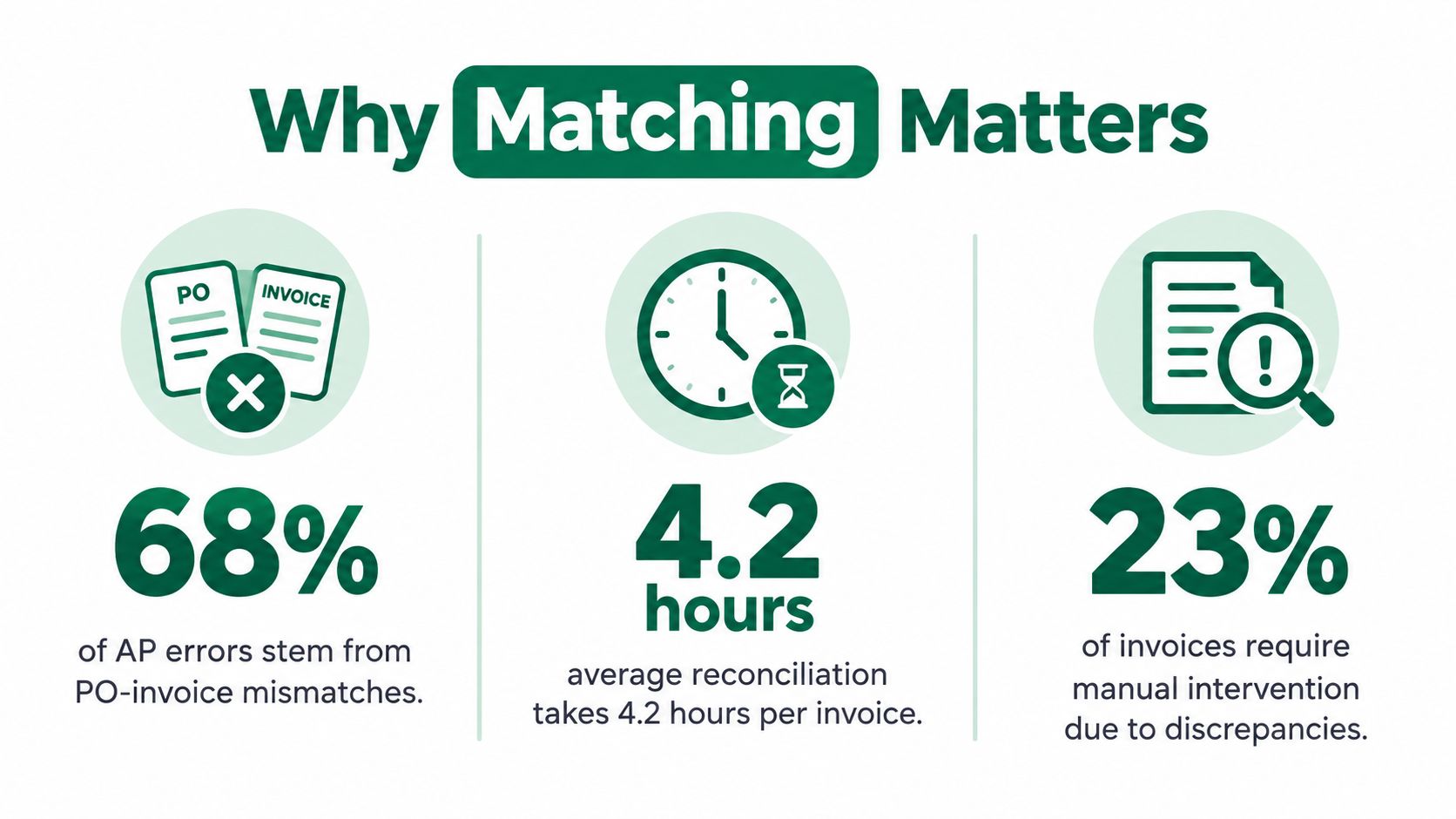
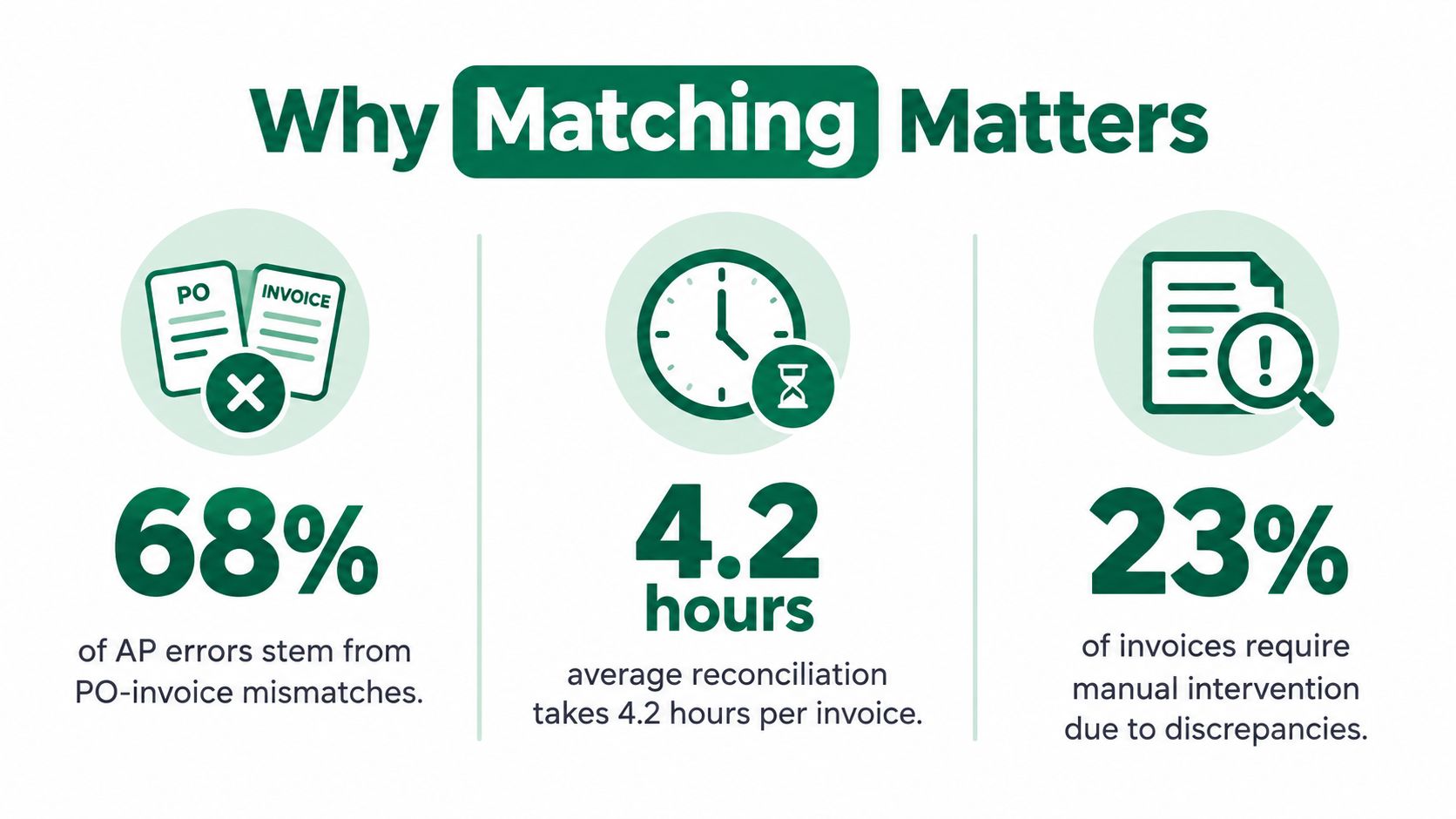
Manual matching also creates measurable operational pressure. The infographic below reports that manual matching relates to sixty-eight percent of AP errors, four point two hours per exception, and twenty-three percent of invoices. The infographic source lets readers review the figures and their stated context.
The control is the explanation
A successful match does not require every field to be identical. It requires evidence that AP checked the invoice against the applicable PO and receipt records, applied tolerances consistently, and obtained authorized approval for any exception.
Practical rule: Release payment when the evidence supports the liability, not merely because the invoice looks familiar.
Poor exception handling creates two exposures. AP may pay an incorrect invoice, or delay a valid one while staff investigate a difference that could have been documented and approved. The first threatens financial control and audit readiness. The second frustrates suppliers and leaves liabilities unresolved during close.
A reliable workflow therefore treats matching as a decision record, not a pass-or-fail box. Retain the original PO, relevant revision, receipt evidence, invoice data, approval, and reason for any override. Three years later, that record should answer the auditor's questions: what changed, who reviewed it, what evidence supported payment, and why the exception was accepted.
What an Invoice and a Purchase Order Actually Are
A purchase order is the buyer's commitment record. It states what the buyer intends to purchase, from whom, in what quantity, at what price, and under which delivery and payment terms. The buyer creates it after the purchase has been approved, and the supplier uses it as the commercial reference for fulfillment.
An invoice is the supplier's request for payment. It should identify what was supplied, the amount due, applicable tax, payment instructions, and the purchase order it relates to. The invoice doesn't replace the PO. It claims that the supplier has performed and is entitled to payment under the agreed terms.
The third document is the goods receipt, or its service equivalent. A warehouse employee may confirm that equipment arrived, while a project manager may confirm that a milestone or service deliverable was completed. Together, the PO, receipt, and invoice show three views of one transaction.
Where each team touches the record
Procurement owns the commercial commitment and PO changes. The receiving team records delivery or service completion. AP validates the invoice and routes exceptions. Finance posts the approved liability, manages payment, and relies on the retained evidence during close and audit review.
The sequence matters:
Commitment: The buyer creates and approves the PO.
Fulfillment: The supplier delivers goods or performs the service.
Receipt: The buyer records what was accepted.
Billing: The supplier submits the invoice.
Validation: AP compares the documents and resolves exceptions.
Payment: Finance releases the approved amount and records the transaction.
This is also why a PO shouldn't be treated as a financing document. If working capital is part of the procurement decision, teams should separately compare PO financing costs rather than confusing financing terms with invoice validation.
A well-run purchase order management process keeps revisions, approvals, receipts, and invoices connected. Without that link, AP is forced to reconstruct the transaction from attachments and conversations, which is where avoidable ambiguity begins.
Required Fields on Each Document
Matching fails before it starts when the documents don't carry the identifiers and commercial details needed to compare them. The PO should contain a unique PO number, supplier ID, legal supplier name, buyer entity, currency, line descriptions, quantities, unit prices, delivery location, delivery terms, payment terms, tax treatment, and the relevant cost or project coding.
The invoice needs an invoice number, invoice date, supplier name and address, tax registration details where applicable, PO reference, buyer entity, line descriptions, billed quantities, unit prices, tax codes, totals, currency, due date, and remit-to information. The supplier's bank details should be controlled through the supplier master, not accepted casually from an invoice attachment.

The fields that prevent false matches
A PO number alone isn't enough. AP should compare the supplier identity, line-level description, quantity, unit price, tax treatment, and receiving evidence. A correct PO number paired with the wrong supplier or an invoice for a different legal entity is still a control failure.
Use a practical intake checklist:
Identity: Confirm supplier, buyer entity, supplier ID, and remit-to details.
Reference: Check the PO number, invoice number, invoice date, and any contract or project reference.
Commercial terms: Compare currency, quantity, unit price, delivery terms, payment terms, and discounts.
Tax: Validate tax or VAT codes, taxable base, tax amount, and total.
Receipt: Link each billed line to a receipt, acceptance record, or approved service milestone.
Service purchases need extra structure. A service PO should identify the period covered, deliverables, rates, milestone definitions, acceptance criteria, and the person authorized to confirm completion. Otherwise, an invoice may be commercially reasonable but impossible to verify against an objective receipt.
Partial delivery needs the same discipline. The receipt should show what arrived, what was rejected, and what remains open. If the supplier bills the full order before completing delivery, AP needs a documented reason for paying the billed portion, not an informal statement that the balance will arrive later.
The best field design reduces interpretation. Use structured line identifiers where possible, require suppliers to reference the PO, and make PO amendments visible to AP and receiving. A matching engine can compare fields quickly, but it can't repair a commitment record that never captured the terms.
Two-Way vs Three-Way Matching Explained
Two-way matching compares an invoice with the purchase order. It fits spend where the PO contains enough evidence to approve payment, such as a controlled recurring service, a low-risk subscription, or a purchase where a separate receipt adds little control.
Three-way matching adds a goods receipt or service acceptance record. It tests what was ordered, what was received, and what was billed. Use it for physical goods, equipment, inventory, and any purchase where delivery status changes the liability. SAP's documentation on transaction history also shows why transaction records need to remain connected across the procurement process.
Spend type | Matching model | Why this model |
|---|---|---|
Recurring service with clear approval | Two-way | The approved PO and service owner confirmation may provide sufficient control. |
Physical goods and equipment | Three-way | Quantity and delivery must be checked against receiving evidence. |
Inventory or materials | Three-way | Payment should reflect what entered stock or was accepted. |
Technical equipment requiring inspection | Four-way | Inspection or quality results add evidence beyond receipt. |
Milestone-based professional services | Two-way or three-way | Use the model that links billing to documented acceptance of the milestone. |
Choose by evidence, not habit
If a receipt exists and is meaningful, use three-way matching. If no separate receipt can establish value, use two-way matching with a defined service approval, contract reference, and segregation of duties. The approval record must show who confirmed the work and what evidence supported that decision. That detail matters when an auditor asks why an invoice was paid without a receipt.
Four-way matching applies when receipt alone does not prove acceptability. Goods may reach the site but fail inspection, configuration, testing, or contractual acceptance. The inspection result becomes the additional payment gate, and the exception record should explain whether the issue was resolved, rejected, or accepted with approval.
Teams commonly choose the wrong model in opposite directions. Some apply two-way matching to goods because receiving data is inconvenient. Others force three-way matching onto services without defining what counts as receipt, leaving AP with invoices that cannot pass technically. A useful three-way matching workflow defines the required evidence for each spend category, which makes exceptions easier to investigate and defend later.
The Matching Workflow Step by Step
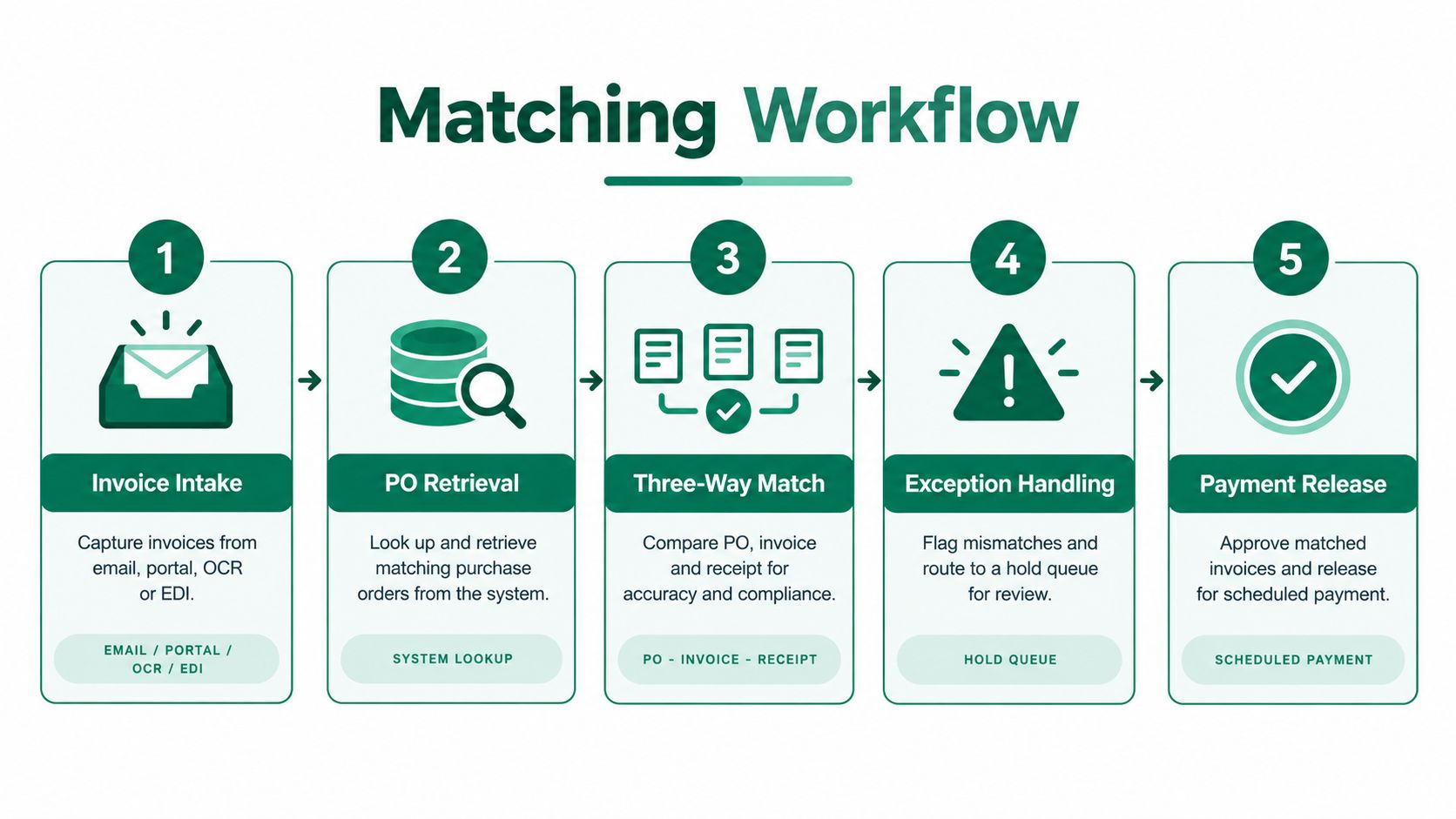
An invoice arrives by email, supplier portal, OCR capture, or EDI. The first checkpoint is intake. The system should assign the invoice a record, preserve the original image or file, identify the supplier, and check whether the invoice number has already been received for that supplier.
Next, the workflow retrieves the PO. If the PO number is missing or invalid, it should search using controlled supplier and reference data, then route the item for investigation rather than letting AP guess. Supplier master synchronization matters here. A changed legal name, duplicate supplier record, or inactive remit-to address can create a false exception before any commercial comparison occurs.
Follow the evidence line by line
The system then compares invoice lines with PO lines and, where required, receipt lines. It checks quantity, unit price, extensions, tax, currency, and totals. Tolerance rules should be explicit. A small rounding difference may be acceptable, while a quantity billed beyond the accepted receipt should create an exception.
Receipt timing is a common operational break. Goods can arrive before the warehouse posts the receipt, or a service owner can delay acceptance while AP waits for evidence. Don't treat every missing receipt as supplier error. Route it to the receiving or service owner with a clear action and escalation path.
The workflow should also identify:
Duplicate candidates: Same supplier, invoice number, amount, or other matching attributes.
PO revision issues: Invoice terms match an earlier version but not the current approved record.
Tax differences: Tax code, rate, or calculation doesn't agree with the applicable setup.
Unallocated lines: The invoice includes freight, fees, or services that weren't represented on the PO.
Approval gaps: The purchase or exception lacks the required authorization.
After validation, a clean invoice moves to approval or scheduled payment. A mismatch enters an exception queue with the exact failed field, supporting documents, owner, due date, and current status. The accounts payable procedures guide should define who owns each queue, not merely describe the matching rule.
A practical system doesn't hide the comparison. It records the values that matched, the values that differed, the tolerance applied, and the person who resolved the issue. That makes the workflow useful to AP today and defensible to an auditor later.
Handling Exceptions Without Grinding Payments to a Halt
A strict match-or-reject rule can weaken control rather than strengthen it. Partial deliveries, approved price changes, service milestones, and change orders often create legitimate differences. Rejecting every mismatch without a defined route encourages workarounds, delays suppliers, and removes the evidence the rule was meant to preserve.
Use a tiered exception policy. It should separate explainable, low-risk differences from issues requiring procurement, finance, tax, or legal review. Set the route before the first exception arrives.
Build the decision tree before the exception arrives
Send quantity variances to the receiving owner first. That person can confirm whether the invoice reflects an accepted partial delivery, an overbilling error, or a receipt that was never posted. Route price variances to procurement or the contract owner, who can verify a change order or negotiated adjustment.
Tax differences need specialist review when the code or jurisdiction is uncertain. Hold duplicate candidates until AP confirms whether the supplier submitted the same invoice twice or whether separate invoices share similar identifiers. Missing receipts should go to the person responsible for acceptance, with a defined escalation date, rather than sit indefinitely in AP's queue.
Require every exception record to include:
Mismatch type: Quantity, price, tax, duplicate, missing receipt, coding, or approval.
Business explanation: What happened and why the invoice remains payable.
Evidence: Revised PO, receipt, contract clause, change order, correspondence, or acceptance record.
Approver: Named person authorized for that exception and spend category.
Resolution: Pay, partially pay, request credit, reject, or hold pending evidence.
That record answers the question an auditor is likely to ask later: who accepted the variance, under what authority, and based on which document?
Root causes deserve their own owner
Repeated exceptions usually originate upstream. Poor supplier master data creates identity and tax problems. Late receiving creates false quantity failures. Informal change orders create price discrepancies. Scope creep creates service invoices that no PO describes accurately.
Track these causes separately from the payment outcome. A payable invoice can still expose a procurement weakness. The goal is to distinguish contract drift from clerical error, assign ownership, and stop repairing the same symptom on every invoice.
The benchmark also gives AP a management signal. Zycus's three-way matching analysis reports 9% exception rates for best-in-class AP teams versus 22% for the average organization, roughly one in eleven invoices versus one in five, and finds that 45% of organizations rank exceptions as a top AP challenge. The analysis connects those results to price and quantity deviations, tolerance rules, and targeted human review.
Keeping an Audit-Ready Trail Over Time
The audit test doesn't happen when AP opens the invoice. It happens later, when someone asks whether the payment was authorized, whether the goods or services were received, and why the amount differed from the original commitment. The answer should come from a connected record, not a search through personal mailboxes.
Retain the invoice image or structured invoice, the approved PO version, every relevant revision, receipt or service acceptance, approval chain, payment record, and exception justification. Keep timestamps and user identities where the system supports them. If a supplier changed its legal entity or bank details, preserve the relevant master-data approval rather than replacing the old information without record.
Minimum evidence package
For each PO-backed payment, an auditor should be able to find:
The locked PO: The version that governed the purchase or the approved change order.
The receipt record: Evidence of delivery, acceptance, inspection, or service completion.
The invoice: Original supplier document and captured fields.
The match result: Fields checked, tolerances applied, and failed comparisons.
The approval: Authorized approver, date, role, and decision.
The exception note: Reason for any variance and supporting evidence.
The payment trace: Posting and settlement information linked to the invoice.
Oracle's PO revision history documentation illustrates why revision visibility matters. A reviewer needs to compare the operative version with the original and understand what changed. Infor's purchase order history guidance likewise describes downstream transaction history that can include invoice receipts.
Retention should follow the organization's legal, tax, contractual, and industry requirements. The appropriate period varies by jurisdiction and record type, so AP should confirm it with finance, legal counsel, or the external auditor. A retention schedule is only useful if records remain searchable and connected throughout that period.
For broader control programs, a compliance monitoring software comparison can help teams evaluate how monitoring, evidence collection, and review workflows fit around their AP and procurement systems. The procurement record still needs clear ownership. Software won't compensate for undocumented approvals or an unposted receipt.
Audit readiness also depends on preserving commercial context. If a specification changed, retain the approved change. If a supplier's quote differed from the final PO, retain the explanation. If an invoice was paid despite a mismatch, retain the evidence that made the payment defensible. Three years later, the question won't be whether the system displayed a green status. It will be whether the organization can show a coherent chain from commitment to payment.
Procright helps procurement teams create traceable sourcing records, compare supplier evidence against locked specifications, and detect commercial drift before it becomes a payment or audit issue. Visit Procright to test how a documented procurement trail can support cleaner PO, receipt, and invoice decisions.
Try it on a real buy
Bring one category. Watch where the flags land.
We use a little analytics to see which pages actually help. Nothing else, no ad trackers.