Managing PPV With AI In Volatile Markets
AI-driven price signals, spec checks, and early alerts to prevent PPV leakage before costs hit COGS.
In this article
PPV gets out of control when teams see price changes after the PO is placed. In fast-moving markets, I’d focus on three things first: price signals, spec checks, and early alerts. That’s how I’d cut the gap between planned cost and actual cost before it hits margin.
Here’s the short version:
PPV = (Actual Price − Standard Price) × Quantity
The biggest PPV leaks usually come from:
market price swings
contract drift
maverick spend
spec gaps
slow price creep
AI helps by:
flagging quote and price outliers early
checking specs before vendors quote
comparing suppliers against actual requirements
spotting small drift like 0.7% to 1.9%
giving teams up to a 14-day head start before repricing
Data still matters:
use 18–24 months of purchase history
aim for 90% clean data
teams below 85% clean data see 3x more ML project failures
A few numbers stand out. Off-contract buying can run 30% above negotiated rates. One supplier drift pattern of 1.6% per quarter led to $4.9 million in losses. And one chemical manufacturer used AI-led sourcing across 8,000+ items and triggered $20 million+ in savings.
If I were setting up PPV control in a volatile market, I’d put AI at the front of the process - not just at month-end reporting - so buyers can act before cost moves show up in COGS.
The Main Sources of PPV Leakage During Market Volatility
PPV leakage in volatile markets usually comes from two places: outside price movement and inside procurement weak spots.
Price Swings, Contract Drift, and Supplier Surcharges
Volatility doesn't hit every cost line at the same time. Commodities, freight, energy, and labor can all move on different schedules, and those shifts often show up before market indices reflect them.
That timing gap matters. Annual contracts start leaking money when pricing resets too slowly. If pricing is fixed while the market moves fast, buyers can get stuck paying rates that no longer match current conditions.
Then there's maverick spend, which makes the problem worse. When employees buy off-contract, costs can come in 30% above negotiated rates. It's the kind of leak that looks small purchase by purchase, then adds up fast.
But outside pressure isn't the only issue. Some leakage starts much earlier.
Specification Gaps and Hidden Cost Creep
Not all PPV leakage comes from market movement. A large share starts at the specification stage, before any vendor is even contacted.
When specs are incomplete, vendors fill in the blanks themselves. That can lead to higher-cost options or nonstandard substitutes being quoted instead of what the buyer had in mind. The result is avoidable overpayment through premium substitutions and inflated quote variance.
Pricing drift is even harder to catch because it often happens quietly. In March 2026, a $380 million infrastructure contractor found that a supplier had increased prices 1.6% each quarter for 18 months. That pattern created $4.9 million in losses before an AI model spotted it.
That's where AI earns its keep. It can flag gaps, drift, and exceptions before PPV leakage lands in finance.
Source of PPV Leakage | Typical Impact |
|---|---|
Maverick Spend | ~1.8% of annual purchase value |
Contract Drift | Fixed terms lag market price resets |
Specification Gaps | Misleading quotes; premium substitutions |
Pricing Drift | 2% drift ≈ $3M–$4M/year on $400M spend |
How AI Improves PPV Control in Real Time
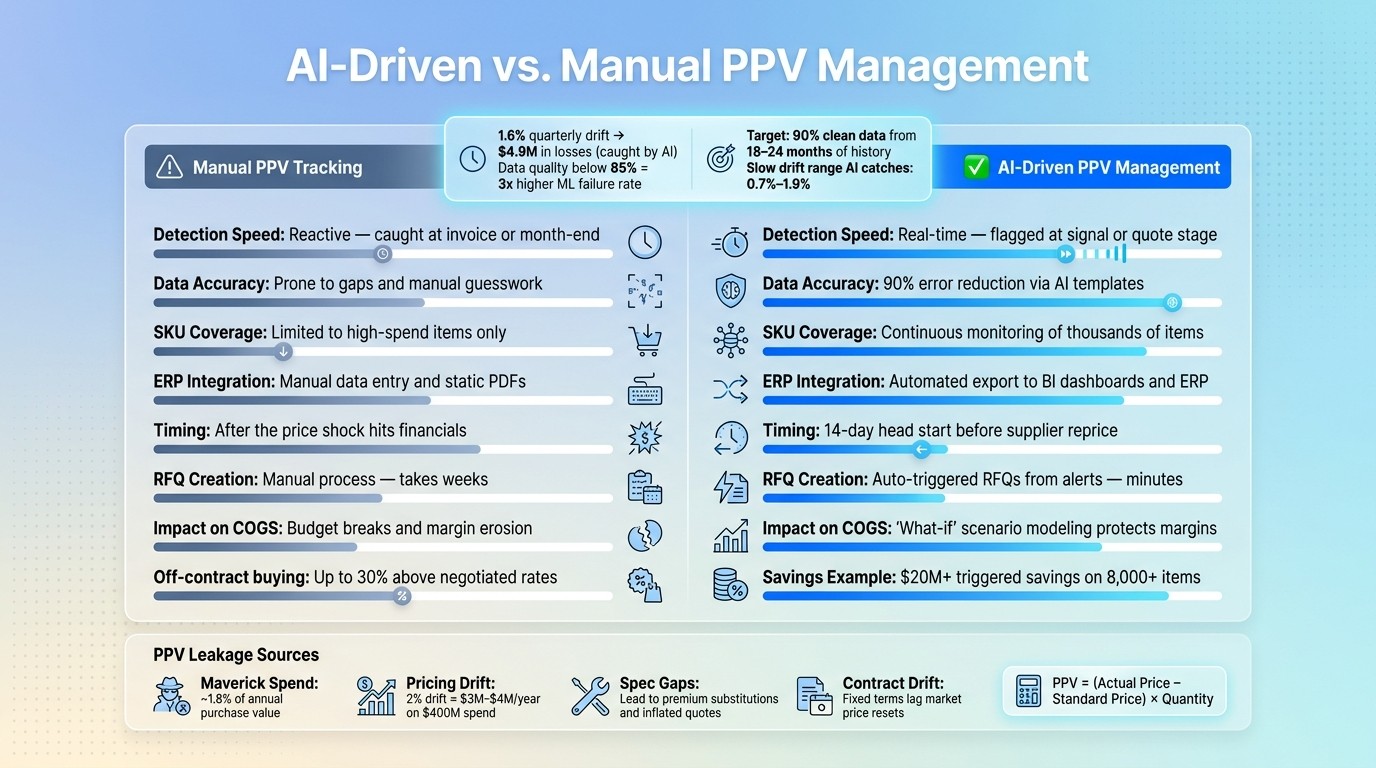
AI vs. Manual PPV Management: Key Metrics & Impact
AI moves PPV control earlier in the buying process. Instead of finding issues after the invoice shows up or at month-end, it spots price outliers, spec mismatches, and approval risks before the purchase goes through. Those checks line up with the three leakage points already on the table: market swings, contract drift, and hidden cost creep.
Spend Signals and Supplier Comparison for Faster Price Decisions
AI builds spend signals using internal cost models and actual transaction benchmarks. So when a price driver changes, the system flags it right away instead of waiting for finance to reconcile the numbers later.
The supplier comparison layer is just as important. AI engines review specifications line by line across web pages and PDFs to rank the best-fit products and suppliers.
One Fortune 500 chemical manufacturer uploaded more than 8,000 items from a $4 billion portfolio into an AI-driven platform. The system flagged savings opportunities on its own and launched more than 300 RFQs, which led to $20 million+ in triggered savings.
Feature | Manual PPV Tracking | AI-Driven PPV Management |
|---|---|---|
Detection Speed | Reactive - caught at invoice or month-end | Real-time - flagged at signal or quote stage |
Data Accuracy | Prone to gaps and manual guesswork | 90% error reduction via AI templates |
SKU Coverage | Limited to high-spend items | Continuous monitoring of thousands of items |
ERP Integration | Manual data entry and static PDFs | Automated export to BI dashboards and ERP |
That same comparison step helps cut spec-driven overbuying too. If the system can tell the difference between what looks close and what actually matches, buyers have a much better shot at avoiding extra cost.
Specification Checks and Compliance Verification to Prevent Avoidable PPV
Vague or incomplete specs are one of the most common and preventable causes of hidden cost creep. When requirements aren't clear, suppliers quote what they have on hand, not what the buyer meant to ask for. That usually leads to premium substitutions and avoidable price increases.
AI deals with that problem at the source. It reads drawings, PDFs, and technical manuals to check whether the item being sourced matches the required technical details. Before the purchase happens, each requirement is marked as compliant, partial, or non-compliant.
Procright is built for this exact issue. It automates specification creation, product discovery, and compliance verification. It uses AI to spot missing requirements and fill technical gaps before vendors are contacted. Its transparent compliance scores give procurement teams a clear, auditable way to compare products, so cost decisions aren't based on half-finished information.
Using AI-optimized, industry-specific templates can cut specification errors by 90%, and AI-driven product discovery and analysis can cut the risk of mismatched sourcing decisions by the same margin.
Leakage Driver | AI-Based Control |
|---|---|
Spec Gaps / Vague Requirements | AI spec parsing and standardized templates catch gaps and fill missing technical details |
Non-Compliant Substitutes | Line-by-line compliance scoring: Yes / Partial / No |
Premium Substitutions | AI comparison engine ranks products by technical match percentage |
Hidden Cost Creep | Standardized templates with automated source verification |
Once the specs are clean, the same data can help buyers see trouble coming before a reprice lands.
Forecast Support and Variance Alerts Before PPV Hits Financials
Most PPV losses give off early warning signs. AI surfaces those signs sooner through lag analysis, which measures the delay between feedstock moves and supplier quotes. When a threshold gets crossed, like a 3% shift in a 3-month forecast, the system sends an alert and can auto-draft an RFQ with suggested suppliers. That cuts response time from weeks to minutes.
Teams using this approach report a 14-day head start on negotiations before a supplier reprice happens.
Metric | Reactive Management | AI-Driven Management |
|---|---|---|
Timing | After the price shock hits financials | Before the quote lands - 14-day head start |
Data Inputs | Last year's budget and static indices | Real transactions, indices, and 12-month outlooks |
Responsiveness | Manual RFQ creation - takes weeks | Auto-triggered RFQs from alerts |
Impact on COGS | Budget breaks and margin erosion | "What-if" scenario modeling protects margins |
How to Add AI-Driven PPV Controls to Procurement Operations
Once AI flags variance, the next step is simple: send it into a workflow that makes someone deal with it.
Data, Workflows, and Thresholds That Make PPV Monitoring Work
AI PPV monitoring depends on clean source data. Before you set alerts or thresholds, teams need 18–24 months of clean transaction history: SKU IDs, quantities, dates, locations, and prices. That history gives the system enough context to spot patterns and catch deviations with accuracy.
The bar here is high. Use at least 90% clean data. Companies under 85% see 3x higher failure rates on machine learning projects. In plain English, bad data poisons the setup. It doesn't matter how smart the model looks on paper if the item master is messy. Clean and standardize item masters before training starts.
Workflow design matters just as much. If every flagged case lands in one inbox, things stall fast. A better setup is to route:
low-variance cases to buyers
mid-variance cases to category managers
high-variance cases to finance for review
You also need a 24-hour reroute rule for unavailable approvers. If a flagged PO sits untouched because someone is out of office, the control falls apart.
Thresholds need a bit of nuance too. Don't just watch for big jumps. AI should also catch slow price drift in the 0.7%–1.9% range before it snowballs into serious leakage. That small creep is where money often slips away without much noise.
Where Procright Fits in a PPV Control Process

A lot of PPV loss starts earlier than people think. It often begins with vague requirements, long before the PO and even before the RFQ. So the control process can't start only after pricing comes back. It has to start at the spec stage.
That's where Procright fits. It sits at the spec gate, where it captures missing requirements and scores compliance before RFQs go out. Its AI agents surface missing technical details like load tolerances, compliance standards, and dimensional constraints that buyers often leave out without noticing.
When those gaps are fixed before a quote is requested, vendors have less room to swap materials, reinterpret the ask, or come back with a higher price. That keeps sourcing tied to what the business actually needs, not just what a vendor says they can provide.
"A procurement decision has three failure points... The first is the specification. If it's incomplete or vague, everything downstream breaks." - Procright
Procright's job in this process is straightforward: stop spec-driven variance before sourcing begins.
Conclusion: A Practical AI Framework for Managing PPV in Volatile Markets
PPV gets hardest to manage when teams spot market changes only after the damage is done. Manual tracking and month-end variance reports just can't keep up when pricing swings fast. By the time supplier increases show up in contracts and budgets, the window to act has often closed.
That puts the focus on three controls that matter most: spend signals and internal benchmarks to spot price drift early, template-based supplier comparisons to check sourcing decisions against actual specs, and variance alerts to send exceptions to the right owners before costs hit COGS.
Clean specs matter just as much. In many cases, spec quality is the biggest missed control. Bad or incomplete requirements make overpayment far too easy. AI-driven specification creation, as Procright applies it, helps catch missing requirements before vendors are asked to quote.
Here’s the split in plain English: AI handles monitoring and alerts; buyers handle exceptions and supplier decisions.
The payoff is simple - earlier action, fewer surprises, and tighter PPV control.
FAQs
How does AI reduce PPV before costs hit COGS?
AI cuts purchase price variance (PPV) before added costs roll into cost of goods sold (COGS). The key is timing: it works at the pre-purchase stage, not after the deal is done.
Procright helps remove common sources of variance by making requirements clearer, spotting missing technical specs, and flagging gaps before suppliers are even contacted.
From there, it compares and ranks products against those specs and checks supplier compliance using traceable technical documentation. That gives teams a firmer way to avoid poor product picks, rework, contract exits, and other losses that push PPV in the wrong direction.
What data is needed for accurate AI PPV alerts?
Accurate AI-driven purchase price variance (PPV) alerts depend on detailed, high-quality data. You need both historical benchmarks and real-time procurement activity to make those alerts useful.
The core inputs are straightforward:
The standard or budgeted cost
The actual unit price paid
The actual quantity purchased
Consistent SKU-level transactions with clear, current ERP records
Procright supports this with transparent, data-driven insights on specifications, product rankings, and supplier reliability.
How can AI catch spec issues before vendors quote?
AI spots spec issues while the draft is still being written. It does that by asking clarifying questions and flagging missing technical requirements - like capacity limits or compliance standards - before any vendor is contacted.
With Procright, that means specs are more complete and measurable. And that matters. If a spec leaves room for guesswork, vendors can fill those gaps with assumptions that happen to work in their favor.
The result is a tighter procurement process with fewer costly errors downstream.
Related Blog Posts
Try it on a real buy
Bring one category. Watch where the flags land.
We use a little analytics to see which pages actually help. Nothing else, no ad trackers.