Real-Time Collaboration in Procurement: Benefits
Live procurement platforms cut costs, shorten cycle times, boost supplier coordination, and enforce compliance with clear audit trails.
In this article
Real-time collaboration in procurement is transforming the way businesses manage their supply chains. By leveraging live data on shared platforms, teams eliminate inefficiencies caused by fragmented communication, delayed responses, and outdated workflows, such as creating specifications manually. Here’s why it matters:
Cost Savings: Companies report a 15–30% reduction in procurement operating costs.
Faster Cycles: Procurement timelines are shortened by 30–50%.
Improved Coordination: Supplier communication becomes seamless with instant updates and shared data.
Efficiency Gains: Administrative workloads drop by over 25%, and processes become 30% more efficient.
Enhanced Compliance: Automated audit trails and centralized data ensure adherence to policies and reduce risks.
Better Decision-Making: Live data enables faster resolution of issues and proactive responses to market changes.
These platforms streamline operations, reduce errors, and improve supplier relationships, making procurement faster, more transparent, and resilient. Businesses adopting this approach see measurable improvements in performance and profitability.
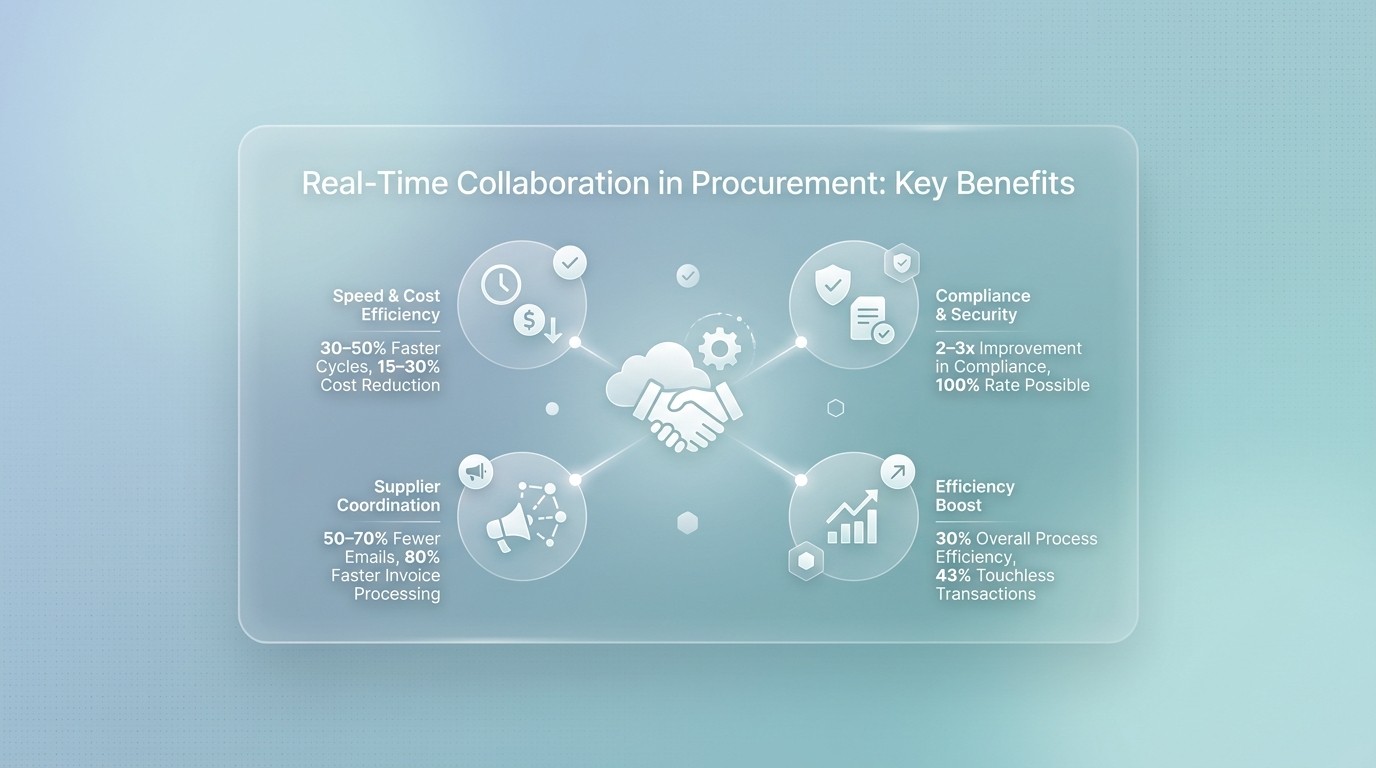
Real-Time Collaboration in Procurement: Key Stats & Benefits
Efficiency Gains from Real-Time Collaboration
Less Administrative Work
Administrative tasks can eat up a lot of time in procurement - things like chasing suppliers for updates, manually re-entering data from emails into ERP systems or performing manual data validation, or trying to track down the latest version of a document. Real-time collaboration platforms simplify this by centralizing all data in one workspace.
Supplier portals are a game-changer here. Vendors can upload invoices, submit responses, and even check payment statuses on their own, without needing to reach out. Automated alerts take care of follow-ups for late responses or missing documents. The impact is clear: these tools can reduce the workload for buyers managing direct-material POs by over 25%. On top of that, companies using procurement orchestration tools report a median 30% boost in process efficiency. By cutting out redundant tasks, these platforms allow for faster, more flexible approval processes.
Faster Approval Timelines
Traditional approval chains can be painfully slow. A request might sit in one person’s inbox for days before moving to the next, creating unnecessary delays. Real-time platforms solve this issue with parallel approvals. Legal, finance, and risk teams can review requests at the same time, supported by automated SLA timers and live status updates. This allows teams to compare products for compliance more efficiently during the review phase. This approach eliminates the need for endless follow-up emails and keeps everyone on track.
"One task takes 3 days? Fine. But five tasks don't take 15 days - they still take 3." - ORO Labs
The results speak for themselves: top-performing organizations complete source-to-contract cycles in just 15 days, compared to 40 days for those not using real-time orchestration.
Case Study: Shorter Procurement Cycles
When companies implement procurement orchestration - a system that connects intake, approvals, and execution across different tools - they see major improvements. Source-to-contract cycle times drop by an average of 20 days. Plus, businesses using these platforms are nearly three times more likely to process purchase orders without manual intervention. In fact, 43% of their transactions are touchless, compared to just 15% for those not using such systems. This streamlined process not only speeds up procurement cycles but also reduces inventory costs and helps companies bring products to market faster.
Better Supplier and Stakeholder Coordination
Clearer Supplier Communication
Relying on emails and spreadsheets often leads to version mismatches and miscommunication. Real-time collaboration platforms solve this problem by providing a single source of truth - a shared space where both buyers and suppliers can access up-to-date information on orders, shipments, and invoices. These platforms often feature transaction-linked Q&A threads attached directly to purchase orders, ensuring that all updates, questions, and answers stay connected to the relevant transaction. No more hunting through crowded inboxes for critical details.
Another key feature is real-time purchase order (PO) acknowledgment. If a supplier faces issues meeting delivery dates or pricing agreements, the system flags it immediately - long before it becomes a major problem. This proactive approach allows procurement teams to zero in on late acknowledgments, price discrepancies, or shipments at risk, cutting down PO-related supplier inquiries by 50–70%. With this streamlined communication, teams can resolve issues faster and more effectively.
Faster Issue Resolution
Real-time updates make it possible to resolve problems before they disrupt production. For instance, if a supplier can't deliver as planned, buyers can quickly pivot to surplus inventory or alternative sources, turning what could have been a crisis into a manageable adjustment.
For suppliers, automated reconciliation and live messaging ensure faster, more accurate payments and significantly reduce disputes. Meanwhile, finance and legal teams benefit from structured communication threads that provide a clear, documented audit trail for every discrepancy, eliminating the chaos of scattered email exchanges.
Take Ag Leader, for example. By integrating real-time supplier coordination with their Epicor ERP system, they improved their customer on-time delivery rate from 76% to 99% and simultaneously reduced their total inventory by 32%. Similarly, JBT AeroTech implemented structured PO execution workflows, cutting missing parts at the start of production from 31% to 8% and boosting supplier on-time arrival rates from 68% to 89%.
"The future of procurement execution is not more reactive follow-up. It is real-time coordination that keeps purchase orders updated and controlled despite changing conditions." - SourceDay
Benefits for Buyers, Suppliers, and Internal Teams
Streamlined communication and faster issue resolution offer measurable benefits for everyone involved in the procurement process:
Stakeholder | Key Benefit |
|---|---|
Procurement | 50–70% fewer status-check emails; more focus on high-risk exceptions |
Finance | Up to 80% faster invoice processing with automated three-way matching |
Legal/Compliance | Centralized audit trails replace fragmented email disputes |
Operations | Early warnings about delivery delays help avoid production downtime |
Suppliers | Faster payments and clearer order data improve business relationships |
Sharing rolling demand forecasts with suppliers enables better planning for production and raw materials, while suppliers providing information on lead-time variability helps buyers fine-tune safety stock levels. This two-way data exchange not only improves efficiency but also builds trust, transitioning relationships from purely transactional to genuinely collaborative. In fact, effective supplier collaboration has been shown to increase operating profit by 2% to 4%.
"Supplier collaboration is the cultural foundation. The software is the enabler. Without the cultural shift... even the best collaboration platform underperforms." - Manuel de Arberas, gosourced.ai
Security and Compliance in Real-Time Procurement Workflows
Centralized Control of Procurement Data
Scattered procurement data - spread across emails, spreadsheets, and shared drives - creates vulnerabilities. A missing certificate here or an outdated contract there can quickly result in compliance issues that slip through the cracks. Real-time collaboration platforms tackle this by consolidating everything into one centralized workspace. This means every document, approval, and communication is stored, version-controlled, and accessible only to the right people.
Why is this so important? Recent research highlights the challenges: 68% of new CPOs cite fragmented or outdated technology as their biggest operational hurdle, while 58% identify poor data quality as a major barrier to speed and security. Centralizing procurement data directly addresses both challenges by improving organization and accessibility.
Security is further strengthened through role-based access control (RBAC), which assigns permissions based on specific job roles. For example, an AP Clerk only accesses what they need, while a Legal Reviewer sees documents relevant to compliance. This "principle of least privilege" reduces internal risks - an essential safeguard, especially since insider threats account for 43% of all data breaches.
"Unchecked access is a primary driver of both accidental data exposure and intentional fraud." - Harsh Singhi, Procurement Automation Professional, ProcBay
By centralizing control and tracking access, organizations create robust audit trails that make compliance oversight far easier.
Tracking Changes for Compliance
One of the standout benefits of real-time collaboration is the creation of an automatic audit trail. Every action - whether it’s an edit, upload, or approval - is logged immediately. This tamper-proof record eliminates the guesswork of manual workflows, where tracking decisions often means sifting through endless email threads.
These immutable logs also enable embedded policy enforcement. For instance, workflows can automatically pause if a required certificate hasn’t been uploaded or block a single user from both requesting and approving the same purchase. Organizations using automated procurement platforms have reported a 2–3x improvement in third-party compliance adherence thanks to these built-in safeguards.
A compelling example comes from Signature Global, which achieved a 100% compliance rate and reduced its PR-to-PO cycle time by 40% by integrating an orchestration platform with their SAP ERP system. This kind of automation not only strengthens compliance but also sets the stage for AI-powered compliance tools.
How Procright Supports Compliance
Procright integrates compliance directly into procurement workflows. Its AI-driven tools verify compliance during key steps - like writing technical procurement specifications and product comparison - flagging gaps in real time. Every product is assessed against defined requirements and given a transparent compliance score, providing teams with a clear and defensible decision-making record.
"Procurement security isn't a feature. It's the foundation." - Jitendra Patidar, Solution Architect, ProcureKey
Better Decisions and Stronger Procurement Resilience
Shared Visibility Across Teams
When procurement teams rely on data-driven procurement decisions, the process becomes quicker and more precise. Real-time collaboration tools provide a single, unified platform, replacing the chaos of fragmented email chains and scattered spreadsheets. This means everyone can see the current status of orders, approvals, or supplier responses in one place. Such transparency allows teams to focus on exceptions - like delayed shipments, unacknowledged purchase orders, or price discrepancies - rather than wasting time manually reviewing every transaction. This streamlined approach ensures that issues are escalated and addressed swiftly.
Faster Escalation and Decision-Making
Real-time platforms don’t just highlight potential problems; they also speed up how quickly those problems are resolved. For example, if a supplier fails to acknowledge a purchase order, the system flags it immediately, enabling buyers to act before production schedules are affected. As SourceDay explains:
"Predictable procurement execution does not mean every supplier hits every date. It means changes are visible early enough for the business to respond."
The impact of such systems is clear. JBT AeroTech saw supplier on-time parts arrival jump from 68% to 89%, while missing parts at production start dropped from 31% to just 8% after implementing real-time escalation protocols and workflows. Similarly, Ag Leader integrated real-time coordination into their Epicor ERP system, which improved customer on-time delivery rates from 76% to 99% and cut total inventory levels by 32%.
Adapting to Changing Market Conditions
Real-time decision-making doesn’t just solve immediate issues - it also helps procurement teams stay ahead of market changes. With 84% of companies admitting they feel unprepared for emerging uncertainties, the ability to adapt quickly has never been more important. Real-time collaboration shifts procurement from being reactive to predictive. AI-powered tools, for example, can simulate "what-if" scenarios - like tariff adjustments, supplier disruptions, or sourcing changes - so teams can evaluate their options before committing to a specific strategy. Pre-set rules for alternate suppliers, split shipments, or expedited orders further simplify responses to sudden changes.
"Control means adopting a proactive stance in the face of uncertainty... the ability to anticipate and respond before a disruption fully crystallizes is what ultimately optimizes costs." - Mita Gupta, EVP and Business Unit Head, WNS Procurement
The Value of True Collaboration With Suppliers and Customers
Conclusion: Key Benefits of Real-Time Collaboration in Procurement
Real-time collaboration is reshaping procurement processes. By tackling challenges like efficiency, supplier coordination, security, and decision-making, it delivers measurable improvements at every stage. For instance, adopting real-time collaboration can increase procurement cycle speeds by 30–50% and enhance supplier response rates by up to 40%.
Speed isn't the only advantage. Real-time workflows also tighten compliance controls. Automated audit trails, role-based permissions, and proactive alerts for document expirations replace outdated manual checks. This streamlines audits and curbs unauthorized spending. As ProcureKey highlights:
"Security gaps in sourcing rarely cause problems immediately. They surface later during audits, supplier disputes, compliance reviews, or internal investigations." - ProcureKey
Improved control leads to better, data-driven decisions. When departments like Finance, Legal, and Operations, along with suppliers, rely on live data instead of outdated reports, teams can make more informed choices. Tools like Procright’s AI-powered platform simplify and secure procurement by automating tasks like automating product specification creation, product comparisons, and compliance scoring, ensuring a strong foundation for sourcing decisions. Learn more at Procright.
"The faster insights are translated into action, the more effective procurement can be to drive resilience, growth, and innovation beyond traditional cost-saving metrics." - Mita Gupta, EVP and Business Unit Head, WNS Procurement
FAQs
What does “real-time collaboration” mean in procurement?
Real-time collaboration in procurement shifts the focus from outdated, fragmented tools like emails or spreadsheets to shared digital platforms. These platforms allow teams, suppliers, and partners to work together using the same live data. This setup simplifies processes like sourcing, contracting, and payments by keeping everyone aligned.
By using real-time data, this approach brings several benefits: greater transparency, fewer errors, and instant updates. Automated workflows and shared visibility also help improve efficiency while reducing risks. It's a smarter way to ensure everyone stays on the same page.
What’s the quickest way to measure ROI after rollout?
The quickest way to gauge ROI after rolling out a procurement solution is by focusing on efficiency metrics like cycle time and accuracy. For instance, keep an eye on how fast tasks like supplier onboarding or moving from requisition to purchase order are completed. You can also measure error rates, such as compliance violations, to better understand time and cost savings. Tools like Procright make this easier by automating tasks like specification creation and compliance checks, enabling teams to showcase value and efficiency improvements in no time.
Related Blog Posts
Try it on a real buy
Bring one category. Watch where the flags land.
We use a little analytics to see which pages actually help. Nothing else, no ad trackers.