Sources of Supplier Information: 10 Options That Hold Up
Compare supplier information sources by reliability, coverage and citation readiness, then combine discovery, official records and independent evidence.
In this article
Where do you verify a supplier before you sign? Most poor sourcing decisions trace back to a single moment, trusting a claim nobody could later trace. A website says certified, a sales rep says two weeks, a brochure says local support, and two years later an auditor asks for the page, date, and version that proved it.
That's why sources of supplier information shouldn't be judged only on what they tell you. You also need to judge whether you can cite, date, and defend what they told you. In the Industrial Buyer Pulse Q3 2025 survey, 31% of respondents began initial research on supplier websites, ahead of industry events at 17% and peer referrals at 14%. Supplier sites are useful starting points, but they're controlled by the supplier, so they can't be your only proof.
This list ranks ten options by reliability and use case, from vendor sites and manuals to public registers, specialist data providers, and AI research platforms. I've weighted each one on audit readiness, not just convenience. Once you've shortlisted and verified a supplier, the same evidence discipline should carry into your steps for onboarding overseas suppliers, where legal names, bank details, and certifications get checked again before the first order.
Table of Contents
1. Procright
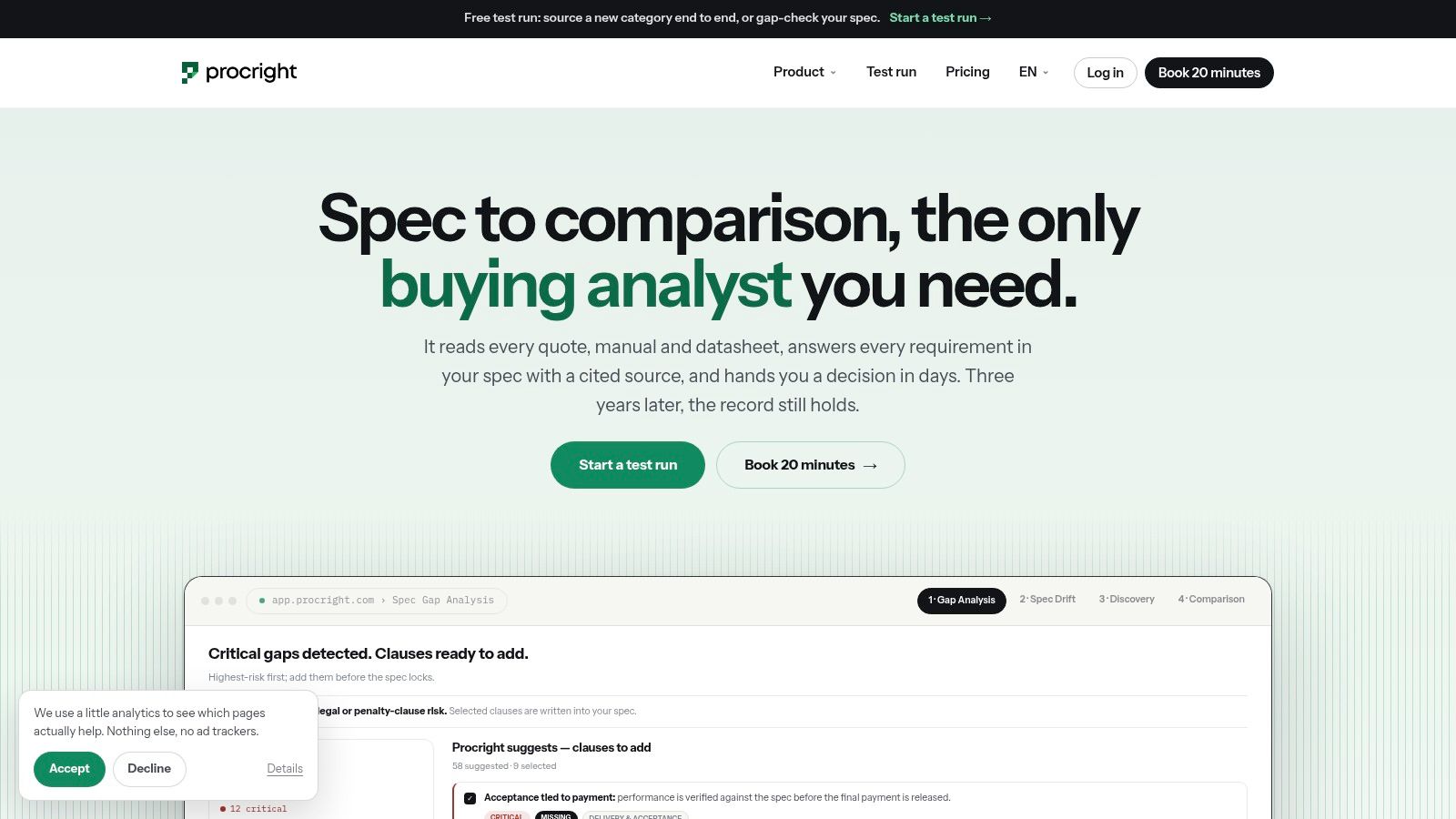
Procright is built to turn scattered supplier claims into a single cited decision record. You name a product or service, it drafts the specification, scans the market, and returns a side-by-side comparison. That matters because most sourcing files fail not on choice, but on traceability.
How It Verifies Claims
Our AI reads guides, videos, forums, reviews, manuals, and supplier sites, so nothing rests only on a supplier's own claims. Each requirement is answered yes, no, or partial, with the source shown for every answer and the reason shown for each elimination. Discovery also scores Market Prevalence, Supplier Stability Index, Interest Radar, and Local Service, which helps you separate a popular option from one that can support you in your region.
Specification gaps flagged early: Missing requirements and single-bidder lines surface before the spec locks.
Spec drift checks: Quotes and terms are compared against the locked spec, with the source page cited for each deviation.
Supplier responses managed in one place: Invitations, progress, and forms sit inside the same event, and quotes stay confidential and belong to you.
Procright reports 3 to 10% price improvements and shorter cycles for customers, with a website example of a vibration sensor decision completed in four days after screening more than 170 options. Testimonials come from procurement and technology leaders at Fizix, Arksoft, vSmart, Ekip, and FolSec. You can also export to DOCX and Excel, so you're not rebuilding the file for finance or audit.
The limits are real. Specific prices aren't shown, plans run from Starter to Public Sector by volume, seats, and audit needs, and it's an early-stage product working with a limited number of teams. Run the free test, either end-to-end sourcing or gap analysis, and judge the citations on your own category first.
2. Matchory
If your problem is a stale vendor list, Matchory is built for documented discovery. You search by process, material, certification, and capacity rather than by company name, which is how you find suppliers who never found you.

Match explanations come with supporting sources, and that's the feature to test hardest. Open three matches, follow each source to the original page, and check whether the certification or capacity claim still reads the same way in context. If you can't, treat the profile as a lead, not evidence.
Where It Fits Best
List enrichment: Uploaded supplier lists get resolved and deduplicated, which cleans up legal names and subsidiaries.
Portfolio analysis: Overlap, risk concentrations, and certification gaps become visible across your base.
Workflow options: Monitoring, RFIs, API, and MCP integrations let you work standalone or connected.
I recommend Matchory for building a defensible longlist, especially when you need to show you searched beyond incumbents. It's enterprise oriented with no standard public pricing, and public profile data still needs independent confirmation before it enters scoring. Record the search criteria and date, or you'll struggle to prove market coverage later.
3. Thomasnet
Thomasnet is the classic longlist tool for U.S. industrial sourcing. A study of B2B purchasing information sources found supplier websites ranked among the most important sources for manufacturers, alongside supplier offers and direct specialist contact. Thomasnet works best when you treat it the same way, as a route to those primary sources rather than a replacement for them.
Search by location, capability, and certification, then open profiles, catalogs, and contact details. The platform states its network includes more than 500,000 U.S. manufacturers and suppliers, which gives you breadth for manufacturing, industrial products, and MRO. Breadth isn't verification, though.
Practical rule: Screenshot the profile and catalog page you relied on, save the retrieval date, and confirm current capacity directly with the supplier. Directory pages change without notice.
Use Thomasnet to create the initial list and start conversations. Don't use it to settle quality, compliance, financial health, or geopolitical exposure, because a listing proves none of those. For audit purposes, cite the underlying supplier document you obtained through the listing, not the listing itself. That distinction sounds small until a rejected supplier challenges your file.
4. Dun & Bradstreet Supplier Intelligence
When the question shifts from "who can make this" to "who is this company and will they still be stable next year," Dun & Bradstreet Supplier Intelligence earns its place. It's a screening and monitoring layer, not a technical comparison tool.

You can screen for business, financial, and restricted party risks, monitor changes with alerts, and search for alternatives by industry, location, size, and risk score. Supplier surveys, portfolio analysis, APIs, and data feeds make it workable at scale. Before you buy, confirm exactly which fields and modules your package includes, because coverage varies.
How to Cite It Properly
Don't write "D&B approved this supplier" in a decision record. Record the legal entity matched, the score or signal at decision date, the threshold you applied, and what you did about exceptions. Scores are decision inputs, not judgments, and an auditor will ask who interpreted them.
Pricing isn't published as a standard rate. I still consider it one of the stronger sources of supplier information for identity and ongoing risk, provided you pair it with technical evidence from manuals, tests, and references.
5. Veridion
Veridion suits teams who want supplier data inside their own systems rather than another portal to log into. You search by product or service, operating location, and certification, then match results against your existing supplier master.

Data arrives through APIs or bulk delivery, and product materials describe source snippets for certain matches. Those snippets are where audit value lives. Keep the snippet, original URL, and retrieval date with the record, so a reviewer can see why a company entered your funnel.
This approach aligns with practical guidance on how to evaluate vendors without relying on their own marketing materials, because a match is only a starting hypothesis. You still need to test it against manuals, registers, and direct responses.
Strength: Product and location searches can surface suppliers outside your current master.
Strength: Integration supports procurement and supplier management workflows.
Limit: Coverage and matching quality need testing in your categories and regions.
Pricing isn't publicly listed, and implementation may need technical work. Pilot it on one category where you already know the market well, then measure false matches and missed known suppliers before scaling.
6. Scoutbee
Scoutbee, identified as a Coupa company, focuses on AI supported discovery and qualification. It aims to find candidates beyond your current base, enrich profiles with capability information, and support comparison when supply is disrupted or a category needs fresh alternatives.

For Coupa users, that ownership connection may simplify procurement and data flow. For everyone else, the first question is practical, what packaging and functionality are current after the announced product transition? Get that in writing before you plan a rollout. Teams comparing broader platforms may also want context on AI sourcing software and how discovery differs from full specification to award workflows.
Use It for Alternatives, Verify Elsewhere
Scoutbee can widen the field quickly, which is valuable during disruption. It doesn't remove the need to verify certifications in issuer registers, confirm capacity with the operating site, or check ownership through independent records. Save the enriched profile version you reviewed, because external data refreshes can make yesterday's rationale hard to reconstruct.
Pricing and detailed access requirements aren't publicly listed. I would shortlist it for supply base visibility, then demand a worked example in your category with sources you can open yourself.
7. EcoVadis IQ Plus
EcoVadis IQ Plus isn't a general discovery tool, and judging it as one misses the point. It's specialist ESG risk information for suppliers you already have or are about to engage.

Risk profiles draw on country, industry, and supplier specific information. You can access certain supplier documents such as certificates and sustainability reports, monitor news and risk signals, use dashboards and exports, and collect supplier input through Vitals. That helps you prioritize which suppliers need deeper assessment instead of sending every supplier the same long questionnaire.
A risk profile tells you where to look harder. It doesn't prove a site level practice, so don't file it as if it were an audit report.
Check data scope, evidence, and regional coverage for your supply base. IQ Plus won't tell you product fit, commercial terms, or technical capability, and pricing isn't listed on the product page. Used narrowly and cited with profile date and scope noted, it's a strong layer for sustainability and compliance reporting.
8. Supplier.io
Supplier.io fills a specific gap that general databases handle poorly, supplier diversity and small business identification. If you report diverse spend, you need consistent classifications tied to your supplier records, not a spreadsheet someone updates before year end.

The platform enriches profiles with diversity and business information, supports diverse spend tracking and reporting, and offers API based integration with procurement and spend systems. That connection matters because classification only helps if it follows the supplier into everyday buying and reporting.
What to Confirm Before You Rely on It
Definitions: Confirm current database coverage and how categories match your program rules.
Issuing authority: Check certification and classification details against the body that issued them.
Refresh cycle: Note when a status was last verified, not just when your report ran.
Standard pricing isn't published on the main site. I wouldn't buy it as a broad technical sourcing engine for every category, because that isn't its strongest use. For diversity programs that must survive customer or regulator scrutiny, specialist data with clear provenance beats manual tagging every time.
9. SAM.gov Entity Information
For U.S. federal work, SAM.gov Entity Information is the official record, and official records carry weight no commercial directory can match. You can search entity registrations and exclusions for free, review related responsibility and qualification information, and use data services or APIs for certain records.

Cite it precisely. Save the entity name and identifier searched, the registration or exclusion result, and the date you checked. "Checked SAM.gov" without those details won't satisfy a reviewer who needs to repeat your steps.
Know the boundary. An active registration doesn't establish technical qualification, capacity, or price competitiveness, and some functions require sign in or federal user access. It's also focused on the U.S. federal contracting ecosystem, so it won't discover the wider commercial market for you.
Among publicly available sources of supplier information, this is one of the easiest to defend for identity and exclusion checks. Pair it with capability evidence from past performance, manuals, and references, and your file shows both eligibility and suitability rather than confusing the two.
10. SBA Small Business Search
The SBA Small Business Search complements SAM.gov when your goal is finding small businesses for government contracting or outreach. There's no marketplace intermediary, just an official search you can document.

You can search by business name, UEI, CAGE code, narrative, or keywords, then filter results. Narrative and keyword search help when you don't yet know company names, while identifiers help when you're confirming a specific firm. If your team is still clarifying categories, this explainer on what an SBE is helps you use the right terms in your sourcing file.
Don't Stop at the Result Page
Capability: Ask for relevant work examples and current availability directly.
Certifications: Verify status with the relevant authority.
Registration: Cross check current status in SAM.gov before award.
It doesn't cover the full commercial market, and it was never meant to. Record your search terms, filters, and date, and you'll have a clean, repeatable trail showing how small business candidates were identified and then qualified.
Comparing the 10 supplier information sources
Source | Best For | Reliability Basis | Coverage Scope | Citation-Readiness |
|---|---|---|---|---|
Procright (recommended) | Evidence-backed sourcing decisions and supplier comparisons | Cites evidence for supplier answers and flags gaps or deviations; customer outcomes are reported by Procright | Broad supplier research, requirement-by-requirement comparisons, scoring, and award workflows | High: linked evidence for answers and audit-ready exports |
Matchory | Supplier discovery and intelligence workflows | Source-backed profiles and match explanations; profile information needs due diligence | Structured supplier search, list enrichment, portfolio analysis, monitoring, and RFIs | Good: match explanations include supporting sources |
Thomasnet | U.S. industrial and MRO supplier discovery | Supplier directory profiles and listings; current capacity and compliance are not verified | U.S. manufacturers, distributors, and service providers | Limited: listings provide business and capability information, not verified evidence |
Dun & Bradstreet Supplier Intelligence | Supplier screening and risk monitoring | D&B business data, risk signals, and monitoring; scores are decision inputs | Business, financial, and restricted-party risk; alternatives and portfolio analysis | Moderate: business data and risk signals support review |
Veridion | Integrated supplier discovery and company data | Product materials describe data matching and source snippets; coverage should be tested | Product, service, location, and certification searches; API and bulk data | Good for some matches: source snippets are available |
Scoutbee | Supplier discovery and qualification | External market and third-party data; current product details should be confirmed | Global supplier discovery, enrichment, comparison, and qualification | Moderate: profile enrichment is described, but citation detail is limited |
EcoVadis IQ Plus | Supplier ESG risk assessment and prioritization | ESG risk profiles, supplier documents, and monitoring signals | Sustainability risk, ESG documents, news monitoring, and reporting | Moderate: documents and risk signals are available; scope should be checked |
Supplier.io | Supplier diversity data and reporting | Supplier profile and diversity information; classifications should be verified | Diverse-supplier identification, spend tracking, reporting, and integrations | Moderate: supporting supplier data is available; confirm with issuing authorities |
SAM.gov Entity Information | U.S. federal registration and exclusion checks | Official U.S. government records | Federal entity registration, exclusions, and related public information | High for federal records: official source, but not proof of supplier capability |
SBA Small Business Search | Finding small businesses for government contracting | Official SBA search resource | Small-business supplier discovery for public-sector and contracting use | Moderate: official directory; verify current status and capabilities separately |
Build a Source Stack You Can Defend in an Audit
No single source proves every supplier claim. A directory proves a company presents itself a certain way, a register proves identity or status, a risk database signals where to investigate, and a manual proves what a product was documented to do at a specific version. Your job is to layer those roles instead of asking one tool to do all of them.
Start with coverage. In Deloitte's 2025 Global CPO Survey, 74% of respondents considered finding alternative supply sources the most effective mitigation strategy, while 64% prioritized greater supply chain visibility. That means your file should show which channels you searched, which candidates you eliminated, and why each one failed the locked specification. A shortlist with no search history looks like preference, not process.
Then separate assertion from corroboration. Procurement leaders report that only 63.9% of master data is accurate, complete, and current, even though 92% consider accurate master data important or mission critical, according to the Ardent Partners 2025 State of Source-to-Pay Digitization summary. Classify each key field as confirmed, partially supported, stale, or unverified, and keep conflicts visible. If a website promises a longer warranty than the contract or manual allows, don't overwrite one with the other. Record both, resolve the difference with the supplier in writing, and score the resolved term.
Look beyond Tier 1 with the same discipline. A 2025 Sphera n-tier survey report found nearly 70% of organizations struggle with data accuracy and quality from Tier 2 to 4 suppliers, and 35% face supplier cooperation or data sharing limitations. Questionnaires alone won't fix that, because a direct supplier may not know its own upstream network in detail. Triangulate disclosures with corporate registries, certification databases, trade records, contract documents, manuals, enforcement data, and local language sources where relevant. Where public data doesn't exist, write unknown and document your search boundary. Silence is not compliance.
Technology helps only when the underlying evidence is clean. The Deloitte 2025 Global CPO Survey report reports data analytics adoption at 88%, ahead of invoice and payment processing at 78%. Before you let analytics or AI influence scoring, insist on entity resolution for legal names and subsidiaries, effective dates, duplicate detection, document quality checks, and an explicit unknown state. Every extracted answer should keep its page or document identifier, retrieval date, extraction method, and confidence status.
Defensible file test: A reviewer who wasn't in the room should be able to reopen each source, see the exact claim you relied on, and reach the same yes, no, or partial call.
So build your stack deliberately. Use Thomasnet, Matchory, Veridion, or Scoutbee to widen the longlist, SAM.gov and SBA search to verify official status, Dun & Bradstreet, EcoVadis, and Supplier.io for specialist depth, and an evidence citing platform to bind the result into one decision record. Whatever combination you choose, capture provenance at the moment you decide, because pages change, scores refresh, and people leave. Future audits will only trust what you can trace.
Stop rebuilding sourcing decisions from screenshots, brochures, and memory, and let Procright draft your spec, scan the market, and compare suppliers requirement by requirement with a cited source for every answer. Start with a free test run on a real category, review the eliminations and drift flags yourself, and keep a decision record you can defend long after signature.
Try it on a real buy
Bring one category. Watch where the flags land.
We use a little analytics to see which pages actually help. Nothing else, no ad trackers.