Supply Chain Resilience Frameworks That Actually Work
Supply chain resilience isn't only about surviving a rare catastrophe. It's about reducing repeated interruptions that damage delivery and working capital.
In this article
A single delayed component can turn a routine procurement decision into a chain reaction. Production pauses, customer deliveries slip, planners book emergency freight, and buyers start calling alternative suppliers without reliable information about capacity, compliance, or lead time. The original disruption may be small, but the operational response becomes expensive and difficult to control.
The scale of that problem changed sharply during the pandemic era. The Business Continuity Institute reported that 27.8% of organizations experienced more than 20 supply chain disruptions in 2020, compared with 4.8% in 2019, a rise of 23.0 percentage points in one year (BCI Supply Chain Resilience Report 2021). Disruption also remained high afterward. In 2023, 11.5% of respondents reported at least 10 disruptions during the previous 12 months, more than twice the pre-pandemic baseline cited in the same BCI series.
That distinction matters. Supply chain resilience isn't only about surviving a rare catastrophe. It's also about reducing the repeated interruptions that damage delivery performance, supplier relationships, working capital, and customer confidence.
Core idea: Resilience is a portfolio of ways to keep operating, not a pile of inventory waiting for a crisis.
This article moves from the basic meaning of resilience to practical frameworks, risk prioritization, mitigation tactics, measurement, and investment decisions. It also addresses two problems many guides overlook: organizations often fund isolated fixes instead of end-to-end redesign, and procurement teams frequently lack trustworthy information beyond direct suppliers.
Environmental and social risks belong in that picture too. Teams assessing supplier location, materials, labor conditions, and traceability can use using PIM for supply chain sustainability to connect product information management with broader sustainability decisions.
What Supply Chain Resilience Really Means
Think of a city power grid. A resilient grid doesn't assume every line will remain available. It uses multiple routes, backup generation, monitoring systems, repair crews, and operating rules that let operators isolate a fault and restore service. A supply chain works in much the same way.
Supply chain resilience is the ability to avoid disruption where possible, withstand the disruption when it occurs, and recover without losing control of essential operations. These are different capabilities:
Avoid means positioning the network so known vulnerabilities are less exposed.
Withstand means continuing critical service while a disruption is active.
Recover means restoring normal or acceptable performance and learning from the event.
A traditional risk register may identify a supplier's financial weakness or a port's exposure to congestion. Business continuity planning may document who should respond when the risk materializes. Resilience connects those activities to operating choices, such as whether another qualified supplier can produce the part, whether a second site can be activated, and whether logistics teams can change the transport lane without renegotiating the entire order.
The ASCM resilience benchmark organizes this capability into Position and Prepare, Sense and Plan, Mitigate and Respond, and Recover. Its methodology includes levers such as strategic inventory, multiple sources or backup sites for critical inputs, and flexibility in order quantities, delivery schedules, transport modes, and lanes (ASCM resilient supply chain benchmark methodology).

Why size doesn't guarantee resilience
Large companies may have more purchasing power, locations, and systems, but those advantages don't automatically create response options. A benchmark by ASCM and the Economist Intelligence Unit assessed 308 publicly listed U.S. companies in consumer electronics, pharmaceuticals, and retail. It classified 8% as fully resilient, 63% as fragile, and 6% as fully antifragile (ASCM and EIU resilience benchmark).
The lesson is practical. Resilience depends on visibility, adaptability, and strategic risk management, not on revenue, market share, or supplier count. A large organization can still have one approved source for a critical component, poor sub-tier information, or rigid delivery terms that prevent a fast response.
Carry this mental model into every procurement discussion: resilience equals visibility plus options plus the ability to execute those options. Inventory may be one option, but it isn't the whole system.
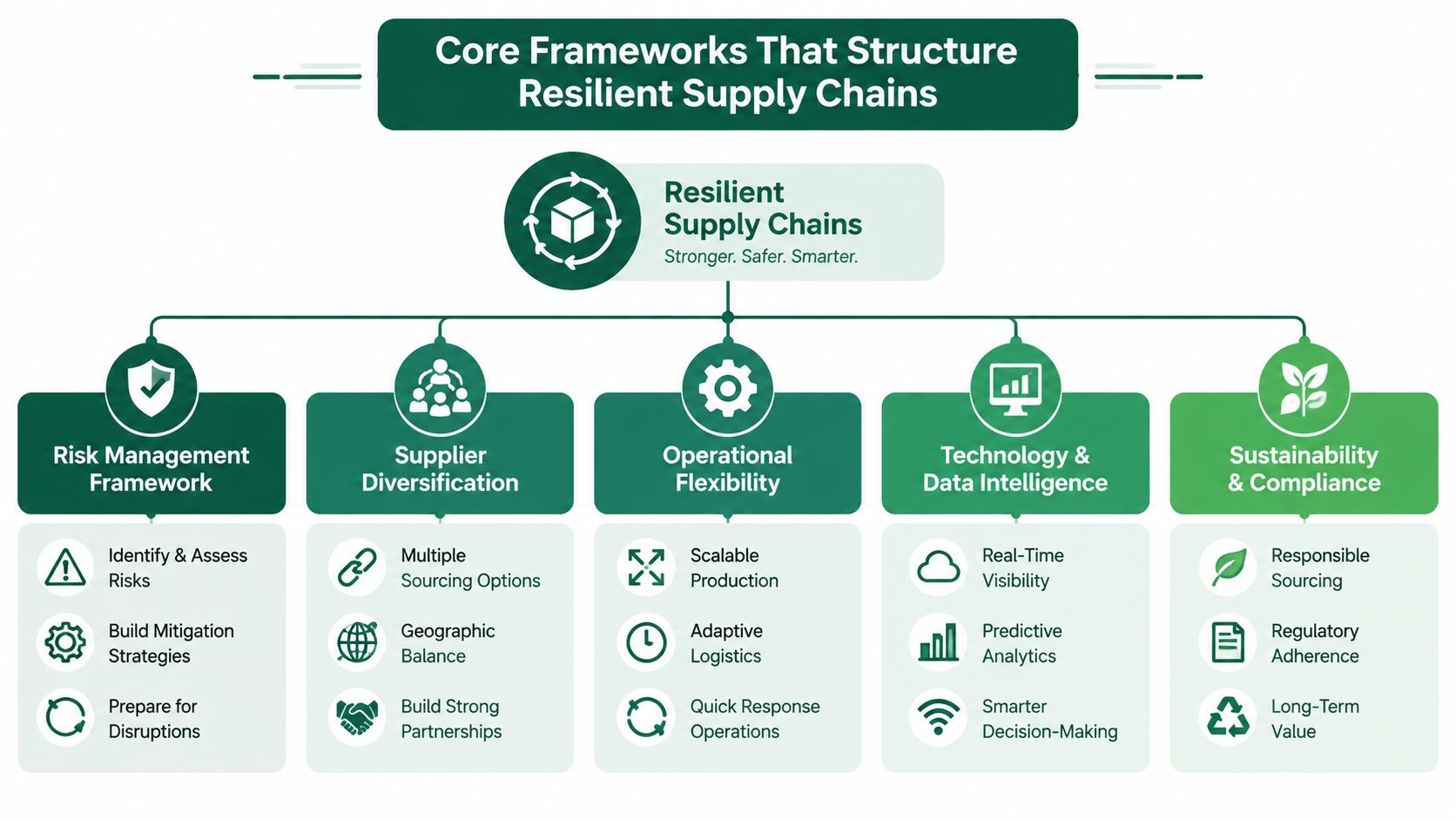
Core Frameworks That Structure Resilient Supply Chains
The four-part framework works best as a progression. Each stage creates the conditions needed for the next, so treating the stages as disconnected checklist items weakens the result.
Position and prepare
This stage establishes the starting position. Procurement teams identify critical materials, map supplier dependencies, confirm contractual obligations, and decide where strategic inventory or backup capacity is justified.
Preparation can include:
Strategic inventory: Hold protection where a stockout would interrupt an essential process, rather than applying the same buffer rule to every item.
Multi-sourcing: Qualify another supplier or production site for inputs that could stop the network.
Design flexibility: Specify acceptable alternatives before an emergency forces rushed substitutions.
Contingency terms: Clarify allocation, delivery, quality, and escalation rules before a shortage occurs.
The decision isn't “more inventory or less inventory.” It's “which combination of options protects the service we need?”
Sense and plan
A prepared network still needs signals. Teams should monitor supplier capacity, lead-time changes, quality drift, logistics constraints, regulatory developments, and demand movements. The useful question isn't whether a dashboard contains more alerts. It's whether a buyer can identify a meaningful change early enough to act.
Planning should connect those signals to decisions. For example, a lead-time increase might trigger a supplier review, a revised order schedule, a temporary allocation change, or a validation of an alternate part. Without a defined response, visibility becomes observation rather than resilience.
Mitigate and respond
This stage turns options into action. Procurement, operations, engineering, logistics, and finance need agreed decision rights. A response may involve changing order quantities, shifting a lane, using another transport mode, reallocating scarce inventory, or activating a qualified backup source.
The portfolio approach matters because every lever has limits. Inventory can expire or tie up cash. Dual sourcing can increase qualification work. Backup sites may share the same geographic or utility exposure. Flexible logistics can cost more during normal operations. Resilience comes from combining options so one weakness doesn't determine the entire outcome.
Recover and learn
Recovery isn't complete when the first shipment arrives. Teams need to restore backlog, verify quality, reconcile commercial changes, and update the risk model. They should also ask which assumption failed and whether the network now has a better response option.
The framework therefore moves from positioning, to sensing, to response, to learning. Its purpose is to shorten recovery duration and stabilize service levels after a shock, not to eliminate every possible disruption.
How to Identify and Prioritize Supply Chain Risks
Risk mapping should start with the item that could stop operations, not with the supplier directory. A Tier 1 map shows direct relationships, but it may conceal a single sub-tier processor, shared raw material, common transport corridor, or regulatory dependency.
Begin by connecting four pieces of information for each critical input:
The requirement: What product, service, or process depends on it?
The source: Which direct and upstream suppliers contribute to it?
The movement: Which sites, lanes, ports, modes, and handoffs are involved?
The recovery path: What can replace it, and how long would qualification or replenishment take?

Use the bullwhip effect as a diagnostic
Small changes in customer demand can become larger order swings as information travels upstream. Buyers may increase orders to protect service, distributors may interpret those orders as new demand, and suppliers may expand production plans even when the original customer movement was temporary.
Lead-time variability, inaccurate inventory records, and weak information sharing make that amplification worse. Reviews of the topic identify real-time data sharing, ERP, RFID, blockchain, vendor-managed inventory, and cross-docking as approaches that can improve coordination and reduce order variability, while also showing that visibility alone won't solve the problem if remanufacturing lead times remain much longer than manufacturing lead times (review of lead time, visibility, and the bullwhip effect).
Use the following matrix to focus attention:
Risk signal | Operational meaning | First procurement question |
|---|---|---|
High likelihood, high impact, slow recovery | A priority exposure that can stop service for an extended period | Can we qualify another source or redesign the requirement? |
Low likelihood, high impact, slow recovery | A strategic vulnerability that needs scenario planning | What minimum capability must remain available? |
High likelihood, moderate impact, fast recovery | A recurring nuisance that may create cumulative cost | Can better data or standard terms reduce repetition? |
Low likelihood, moderate impact, fast recovery | A monitor-and-review item | What signal would move this risk into active response? |
Look for concentration in four areas: supplier concentration, geographic concentration, logistics bottlenecks, and regulatory interdependencies. A supplier may appear diversified at the company level while several products depend on the same site. A network may use multiple suppliers that all rely on the same upstream chemical, certification, or transport lane.
For a deeper treatment of exposures that remain hidden in ordinary risk registers, procurement teams can review how to uncover and manage hidden supply chain risks.
The following video can help teams visualize how disruption signals move through a network before they build their own risk map.
Mitigation Tactics That Reduce Impact and Speed Recovery
A common assumption is that resilience starts with more inventory. Inventory can help, but it only covers the time and demand conditions it was designed for. If the supplier's lead time changes unpredictably or the inventory record is wrong, the buffer may provide false confidence.
The bullwhip effect explains why. A small downstream change becomes a larger upstream order variation when each participant forecasts separately and adds its own protection. Information quality and lead-time control attack the source of that amplification.

Improve the signal before increasing the buffer
Real-time data sharing gives suppliers and buyers a common view of orders, inventory, schedules, and exceptions. ERP systems can centralize transactions. RFID can improve movement records. Vendor-managed inventory can shift replenishment decisions closer to the party with better stock information. Cross-docking can reduce storage handoffs where the operating model supports it. Blockchain may help with shared records in suitable multi-party environments, although the technology won't repair incomplete or unreliable source data.
These tools work when teams connect them to decisions. A control tower that reports a late shipment but doesn't assign an owner or define an escalation path adds awareness without response capacity. The same applies to supplier portals that collect information nobody reviews.
Teams assessing real-time logistics data tools should ask which decision the data will improve, who owns that decision, and how quickly the organization can act.
Put mitigation inside the procurement workflow
Procurement can reduce future disruption before a purchase order exists:
Lock specifications carefully: Define acceptable performance, materials, certifications, delivery conditions, and substitution rules.
Score supplier resilience: Review capacity, site dependencies, lead-time behavior, backup arrangements, and evidence quality alongside price.
Detect drift: Compare quotes, manuals, warranties, and terms against the approved requirement before signature.
Coordinate forecasts: Share changes early enough for suppliers to adjust without creating exaggerated order swings.
Forecasting should support sourcing rather than operate as a separate planning exercise. Teams can use supply chain forecasting guidance to connect demand assumptions with supplier decisions and replenishment rules.
The difficult question is why organizations keep funding tactical fixes when the risk is systemic. Expediting one shipment may protect one customer order, but it doesn't resolve a recurring lead-time problem, a missing sub-tier relationship, or a specification that permits only one viable source. Resilience improves when teams fund the combination of better information, qualified alternatives, flexible commercial terms, and disciplined response ownership.
Measuring Resilience and Closing the Investment Gap
A resilient network needs a dashboard that measures operating ability, not just completed projects. Useful measures include:
Time to survive: How long critical operations can continue under a defined disruption.
Time to recover: How long it takes to restore acceptable service and clear the resulting backlog.
Service-level stability: Whether delivery performance remains within the agreed range during disruption.
Disruption frequency: How often interruptions occur, including repeated incidents that individually seem minor.
Recovery cost: The operational and commercial resources required to return to normal performance.
These measures should be attached to specific products, suppliers, lanes, and scenarios. An average network figure can hide the fact that one critical component has no practical substitute. Pair the metric with an owner, a trigger, and a documented response so the dashboard supports decisions instead of merely describing history.
The funding problem
The resilience case often fails because risk recognition and investment approval sit in different conversations. Oliver Wyman reported in 2025 that only 4% of companies planned to increase resilience budgets, more than a third expected cuts, and just 5% had a full resilience strategy. At the same time, 68% were pursuing isolated initiatives (Oliver Wyman supply chain resilience findings).
That gap changes how procurement should present a business case. Instead of asking for a general resilience budget, connect each proposed lever to a measurable exposure:
A second source addresses a specific single-point dependency.
Better supplier data improves an identified response decision.
Flexible logistics terms reduce recovery friction on a defined lane.
Specification changes create qualified alternatives for a constrained input.
The OECD's 2025 review frames resilience as a systems problem involving interdependencies, trade concentration, and regulatory barriers. That means a local fix may not protect the network if several suppliers share the same upstream exposure.
Visibility beyond Tier 1
More visibility isn't automatically better visibility. Sphera's 2026 survey found 44.5% of respondents cited poor data quality or completeness as a major barrier to accurate Tier 2 and beyond visibility, while 32.4% cited limited supplier cooperation or data sharing (Sphera Supply Chain Risk Survey 2026). DnB's 2025 manufacturing survey found that only 24% of manufacturers had data on modern slavery in their supply chains.
The practical question is, “Which upstream data is worth collecting?” Start with information that can change a decision: the site producing a critical input, the shared sub-tier dependency, the actual lead time, the recovery alternative, and the evidence supporting compliance. Build supplier cooperation through clear purpose, limited requests, shared benefits, and consistent review.
For teams connecting forecasting with proactive risk decisions, AI forecasting for supply chain resilience offers a useful perspective on bringing predictive insight into procurement workflows.
Building Your Resilient Supply Chain Roadmap
Start with a current-state review. Identify the products and services where a disruption would affect customers, production, safety, compliance, or essential operations. Map the direct supplier, the known upstream dependencies, the transport path, the lead-time behavior, and the recovery option.
Then select two or three high-impact levers. A team might qualify an alternate supplier, revise a rigid specification, improve supplier data collection, or negotiate flexibility in delivery schedules and transport modes. Choose based on impact and recovery time, not on which initiative is easiest to announce.
Create audit-ready evidence as the work progresses. Keep the approved specification, supplier responses, qualification records, risk rationale, scoring method, exception decisions, and contract terms together. Traceability helps procurement defend the decision later and helps operations understand which assumptions support the response plan.
A practical decision checklist includes:
Criticality: Which inputs can interrupt essential service?
Concentration: Where do suppliers, sites, materials, or lanes overlap?
Information quality: Which facts are current, verified, and decision-ready?
Options: Can the team switch source, site, quantity, schedule, mode, or lane?
Recovery: Who acts first, and how will the organization measure restoration?
Learning: What evidence will be reviewed after the event?
Supply chain resilience is continuous capability building. Networks change, specifications drift, suppliers evolve, and new dependencies appear. The strongest procurement teams revisit their assumptions, maintain supplier collaboration, and keep response options usable before the next disruption tests them.
Procright supports sourcing workflows from specification creation through supplier discovery, evidence-based comparison, weighted scoring, and spec drift detection, helping procurement teams maintain traceable decisions around supplier risk and resilience. Visit Procright to explore how your team can build more defensible, audit-ready sourcing decisions.
Try it on a real buy
Bring one category. Watch where the flags land.
We use a little analytics to see which pages actually help. Nothing else, no ad trackers.