Vendor Contract Negotiation: Enterprise Playbook
In this article
Starting renewal discussions more than 90 days before the opt-out date can produce average savings of 49%, compared with only 19% when talks begin 30–90 days before renewal. The practical answer is to negotiate the contract lifecycle, not just the price: lock the specification early, control structural clauses, document every concession, and monitor drift after signature.
That result is counterintuitive for teams that treat negotiation as the final conversation before a contract expires. The strongest negotiating position usually exists before the vendor sends its last proposal, when requirements can still change, alternatives can still be assessed, and internal stakeholders can still agree on what matters. A vendor contract negotiation that starts with a rushed redline often ends with a modest discount and weak protection against future cost increases.
Table of Contents
Why Vendor Contract Negotiation Fails Without Early Structure
Clause and SLA Negotiation Tactics That Protect Long-Term Value
Vendor Contract Negotiation Playbook Checklist and Templates
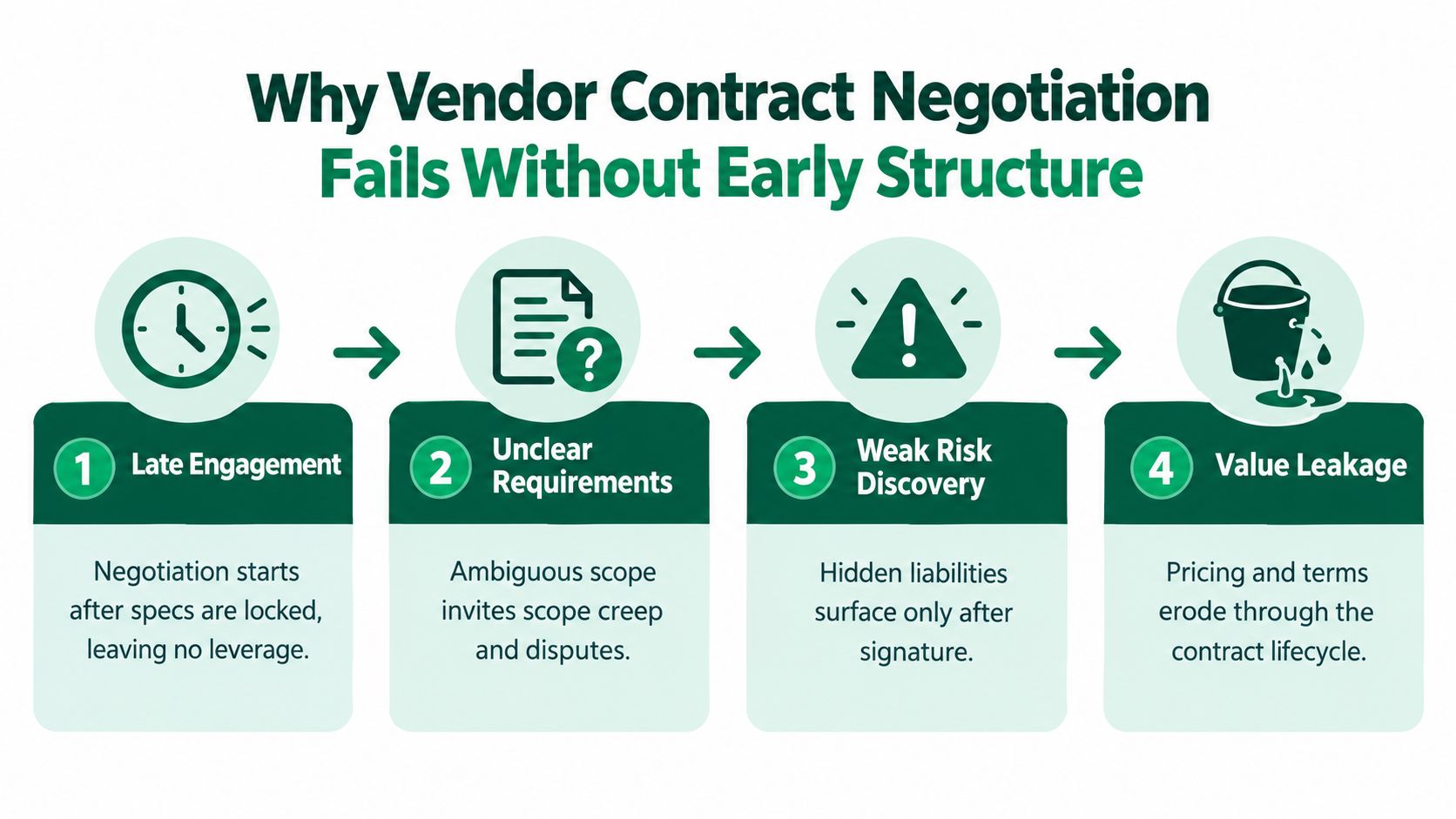
Why Vendor Contract Negotiation Fails Without Early Structure
Late negotiation compresses every decision into the period when the buyer has the least flexibility. The specification is already fixed, the business wants continuity, and the vendor knows the switching cost is rising. Procurement then focuses on the most visible lever, the headline price, while renewal mechanics, usage definitions, service remedies, and exit rights receive rushed attention.
The timing benchmark is clear. Teams that started renewal discussions more than 90 days before the opt-out date achieved average savings of 49%, compared with 19% for teams beginning 30–90 days before renewal, according to Procr's vendor contract negotiation savings analysis. That isn't merely a reason to send calendar reminders earlier. It shows that negotiation performance is path-dependent. Earlier market scanning and clearer specifications create choices that aren't available during a last-minute renewal.
Treat negotiation as lifecycle management
A durable process has distinct control points:
Preparation: Define the business outcome, specification baseline, dependencies, and fallback position before contacting suppliers.
Market challenge: Test whether the requirements permit meaningful competition or unintentionally describe one vendor.
Commercial design: Negotiate price alongside renewal triggers, escalation rules, service credits, usage limits, and termination rights.
Decision control: Score responses against evidence and preserve the reason for every concession or rejection.
Post-award monitoring: Compare invoices, delivered services, and vendor changes against the signed agreement.
This process matters at national scale as well as within an individual category. A 2024 National Contract Management Association analysis estimated that simplifying and modernizing U.S. public-sector contract negotiation could reduce transaction costs by 13.3%, equivalent to about $100 billion based on 2023 federal spend. The implication for enterprise procurement is practical: drafting, review, and term alignment are cost drivers, not administrative details.
Practical rule: If the team can't explain which clause protects value after renewal, the negotiation isn't finished when the price is agreed.
The best negotiators I've worked with don't rely on theatrical pressure in the final meeting. They build advantage by making requirements precise, alternatives credible, and internal approvals predictable. The redline is where those decisions become visible, not where they begin.
Preparation and Risk Discovery Before You Invite Vendors
Negotiating power is largely decided before vendors see the request for proposal. A weak specification, missing compliance boundaries, or a requirement that effectively names one supplier leaves little room to challenge price, terms, or delivery assumptions.
Create a specification baseline that separates must-have requirements, preferred capabilities, implementation dependencies, and unacceptable risks. Define how each requirement will be tested. “Easy to use” expresses a preference. A documented workflow, response expectation, integration requirement, or acceptance test gives the negotiation something verifiable to address.
Audit the dependencies, not just the product
Examine the operating model around the purchase before reviewing a vendor's quote. Map integrations, data flows, implementation ownership, support dependencies, regulatory obligations, and the difficulty of replacing the service. A low-cost service may require specialist support, restrict data extraction, or force the business into a proprietary workflow. Those dependencies belong in the sourcing assessment.
Keep the risk register practical and assigned:
Specification gaps cover missing acceptance criteria, unclear service boundaries, and implementation tasks with no defined owner. Concentration risk arises when only one supplier can plausibly satisfy a requirement without a documented reason or mitigation. Commercial ambiguity includes unclear billable users, usage units, volume tiers, renewal dates, and change-order rules. Compliance exposure covers missing controls for security, data handling, records, accessibility, and sector-specific obligations. Exit friction appears when the buyer has no defined export format, transition assistance, wind-down access, or migration responsibility.
Research should test supplier assertions against material outside the sales process. Manuals, technical documentation, customer reviews, forums, public procurement records, and implementation materials may reveal limitations that presentations omit. Public-sector teams can use UK public sector bid software to organize bid information and requirements, while validating each material claim against supporting evidence.
Apply a vendor due diligence checklist so the review does not depend on one category expert's memory. By the time vendors are invited, the team should have three working documents: a locked specification baseline, a supplier summary, and an early-risk register that assigns an owner and proposed treatment to each exposure.
Keep an audit trail for the research. Record what was reviewed, which claims were confirmed, what remains unanswered, and how each unresolved issue affects the sourcing decision. This gives legal, security, finance, and operations a shared evidence base and prevents fundamental questions from resurfacing during the final redline.
When stakeholders need a concise explanation of the preparation model, the following video can support the discussion.
Clause and SLA Negotiation Tactics That Protect Long-Term Value
A contract can look inexpensive at signature and still become costly through automatic renewal, unclear usage rules, weak remedies, and uncontrolled change. Headline price is only one input into realized value. The structure around that price determines whether the buyer can enforce the bargain.
McKinsey found that more than 75% of contracts lacked a complete set of KPIs and reporting linked to total cost of ownership, while 80% had no benchmarking clause for testing prices against market standards, according to its contracting for performance analysis. Those findings point to a straightforward redline priority: define how performance and price will be measured before the supplier's obligations become difficult to enforce.
Put the important terms into the commercial model
Start with renewal. Require a clear notice process, a meaningful opt-out window, and an affirmative approval step where the business needs control over continuation. An auto-renewal clause should also state what happens to price, scope, unused capacity, and service levels at renewal. A cap is useful only if the baseline and calculation method are unambiguous.
Termination rights should match the actual risk. Termination for cause may cover material service failure, security incidents, insolvency, or repeated missed obligations. Termination for convenience can protect the buyer when the service is no longer needed, but the supplier may demand a longer commitment or a commercial charge in return. That trade-off is acceptable only when the exit cost is known and the business has measured the value of flexibility.
Make service performance enforceable
An SLA needs more than a target. Define the measurement window, exclusions, reporting owner, response and resolution obligations, and remedy for failure. Service credits shouldn't be the only remedy where downtime or delayed delivery can disrupt critical operations. Connect serious or repeated failures to escalation, remediation plans, termination rights, or fee adjustments.
Volume tiers deserve equal attention. Clarify whether unused capacity expires, whether the vendor can move the buyer into a higher tier automatically, and whether growth receives marginal pricing or repricing of the entire volume. In consumption-based services, set alerts, approval thresholds, and a hard commercial cap unless the buyer expressly authorizes additional usage.
Economic price adjustment and cost-transparency clauses can help when suppliers face inflation or supply volatility. Procurement commentary from SAP describes buyers using these mechanisms where fixed pricing or limited indexation no longer reflects market conditions, as discussed in SAP's procurement commentary. The buyer should require evidence for an adjustment, define the relevant cost drivers, and include a review or reversal mechanism. Otherwise, an adjustment clause can become an open-ended escalation right.
Scoring Suppliers and Deciding With Evidence
A supplier scorecard should make disagreement visible before it reaches the executive approval meeting. If one reviewer values implementation speed and another values data controls, a single total score can conceal the conflict. Separate the criteria, assign weights before reviewing proposals, and require an evidence record for each answer.
Use a simple response model for every requirement:
Response | Meaning | Required evidence |
|---|---|---|
Yes | The supplier meets the requirement as written | Contract language, manual, certification, or documented response |
Partial | The supplier meets only part of the requirement or needs a condition | Exact limitation, commercial effect, and proposed mitigation |
No | The supplier doesn't meet the requirement | Elimination reason or approved exception |
Unverified | The supplier hasn't provided enough evidence | Owner, due date, and escalation path |
This approach prevents polished proposals from receiving credit for promises that never appear in the contract. It also exposes conflicts between the proposal, technical documentation, warranty terms, delivery commitments, and payment conditions.
Match the tactic to the category
Category condition | Negotiation emphasis | Decision warning |
|---|---|---|
Competitive market | Use comparable bids to challenge price, scope, and service remedies | Don't trade away exit rights for a small discount |
Concentrated market | Prioritize continuity protections, benchmarking, audit rights, and transition support | Don't pretend a weak alternative is a credible BATNA |
High operational risk | Weight resilience, implementation ownership, support, and measurable SLAs | Don't let a low quote hide delivery dependencies |
Strategic supplier | Exchange commitment for defined value, transparent pricing, and governance | Don't accept relationship language instead of obligations |
Keep supplier responses, source documents, reviewer comments, and elimination reasons in one controlled workspace. Role-based access and external review links allow legal, finance, security, and business owners to collaborate without creating disconnected email versions.
A supplier scorecard template can provide a starting structure, but the criteria must reflect the actual risk of the purchase. A defensible recommendation says not only who won, but why the other options were rejected and which assumptions could change the decision.
Redline Workflows and Approval Pathways That Actually Work
A contract redline is a control system, not a shared writing exercise. Without one authoritative version, legal may revise liability while finance changes payment terms, security adds controls, and the vendor responds to an outdated file. The final document can then contain concessions nobody can trace back to an approved trade-off.
Set ownership before the first edit. Assign one document owner, one controlled version, named reviewers, and a decision log for material changes. Each proposed change should link to a requirement, a quantified commercial effect where available, or a defined risk treatment. Record non-price protections, including renewal triggers, benchmarking rights, consumption caps, and drift controls, alongside price changes. A discount that removes those protections may increase the buyer's long-term exposure.
Use a staged review, with handoffs recorded rather than passed through disconnected email threads. The business owner confirms scope, deliverables, acceptance criteria, and operating assumptions. Security and compliance then address data handling, access, audit rights, resilience, and regulatory obligations. Finance tests pricing structure, payment terms, escalation mechanics, credits, tax treatment, and budget exposure. Legal resolves liability, indemnity, intellectual property, confidentiality, termination, governing law, and disputes. Executive approval should address only unresolved exceptions above the agreed risk or commercial threshold.
Keep reviewers from reopening settled language without identifying the change that justifies it. For every open item, record the accepted fallback, accountable owner, approval limit, and escalation trigger. This preserves room to compromise without allowing a late concession to erase an agreed protection.
Decision discipline: A late change is material if it affects scope, cost, enforceability, renewal control, or the buyer's ability to exit.
Comments should end in a disposition: accepted, rejected, replaced, or escalated. Store the original request, vendor response, internal position, final wording, and approver together. That audit trail shows why a clause changed and which evidence supported the decision after the negotiation team has moved on.
For public-sector and government contracting teams, govcon software can organize solicitation and supplier information, while the approval path still requires clear ownership and escalation rules. Fast execution has value only when the record remains complete. A quick signature on an untracked compromise is a procurement failure, not process efficiency.
Post-Award Drift Controls and AI Vendor Contract Risks
A signed contract protects value only if the buyer keeps testing reality against the document. Vendors may revise manuals, product packaging, support routes, usage units, or service behavior. Internal teams can also deploy configurations outside the approved scope. Without post-award controls, the organization keeps paying for terms that no longer describe what it receives.
Track commercial and operational drift
Set review points for invoices, renewal dates, usage reports, service reviews, product changes, and material security updates. Check signed prices and definitions against actual invoices. Compare the approved specification with deployed features and current vendor documentation. Match SLA results to the remedies claimed, missed, or left unused.
Record each variance in a drift register:
Commercial change: The original term, observed change, effective date, and invoice or budget impact.
Operational change: The affected service, user group, integration, or delivery obligation.
Contract response: Required notice, cure period, credit, renegotiation, or exit option.
Decision owner: The person authorized to accept, challenge, or escalate the deviation.
The register should link to the invoice, usage report, service record, or vendor notice that supports the entry. That evidence makes renewal decisions audit-ready and prevents a verbal explanation from becoming the only record of cost creep.
AI and consumption-based contracts add less visible exposure. A 2026 industry analysis from TechTarget reports that enterprise negotiators often fail to address whether organizational data trains vendor models, whether data remains after a transaction, and how uncapped usage, automatic tier escalations, or vague seat and API definitions affect cost, as described in TechTarget's AI vendor negotiation guidance.
The redline should define training permissions, retention and deletion, model behavior changes, accuracy baselines, latency expectations, audit access, security notifications, indemnification boundaries, and a billable event. Consumption caps and tier thresholds should be measurable. A pilot also needs a documented scale-up path, including pricing and risk assumptions that cannot change without notice as usage grows.
Control principle: A vendor change affecting price, data use, security posture, or model behavior creates a documented review event.
Set renegotiation triggers before signature. Examples include a new usage tier, material pricing change, altered data processing, a security-control change, repeated SLA failure, or a model update affecting an agreed business process. A contract renewal management guide can help convert those triggers into a repeatable review calendar instead of relying on individual memory.
Vendor Contract Negotiation Playbook Checklist and Templates
A useful playbook should fit into the work, not sit in a policy folder. Build it around the evidence the team must produce at each stage, from the first specification draft through renewal review. The same structure can support cloud licensing, hardware, professional services, facilities, MRO, and other categories, while the risk thresholds change by purchase.
Preparation template
Create a short event brief containing:
Business outcome: What the purchase must enable and how success will be recognized.
Specification baseline: Mandatory requirements, acceptance tests, dependencies, and exclusions.
Supplier assessment: Viable alternatives, concentration concerns, and evidence supporting each assessment.
Risk register: Commercial, operational, security, compliance, and exit risks with owners.
Negotiation position: Must-have terms, acceptable trades, fallback positions, and walk-away conditions.
The specification should have a formal lock gate. After that point, changes need an owner, a reason, and an assessment of their effect on competition and cost. This prevents a stakeholder from adding a late preference that unintentionally creates a single-bidder event.
Negotiation and scoring template
Use a weighted scorecard with a separate commercial worksheet. Keep technical compliance, delivery capability, supplier risk, service obligations, and price visible rather than compressing everything into one unexplained number.
Record:
Each requirement as yes, no, partial, or unverified.
The source supporting the response.
The supplier's qualification or exception.
The cost or operational effect of the exception.
The reviewer, decision, and date.
The clause that carries the final commitment.
For the redline, maintain a concession ledger. It should show what the buyer requested, what the vendor offered, what the buyer gave in return, and whether the exchange changed renewal, liability, service, usage, or exit exposure.
Post-signature control template
At handover, create a contract record with the signed scope, pricing schedule, renewal trigger, notice obligation, KPIs, SLA reports, data terms, audit rights, and termination process. Assign each obligation to a named owner and schedule reviews around the terms most likely to drift.
The completed playbook should answer five questions without searching through email:
What did we buy?
Why did we select this supplier?
Which terms protect the expected value?
What evidence shows the supplier is performing?
What event requires renegotiation or exit?
That is the difference between a negotiation document and a reusable operating system. It gives procurement a defensible record, gives finance visibility into commercial exposure, and gives business owners a clear route to challenge changes before they become accepted practice.
Procright supports procurement teams with specification drafting, supplier discovery, evidence-backed scoring, redline preparation, and audit-ready records across the path from first draft to final award. Use the platform to test your next sourcing event or gap analysis, then visit Procright to see how it can help control contract value before and after signature.
Try it on a real buy
Bring one category. Watch where the flags land.
We use a little analytics to see which pages actually help. Nothing else, no ad trackers.