Top 7 Challenges in Cross-Source Data Consolidation
Seven common failures when consolidating supplier data from ERPs, PDFs, spreadsheets and web sources — why normalization, verification, and traceability matter.
In this article
If your supplier data comes from ERPs, PDFs, spreadsheets, websites, and contracts, the main problem is not collection. It’s getting those records to agree.
I’d sum it up like this: cross-source consolidation usually fails in 7 places - mismatched records, missing fields, conflicting specs, duplicate entries, unverified compliance claims, slow manual review, and weak audit trails. The article makes one point clear: more data does not fix bad alignment, which is the foundation of data-driven procurement decisions. It often adds more conflict.
Here’s the short version of what you need to watch:
Records don’t match across systems because names, fields, and units differ.
Missing data breaks matching, comparison, and compliance checks.
Product specs conflict even when two records look like the same item.
Duplicates split spend and hide supplier totals.
Compliance claims need proof from source documents.
Manual review takes too long, especially as workloads grow.
Traceability matters because a clean record without source links is still hard to trust.
A few numbers stand out:
79% of organizations do not normalize vendor data across systems.
75% of procurement teams lack a shared data model across core platforms.
47% say low data quality blocks AI use in supply chain work.
Manual intake can take 30 to 45 minutes for about 70 fields.
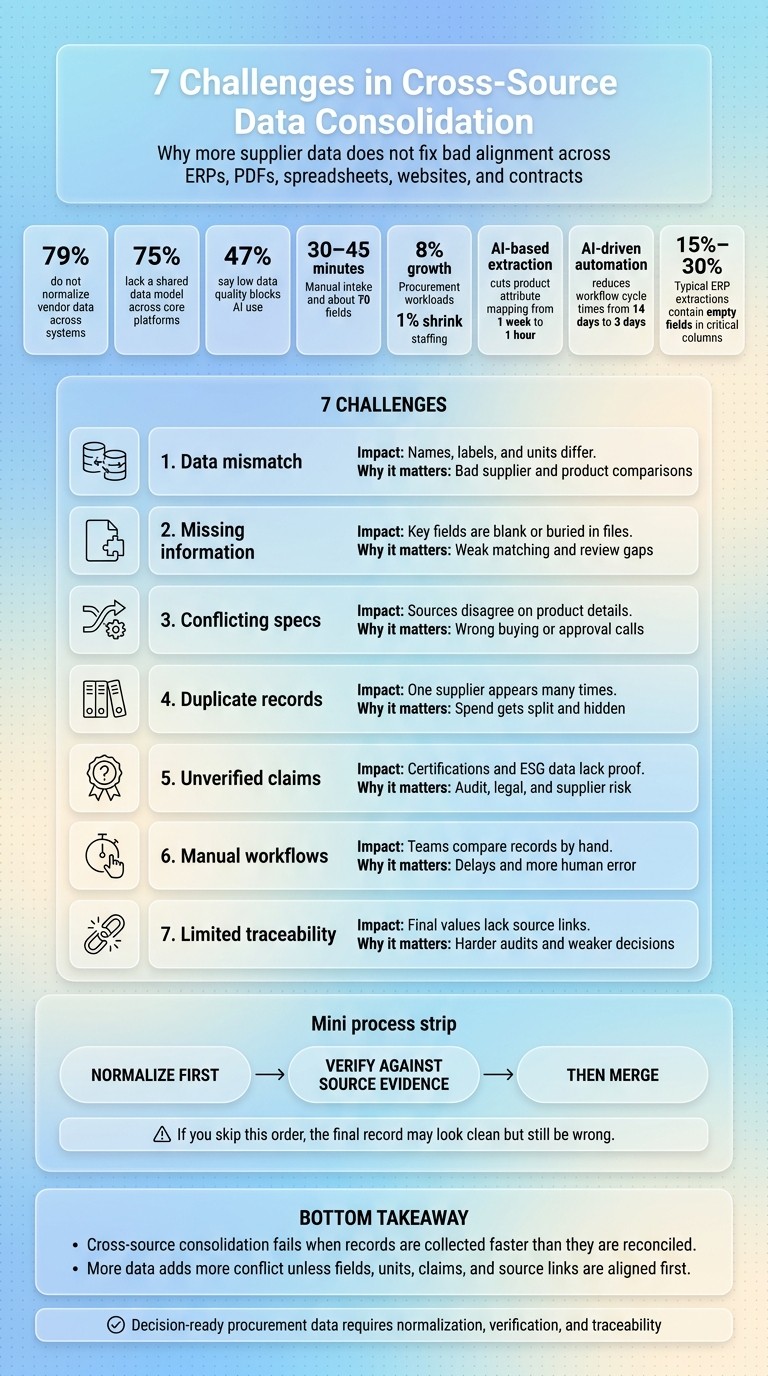
7 Challenges in Cross-Source Data Consolidation
Quick comparison
Challenge | What goes wrong | Why it matters |
|---|---|---|
Data mismatch | Names, labels, and units differ | |
Missing information | Key fields are blank or buried in files | Weak matching and review gaps |
Conflicting specs | Sources disagree on product details | Wrong buying or approval calls |
Duplicate records | One supplier appears many times | Spend gets split and hidden |
Unverified claims | Certifications and ESG data lack proof | Audit, legal, and supplier risk |
Manual workflows | Teams compare records by hand | Delays and more human error |
Limited traceability | Final values lack source links | Harder audits and weaker decisions |
I see the core lesson as simple: normalize first, verify against source evidence, then merge. If you skip that order, the final record may look clean, but it can still be wrong.
Why Cross-Source Consolidation Fails in Procurement
Cross-source consolidation tends to break when teams gather records faster than they can reconcile them. The root problem is simple: the source records were never normalized into the same format in the first place. Putting them in one place doesn't fix that. It just brings the conflicts into plain view. In procurement, those failures usually show up in seven recurring ways.
Procurement Decisions Need One Reliable Record
When records don't line up, every downstream procurement decision starts on shaky ground. Buyers, sourcing teams, and compliance leads need one record with one name, one field set, and one source of truth. Without that, even basic decisions turn into guesswork.
The problem is common. 79% of organizations do not normalize vendor data across their various systems. That means many teams are making calls based on records that were never built to work together.
More Data Only Increases Conflict When Fields, Units, and Names Are Inconsistent
More data sounds like progress. In practice, it can make the mess worse.
When records conflict, teams don't move faster. They stop and debate which version to trust. One system lists a supplier one way, another uses a different name, and a third stores the same field in different units. At that point, adding another source doesn't clear things up. It adds one more layer of noise.
The same issue applies to AI. If the data going in is flawed, AI tools for data validation don't clean up the problem on their own. It scales the confusion.
Decision-Ready Data Must Be Reconciled and Auditable
Even if fields appear to match, a record still falls short if no one can trace it back to its source. A record is only usable when conflicts have been resolved, fields have been standardized, and each claim points back to source evidence.
A compliance claim without source evidence is unverified, making it impossible to compare products for compliance efficiently. The next seven issues show where consolidation breaks most often.
1. Data from Different Source Types Does Not Match
The first problem is pretty straightforward: the same supplier or product often shows up in different ways across different sources.
A supplier listed as "ABC Ltd." in your ERP might appear as "A.B.C. Limited" in a PDF contract and "ABC Trading" in a catalog spreadsheet. To each system, those can look like three separate entities even though they point to the same vendor. That mismatch hits two areas right away: supplier identity and product comparison.
And even after records are matched, another issue shows up: the fields still may not mean the same thing.
Different systems use different schemas, field names, and definitions. So the same label can point to different data. For example, one system may use "lead time" to mean supplier lead time, while another uses it for the full order-to-receipt cycle. That kind of mismatch is nasty because it doesn't always trigger an obvious error. It can just produce the wrong output quietly.
Units of measure cause the same kind of trouble. One supplier may quote a "100-meter roll" while another uses "meters." If that data isn't normalized, side-by-side cost comparisons can fall apart fast. And once that happens, bad sourcing calls can slip through before anyone notices.
When source labels and units don't line up, automation can:
misclassify the same item
compare records that aren't actually alike
distort cost and sourcing comparisons
This is where context-aware AI can help. Instead of only matching text strings, it reads the surrounding context. That means it can map "Notebook" and "Portable PC" to the same item inside a consistent taxonomy, then apply unit conversions so the comparison reflects actual equivalence. Platforms like Procright can help by analyzing source data from web pages and PDFs, comparing products, and verifying compliance.
A consolidated record also needs source-backed fields such as:
tax IDs
legal names
addresses
ship-to and invoice-to locations
product attributes
commodity codes
It also needs lineage for each reconciled value, so you can trace where each field came from. Even when formats line up, missing fields create a different consolidation problem.
2. Incomplete or Missing Source Information
Missing values are the next thing that trips up consolidation. A supplier record might be missing a tax ID. A product might not include a unit of measure. A contract PDF might bury payment terms inside unstructured text. On the surface, those gaps can look small. Later, they can break matching, side-by-side comparison, and compliance checks. A record with blanks still isn't ready for a decision.
The procurement impact is hard to ignore. Low data quality blocks AI scaling in supply chain operations for 47% of respondents. And the fallout isn't abstract. A team might label a high-risk supplier as low-risk using supplier risk monitoring AI tools, miss duplicate payment exposure, or overlook a savings chance. When source data is fragmented or incomplete, AI can make things worse by filling in the blanks with guesses instead of checked facts.
Some fields are safer for AI inference than others. AI can often infer lower-risk fields like spend category, unit of measure, or likely pricing. But critical fields need source-backed proof. Platforms like Procright can check missing fields against evidence found in web pages and PDFs.
Use AI to fill lower-risk gaps. For regulated fields, require evidence.
Field Type | Can AI Infer? | Source Evidence Required |
|---|---|---|
Spend category | Yes | No |
Unit of measure | Yes | No |
Tax ID / legal registered address | No | Yes - official registration records |
Bank details | No | Yes - validated supplier documents |
Compliance certifications | No | Yes - source certificates or third-party databases |
That line is what separates helpful automation from unreliable guesswork.
3. Conflicting Product Specifications
Matching records is only half the job. The tougher part is dealing with specs that clash.
Even when two records point to the same product, they can still disagree on the details. Old product names, region-specific packaging, and different unit formats can make one item look inconsistent from source to source. That helps explain why 75% of procurement teams have no shared semantic data model across their ERP, AP, sourcing, and finance systems.
When teams merge conflicting specs without checking them, they don’t solve the problem. They bury it. And once a bad record enters an automated procurement workflow, that mistake can spread fast.
A better path is simple: flag the conflict and trace it back to the source. AI can spot when two records describe the same product but disagree on a field, then show that mismatch for review instead of quietly merging it. Procright does this by analyzing source material from PDFs and web pages, so buyers can see exactly what each source said. The aim is evidence-backed reconciliation that can be traced and rolled back.
Once the conflict is out in the open, the next step is picking the right rule based on source authority and risk.
Conflict Resolution Mode | Description | Application Example |
|---|---|---|
Highest-trust source wins | The highest-ranked source wins outright. | Using manufacturer data for official part numbers. |
Most recently verified value wins | The latest validated value wins. | Updating volatile fields like stock or lead time. |
Merge only when trusted sources agree | Accept the value if two independent trusted sources agree. | Verifying material composition or certifications. |
Human adjudication | Required for high-value or regulated fields. | Resolving disagreements in safety or energy labels. |
Without evidence, a conflict isn’t resolved. It’s just hidden.
4. Duplicate and Overlapping Records
Even when product specs line up, duplicate records can still break up spend and blur supplier visibility.
Conflicting specs are easy to spot. Duplicates are quieter - and often do more damage. ERP systems, PDFs, spreadsheets, and web catalogs often split the same supplier or product across several records. A different legal address, shipping address, or invoicing address can turn one company into multiple entries. That leaves teams with an inflated supplier list, broken-up spend data, and missed volume discounts.
One FMCG company found 340 unique entries for a single logistics provider across its systems. When records are split like this, total spend gets hidden, negotiating power drops, and category analysis gets skewed.
AI handles this with entity resolution, which goes past basic deduplication. Instead of checking for exact text matches only, it connects records using shared Tax IDs, overlapping transaction histories, matching bank details, and similar contact data. Then it applies confidence scores to decide the next step. High-confidence matches can be auto-merged. Mid-confidence pairs can go to a human review queue. Tools like Procright can analyze source PDFs and web pages to match supplier and product records before the merge happens.
What makes deduplication auditable is the evidence trail. Every proposed merge should show why it was flagged, not just that the system marked it. Keeping the original source values next to the normalized record gives teams a clear way to review, question, or reverse a merge if needed.
Matching Layer | Method | Action |
|---|---|---|
Deterministic | Exact match on Tax ID, GTIN, or MPN + Brand | Auto-merge |
Composite | Brand + Model + Core Specs (size, material) | Auto-merge or route to review |
Fuzzy/Semantic | Title similarity, description embeddings | Route to human review queue |
Variant | Distinguishing color/size differences | Block merge (preserve variants) |
Once duplicates are merged, the next issue is whether the claims tied to those records have been verified.
5. Unverified Compliance Claims
Suppliers often report their own certifications, ESG metrics, and regulatory status. The problem is simple: procurement teams usually don't have the time or the right tools to check every claim against the original document.
When those claims are scattered across PDFs, supplier portals, and ERP fields without source links, it gets messy fast. Teams can't easily tell if a certification is current or expired. And before supplier approval, sourcing, or renewal, they need proof they can trust. Without source-linked evidence, compliance data can't be compared, checked, or audited.
The scale of the issue is hard to ignore. 93% of procurement and supply chain leaders have experienced harm from supplier misinformation, and 75% of procurement professionals doubt the accuracy of the data they present to stakeholders. In 2021, U.S. Customs and Border Protection seized Uniqlo cotton shirts after the company could not prove they were free of forced-labor risk.
This is where things get risky with AI. If the source data isn't verified, AI can turn compliance gaps into false confidence. A clean-looking compliance field may look ready for a decision, but it isn't unless each claim is tied back to source evidence.
Procright analyzes source PDFs and web pages to extract compliance attributes and link each score to evidence. That makes compliance data auditable. But if verification still leans on manual review, speed drops fast.
The same problem shows up across regulatory, operational, and reputational risk.
Risk Type | Impact of Unverified Claims | Evidence Needed |
|---|---|---|
Regulatory | Fines, shipment seizures, and legal penalties for non-compliance | Certificates of origin, tax IDs, and third-party audit reports |
Operational | Supply chain disruptions and failed automation due to hallucinated risk scores | Real-time financial health scores and validated performance metrics |
Reputational | Damage to brand value from unethical suppliers or unverified "green" claims | Verified ESG compliance metrics and supply chain transparency data |
6. Slow Manual Comparison Workflows
Even when records are verified, work still drags if teams compare everything by hand. Procurement slows down fast when data is scattered across spreadsheets, PDFs, supplier catalogs, websites, and ERP records. At that point, people have to line things up manually, field by field, format by format. It's tedious work, and it opens the door to mistakes.
A typical procurement intake form includes about 70 fields and still takes 30 to 45 minutes to complete manually. At the same time, procurement workloads are projected to grow by 8% in 2026, while staffing is expected to shrink by 1%. That mismatch puts more pressure on teams, slows review cycles, and leaves records unresolved for longer.
AI helps by handling extraction and matching before a person steps in. AI-based extraction can cut product attribute mapping from a week to about an hour. Across procurement workflows more broadly, AI-driven automation can shrink cycle times from 14 days to 3 days by removing manual bottlenecks.
That’s where source-aware tools come in. Procright can analyze PDFs and web pages, pull out structured fields faster, and let reviewers spend their time on exceptions instead of rebuilding records from scratch. Speed helps. But teams still need source traceability for the extracted data.
7. Limited Traceability and Auditability
Even when the match is right, it can still fall apart if no one can trace each field back to its source. Speed doesn't mean much if a team can't show where a procurement decision came from. Once multi-source product data is aggregated from mixed records, the lineage behind each field can disappear fast. A reviewer may see the final number but have no clear path to the source document that supports it.
That gap creates real risk. Low data quality cuts into AI's value and makes audits harder to defend. If no one can reconstruct the reasoning behind a decision, compliance claims get a lot harder to verify.
As AI takes on more review work, missing source links can pile up faster than teams can check them. That's why keeping source evidence matters just as much as the final consolidated record.
A final record alone isn't enough. Teams also need the source documents and field-level mappings behind each record. In regulated industries like aerospace and medical devices, that traceability has to be part of the process from day one, not bolted on later.
Procright deals with this by keeping a clear link between every extracted attribute and its source file, whether that's a PDF spec sheet, a supplier web page, or another record. That makes procurement decisions much easier to audit. The tables below show what source-backed traceability looks like in practice.
Example Table: Reconciling Conflicting Product Specifications
When the same product shows up in a few places, the gaps can look small at first glance. But those gaps can still change a buying decision, a compliance check, or a parts match.
That’s why The best AI procurement tools shouldn’t blend conflicting details into one neat-looking record. It should surface the mismatch and point out what needs a human review.
Here’s what that looks like in practice.
Field | Source A | Source B | Source C | AI Action |
|---|---|---|---|---|
Dimensions | 24 x 18 x 12 in. | 610 x 457 x 305 mm | 24 x 18 x 10 in. | Convert units to mm; flag 50 mm height conflict for review. |
Material | Stainless steel | 304 stainless steel | Steel housing | Flag "Steel housing" as vague; request PDF spec sheet for grade verification. |
Certification | UL listed | UL listed | No certification shown | Mark as "Incomplete"; check for the UL file number in the source record. |
Model reference | MX-2400 | MX2400 | MX-2400A | Flag as potential naming variant vs. different model; check revision history. |
Pricing note | $1,250.00 each | Price on request | $1,180.00, discontinued stock | Separate price from availability and flag source-date differences. |
A simple rule helps here: normalize first, then compare. Convert units before judging whether specs line up. If a source uses loose wording like "Steel housing", don’t guess what that means. Flag it and ask for the spec sheet. And when pricing appears next to stock notes, keep those as separate facts so the record doesn’t mix cost, availability, and timing.
The same source-first approach also applies to compliance claims.
Example Table: Verifying Compliance Claims Against Source Evidence
Here’s what this looks like in practice.
Use this table to connect common compliance claims to the proof needed to check them. If a claim doesn’t have source evidence behind it, it’s Not verified - even when it looks complete on the surface.
The table lays out the claim, the evidence needed, and the risk when that evidence isn’t there.
Claim type | Vendor claim | Source evidence | Status | Risk note |
|---|---|---|---|---|
UL listing | "UL certified" | Vendor spec sheet, test report, or official certification record | Verified / Not verified | Unsupported safety claim can block approval |
RoHS compliance | "RoHS compliant" | Compliance file, test report, or sustainability certification | Verified / Not verified | Missing evidence raises regulatory risk |
Country of origin | Country-of-origin declaration | Manufacturer statement or shipping notice | Verified / Not verified | Trade and supplier eligibility risk |
Lead time | "Ships in 7 days" | Purchase order acknowledgment, shipping notice, or dated supplier confirmation | Verified / Not verified | Delivery risk if claim is outdated |
Warranty term | "5-year warranty" | Official warranty document or contract terms | Verified / Not verified | Post-purchase coverage may differ from claim |
A claim may still be marked Not verified if the evidence is expired, doesn’t match, or leaves gaps.
Tools like Procright can automate this evidence mapping. Procright links each claim to source evidence, so Verified means there’s proof behind it, not just a checked box.
The same rules also help speed up lower-touch validation in AI workflows that break down silos.
Don’t take the claim at face value. Check the source evidence. If it’s missing, out of date, or tied to a different entity, mark it as Not verified and flag it before it moves further in the decision process.
How AI Converts Messy Source Inputs into Decision-Ready Procurement Data
These seven issues don’t show up one at a time. They stack on top of each other.
A missing field can skew a side-by-side supplier comparison. A duplicate record can throw off spend analysis. And once both problems land in the same dataset, the mess spreads fast. That’s why AI needs to handle normalization, conflict detection, verification, and logging in one flow. Consolidation isn’t one task. It’s a sequence.
Standardizing Fields Across Mixed Source Formats
The first step is normalization.
AI maps different labels into one shared schema and converts units before anything gets compared. If one source says vendor name, another says supplier, and a third uses a custom ERP field, the system brings those into the same structure. It also lines up units so teams aren’t comparing apples to oranges.
Finding Gaps, Conflicts, and Duplicates Before Decisions Are Made
Before a buyer sees the data, AI can catch the problems that would slow down or derail a decision.
Typical ERP extractions contain 15% to 30% empty fields in critical columns - the kind of issue AI can spot before review. It can also flag conflicting entries and overlapping records early, instead of letting them slip into supplier scoring challenges, compliance checks, or sourcing decisions.
Duplicate detection matters here too. Entity resolution can match "Acme Corp" and "Acme Holdings LLC" as the same supplier without needing an exact string match. That sounds simple, but it saves teams from making decisions based on split or repeated supplier records.
Using Source-Backed Verification for Compliance and Comparison
Verification only works if the data ties back to proof.
Instead of taking a supplier claim at face value, AI can link that claim to the source record and show whether the evidence is current, complete, and tied to the right entity. That gives procurement teams something concrete to review, not just a pass/fail label.
Procright uses this method directly: its platform links each compliance match to the specific source record, so procurement teams can see the evidence behind the result.
Cutting Manual Review Time While Keeping an Audit Trail
Once the data is standardized and checked, the main time savings come from cutting manual rework.
But speed alone isn’t enough. If no one can trace how a value was changed or why a record was flagged, errors scale just as fast as output. AI should log every standardization step, each flagged conflict, and every verification link. That includes field-level lineage for each normalized value and exception, so reviewers can trace the full path behind a decision.
That matters most in regulated categories, where a buyer may need to show exactly which source confirmed a compliance requirement.
Conclusion
The 7 Challenges to Keep in View
Cross-source consolidation tends to break in the same ways again and again. And these seven problems don't stay isolated for long. They stack up, feed into each other, and can derail procurement decisions faster than most teams expect.
Gartner says data access and quality account for 30% of analytics performance, while 79% of organizations still don't normalize vendor data across systems. That's the danger zone. It's where procurement choices start drifting off course without much warning.
The answer isn't piling on more inputs. It's stricter validation.
Why Structured Validation Matters More Than Raw Data Collection
More data, by itself, doesn't fix consolidation problems. Alignment does. Procurement teams need one trusted view across ERP, finance, and supply chain systems.
That's where structured validation comes in. Normalize fields, resolve conflicts, deduplicate records, and verify claims against source evidence. Those steps separate data that looks complete from data a team can actually use.
Platforms like Procright support this workflow by analyzing specifications, comparing products, and scoring supplier performance by linking compliance scores to source evidence. That turns fragmented source data into procurement decisions teams can trust.
Raw data collection starts the process. Structured validation makes that data usable.
FAQs
How do I start normalizing supplier data?
Start by pulling 12 to 24 months of accounts payable transaction history. This gives you enough data to spot supplier name variations and duplicate suppliers already sitting in your system.
Then zero in on three core processes:
Data cleansing to fix inaccurate records
Entity resolution to connect records that belong to the same supplier
Data harmonization to standardize information across sources
Think of it like cleaning out a messy filing cabinet. First, you find the duplicate folders. Then you correct bad labels. After that, you make sure everything follows the same format so it’s easier to use day to day.
Which fields always need source proof?
There’s no fixed field list in procurement. The fields that need source proof depend on your use case, but every field tied to your goal should be fully filled in.
The fields that usually need the highest level of accuracy and verification are supplier identities, tax IDs, addresses, contract metadata, and category codes.
Procright helps with transparency by showing the documents, guides, or videos behind each match.
When should AI hand off to human review?
AI should hand off to human review when procurement calls for judgment, nuance, or a check on AI-generated findings.
A human-in-the-loop approach matters most when data quality is uneven. People should question, verify, and, when needed, override AI recommendations. Tools like Procright can make that review easier by showing the source behind each automated match.
Related Blog Posts
Try it on a real buy
Bring one category. Watch where the flags land.
We use a little analytics to see which pages actually help. Nothing else, no ad trackers.