Vendors and Suppliers Difference: A Practical Guide
In this article
You've probably seen this happen. A manufacturing team buys a cloud platform, records the counterparty as a “supplier,” and sends the agreement through a template designed for raw materials. The contract includes goods-receiving language, physical warranty terms, and delivery provisions, while the actual purchase depends on uptime, security controls, support response, and data handling.
The problem isn't vocabulary. It's control design. Vendor and supplier are operational labels that influence sourcing governance, contract clauses, performance measures, and risk ownership. Treating them as synonyms may feel harmless during an informal conversation, but it can create avoidable friction when procurement, legal, finance, IT, and operations apply different rules to the same relationship.
Table of Contents
Why the Vendors and Suppliers Difference Matters in Real Procurement
A mid-market manufacturer signs a master services agreement with a SaaS provider. The buyer's procurement system classifies the company as a supplier because the software supports production planning. Legal then reuses a supplier agreement originally drafted for physical components. The document requires inspection at goods-in, sets warranty obligations around defective units, and links acceptance to shipment quantities. None of those controls addresses the service the business is buying.
The negotiation slows down because both sides are solving the wrong problem. The SaaS provider wants clear service levels, data protection responsibilities, incident notification, and exit assistance. The buyer's template focuses on replacement parts, delivery acceptance, and product defects. By the time the mismatch becomes visible, stakeholders are debating whether to re-paper the agreement or accept a weak compromise.
Practical rule: Classify the relationship by what the counterparty provides and how your organization depends on it, not by the company's preferred label.
Business references commonly distinguish suppliers as upstream providers of raw materials, components, or semi-finished goods and vendors as sellers of finished goods or services closer to the end customer. The terms are still used interchangeably in many organizations, so the boundary works best as an operational convention rather than a universal legal definition. Investopedia's explanation of vendor terminology reflects both realities.
That convention becomes useful when it changes what your teams do. A supplier relationship may require capacity planning, shared inventory visibility, quality controls, and continuity planning. A vendor relationship may call for standardized pricing, service levels, support obligations, and a simpler replacement process. The label should tell your systems which governance path to use.
Misclassification creates recognizable symptoms:
Audit findings: The file lacks the evidence expected for the relationship's actual risk.
KPI drift: The dashboard tracks delivery quantities when the actual failure mode is service interruption or poor support.
Renegotiation friction: The contract template makes ordinary commercial changes look like exceptions.
Ownership confusion: Procurement, operations, IT, and finance each manage the counterparty under a different definition.
The right question isn't, “Which word is technically correct?” Ask, “Which classification produces the right controls for this spend?” That is the procurement-grade version of the vendors and suppliers difference.
Defining Vendor and Supplier in Plain English
Use a working definition that your category managers can apply without consulting a dictionary.
A vendor sells a finished good, service, or technology that your organization can use, deploy, resell, or consume. The relationship usually sits closer to the buyer or end customer. It may be recurring, particularly for software or managed services, but the commercial logic often remains transaction-oriented. You pay for a license, subscription, project, support package, finished item, or defined service outcome.
A supplier provides an input that feeds your operations or another stage of the supply chain. That input may be a raw material, component, semi-finished good, production capacity, or recurring operational capability. The relationship normally demands more coordination because availability, quality, lead time, and continuity affect what your organization can produce or deliver.
Three signals for a vendor classification
Supply-chain position: The counterparty is usually downstream from your core production process. A SaaS platform, office equipment provider, or consulting firm gives your team something ready to use or a service configured around a defined requirement.
Primary audience: The counterparty deals with your internal stakeholder, customer-facing team, or end customer. A vendor may sell in both business-to-business and business-to-consumer channels, while suppliers are more commonly business-to-business and bulk-oriented. Ramp's vendor overview describes this finished-goods and services orientation.
Relationship shape: The contract emphasizes purchase terms, licensing, support, delivery, or a defined outcome. Even if the relationship lasts for years, the buyer can still manage it as a vendor relationship when the primary value is a service or finished deliverable rather than an upstream production input.
Three signals for a supplier classification
Supply-chain position: The counterparty is upstream and provides something your production, fulfillment, or operational system consumes. Raw materials and contract-manufactured parts are straightforward examples.
Primary audience: The counterparty mainly serves businesses that transform, integrate, distribute, or depend on the input. Its value is tied to continuity and availability, not merely the completion of a purchase order.
Relationship shape: The agreement tends to cover forecasts, capacity, quality, lead times, volume commitments, pricing mechanisms, and escalation procedures. The buyer and supplier may need deeper planning and information exchange than a routine vendor relationship requires.
A company can occupy both roles. If you buy raw steel for production and finished brackets for resale from the same business, classify each buying relationship separately. The legal entity doesn't determine the label. The purchased deliverable and its operational role do.
Use these definitions in a category taxonomy:
Vendor: A counterparty providing finished goods, services, or technology for direct use, resale, or a defined business outcome.
Supplier: A counterparty providing upstream materials, components, capacity, or operational inputs that the organization depends on to produce or deliver.
Head-to-Head Comparison Across Five Procurement Criteria
The cleanest way to apply the vendors and suppliers difference is to compare the relationship across the criteria that affect sourcing and contract decisions.
Criterion | Vendor | Supplier |
|---|---|---|
Supply-chain position | Downstream, closer to the internal user, buyer, or end customer | Upstream, feeding production, fulfillment, or operational continuity |
Relationship length and depth | Often transactional or standardized, with limited integration | Often ongoing and integrated, with planning, forecasting, and coordination |
Contract structure | Purchase terms, licenses, support obligations, delivery terms, and service levels | Framework agreements, capacity commitments, quality terms, lead times, forecasts, and continuity provisions |
Pricing logic | Unit price, subscription, license, project fee, or service charge | Volume tiers, negotiated input pricing, indexation, rebates, and committed capacity |
Risk profile | Service, delivery, compliance, data, or replacement risk | Availability, quality, concentration, capacity, production, and continuity risk |
A vendor licenses SaaS seats. The buyer cares about access, configuration, support, renewal mechanics, data handling, and service performance. A supplier provides contract-manufactured parts. The buyer cares about specification conformance, production capacity, incoming quality, lead time, traceability, and the supplier's ability to maintain supply.
The same contrast appears with physical goods. A vendor sells finished products that the buyer can use or resell without material transformation. A supplier delivers raw materials or components that become part of a product or enable the organization to keep producing. Procurement guidance commonly makes this distinction because platforms and inventory processes often need to model finished goods and production inputs differently. GEP's procurement comparison connects the distinction to contract design and performance management.
What each criterion changes in practice
Supply-chain position determines who owns the primary operational dependency. An upstream supplier belongs in production continuity and material availability discussions. A downstream vendor belongs in delivery, service fulfillment, or final award discussions.
Relationship depth determines how much governance the buyer should fund. An integrated supplier may need joint planning and structured reviews. A routine vendor can usually operate through a more standardized workflow.
Contract structure determines which obligations are measurable. A supplier agreement needs clear specifications, acceptance standards, and replenishment or capacity expectations. A vendor agreement needs usable service descriptions, support commitments, and commercial protections.
Pricing logic affects negotiation strategy. A vendor discussion may center on license scope, rate cards, or service packages. A supplier negotiation may depend on volumes, input costs, minimum commitments, and the commercial effect of changes in demand.
Risk profile determines escalation. Supplier failure can interrupt production or delivery. Vendor failure may affect users, service quality, or compliance, and may still be critical when the service supports an essential business process.
Use a structured supplier evaluation criteria template during category reviews, but adapt the weighting to the relationship type. The label is useful only when it leads to a relevant evaluation model.
How the Label Changes Contracts, SLAs, and KPIs
The label selected during intake often determines which contract library and performance dashboard procurement uses. That makes classification a design decision, not a semantic preference.
A supplier contract should protect the flow of inputs. It may include volume-based rebates, raw-material indexation, minimum order commitments, force majeure treatment, quality acceptance at goods-in, traceability duties, and remedies for recurring nonconformance. Those terms help the buyer manage production exposure rather than merely record a purchase.
A vendor contract should protect the use of the delivered service or finished product. For SaaS and managed services, the agreement may need service-level commitments, uptime targets, support response, mean-time-to-restore expectations, information-security duties, audit rights, and indemnity caps that reflect data exposure. For finished goods, the emphasis may shift toward delivery terms, product warranty, returns, and service fulfillment.
Contract Element | Supplier Treatment | Vendor Treatment |
|---|---|---|
Commercial pricing | Volume tiers, input-cost mechanisms, rebates, and committed quantities | Unit price, subscription fee, project rate, or standard service charge |
Delivery and acceptance | Lead time, batch acceptance, inspection, quality release, and quantity variance | Delivery date, implementation milestone, user acceptance, or service commencement |
Performance control | On-time-in-full delivery, defect levels, capacity, continuity, and responsiveness | SLA attainment, support response, restoration performance, and service quality |
Risk allocation | Supply interruption, quality failure, production dependency, and alternate-source support | Data exposure, service interruption, warranty, compliance, and exit assistance |
Review mechanism | Forecast sharing, operational reviews, corrective actions, and joint planning | Service reviews, renewal discussions, issue escalation, and commercial performance checks |
The KPI set must follow the failure mode. For suppliers, procurement may track on-time-in-full delivery, defect parts per million, price variance, lead-time adherence, and capacity availability. For manufacturers using external inputs, those measures reveal whether the counterparty is protecting production continuity.
For vendors, the dashboard may track SLA attainment, internal-user satisfaction, support response, restoration performance, and security incident counts. A SaaS provider can deliver every license correctly and still fail the business through weak support or repeated service interruption.
The wrong KPI doesn't create visibility. It creates false confidence.
This is why a procurement contract should connect obligations, evidence, and remedies rather than only state commercial terms. The procurement contract guide provides useful context for the role of specifications, responsibilities, and enforceable conditions.
Mislabeling creates three downstream defects. The CLM system pulls the wrong clause library, the risk team evaluates the wrong exposure, and the performance dashboard measures activity instead of business impact. Correcting the label before onboarding is cheaper than renegotiating after the first failure.
Matching the Right Label to Real Sourcing Categories
Category names alone won't settle classification. Examine the nature of the value, the form of the deliverable, and the way your organization depends on it.
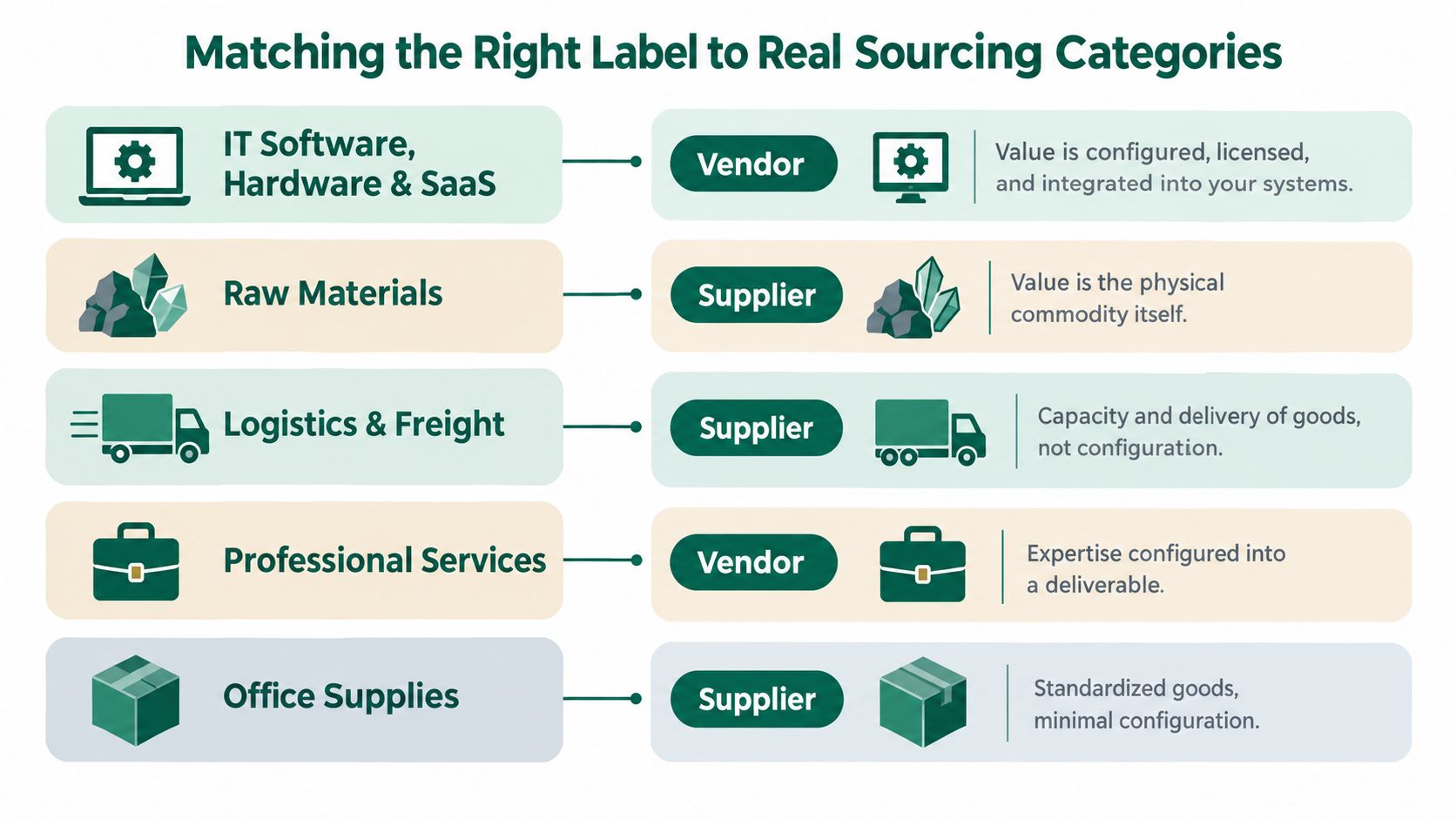
IT software hardware and SaaS
Treat software, hardware, and SaaS providers as vendors when the value is configured, licensed, supported, or integrated into your systems. The sourcing event should test functionality, implementation obligations, support coverage, security requirements, compatibility, and exit conditions.
Hardware can become more supplier-like when the buyer depends on a recurring flow of components for assembly or production. Don't classify the counterparty from the word “hardware” alone. Classify the actual purchase.
MRO and indirect consumables
MRO items and indirect consumables usually fit the supplier side when they're recurring physical inputs that operations must replenish. The buyer should focus on availability, replenishment, substitution rules, delivery reliability, and price control.
Routine office purchases are different. Standardized stationery or general-use items may be managed as vendor spend because the goods require minimal configuration and are relatively easy to replace. The operational control should match the consequence of interruption.
Cloud infrastructure
Cloud infrastructure is a deliberate hybrid. Procurement may call the provider a vendor because the contract revolves around service levels, support, security, and data access. Finance and infrastructure teams may need supplier-style controls because committed spend, consumption patterns, architecture dependency, and exit planning affect operational continuity.
Use a hybrid tag when one label would hide a material control. The answer isn't to force cloud into a pure category. It's to assign both the commercial owner and the operational-risk owner.
Professional services
Consulting, audit, implementation, and other professional services generally belong in the vendor bucket. The value is expertise configured into a defined deliverable, not a physical input consumed in production. The contract should define scope, milestones, acceptance, personnel responsibilities, confidentiality, intellectual property, and change control.
A long engagement doesn't automatically make a services firm a supplier. Duration matters, but the form of value matters more.
Logistics freight and finished-goods resale
Logistics and freight can require supplier-style management when the business depends on delivery capacity and operational continuity. The buyer should assess routing, capacity, claims, delivery performance, escalation, and contingency options.
Finished goods purchased for resale are usually handled as supplier transactions when the organization depends on a recurring physical flow of products for its commercial operation. A distributor may sell finished goods, but the buyer's control problem concerns availability, quantity, quality, and replenishment.
Use category management guidance for segmenting spend to separate transactional buying from relationships that need deeper category governance.
The category should determine the default label, but the purchase context gets the final decision. A single counterparty may supply production inputs, sell finished goods, and provide implementation services under separate scopes.
Review hybrid categories during intake rather than waiting for a contract dispute. That is where procurement can decide which obligations, KPIs, and approval paths need to coexist.
When the Words Are Used Loosely and What to Do About It
Loose usage is acceptable in a hallway conversation. It isn't a sound basis for master-data design, risk reporting, or contract automation.
Finance may use “vendor” as an umbrella term for any party the organization pays. Procurement may call a critical production-input provider a supplier. Legal may refer to both parties as contractors or service providers. Each label can be reasonable within its own context, but the organization still needs one operational classification that downstream systems can use consistently.
Late-stage relabeling creates avoidable work. A counterparty first onboarded as a routine vendor may later require supplier-style reviews, stronger continuity evidence, and a different approval path. If the contract has already been signed, the buyer may need to re-paper terms, reconcile inconsistent accrual treatment, and repair risk reporting that grouped unlike relationships together.
Where standardization improves control
Standardize the terms in categories where evidence and accountability matter:
SOX-scoped spend: Use consistent tags so approval, access, change, and payment controls can be tested against the right population.
ESG disclosures: Separate upstream material relationships from downstream service and finished-goods purchases when collecting relevant evidence.
Supplier codes of conduct: Apply the right expectations to parties whose labor, sourcing, manufacturing, or operational practices affect the supply chain.
Business continuity planning: Identify counterparties whose failure can interrupt production, fulfillment, or essential systems.
Contract lifecycle management: Route each relationship to clauses and review schedules that fit the actual exposure.
The distinction should not become bureaucratic theater. Standardizing a low-impact internal purchase won't create value if nobody uses the data. But standardization is justified whenever the label changes the control owner, evidence requirement, KPI set, or escalation route.
Keep loose terminology for internal-only conversations and informal sourcing memos. Require a formal classification before supplier onboarding, contract approval, purchase-order creation, and risk review.
Put the glossary in procurement policy. Add a vendor, supplier, or hybrid field to the master record and require the same tag on every purchase order. Downstream systems should enforce consistency rather than relying on tribal knowledge.
A Practical Decision Rule for Classifying Any Counterparty
A procurement lead can classify most new counterparties with three questions. Record the answers, don't just select a label from memory.
Question one asks where the relationship sits
Is the counterparty upstream or downstream of your core production, fulfillment, or operational process?
If it provides raw materials, components, production capacity, or an input that your organization transforms or depends on, start with supplier. If it provides a ready-to-use product, service, technology, or outcome to an internal user or customer-facing function, start with vendor.
Don't overrule the classification just because the provider is large, well known, or strategically important. A major software company can still be a vendor. A smaller component manufacturer can still be a supplier.
Question two tests the commercial relationship
Does the counterparty set the price through a catalog, rate card, license model, or service proposal, or does the buyer negotiate around capacity, volumes, inputs, and production economics?
Vendor relationships usually center on a defined offer and a buyer's selection among service or product options. Supplier relationships more often require negotiation around quantities, availability, lead times, quality, and commitments.
This question is a signal, not a standalone verdict. A cloud provider may use standardized pricing while still creating supplier-like operational dependency.
Question three examines the deliverable
Is the deliverable standardized goods, or is it an outcome configured around your requirements?
Physical goods delivered as-is generally support a supplier classification when they are production or operational inputs. Expertise, licensing, configuration, implementation, and managed outcomes generally support a vendor classification.
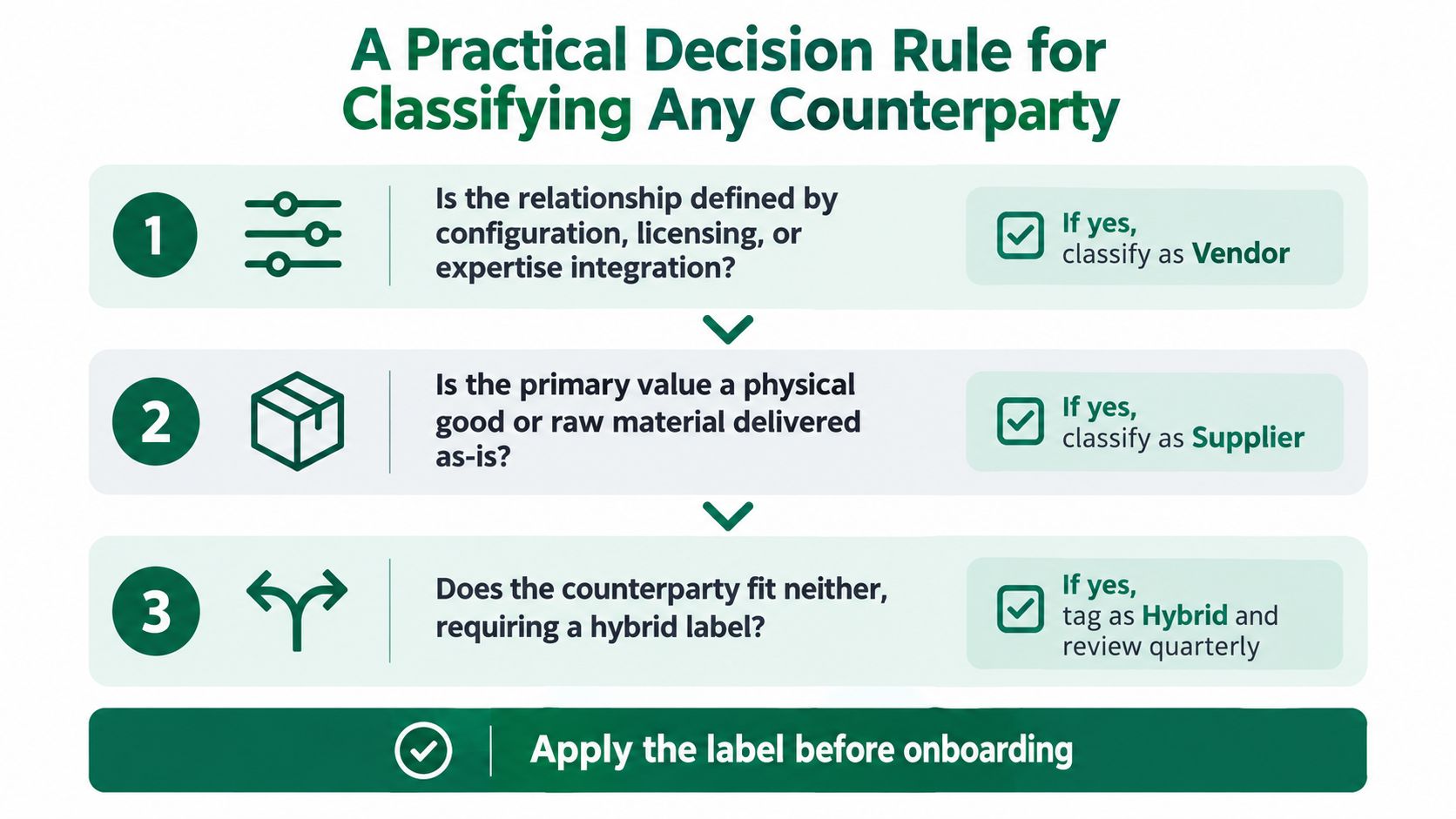
Resolve the messy middle
Marketplace intermediaries should be classified according to what the organization buys. If the intermediary only facilitates a transaction, tag the commercial relationship as vendor-like and document the underlying fulfillment risk separately.
Agents and group purchasing organizations may be vendors for the service they provide, while the manufacturers or distributors behind the arrangement may require separate supplier records.
White-label resellers need scope-based classification. The reseller is a vendor for the commercial interface, but the underlying producer may be a supplier if its capacity and quality determine delivery.
Subsidiaries of larger manufacturers should be evaluated as counterparties in their own right. Parent-company size doesn't remove the need to document the specific entity, contract scope, and operational dependency.
Record the classification, reasoning, decision owner, and date in the vendor master. Review the tag at renewal, after a scope expansion, or when the counterparty begins providing a different deliverable. A SaaS vendor that becomes embedded in production planning may need hybrid treatment. A component supplier that begins selling a finished, off-the-shelf product may move toward vendor treatment.
The practical answer to the vendors and suppliers difference is simple: apply the label that activates the right control path, then revisit it when the relationship changes.
Use Procright to structure supplier discovery, compare vendor responses against specification requirements, and retain cited evidence in an audit-ready sourcing record. Visit Procright to test how its sourcing workflow can support clearer classification and more defensible award decisions.
Try it on a real buy
Bring one category. Watch where the flags land.
We use a little analytics to see which pages actually help. Nothing else, no ad trackers.