AI in Procurement: Cost-Benefit Insights
AI in procurement pays only when treated as a finance case — clean data, TCO/ROI and auditable KPIs drive real 15–45% savings.

AI can cut procurement costs, shrink cycle times, and lower risk - but only if I measure it with clean data and finance-ready KPIs.
Here’s the short version: the article shows that AI in procurement is not just about getting a lower unit price. It’s about seeing the total cost of a decision, including labor, contract leakage, supplier risk, and invoice handling. Research cited in the piece points to 15% to 45% cost reduction, up to 30% less manual work, payback in 18 to 24 months, and in some cases 500%+ ROI over three years.
If I want to judge whether AI is worth it in procurement, these are the main points:
Use TCO, ROI, and NPV, not purchase price alone
Start with clean data, because weak inputs break the math
Focus on a small pilot first, such as spend analysis or RFP work
Track hard numbers like realized savings, invoice cost, cycle time, and leakage caught
Keep human approval and audit trails in place for finance and compliance checks
A few facts stand out:
Manual invoice handling can cost $12 to $15 per invoice, versus $2 to $4 with AI-assisted processing
Bristol Myers Squibb cut RFP time from months to under 30 days
Predictive supplier risk analysis can cut delays by 30%
Data prep can account for 50% to 100% of implementation cost
Change management can add 30% to 50% to the starting tech cost
My takeaway: the article makes a simple point. AI pays off in procurement when I treat it like a finance case, not a software demo.
That means I need clean baselines, careful cost modeling, and proof that savings can be checked in dollars - not just claimed in slides.
AI in Procurement: Use Cases with the Highest ROI in 2026
How Procurement Cost-Benefit Analysis Is Measured
AI-driven procurement analysis only helps if you can measure what it changes. And that starts with a simple truth: purchase price is not the same as total cost.
A solid cost-benefit analysis needs to look past the sticker price and include acquisition, implementation, training, maintenance, downtime, and compliance risk.
TCO, ROI, and NPV in Procurement Decisions
When procurement teams size up AI-driven value, three financial frameworks do most of the work.
Total Cost of Ownership (TCO) covers all costs beyond the initial purchase price. That includes software licenses, data integration, training, change management, and maintenance. Change management alone can add 30% to 50% to the initial technology cost. If the source data is messy, though, even a careful TCO model can fall apart.
Return on Investment (ROI) is calculated as first-year net value divided by first-year total cost, including software spend and internal time. Net value includes both direct savings and cost avoidance. Say an AI tool flags an automatic price escalation clause before renewal. That one catch could stop a $340,000 contract overrun. Research also shows AI-enabled procurement can increase ROI by up to five times compared to manual processes. That’s a big reason teams shouldn’t stop at year one.
Net Present Value (NPV) matters because the cost and the payoff don’t land at the same time. AI spend tends to hit early, while savings build over several years. NPV gives a better view of that multi-year effect than a first-year ROI figure on its own.
"The teams that get sign-off are not the ones with the biggest projected number. They are the ones who calculate honestly, report ranges, and tie every dollar to something finance can already track." - Sandeep Karangula, Co-Founder, MoleculeOne.ai
Data Inputs That Make Cost-Benefit Analysis Reliable
AI-driven cost analysis depends on six procurement inputs: purchase orders, invoices, contracts, supplier performance records, internal usage data, and external market signals such as ESG ratings and geopolitical risk feeds.
For the analysis to hold up, the data has to be clean enough to trust. Spend data needs at least 85% classification accuracy before AI can produce findings that mean much. In most procurement AI setups, teams also need 6 to 10 weeks of data cleanup before the AI layer starts doing its job. That prep work is not minor, either. Data preparation alone often makes up 50% to 100% of implementation costs.
Each input plays a different role in the model:
Data Input | Why It Matters | Reliability Requirement |
|---|---|---|
PO History (3 yrs) | Enables price benchmarking and trend analysis | SKU-level detail |
Supplier Master | Prevents duplicate vendors and fragmented spend | Consistent IDs across ERPs |
Contract Clauses | Identifies value leakage and auto-renewal risks | Digitized, searchable text |
Risk Signals | Predicts bottlenecks and ESG compliance gaps | Real-time external risk data |
Item Master | Supports SKU rationalization and should-cost modeling | Standardized units and categories |
A smart way to start is with one pilot category, such as direct materials for a single product family, within 90 days. Once the inputs are clean, AI can turn procurement data into cost drivers, risk scores, and scenario models.
How AI Improves Procurement Analysis and Decision Quality
Turning Raw Procurement Data into Usable Cost Drivers
Once procurement data is clean, AI can spot cost drivers across thousands of transactions in one pass.
AI-based spend classification tools clean up and sort transactions pulled from free-text descriptions and invoice data. That matters because raw procurement data is often messy. Item names vary, suppliers describe the same product in different ways, and invoice lines rarely come in a neat format.
After that first cleanup, AI can reclassify spend line by line. This makes it easier to see hidden cost drivers like maverick spend, price variance, duplicate items, and contract leakage by matching invoices against contract terms. Maverick spend alone can account for 12% to 18% of off-contract spend. In plain terms, money slips out through side doors when teams buy outside approved agreements.
AI also helps with should-cost modeling. It can build reference benchmarks from raw material indices and labor data, which gives buyers a cost view based on actual inputs instead of relying on one supplier quote. That changes the conversation in sourcing. Buyers aren't stuck reacting to a number on a page; they can push back with a clearer breakdown of what is driving the price.
Once those cost drivers are out in the open, teams can test which moves are most likely to pay off.
Scenario Modeling, Risk Scoring, and Multi-Criteria Evaluation
With cost drivers exposed, procurement teams can run what-if simulations for price changes, demand swings, lead time shifts, and supplier reliability inside one model that weighs cost, risk, and service impact. Instead of looking at price alone, teams can see the tradeoffs side by side.
AI also helps map suppliers beyond Tier 1. Those multi-tier supplier maps can automatically flag high-risk tiers and point teams toward more reliable backup options. That's a big deal when a direct supplier looks fine on paper, but trouble is sitting deeper in the chain.
Risk monitoring is another area where AI earns its keep. Predictive alerts have been shown to cut operational delays by 30%. On top of that, AI can handle complex category analysis about 90% faster than manual methods. For busy procurement teams, that speed means less time digging through spreadsheets and more time making calls that affect cost and supply continuity.
Where Procright Fits in the Workflow
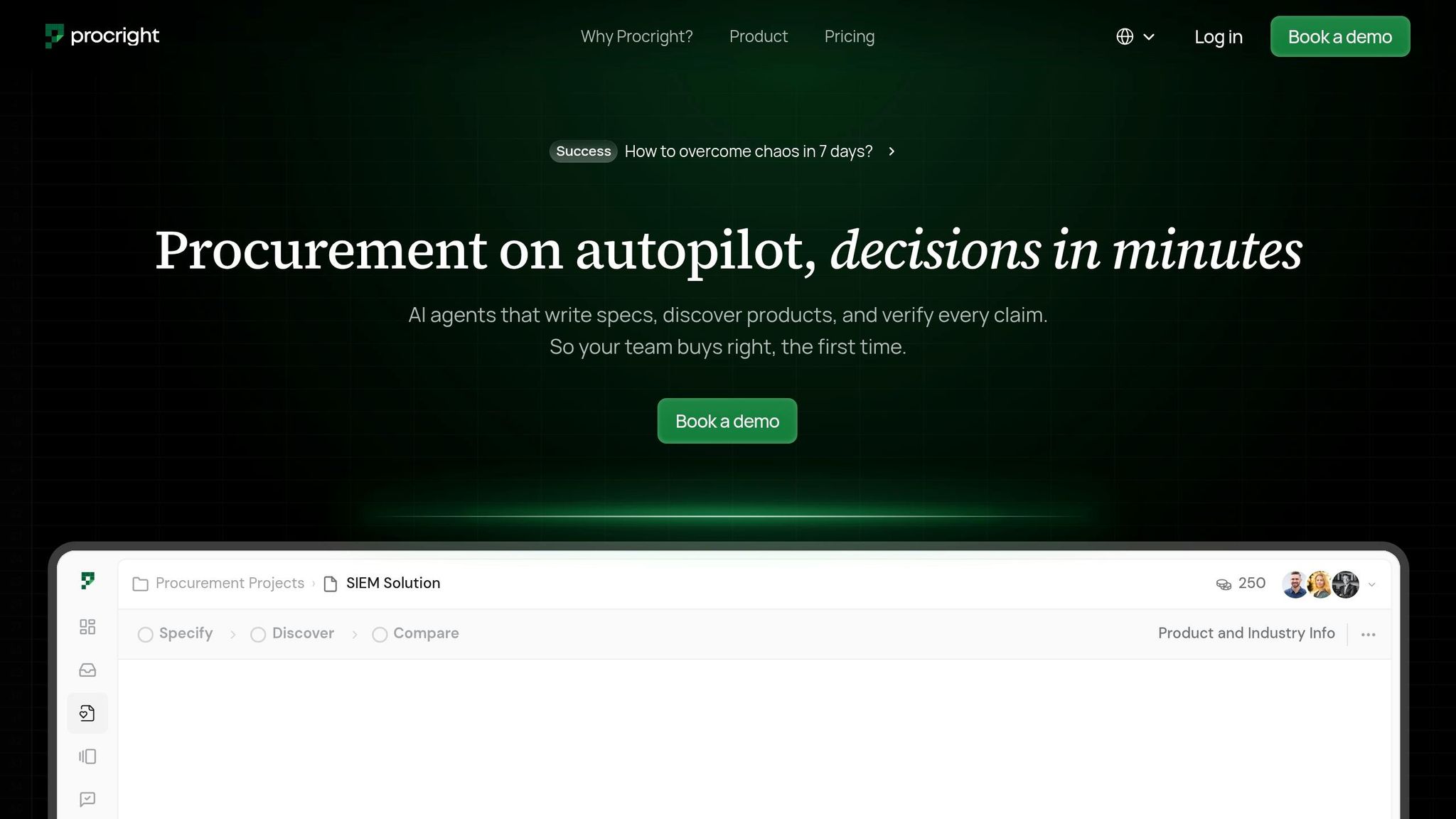
Standardized specs make those scenarios easier to use in sourcing.
Procright sits at the front of the workflow by turning source material into standardized specs and dynamic categorization, comparing products against those specs, and showing clear compliance scores. That supports the kind of multi-criteria evaluation research connects with more reliable product-selection decisions.
Research-Backed Use Cases: Where AI Delivers Measurable Procurement Value
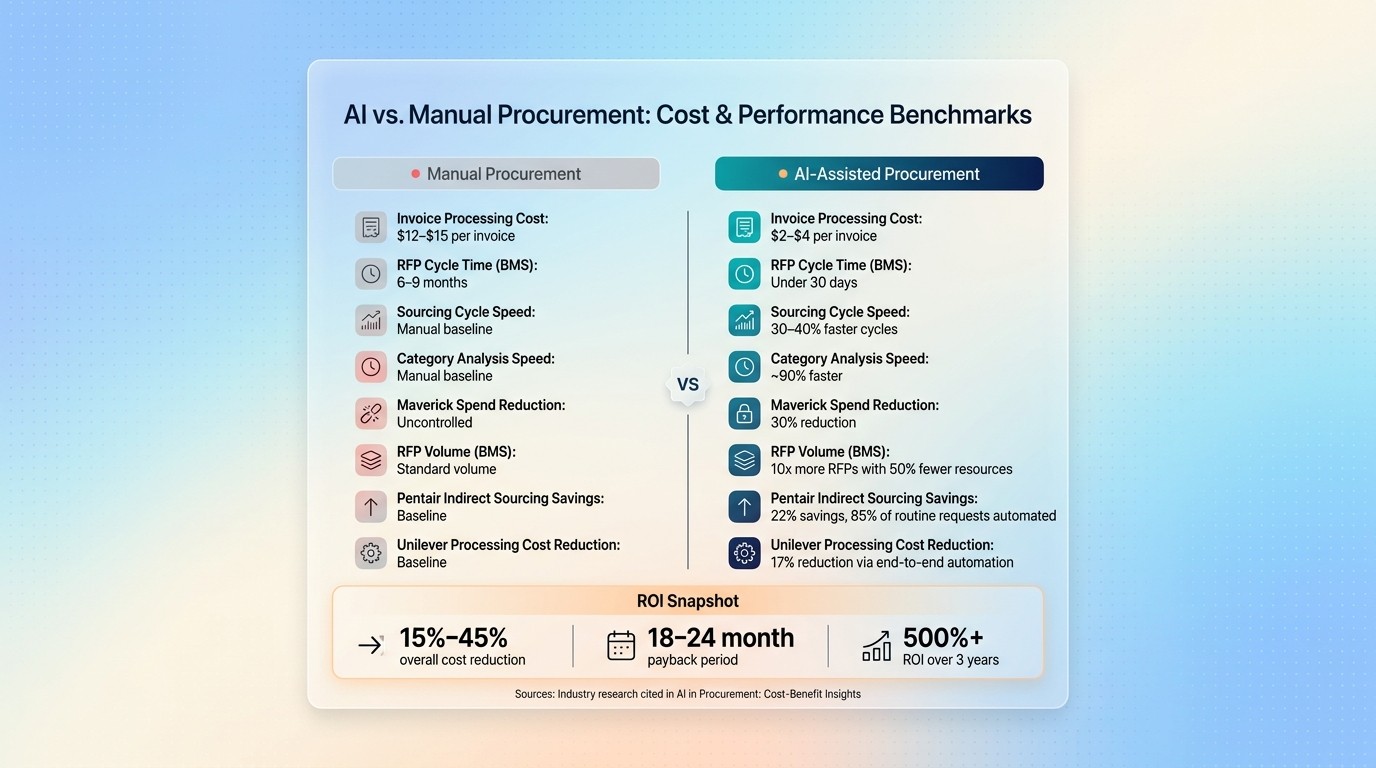
AI vs. Manual Procurement: Cost & Performance Benchmarks
Spend Analysis and Category Management
The clearest ROI shows up in three workflows: spend analysis, sourcing, and invoice processing. Spend analysis is often the fastest place to see value. AI cleans up fragmented transaction and supplier data, then spots price variance and rogue spend far faster than a manual review can.
A global SaaS company added an AI-based spend analysis layer on top of its existing ERP and cut software expenses by 23%. It also reduced sourcing cycle times by 50%. Coca-Cola Europacific Partners rolled out AI across 28 countries to optimize more than $15 billion in spend. That effort produced $40 million in annual savings and a 30% reduction in maverick spend.
That same pattern shows up in sourcing too, where cycle time and award quality tend to shape most of the savings.
Sourcing, Supplier Selection, and Compliance Control
AI shortens RFP cycle time, improves bid scoring, and flags contract risk before it turns into leakage.
Bristol Myers Squibb cut its RFP process from 6–9 months to under 30 days. That let the team run 10 times more RFPs while using 50% fewer resources. Pentair, a $4 billion water treatment company, deployed AI sourcing for indirect categories in just two months. In its first-year managed categories, it achieved 22% savings while automating 85% of routine sourcing requests.
AI-powered contract tools also catch renewal issues before they slip through the cracks, making it easier to compare AI procurement tools that handle complex compliance. That means lower total cost, faster award decisions, and less leakage.
The last big payoff comes from transaction-heavy work, where manual handling creates a lot of avoidable cost.
Operational Procurement and Invoice Processing
Manual invoice handling usually costs $12 to $15 per invoice. With AI-assisted direct processing and no manual touch, that drops to $2 to $4. That cuts labor cost and reduces processing errors at the same time. If a company handles thousands of invoices each month, the math gets big in a hurry.
Unilever achieved a 17% reduction in procurement processing costs through end-to-end AI automation, including automated invoice processing and intelligent spend classification. The examples below show the main cost drivers and outcomes:
Use Case | Primary Cost Drivers | Primary Benefit | Key Metrics |
|---|---|---|---|
Spend Analysis | Fragmented data, rogue spend | Consolidation, price variance detection | 2–5% total spend savings; 30% maverick spend reduction |
Sourcing & Selection | Slow RFPs, inconsistent scoring | Faster cycle times, better bid scoring | 30–40% faster cycles; 3–7% incremental savings |
Compliance & Contracts | Value leakage, auto-renewals | Renewal errors avoided, leakage prevented | Up to 9% annual revenue protected |
Invoice Processing | Manual data entry, high error rates | Direct processing, lower labor cost | $2–$4 cost per invoice vs. $12–$15 manual |
Supplier Risk | Static monitoring, delayed signals | Real-time monitoring, predictive alerts | 30% reduction in delays |
These gains only matter if teams track them with finance-ready KPIs. The next step is to prove those savings with metrics finance can verify.
Putting AI ROI to Work in Procurement
KPIs and Reporting Methods That Matter
Proving AI value to a CFO comes down to two things: the metrics you track and how honestly you report them. These numbers turn TCO, ROI, and NPV into results finance can check for itself.
Some metrics matter more than others. Hard savings - like direct spend reduction and a lower cost per invoice - usually carry the most weight. Risk reduction comes next, especially when you can put a dollar figure on contract leakage or supplier disruptions. Efficiency gains, such as time saved or shorter cycle times, matter too. But finance usually wants to see how those gains connect to budgeted labor savings or capacity that was clearly redeployed.
Track only finance-verifiable KPIs.
Use these KPIs to compare post-deployment results against pre-AI baselines.
Metric Category | Key KPI | Finance-ready measure |
|---|---|---|
Financial | Realized savings, cost avoidance | Documented spend reduction against prior-period baseline |
Efficiency | Process cost per transaction | Verified PO/invoice cost before and after deployment |
Speed | Sourcing cycle time | Days from RFQ to award, tracked per category |
Compliance | Contract leakage rate | Dollar value of renewals caught vs. missed |
Risk | Supplier defect rate and on-time delivery | Disruption incidents logged pre- and post-deployment |
Before deployment, capture the baseline. Record current cycle times, error rates, FTE hours, and cost per transaction. If you skip that step, you're flying blind later. There’s no clean way to show what changed if you never pinned down where you started.
When you report results, use a confidence factor - usually 0.7 to 0.9 - to discount projected savings. And present ranges instead of a single number. Finance tends to trust that format more because it shows a little discipline instead of wishful thinking.
Key Takeaways for Procurement Leaders
Measured ROI only stands up when the data is clean, the baseline is fixed, and the result can be audited. The pattern is pretty simple: AI delivers its biggest returns when the underlying data is clean and the process is transparent and auditable.
Governance is not optional. Financial decisions and final approvals need human review. AI outputs should stay inside pre-set business rules and approval thresholds, not loose prompting with no guardrails. Every AI-driven action should leave behind a documented audit trail, so compliance reviews don’t turn into a scavenger hunt. Platforms like Procright are built with this in mind, providing transparent compliance scores and structured decision logic that teams and auditors can actually follow.
The implementation path that tends to work is staged. Start with a high-impact, low-complexity use case like spend classification or RFP drafting. Prove the numbers first. Then expand. Clean data, defined KPIs, and an auditable trail are what separate teams that scale AI well from those stuck in pilot purgatory.
FAQs
How do I calculate AI ROI in procurement?
Calculate AI ROI by comparing your current baseline costs, like $50.00 to $150.00 per purchase order and $12.00 to $15.00 per invoice, against measurable AI results. Look at what changes in plain business terms: hours cut from manual work, shorter sourcing cycle times, or dollars brought back from pricing leakage.
Keep the focus on results the business can see. If a team spends too much time on repetitive tasks, measure the time saved. If margin slips because of off-contract buying or missed pricing terms, track the dollars recovered.
A smart way to start is with a high-impact pilot. Contract compliance and category strategy are strong early use cases because they can show clear value fast. Aim for a pilot that can prove results within 90 days.
What data do I need before starting?
Before you start, set a baseline for ROI and decide what success looks like. That gives you something solid to measure against instead of guessing later.
Clean up your spend data too. AI needs at least 85% classification accuracy to work well, so messy data can throw the whole thing off. It also helps to run a two-week baseline sprint to track how much manual work your team is doing today.
The main data points to gather include:
Current costs, such as $50–$150 per purchase order and $12–$15 per invoice
Sourcing cycle times
Success KPIs
Historical contracts and transaction records
Without that baseline, it’s hard to tell whether you’re saving time, cutting costs, or just shifting work around.
Which AI procurement pilot should I run first?
Start with a high-impact, low-complexity use case that you can repeat, one that involves lots of documents and is easy to measure.
Strong first pilots include generative AI for drafting RFPs, contract summaries, and supplier communications. You can also start with narrow review work, like checking supplier specifications and onboarding documents.
Set your KPIs at the start. For example:
Review-cycle reduction
Buyer hours saved
That makes ROI easier to show and gives you a clear case for scaling later.