How AI Simplifies Energy Compliance Verification
AI maps rules, extracts clauses, auto-checks vendor specs, and creates traceable compliance scores for energy procurements.

Energy compliance checks get hard fast when one project can face more than 2,700 yearly requirements. I’d sum it up like this: AI helps procurement teams turn scattered rules, PDFs, datasheets, and vendor files into a clear checklist with source-linked proof.
If I were explaining the article in plain English, here’s the core idea:
I start by mapping every rule that applies before sourcing begins
I use AI to pull clauses from regulations, tariffs, RFPs, and supplier documents
I turn those clauses into a requirements list with pass/fail checks and scored items
I compare vendor specs against that list and flag gaps
I keep every score tied to source evidence for review and audit
I send low-confidence results to human reviewers before award
I track rule changes and certificate expirations so checks stay current
The article also makes one thing clear: manual review does not hold up well at scale. Teams lose time to paper-heavy work, wrong standard editions can knock out a bid, and audit trails often end up buried in inboxes. AI helps by organizing the work, standardizing units and terms, and showing why a product passed, failed, or needs more proof.
Here are the main parts covered:
U.S. rule mapping across federal, state, local, and internal policy layers
Clause extraction and requirements traceability
Spec and checklist creation in Procright
A 6-step AI verification workflow
Compliance scoring for supplier review
Product comparison with evidence, cost, fit, and risk
Human review, audit logs, access control, and rule-set updates
A few facts stand out:
2,700+ yearly compliance requirements can apply to one renewable project
22% of procurement teams’ yearly time is lost to manual and paper-based work
ASHRAE 90.1-2022 is 14% more efficient than the 2019 edition
In May 2026, Lucius AI parsed a 212-page WAPA solicitation and found 147 compliance criteria
If you want the short version, it’s this: AI helps me check energy procurement compliance with more consistency, clearer proof, and less manual document chasing. The article then walks through how to set that up in a way procurement, engineering, legal, and compliance teams can review and use.
AI for Energy: From advanced operations to emissions management | BRK365
Map procurement requirements to U.S. regulatory obligations
Before you look at a single product, get clear on every rule the purchase needs to meet. Skip this, and teams often run into trouble late in the process - sometimes a vendor gets knocked out near the end, and sometimes the issue shows up after award.
Identify the regulations, standards, and internal policies that apply
Map each purchase to the regulations, standards, and internal policies that apply before sourcing begins. At the federal level, FAR Part 23 requires agencies to buy ENERGY STAR-certified or FEMP-designated products, and FAR Part 41 governs utility service acquisitions, which must align with state law and utility commission rulings.
State and local codes add another layer. Most U.S. projects follow IECC or ASHRAE 90.1, while California requires Title 24. Edition control matters too. ASHRAE 90.1-2022 is 14% more efficient than the 2019 edition, so using the wrong version can throw off the whole review.
Then there are other rules that shape what clears compliance, including cybersecurity requirements like NERC CIP, emissions rules from the EPA, and your organization’s resilience and small business policies.
Once that rule set is defined, AI can pull the exact clauses and turn them into something your team can review without digging through piles of source documents.
Use AI to extract clauses and normalize technical requirements
AI scans commission orders, tariffs, RFPs, and datasheets for mandatory terms like "shall" and "must." It captures each clause with its page reference and clause number. From there, AI turns those clauses into a requirements traceability matrix that separates pass/fail gates from scored criteria, so reviewers can see what knocks out a product versus what changes its score.
AI also normalizes units and formatting for side-by-side comparison, which makes product evaluation more dependable. In May 2026, Lucius AI showed this at scale by parsing a 212-page solicitation for a 24-month solar array installation issued by the Western Area Power Administration (WAPA). It identified 147 distinct compliance criteria and auto-populated an RTM formatted to DCMA specifications.
That kind of structured rule set feeds straight into automated specification drafting and checklist generation.
Create structured specifications and checklists with Procright
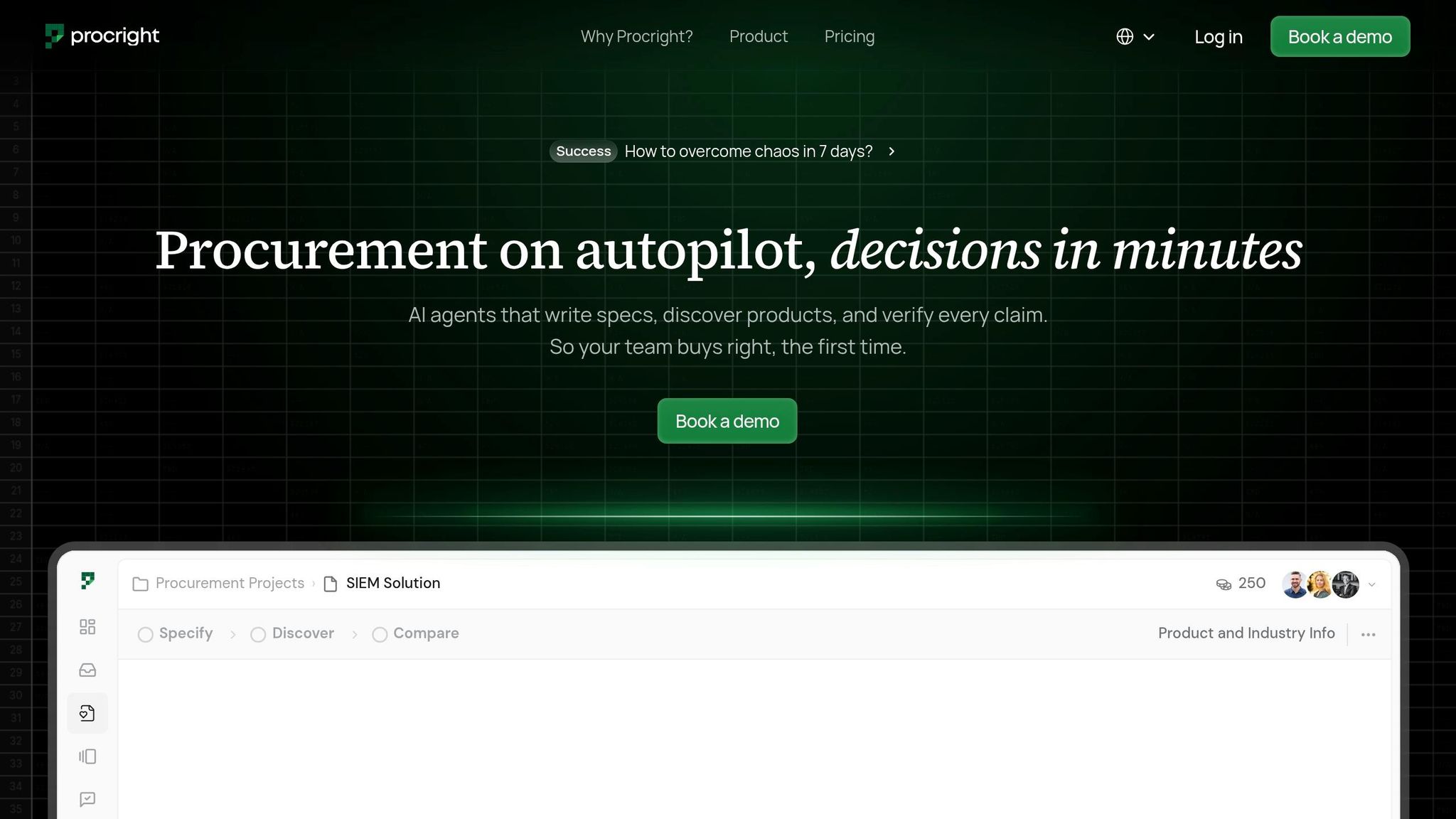
Procright handles this by generating regulation-aware specifications directly from your compliance criteria. It organizes requirements item by item, links each item back to its source regulation, and sets up the checklist so technical review and commercial review stay separate. Every extraction and decision is logged, which creates an audit trail for internal and regulatory review.
The result is a sourcing package where every requirement is traceable before a single supplier response comes in. That makes the product evaluation step much faster and easier to defend.
Build an AI-driven compliance verification workflow
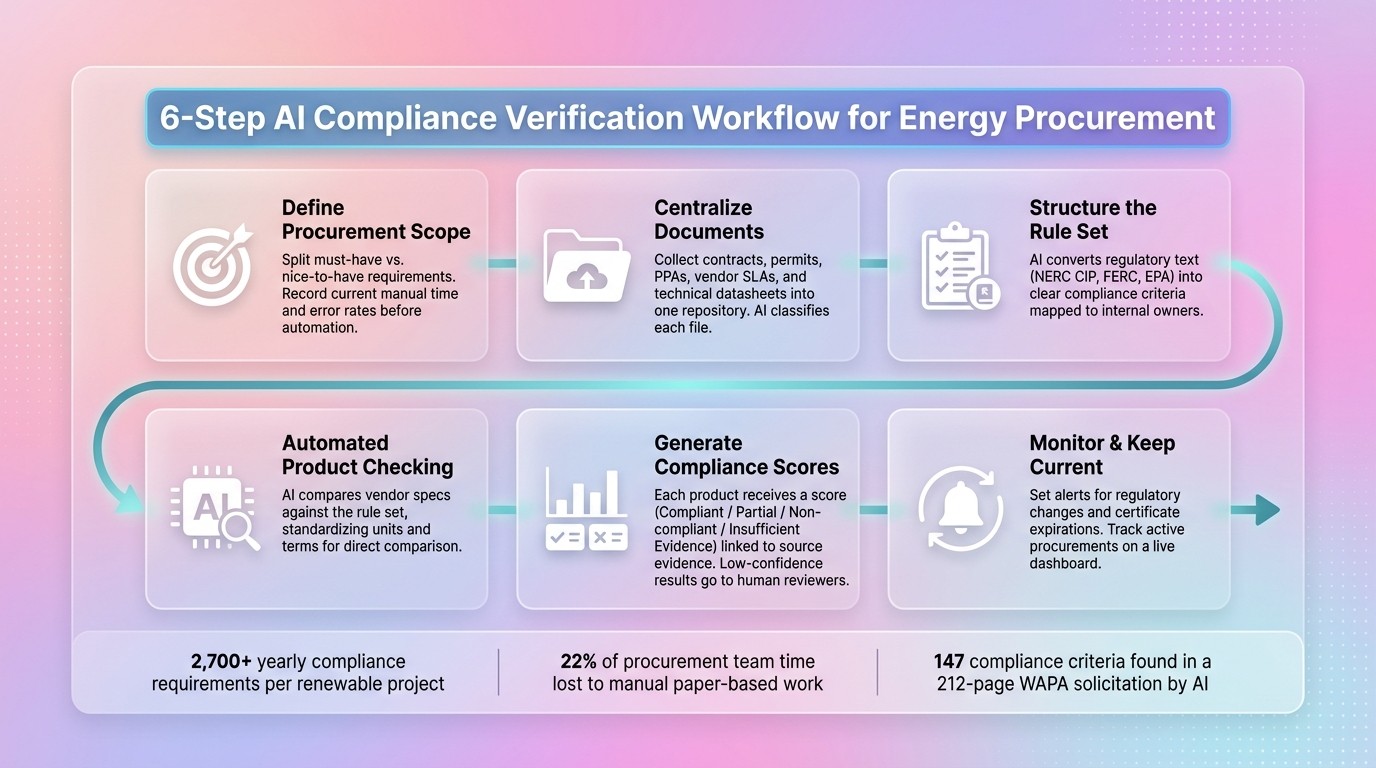
6-Step AI Compliance Verification Workflow for Energy Procurement
With your rule set set up and your specs locked in, the next move is simple: turn that prep work into a process you can run again and again, and one you can audit later without digging through emails and spreadsheets.
Steps 1–3: Scope the purchase, centralize documents, and structure the rule set
Start by defining the procurement scope in plain terms. Split must-have requirements from nice-to-have requirements, and record current manual time and error rates before you automate anything.
Next, bring your documents into one place. That includes contracts, permits, PPAs, vendor SLAs, and technical datasheets. Once those files are centralized, AI can classify each one and pull out the obligations that apply.
Then use AI to turn regulatory text, like NERC CIP, FERC, and EPA requirements, into clear compliance criteria. After that, map each requirement to the internal owner or system tied to it. This rule set is what automated checking runs on.
Steps 4–5: Check products automatically and generate compliance scores
At this stage, AI compares vendor specs against the rule set and standardizes units and terms so the comparison is direct.
Procright helps here by automating compliance verification and generating clear compliance scores for each product. Every finding links back to source evidence, so reviewers can see why a product was marked compliant, partial, non-compliant, or unable to verify.
Verification Status | Meaning | Action Required |
|---|---|---|
Compliant | Meets or exceeds requirement | Proceed with procurement |
Partial | Close but not exact match | Clarify and evaluate risk |
Non-compliant | Does not meet requirement | Flag for rejection or decision |
Insufficient evidence | Insufficient evidence provided | Request additional documentation |
If a case comes back with low confidence, send it to a human reviewer before the award decision. That way, the scores don't just sit in a report. They help move the process from verification into procurement review.
Step 6: Monitor updates and keep verification current
Use supplier risk monitoring tools to set alerts for regulatory changes and certification expirations, and track active procurements in a dashboard so verification stays up to date. Keep those scores current so they can feed the final award decision.
Use compliance scores and evidence to support procurement decisions
With verified scores and evidence in hand, procurement can move beyond rule-checking and make data-driven procurement decisions. Once compliance scores are set, use them as part of the award decision. Treat compliance as a gate first, then review total cost, capacity, efficiency, reliability, and delivery risk together.
Keep technical scoring separate from price until the final award.
Present findings in a product comparison table
A comparison table helps teams spot trade-offs fast and record the reason behind the award. Procright supports this by linking each compliance score to the source evidence, so reviewers can see exactly why a supplier received a given score.
Product / Supplier | Compliance Score | Key Criteria Met or Missed | Evidence Sources | Total Cost (USD) | Technical Fit | Risk Level |
|---|---|---|---|---|---|---|
Supplier A (Solar) | 95/100 | Met: NERC CIP, ISO 27001; Missed: Local EPA permit update | PPA Clause 4.2; EPA Filing ID #992 | $4,200,000 | High | Low |
Supplier B (Grid) | 78/100 | Met: FERC; Missed: Cybersecurity insurance minimums | Insurance Certificate v2; Contract Sec. 8 | $3,850,000 | Medium | Medium |
Supplier C (HVAC) | 62/100 | Missed: Grid reliability standards, ESG reporting | Audit Log 2026-Q1; SCADA Data | $3,600,000 | Low | High |
If a lower-priced supplier still has open reliability or reporting gaps, the table puts that trade-off front and center. Stakeholders can scan it, trace the evidence, and approve the decision with more confidence.
Governance and conclusion: Keep AI verification accurate, auditable, and useful
Once compliance scores land in the comparison table, governance is what makes them auditable and defensible. AI can speed up compliance verification. But governance is what makes the output hold up under scrutiny.
Set controls for human oversight, audit logs, and model review
Model output on its own is not a defensible basis for a multi-million-dollar award.
Each extracted obligation should have a named owner and a named reviewer. Procurement, engineering, compliance, and legal each need a clear part in reviewing outputs before any award decision is final. Role-based access controls help enforce that setup by keeping technical and commercial evaluations separate until award.
That structure only works if every decision is recorded. Log every check, score change, approval, and rationale in a central repository. Regulators need a decision trail, not just an outcome.
Rule sets should also be reviewed after every regulatory change and model update. AI models can misread new or ambiguous regulatory language, or miss context that an experienced reviewer would catch right away. Regular cross-functional review helps close that gap before it turns into liability.
This control layer turns automation into evidence a team can use at award time.
Key takeaways for energy procurement teams
Map obligations early. Centralize documents. Automate checks. Score evidence. Monitor changes.
Procright supports this flow with traceable specifications and compliance scores.
FAQs
What documents should I centralize first?
Start with your existing technical specifications. In Procright, you can pull scattered files, like PDFs and DOCX documents, into one consistent master document.
Putting these specs in one place gives the AI a clean source to work from. It can review requirements, flag missing technical details, and help set a clear baseline for product discovery and compliance checks. It also creates an audit-ready record of requirements and decisions.
How does AI handle low-confidence compliance checks?
For low-confidence compliance checks, AI keeps things transparent with clear labels: Yes, Partially, No, or Not Found.
Procright also shows the technical documents, guides, or videos behind each match, so users can check the source for themselves. Human reviewers then confirm those findings before they shape high-stakes procurement decisions.
How often should energy compliance rules be updated?
Energy compliance rules need close, continuous attention because federal, state, and international requirements are fragmented. And while many industry codes and standards tend to update on a three-year cycle, local amendments, errata, and enforcement practices can shift much more often.
That gap is where AI tools help. They can scan for updates in real time, which lets teams adjust policies right away instead of waiting for the next scheduled review.
Procright supports this work by automating specification creation and compliance verification.