How Dynamic Categorization Improves Product Discovery
Dynamic categorization turns catalogs into living systems that use AI to normalize product data and make discovery faster and compliant.
Dynamic categorization is transforming how procurement teams find and organize products. Unlike static systems, it uses AI to classify and enrich product data in real time, ensuring accurate search results using NLP search use cases and efficient catalog management. Here’s why it matters:
Static systems struggle: Fixed taxonomies can't keep up with new products or changing standards, leading to misclassified items and incomplete filters.
AI-powered solutions: Dynamic categorization extracts data from unstructured sources (like PDFs) and aggregates product data accurately, even when supplier data is inconsistent.
Key benefits: Faster searches, better filter functionality, and reduced manual work - cutting classification time by up to 90%.
Real-world impact: Companies report improvements like an 80% reduction in catalog management time and higher search accuracy.
This approach not only saves time but ensures procurement teams can quickly find compliant, in-stock items, making it a game-changer for product discovery.
What Is Dynamic Categorization and How Does It Work?
Defining Dynamic Categorization
Dynamic categorization uses AI to automatically assign products to the correct categories based on their titles, descriptions, and technical details. Unlike static taxonomies that are rarely updated, dynamic systems process data continuously and adjust categories in real time. This approach excels at handling unstructured data. For instance, multimodal large language models (LLMs) can extract structured attributes from sources like text, images, PDFs, and even product manuals. So, even if a supplier provides only a PDF spec sheet without a clean data feed, the system can still pull out the necessary details and categorize the product accurately. The result? Better product discovery, as explained further below.
"AI Product Categorization replaces error-prone, time-consuming manual tagging with consistent, machine-learned decisions that align with your existing taxonomy and business rules." - Virto Commerce
Key Technical Approaches
Let’s break down how dynamic categorization achieves its automation magic.
Natural Language Processing (NLP): NLP converts product descriptions into numerical vectors that capture their meaning. This allows the system to recognize that "stainless steel hex bolt, M8, grade 8.8" and "M8 hex fastener, 316 SS" are essentially describing the same product type, even if the wording differs.
Machine Learning Models: These models are trained on a company's specific taxonomy and improve over time. For example, Shopify's system processes millions of predictions daily with high acceptance rates from merchants.
Clustering Techniques: Methods like k-means clustering group similar products together, revealing micro-categories that static systems often miss. For instance, categories like "eco-friendly industrial degreasers" or "ATEX-rated wireless sensors" can emerge, reflecting real buyer demand.
A crucial component is the validation queue. If the AI isn’t confident in its classification, the system flags the item for human review before publishing it. This human-in-the-loop process ensures high-quality results without requiring manual input for every product.
Static vs. Dynamic Categorization: A Side-by-Side Look
The differences between static and dynamic categorization go beyond technology - they directly affect how quickly buyers find products and how much effort your team spends managing the catalog. Here’s a quick comparison:
Feature | Static Categorization | Dynamic Categorization |
|---|---|---|
Maintenance | Manual, time-intensive, prone to bottlenecks | Automated; updates and scales effortlessly |
Adaptability | Requires manual re-mapping for taxonomy changes | Automatically adjusts as taxonomies evolve |
Search Method | Relies on exact keywords | Context-aware; understands intent and plain language |
Data Sources | Limited to structured feeds and manual entry | Extracts data from text, images, and PDFs |
Scalability | Struggles with large catalogs | Handles millions of SKUs across channels |
Efficiency | Slow onboarding for new vendors and products | Speeds up time-to-market for long-tail SKUs |
Dynamic categorization offers clear efficiency gains. AI-powered systems can cut manual classification time by 60–90%. Plus, when catalog data is accurate and complete, shoppers can find products faster. That’s critical, considering 87% of buyers say detailed product data is "extremely" or "very important" in their purchasing decisions. These advantages make dynamic categorization a game-changer for improving product discovery in procurement.
ai-PULSE 2025: Cracking Product taxonomy at scale - A multimodal, zero-shot approach
How Dynamic Categorization Improves Product Discovery
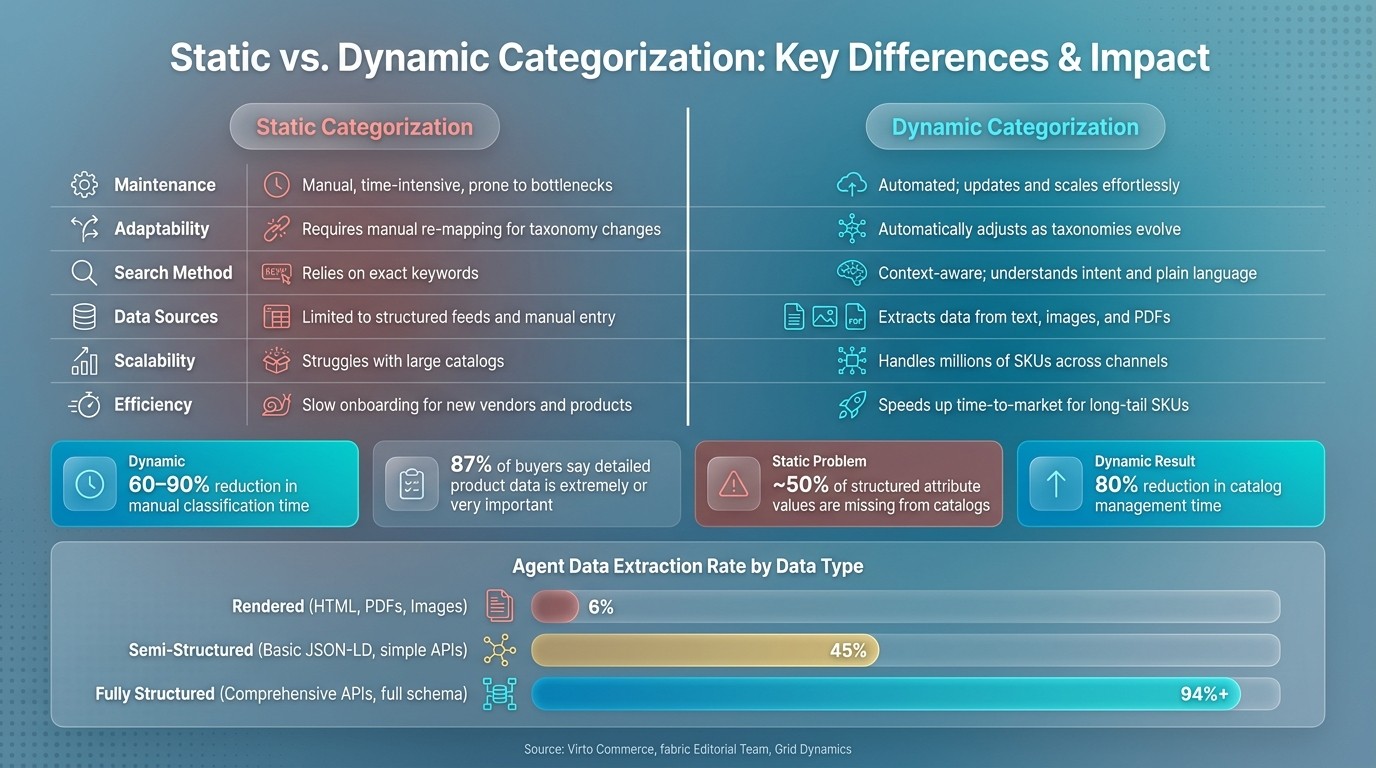
Static vs. Dynamic Categorization: Key Differences & Impact
Better Search Relevance and Precision
Static keyword searches often fall short because they rely on exact matches to supplier-provided terms. Dynamic categorization changes the game by focusing on intent. It analyzes product attributes, technical details, and context to deliver results that align with what buyers are actually looking for - not just the exact words they type.
Take this example: one supplier lists "316 SS hex fastener", while another calls it a "stainless steel hex bolt, M8." Without a system to normalize these terms, a filtered search might only show one of these options. Dynamic categorization standardizes such variations, ensuring both products appear, no matter how they're described.
Here's a staggering fact: nearly 50% of structured attribute values are missing from product catalogs. This often leads to empty search results, even when compliant and in-stock items are available. By filling in these gaps, dynamic categorization ensures filters work properly and search results are complete.
"In large catalogs, a missing structured attribute can quietly suppress visibility, leaving in-stock items hard to discover and slowing sell-through." - fabric Editorial Team
This approach not only improves search precision but also integrates seamlessly with fragmented data sources.
Better Coverage Across Fragmented Data Sources
Dynamic categorization doesn’t just refine search - it also solves the problem of inconsistent supplier data. Procurement teams often receive information in a mix of formats - spreadsheets, PDFs, images, or product manuals - each with its own naming conventions. This can result in disorganized catalogs where identical products are listed under different names or overlooked entirely if details are hidden in unprocessed documents.
By extracting and structuring data from these sources, dynamic categorization creates a unified taxonomy. For instance, it can pull key specifications from PDFs and other unstructured formats, making previously hidden products visible and searchable.
The results can be transformative. In early 2026, a major grocery retailer used AI-powered catalog enrichment to address categories where feature completeness was as low as 1%. After automating data extraction and classification, their product detail page (PDP) completeness soared to over 80%. This not only reduced manual work but also improved search consistency across their entire catalog.
Keeping Up with New Products and Standards
When new products hit the market or compliance standards change, manual categorization struggles to keep up. Dynamic categorization, on the other hand, handles these updates automatically. New SKUs are classified immediately based on their attributes, assigned to the correct category, and matched with the appropriate attribute template. Certifications like CE, ATEX, or RoHS are extracted directly from technical documents, ensuring that regulated products are flagged and verified without human intervention.
This system is also agile enough to adapt to taxonomy updates. For example, Google revised its Product Taxonomy in January 2026, adding categories like Smart Home, EV Accessories, and AI & Robotics, with a compliance deadline of July 31, 2026. Dynamic categorization can re-map products to meet these new standards effortlessly, while static systems require time-consuming manual adjustments across thousands of SKUs.
Implementing Dynamic Categorization in Procurement
Preparing Data for Dynamic Categorization
To categorize products accurately using AI, the first step is ensuring clean and consistent data through AI-driven validation. This involves a thorough audit of product information stored across systems like PIM, ERP, and CMS. The goal? Measure field completeness and identify inconsistencies in your data. Without this foundation, categorization efforts can falter.
Start by normalizing supplier data. This includes standardizing attribute terminology, converting metric units to imperial (or vice versa, depending on your needs), and ensuring all pricing is in USD. Consistent language and units are critical for AI models to interpret data without confusion.
Once data is normalized, focus on filling in the blanks. Missing fields - like material, dimensions, or compliance status - should be enriched using manufacturer feeds or product documentation. Assigning canonical product IDs and Manufacturer Part Numbers (MPNs) is another key step. These identifiers prevent AI from merging product variants incorrectly or pulling mismatched compatibility profiles.
"The best AI-ready catalogs treat every critical product claim like a mini audit trail. If your team cannot explain where a field came from, a model probably should not be asked to trust it." - Avery Morgan, Senior SEO Content Strategist
Unmapped items should always be flagged for manual review. This step ensures that quality issues don't cascade downstream. High-quality, standardized data not only improves AI performance but also enhances search accuracy and product discovery.
How AI Classification Pipelines Work
Once the data is cleaned and standardized, AI classification pipelines take over, dynamically categorizing products. These pipelines can process data from multiple sources - CSVs, PDFs, or PIM feeds - using contextual analysis to classify items accurately.
The most effective pipelines rely on coordinated automation, where specialized agents handle distinct tasks. For example:
A Structure Analysis Agent identifies gaps in the category hierarchy.
A Product Analysis Agent examines purchasing data to suggest new subcategories based on emerging trends.
A Merge Coordination Agent reconciles overlapping suggestions into a cohesive set of changes.
An automated "judge" layer evaluates these changes for consistency and alignment with the existing hierarchy. This automation significantly reduces the workload for human teams. Take Shopify's Product Taxonomy team, for instance. In February 2026, they implemented an agent-driven pipeline that expanded their taxonomy from 400 to over 10,000 categories in just weeks. During the proof-of-concept phase, the telephony vertical alone gained 34 new categories, thanks to the leadership of Kshetrajna Raghavan and Ricardo Tejedor.
"You have to log everything happening inside the agents, not just for reproducibility, but for human traceability." - Kshetrajna Raghavan, Principal Machine Learning Engineer, Shopify
Validated classifications are stored in vector databases, creating a feedback loop. This loop ensures that past decisions enhance future predictions, making the system smarter and more efficient over time.
How Procright Applies Dynamic Categorization
Procright showcases these advanced processes in real-world procurement. Its AI-powered platform eliminates the need for buyers to manually sift through supplier catalogs. Instead, Procright analyzes product specifications and automatically maps items to the correct categories in real time.
The platform also handles compliance attributes like RoHS status or CE marking. These are identified and verified automatically, saving procurement teams from combing through technical documents. By working with structured, enriched data instead of raw, inconsistent inputs, teams can quickly compare products for compliance and generate specifications. The result? Faster product discovery and greater confidence in decision-making.
Measuring the Impact of Dynamic Categorization
Core Metrics for Product Discovery
Once dynamic categorization is in place, it's crucial to track specific metrics to see if it's delivering results. The top three to monitor are average search time, search actions per successful purchase, and catalog abandonment rate. These numbers reveal how well customers are navigating the catalog and finding what they need efficiently.
Here’s a real-world example: a mid-sized manufacturing company revamped its catalog with integrated filters and managed to cut average ordering time by 40%. That’s a strong indicator of success.
Another important metric is the ratio of catalog-based orders versus free-text or "maverick" purchases. A high rate of off-catalog buying often signals that the categorization system isn’t surfacing the right products. If customers can’t locate items quickly, they’ll bypass the catalog entirely, which defeats the purpose of structured categorization.
These metrics not only highlight user experience but also provide a foundation for assessing the quality of the underlying data.
Quality and Governance Indicators
Dynamic categorization thrives on high-quality data. A key measure here is data liquidity, which reflects how structured and readable your product data is for AI systems.
The difference between structured and unstructured data is massive. Fully structured data - organized with comprehensive APIs and schemas - achieves an agent extraction rate of 94% or higher. In contrast, unstructured formats like PDFs or static HTML pages only reach 6%. This discrepancy directly impacts how accurately and quickly products are categorized.
Data Tier | Data Type | Agent Extraction Rate |
|---|---|---|
Tier 1 | Rendered (HTML, PDFs, Images) | 6% |
Tier 2 | Semi-Structured (Basic JSON-LD, simple APIs) | 45% |
Tier 3 | Fully Structured (Comprehensive APIs, full schema) | 94%+ |
Higher extraction rates mean more reliable categorization, which translates to better product discovery for users.
For those needing a deeper dive into data quality, the Comparable-Spec Index is a helpful tool. It scores data across five dimensions - Coverage, Normalization, Citation, Confidence, and Decision-Readiness - on a scale of 0 to 4. A score of 16 or higher out of 20 indicates that the data is ready for accurate product comparisons. Regular audits of low-confidence AI-extracted values are critical, as these are often the source of catalog errors.
Using Feedback to Refine Categorization Over Time
Tracking metrics is just the beginning. To keep improving, it’s essential to incorporate feedback into the system. Every categorization decision helps refine the model for future use.
This feedback comes in two forms: direct signals and indirect signals. Direct signals include user corrections or flagged errors, while indirect signals are derived from patterns like zero-result searches or sudden traffic drops in a category. Both types of signals are valuable, but the real power lies in aggregating them to identify broader trends rather than focusing on individual complaints.
"What distinguishes high-performing teams is not that they 'use AI' or 'have a PIM,' but that they treat the catalog as a living system. One that evolves with customer behavior, product strategy, and channel complexity." - Netguru
A strong target is achieving a 95% or higher completeness score across key product categories. Additionally, tracking the discoverability rate - the percentage of SKUs that generate at least one view per month - can show whether your enrichment efforts are making products easier to find. A rising discoverability rate is a clear sign that your feedback loop is driving improvements.
Conclusion: The Case for Dynamic Categorization
A staggering 87% of shoppers consider product data "extremely" or "very important" when making purchasing decisions. Yet, nearly half of structured attribute values are missing from most catalogs. This disconnect highlights the limitations of static systems and underscores why dynamic categorization is becoming indispensable.
"The catalog now sits at the center of every digital commerce experience. It determines what appears in search results, which filters work, and which recommendations feel relevant." - Grid Dynamics Market Analyst
The benefits of AI-driven categorization are hard to ignore. Companies adopting these systems report an 80% reduction in catalog management time while achieving categorization accuracy rates of 95% or higher, far surpassing the 88–92% range typical of manual processes. Tasks like onboarding new supplier catalogs, which used to take weeks, can now be completed in hours by automatically aligning external data with internal taxonomies.
Dynamic categorization doesn’t just improve operational workflows - it also reshapes buyer processes. For procurement teams, it embeds compliance rules directly into the purchasing process, ensuring buyers select approved products upfront. This proactive approach minimizes rework, curbs unauthorized spending, and provides procurement leaders with cleaner, more actionable data for supplier negotiations and reporting. Tools like Procright exemplify this, combining AI-powered product discovery with automated compliance checks, including supplier risk monitoring, enabling teams to compare products while ensuring adherence to company policies.
Relying on a static catalog is no longer viable. Dynamic categorization turns your catalog into a continuously evolving system - one that adapts to new supplier data, changing standards, and buyer needs. This adaptability ensures faster, more accurate product discovery and keeps pace with the demands of modern procurement.
FAQs
What data do I need before using dynamic categorization?
Before diving into dynamic categorization, make sure your product data is complete, accurate, and well-organized. This means having detailed attributes, clear and concise descriptions, and proper taxonomy. These elements are essential for organizing products effectively and making them easier for customers to find.
How does AI handle PDFs and messy supplier catalogs?
AI handles PDFs and messy supplier catalogs by using tools like optical character recognition (OCR) and natural language processing (NLP). These technologies help extract structured product data from unorganized formats, identify issues like pricing mismatches, and highlight missing details. By automating data validation and turning complex information into actionable insights, AI enhances accuracy, cuts down on manual work, and simplifies procurement processes - leading to quicker and more dependable decision-making.
How do you measure if product discovery is improving?
Improving product discovery involves tracking key metrics such as search relevance, filter effectiveness, catalog data quality, and user engagement. Indicators like fewer zero-result searches and faster access to relevant products signal progress in this area.
To measure success, it's essential to regularly analyze factors like search query performance, bounce rates, exit rates, and filter usage. These insights help ensure that users are finding what they need more efficiently, making the overall discovery process smoother and more effective.