Manual vs. AI Procurement: Key Differences
AI procurement outperforms manual methods in speed, accuracy, compliance, and cost, exposing the hidden costs of manual sourcing.
Procurement is evolving. Manual methods rely on emails, spreadsheets, and human oversight, but they’re slow, error-prone, and hard to scale. AI-driven procurement automates repetitive tasks, improves accuracy, and provides predictive insights, helping businesses save time and money. Using the best AI procurement tools can further streamline these processes.
Key Takeaways:
Manual Procurement: Suitable for small, simple operations. It’s flexible but prone to delays, errors, and inefficiency.
AI Procurement: Automates workflows, reduces errors, and offers real-time data insights. It’s faster, more scalable, and boosts compliance.
Quick Comparison:
Aspect | Manual Procurement | AI Procurement |
|---|---|---|
Speed | Weeks for approvals | 2–3 days for approvals |
Error Rate | ~8% | <2% |
Compliance | 50–60% | 85–95% |
Scalability | Limited by manual effort | Handles large volumes |
Cost Savings | 1–2% EBITDA loss annually | 3–7% incremental savings |
AI procurement transforms how teams work, freeing them from tedious tasks so they can focus on strategy and supplier relationships. Companies that switch to AI see faster cycles, fewer errors, and significant cost benefits.
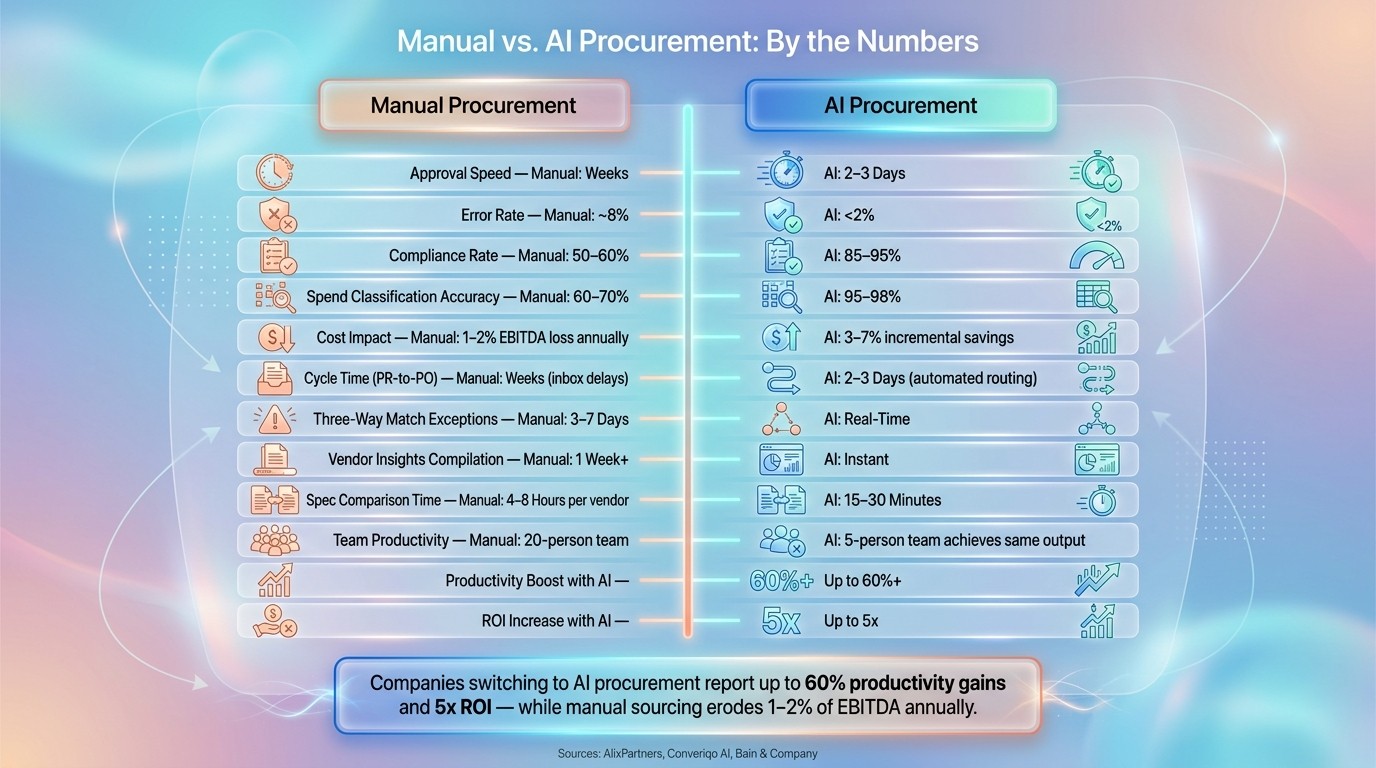
Manual vs. AI Procurement: Key Stats & Performance Comparison
Manual Procurement: How It Works, Where It Helps, and Where It Falls Short
Common Manual Procurement Workflows
Manual procurement typically follows a procurement lifecycle. First, an employee submits a request form and emails it to the procurement team. The finance department then cross-checks the request against a spreadsheet-based budget. Approvals are circulated through email. Once approved, the buyer manages RFQs and RFPs using shared folders and spreadsheets, eventually creating and issuing a purchase order manually.
Next, the receiving clerk logs delivery data from physical slips, while the accounts payable team painstakingly performs a three-way match of the purchase order (PO), goods received note (GRN), and invoice in Excel. Payments are processed in batches, and compliance is monitored through periodic audits, often on a quarterly basis. Every step relies heavily on individual follow-ups to ensure progress.
For small teams with simple procurement needs, this approach can still work without major issues.
Where Manual Procurement Works
Manual procurement can excel in low-volume, uncomplicated scenarios. For small teams managing straightforward purchases, it’s a practical option. There’s no need for new software, no complex data migration, and no learning curve. Teams rely on familiar tools like email and spreadsheets, keeping upfront costs practically nonexistent.
Another advantage is flexibility. When a purchase falls outside standard processes or requires unique negotiation, a human buyer can adapt in real time. As noted in industry analysis:
"Manual procurement survives longest in small teams with low complexity." - Converiqo AI
Tasks with clear rules and predictable parameters - such as fixed-price orders with stable vendor relationships - are where manual workflows perform best.
The Drawbacks of Manual Procurement
Despite its simplicity, manual procurement often creates bottlenecks. Missing details in requisitions, overlooked preferred vendors, or delayed approvals due to someone being unavailable are common issues. These small inefficiencies can build up over time, creating significant friction.
The numbers tell the story. A typical manual procurement cycle takes 21 days on average, with an error rate of about 8%. Comparing vendor specifications, which involves pulling data into spreadsheets for side-by-side reviews, can take 4 to 8 hours per vendor. And as procurement workloads are expected to grow by 10% in 2025 while budgets increase by only 1%, these inefficiencies will only become more pronounced.
Here’s a breakdown of how manual tasks impact operations:
Task | Manual Effort | Operational Impact |
|---|---|---|
Requisition | Fill out form, send via email | Delayed intake due to missing details |
Budget Check | Finance reviews spreadsheets manually | Approval delays; risk of overspending |
Spec Comparison | Extract data to spreadsheets | 4–8 hours per vendor; high error risk |
Invoice Match | Three-way check in Excel | ~8% error rate; missed early-pay discounts |
Spend Analysis | Manual data cleaning and tagging | Reactive reporting; missed savings |
The biggest challenge is visibility. After a PO is issued, 60% of finance leaders report losing real-time oversight of vendor spending. AI-driven tools solve this by providing real-time monitoring and automated alerts. Additionally, manual classification of spend data achieves only 60–70% accuracy, compared to the 95–98% accuracy offered by AI tools. This lack of precision means decisions are often based on incomplete or misclassified data - without teams even realizing it.
"The cost of manual procurement is not just labor. It also appears as slower buying cycles, missed discounts, avoidable leakage, and compliance risk." - Converiqo AI
AI-Driven Procurement: Features and Advantages
Core Features of AI-Driven Procurement
Traditional procurement processes often rely on spreadsheets and endless follow-ups, but AI changes the game by automating decisions and eliminating manual tasks. Jeff Gerber, CEO of Suplari, sums it up perfectly:
"The biggest value isn't in automating how work flows - it's in automating what decisions get made."
AI tools can classify spend transactions with an impressive accuracy rate of over 95%, thanks to machine learning models. They also keep tabs on vendor compliance in real time, ensuring contract terms are met and flagging unauthorized spending before it impacts budgets. On top of that, these tools predict risks by analyzing supplier financial health and supply chain signals, giving procurement teams a proactive edge.
These capabilities are at the heart of platforms like Procright, which push the boundaries of what procurement teams can accomplish.
Procright: AI-Powered Procurement Platform
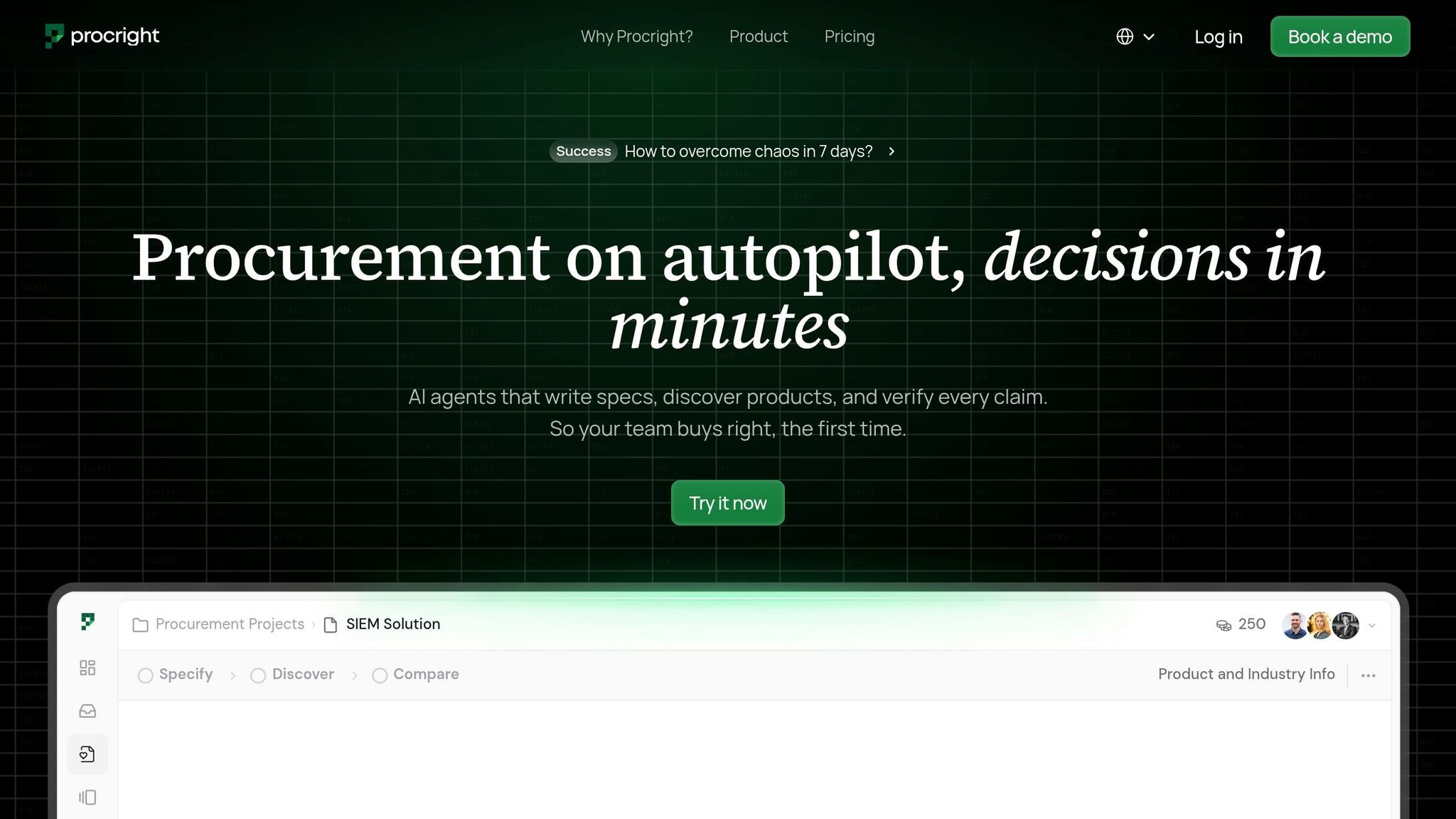
Procright integrates these advanced features into a single platform tailored for procurement teams. One standout feature is its specification automation, which extracts data from vendor datasheets, standardizes terminology and measurements, and creates comparison matrices. What used to take 4–8 hours can now be done in just 15–30 minutes.
Procright doesn't stop there. It automates compliance verification by scoring and ranking products against specific requirements, using clear, data-driven insights instead of gut feelings. Its real-time product discovery tool scans the web, PDFs, and videos to find relevant vendors from around the world, slashing research time from days to mere hours. The platform also facilitates team collaboration with industry-specific templates, eliminating the need for endless email chains and keeping everyone on the same page.
With these tools, Procright not only simplifies individual tasks but also elevates the overall efficiency of procurement operations.
How AI Speeds Up and Improves Procurement
AI adoption has a dramatic impact on procurement efficiency. It can cut procurement cycles in half and reduce overall costs by 15–30%. For context, a small team of five leveraging AI automation can accomplish more than a manual team of twenty still relying on spreadsheets.
This shift redefines the role of procurement professionals. Priya Sharma, Procurement Technology Lead at SpecLens, explains:
"AI augments procurement professionals - it automates data entry so teams can focus on negotiation, supplier strategy, and risk."
Manual vs. AI Procurement: A Direct Comparison
Efficiency and Cycle Time
AI-powered procurement systems are a game-changer when it comes to speed. Tasks that might take weeks in a manual setup - like handling purchase requisitions delayed by email or approval bottlenecks - can be completed in just 2–3 days thanks to automated routing. Handling three-way match exceptions (comparing purchase orders, receipts, and invoices) is another example: what takes 3–7 days manually happens almost instantly with AI. Similarly, generating vendor performance insights, which used to require over a week of manual data gathering, now takes just minutes.
Task | Manual Process | AI-Driven Process |
|---|---|---|
PR-to-PO Cycle Time | Weeks (inbox delays) | 2–3 days (automated routing) |
Three-Way Match Exceptions | 3–7 days | Real-time |
Invoice Error Identification | 3–5 days | Real-time |
Vendor Insights Compilation | 1 week+ | Instant |
Category Strategy Development | Days to weeks | Up to 90% faster |
This speed boost doesn’t just save time - it also improves accuracy and compliance, as outlined below.
Accuracy and Compliance
Manual data entry is error-prone, and the consequences are costly. A large percentage of invoices in manual systems require human intervention, with 57% of finance professionals citing payment delays caused by manual bottlenecks. Compliance, meanwhile, often hinges on employees remembering to follow offline policies, a process that’s far from reliable.
AI eliminates these risks by embedding compliance checks directly into workflows. It enforces budget rules, preferred supplier lists, and exception paths automatically. This shift results in compliance rates rising from 50–60% in manual systems to 85–95% with AI-driven processes. Tools like Procright go even further, using compliance scoring to rank products against specific requirements, replacing guesswork with clear, data-backed decisions.
By reducing errors and ensuring consistent compliance, AI prepares procurement operations to handle growth with ease.
Scalability and Data Handling
Manual procurement systems struggle as operations expand. When supplier numbers grow or spend categories multiply, spreadsheets and email chains quickly become unmanageable. 60% of procurement leaders report lacking real-time visibility into vendor spending with manual systems, and 40% admit they don’t have the data to properly manage supplier risks.
AI, on the other hand, scales effortlessly. It continuously monitors supplier health, flags anomalies, and consolidates data across all vendors. These are tasks that manual teams simply can’t handle at scale. In fact, a 5-person team using AI tools can outperform a 20-person team relying on manual processes. The difference isn’t about individual capability - it’s about the system handling the heavy data work automatically.
Cost and ROI
The hidden costs of manual procurement can quickly add up.
"Manual sourcing can erode 1–2% of EBITDA annually while competitors compound gains." - AlixPartners
Switching to AI-driven procurement delivers measurable returns. Companies see incremental savings of 3–7%, productivity boosts of 60% or more, and ROI increases of up to 5 times. Even automating the three-way matching process can cut manual processing by 70–80%, directly reducing labor costs tied to exception handling.
These financial gains, paired with improved workflows, also elevate the overall user experience.
User Experience and Change Management
AI doesn’t just streamline processes - it also makes them more user-friendly. Manual systems often rely on individual expertise, meaning processes vary from person to person. When experienced employees leave, their knowledge goes with them, approvals get misplaced, and new hires face steep learning curves.
AI platforms standardize everything. Tools like Procright offer industry-specific templates and guided workflows, ensuring every team member follows the same process, regardless of experience. Collaboration happens within the platform, and decisions are based on consistent, reliable data - not individual judgment. This uniformity simplifies onboarding and makes audits far less stressful.
#5 AI Creates Complex Event 6X Faster than Manual Execution
Moving From Manual to AI Procurement
Shifting from manual procurement to AI-driven systems can feel like a big leap, but understanding your team's readiness and planning carefully can make all the difference.
How to Assess Your Readiness for AI Procurement
Before diving into AI tools, take a close look at your procurement data, workflows, technology, and team capabilities. A telling statistic: 74% of procurement leaders admit their data isn’t AI-ready. That means most organizations need to address a few basics before adopting AI.
Here are four key areas to evaluate:
Readiness Pillar | Key Assessment Question |
|---|---|
Data Quality | Is our procurement data accurate and structured? |
Process Documentation | Are our workflows documented? |
Tech Stack | Do our current systems support seamless API integration? |
People | Does the team trust AI outputs and know how to question them? |
You don’t need perfection to get started. Focus on structuring your data and documenting processes enough to move forward. Bain & Company warns, "Automating broken processes simply scales inefficiency. Without governance, standardized workflows, and defined ownership, AI outputs still require manual workarounds." By addressing these foundational elements, you’ll set the stage for a smoother transition.
A Step-by-Step Adoption Roadmap
Jumping into AI without a clear plan can backfire - 95% of AI procurement pilots fail when rushed. A phased approach works best, such as a 90-day sprint model that focuses on small, manageable steps.
Phase | Timeline | Key Actions | Procright Integration Point |
|---|---|---|---|
Baseline & Quick Wins | Days 0–30 | Clean supplier data; consolidate 18 months of spend; identify tail spend. | Use Procright to ingest and normalize legacy ERP/AP data. |
Automate & Standardize | Days 31–60 | Implement guided buying; pilot AI contract analytics; switch on automated 3-way matching. | Deploy Procright's orchestration layer to route requests to preferred vendors. |
Scale Intelligence | Days 61–90 | Expand risk monitoring with external feeds; integrate demand signals; publish executive dashboards. | Activate Procright's autonomous agents for predictive risk and savings tracking. |
Success stories show what’s possible with AI procurement. For example, Bristol-Myers Squibb slashed RFP turnaround times from 27 days to just 3 - a 90% reduction - while Pentair achieved 22% savings in their first year after rolling out an AI sourcing platform across indirect procurement categories in only two months.
Start with spend visibility and analytics to pinpoint areas with the most potential for automation. From there, scale up strategically. As Jeff Gerber, CEO of Suplari, explains:
"The biggest value isn't in automating how work flows - it's in automating what decisions get made."
Conclusion: Manual vs. AI Procurement
The difference between manual and AI-driven procurement goes far beyond speed - it transforms how teams operate. Manual methods trap procurement teams in a cycle of chasing approvals, fixing invoice mistakes, and relying on outdated data. AI flips the script, enabling procurement teams to monitor supplier risks, uncover savings consistently, and scale operations without increasing staff.
Sticking to manual sourcing can cost companies around 1% to 2% of EBITDA annually, while those embracing AI-driven procurement report productivity boosts of 60% or more and ROI increases of up to five times. As Christopher Sawchuk, Principal and Global Procurement Advisory Practice Leader at The Hackett Group, explains:
"The real opportunity lies in scaling AI-driven transformation across sourcing, contract management, and supplier collaboration."
Procright integrates AI into every step of the procurement process, from automating specification creation to real-time compliance checks and product comparisons. This approach allows your team to focus on strategic decisions rather than getting bogged down in routine tasks. By embedding AI directly into workflows, Procright provides a single, dependable source of truth from intake to award. The result? Greater efficiency, cost savings, and a foundation for long-term growth.
At its core, manual procurement belongs to a bygone era. As procurement workloads expand and spend categories grow more complex, AI-driven solutions equip teams to tackle these challenges directly. Organizations that adopt AI now will see their benefits multiply over time, while those clinging to manual processes will continue to bear the hidden costs of inefficiency.
FAQs
When is manual procurement still a good fit?
Manual procurement works best when tasks require human judgment, expertise, and adaptability. This approach is particularly useful for handling unstructured data or making nuanced decisions. Common examples include reviewing contracts, managing low transaction volumes, or addressing highly customized procurement needs. It’s also the go-to choice in situations involving incomplete or poorly structured data. In high-stakes or heavily regulated industries, manual processes help ensure accuracy and compliance where automation might not meet the mark.
What data is needed before adopting AI procurement?
To successfully implement AI in procurement, organizations must ensure their procurement data is well-organized, accurate, and dependable. This means using standardized formats for critical data areas such as solicitations, vendor details, and other essential information. Consistency in these areas lays the groundwork for smooth and efficient integration.
How fast can we see ROI after switching to AI procurement?
Organizations frequently experience a return on investment (ROI) from AI procurement in just a few months. Many report tangible benefits such as quicker workflows and reduced costs within 6 to 12 months of implementation. However, outcomes can differ depending on how extensively and effectively AI tools are integrated into current processes.