Manual vs. AI Specification Data Extraction
Compare manual and AI methods for extracting technical specs—speed, accuracy, scalability, and hybrid approaches.
Extracting data from technical documents is a critical part of procurement. But should you rely on manual methods or AI for the job? Here's the key takeaway:
Manual extraction works well for small, nuanced tasks but is slow and prone to errors (1%-4%).
AI extraction is faster (under 30 seconds per document), more accurate (99%), and better for large-scale projects.
Quick Overview:
Manual Pros: Better for judgment-heavy tasks and one-off projects.
AI Pros: Handles high volumes, normalizes data, and flags inconsistencies automatically.
Challenges: Manual is time-intensive; AI struggles with poor-quality scans and requires clean data.
Quick Comparison:
Criteria | Manual | AI-Driven |
|---|---|---|
Accuracy | 96%-99% (with errors) | Up to 99% |
Speed | 30-90 mins/doc | Under 30 seconds/doc |
Scalability | Limited | High |
Cost | Labor-intensive | Cost-efficient for volume |
Audit/Compliance | Time-consuming | Automated and traceable |
For large-scale procurement, AI outperforms manual methods, saving time, reducing errors, and improving efficiency. However, a hybrid approach - AI for speed and humans for complex reviews - can offer the best results. This is particularly effective when you need to compare products for compliance across multiple technical data sheets.
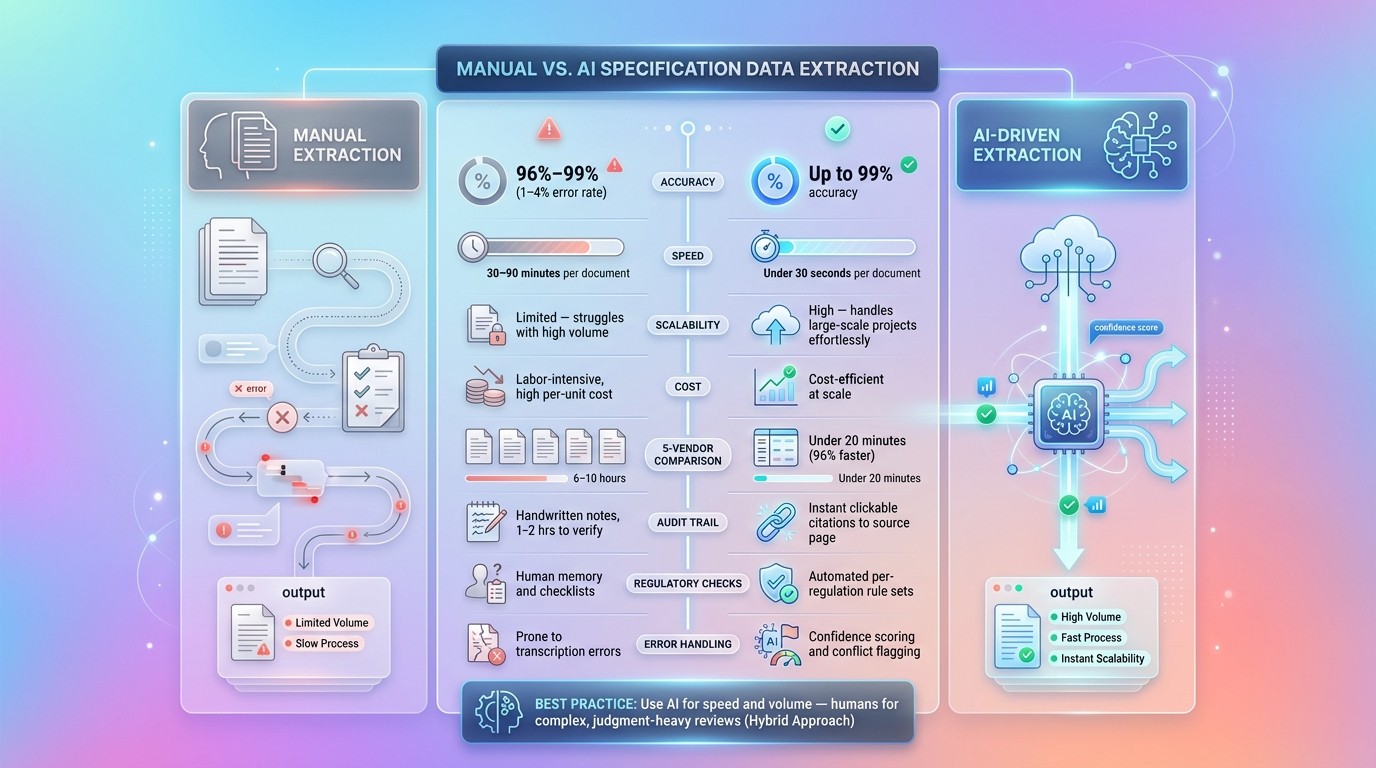
Manual vs. AI Specification Data Extraction: Key Metrics Compared
Manual Specification Data Extraction
How Manual Extraction Works
Manual extraction starts with a technician identifying the necessary specifications - things like operating pressure, temperature range, or required certifications. They then comb through documents such as PDFs, brochures, and web pages, carefully entering the data into a spreadsheet or a Product Information Management (PIM) system. On average, this process takes between 30 and 90 minutes per document.
But it doesn’t stop there. The process also requires interpreting technical abbreviations and converting units (e.g., PSI to bar, inches to millimeters, or HP to kW). Missing data points are flagged, and extracted values are validated against requirements, often using color codes - green for meeting the criteria, red for falling short. This method allows technicians to identify and compare hundreds of vendors with precision or use AI procurement software to accelerate the process. These steps showcase why manual extraction, despite its time-consuming nature, is often praised for its attention to detail.
Where Manual Extraction Works Well
Manual extraction shines in scenarios where nuanced judgment is essential. For instance, when a spec sheet uses vague or overly promotional language, a skilled technician can sift through the noise to extract meaningful technical details. Similarly, when key specifications are buried in appendices or footnotes, a human reviewer is more likely to catch them.
This approach is also ideal for smaller, one-off projects. Setting up an automated pipeline for such cases may not be worth the effort. Additionally, when vendors present their offerings in vastly different ways - like one selling a complete system and another offering individual components - a technician can manually break down the information to create a fair, side-by-side comparison. However, this method’s strengths in depth and flexibility come at the cost of speed and scalability, especially when compared to the best AI procurement tools.
Limitations and Risks of Manual Methods
Manually comparing 10 vendors across 50 specifications can take anywhere from 15 to 25 hours. This delay can slow down critical decision-making processes. Beyond the time factor, manual transcription introduces a 1%–4% error rate, with issues like transposed decimals, misread units, or missed symbols (e.g., ±, Ω, ≤). In high-stakes fields like engineering or compliance, even the smallest mistake can have severe consequences.
"A compliance matrix where every symbol is wrong isn't just useless - it's dangerous." - SpecMake
There are also subtler risks. For example, a technician might overlook a footnote clarifying a headline figure, such as "rated at 50% load under ideal conditions." Alternatively, they might assume that a missing specification indicates a failure to meet requirements, when in reality, the vendor simply left it out of the summary sheet. These oversights can lead to poor vendor choices and expensive compliance errors.
AI Specification Data Extraction
How AI Extraction Works
AI extraction combines three main technologies to transform unstructured documents into structured data. First, Optical Character Recognition (OCR) converts scanned pages into text that machines can read. Then, Natural Language Processing (NLP) steps in to interpret the meaning and context of that text. Finally, Large Language Models (LLMs) use domain-specific knowledge to accurately interpret technical terms like "DFT" (dry film thickness) and differentiate between test-standard values.
Extracting tables from PDFs is particularly tricky. Many of these tables are not true table elements but text fragments positioned using X/Y coordinates. Advanced systems rely on position-aware extraction to match values like "±0.5 μm" with their corresponding properties. These pipelines also detect symbols from PDF operators, ensuring accurate handling of characters like ±, Ω, and ≤. This precision is critical for procurement teams, as it ensures every technical detail is captured correctly.
This streamlined extraction process delivers unmatched speed and reliability.
Strengths of AI-Driven Extraction
AI extraction stands out for its speed and consistency. For example, comparing data from five suppliers - which might take around 8 hours manually - can be completed in under 20 minutes with AI, cutting the time by 96%. This efficiency allows procurement teams to evaluate more vendors and focus on strategic tasks. On the accuracy front, AI systems achieve an impressive 99% accuracy rate for structured specifications, far outperforming the 1%–4% error rate seen with manual data entry.
Another advantage is automatic unit normalization, which ensures consistent comparisons across data sets. Modern platforms also provide confidence scores and page-level citations for each extracted data point, making it easy to verify information.
Solutions like Procright take these benefits even further by combining AI extraction with compliance checks and product scoring. This means teams don't just get structured data - they also gain actionable insights to make data-driven procurement decisions.
Limitations and Requirements of AI Extraction
Despite its strengths, AI extraction does face some hurdles. Poor-quality scans remain a major challenge. OCR systems can misread similar characters, leading to errors. Additionally, generic AI models may lack the specialized knowledge needed to interpret certain test standards, emphasizing the need for models trained on technical procurement data.
Another issue is the risk of "hallucination", where models generate plausible but incorrect data. To counter this, techniques like Retrieval-Augmented Generation (RAG) restrict outputs to verified facts from the source documents and enforce strict source citations.
Effective AI extraction also requires a solid digital infrastructure. Systems must handle multiple file formats - like PDFs, Word documents, Excel spreadsheets, and HTML - while ensuring data security through measures such as AES-256 encryption. They should also export structured outputs (e.g., JSON or CSV) that integrate seamlessly with tools like PIM, ERP, or PLM systems.
Finally, organizations must address data readiness. Many procurement teams struggle with siloed data, inconsistent taxonomies, or duplicate supplier records. In fact, 74% of procurement leaders report that their data is not yet suitable for AI applications. A data cleanup phase may be necessary to unlock AI's full potential.
Manual vs. AI: A Side-by-Side Comparison
Building on earlier insights, comparing key metrics reveals the strengths of each approach.
Accuracy and Data Quality
Manual extraction tends to falter when handling multiple documents, while AI maintains consistent performance, avoiding the gradual decline seen with human methods.
AI also excels at normalizing vendor-specific terminology, making data comparisons easier. For instance, it can interpret "IP67" and "waterproof up to 3 feet" as equivalent, reducing the confusion that often slows down manual reviewers.
"GenAI normalizes '10k USD' and '$10,000' automatically. It knows 'IP67' implies water resistance even if the word 'water' isn't on the page." - Priya Sharma, Procurement Technology Lead, SpecLens
Another advantage is how AI handles uncertainty. Instead of guessing, it assigns confidence scores (ranging from 0–100%) to extracted data. This allows procurement teams to focus their efforts on ambiguous data points rather than rechecking every entry.
Speed, Scalability, and Cost
When scaling extraction tasks, speed and cost become critical factors - and the difference between manual and AI methods is striking.
Manually comparing datasheets from five vendors across 30 specifications can take 6–10 hours, whereas AI can complete the same task in just 30–60 minutes. For complex PDF tables, AI extraction takes about 90 seconds, compared to 6 hours of manual work.
Manual entry often consumes up to half of a procurement team’s time. In contrast, AI frees up resources for more strategic activities. Moreover, errors in manually maintained spreadsheets can lead to project budget overruns of 25–40% post-award in construction procurement.
"Manual specification comparison is the single biggest time sink in modern procurement. Teams that spend 6–8 hours per RFP cycle building vendor spreadsheets have no bandwidth left for strategic sourcing." - SD, Senior Director of Strategic Sourcing, Fortune 500 Manufacturing Company
The financial benefits of AI are equally compelling. Automating just 20 comparisons annually can save over $8,000 per team member. Platforms like Procright are designed to reduce the administrative workload, enabling teams to focus on actionable insights rather than data collection.
Compliance and Governance
Manual compliance checks often rely on individual expertise and checklists, making them inconsistent and harder to audit. Reviewers may overlook key regulatory requirements like REACH or RoHS due to the lack of systematic safeguards. AI platforms, on the other hand, automatically run checks for specific regulations and flag conflicts instead of issuing vague warnings.
Audit trails are another area where AI outshines manual methods. Verifying manual comparisons typically takes 1–2 hours for five vendors, requiring extensive reviews of PDFs and handwritten notes. AI simplifies this process by linking every extracted data point to its exact source page and verbatim quote, making verification both instant and fully traceable.
Feature | Manual Method | AI-Driven Method |
|---|---|---|
Verification Speed | 1–2 hours per comparison | Instant / automated |
Audit Trail | Handwritten notes | Clickable citations to source page |
Regulatory Checks | Human memory and checklists | Automated per-regulation rule sets |
Error Handling | Prone to transcription errors | Confidence scoring and conflict flagging |
This level of traceability is crucial as compliance requirements grow more intricate. Preparing product data for structured regulatory formats manually is a daunting task, but AI can automatically score, structure, and streamline the data, minimizing the risk of errors that could surface during audits.
The performance gap between manual and AI-driven methods has a direct impact on procurement efficiency and decision-making, making a strong case for the adoption of AI in data extraction.
Choosing the Right Approach
There’s no one-size-fits-all solution here. The best method depends on your data volume, the consistency you need, and how advanced your procurement processes are. Factors like accuracy, speed, and scalability also play a big role in deciding what works best for your needs.
When Manual Extraction Works Best
Manual extraction shines in certain situations. For low-volume tasks, like reviewing a single vendor’s details, it’s often the simplest and most cost-effective option. For example, if you’re reordering from a familiar vendor and already know the document inside out, manual review can be quick and hassle-free.
But as soon as you’re dealing with multiple documents from different suppliers - each with its own formatting - manual extraction becomes a headache. The error rate for comparing multiple documents manually can reach 30–40%, which can lead to expensive mistakes as the workload grows.
When AI Extraction Is the Smarter Choice
AI extraction is ideal for high-volume tasks. Imagine comparing specifications from 10 vendors across 50 categories. Manually, this could take anywhere from 15 to 25 hours. With AI, the same job can be done in just about 60 minutes. That’s a game-changer for efficiency.
AI is also a lifesaver when you need standardized data. Vendors often use different units or terminology - for instance, horsepower versus kilowatts. Manually normalizing such data is slow and prone to errors. AI takes care of this effortlessly, producing clean, structured outputs (like JSON or Excel files) that integrate seamlessly with tools like PIM or ERP systems. Plus, it provides solid compliance traceability, which is critical for procurement teams.
"The future of specification comparison lies in AI-powered automation. Tools that can read vendor documents, extract specifications, normalize data, and generate comparison matrices will become essential for competitive procurement teams." - Rhea Kapoor, Head of Procurement Research, SpecLens
Platforms such as Procright are built for these scenarios. They automate processes like specification analysis, product comparison, and compliance checks, allowing teams to rely on structured, accurate data instead of manually created spreadsheets.
A Hybrid Approach: AI Extraction with Human Review
For high-stakes decisions, blending AI with human expertise is the most dependable route. This hybrid model leverages AI for tasks like data extraction, normalization, and structuring, while humans step in to review flagged discrepancies - things like low-confidence scores, missing data, unit mismatches, or internal contradictions.
This method keeps human reviewers focused on the tricky 6% of data points, while AI confidently handles the other 94%. For example, if a component’s pressure rating is listed differently on separate pages of a document, AI will flag the inconsistency. A domain expert can then resolve the issue by contacting the manufacturer, ensuring both speed and accuracy.
Conclusion
When comparing manual and AI-driven extraction, the advantages and trade-offs become clear. Manual extraction provides control but demands significant time, while AI offers unmatched speed and scalability with dependable and verifiable results. For smaller tasks, manual methods might suffice. However, for complex, multi-vendor comparisons, AI is the clear winner. For instance, a 5-vendor comparison that would require 8 hours manually can be completed in under 20 minutes using AI tools. Plus, AI extraction achieves an impressive 99% accuracy rate, linking each data point to its source for instant verification.
"Manual specification comparison is the single biggest time sink in modern procurement. Teams that spend 6–8 hours per RFP cycle building vendor spreadsheets have no bandwidth left for strategic sourcing." - Senior Director of Strategic Sourcing, Fortune 500 Manufacturing Company
For procurement teams grappling with increasing data volumes, strict compliance demands, or the need for multi-vendor comparisons, AI is more than a time-saver - it enables teams to focus on strategic decisions that require human expertise. Tools like Procright streamline specification analysis, product comparisons, and compliance checks, allowing teams to work with structured, ready-to-use data instead of labor-intensive spreadsheets.
A balanced approach - leveraging AI for efficiency and human judgment for critical decisions - represents the most effective way forward for modern procurement workflows.
FAQs
When should I choose manual extraction instead of AI?
Manual extraction works best when dealing with a small number of straightforward, well-structured documents you're already familiar with. It's particularly effective if you know precisely where the needed data is located, making the process faster. This method also shines when handling highly irregular documents or those with complex layouts - like nested tables or multi-row headers - where AI might have difficulty interpreting subtle details accurately.
How do AI tools avoid making up missing spec values?
AI tools play a crucial role in maintaining accuracy by carefully examining extracted data. They flag inconsistencies, identify gaps, and detect mismatches when compared to the original source documents. This thorough auditing process ensures that the information used is both reliable and verified, reducing the risk of including unsupported or incorrect specifications.
What do I need to prepare before using AI extraction at scale?
Before expanding AI extraction efforts, it's crucial to start with a well-defined specification list. This should include essential data points such as dimensions, performance metrics, and compliance requirements. To ensure accuracy, rely on high-quality, structured documents like PDFs or DOCX files. Make sure the documents are clear and easy to read, as this directly impacts processing accuracy.
During the initial phase, establish a review process to carefully evaluate AI outputs. This helps catch errors early and fine-tune the system. Additionally, invest time in educating your team about what AI can and cannot do. Understanding its capabilities and limitations will go a long way in achieving better results.