How AI Helps Build ESG-Ready Supply Chains
AI embeds ESG into procurement by automating supplier data, real-time risk scoring, and audit-ready reporting for compliant supply chains.
In this article
AI is transforming supply chains by enabling real-time ESG compliance and risk monitoring. Traditional methods like manual audits and spreadsheets can't keep up with new regulations like the EU's Carbon Border Adjustment Mechanism (2026) or California's transparency laws. Here's how AI enhances ESG compliance:
Automated Data Collection: AI gathers supplier data from contracts, certifications, and public databases, reducing onboarding time by up to 50%.
Real-Time Monitoring: AI tracks emissions, labor practices, deforestation risks, and certification expirations, flagging issues immediately.
Risk Scoring: AI predicts future risks by analyzing trends and external factors, helping companies avoid disruptions and lower costs.
Balanced Sourcing Decisions: AI integrates ESG metrics with cost and quality, enabling smarter procurement choices.
Audit-Ready Records: AI ensures transparent, defensible ESG reporting for frameworks like CSRD and GRI.
ESG-Ready Supply Chains and Where AI Fits In
What Makes a Supply Chain ESG-Compliant?
To achieve ESG compliance, companies must weave environmental, social, and governance criteria into every layer of procurement - from selecting suppliers to reviewing their ongoing performance. This approach not only aligns with new regulatory demands but also builds trust with investors and consumers.
The environmental pillar focuses on areas like Scope 1, 2, and 3 emissions, energy and water usage, waste management, and ensuring sourcing practices avoid deforestation. The social pillar emphasizes fair wages, reasonable working hours, addressing modern slavery risks, and promoting workforce diversity. Lastly, governance includes anti-corruption measures, data privacy certifications, and strong oversight at the board level.
Governance often acts as an early warning system for deeper issues:
"Governance weaknesses are a leading indicator of broader problems. Suppliers with poor governance structures are more likely to have environmental and social issues as well." - OneStop ESG
To truly influence procurement, ESG assessments must be embedded into the entire process - spanning supplier onboarding, tender evaluations, contracts, and performance reviews. Keeping these assessments siloed in sustainability teams limits their impact:
"If ESG assessment operates separately from procurement, it won't influence sourcing decisions. It needs to be part of supplier onboarding, tender evaluations, contracts, and performance reviews." - OneStop ESG
This integrated approach creates the foundation for AI to step in, providing real-time insights and enhancing ESG compliance at every stage.
AI Use Cases: From Risk Screening to Compliance Tracking
Traditional ESG compliance methods, such as self-assessments and audits, often fall short - they're costly, time-consuming, and prone to inaccuracies. AI transforms this process by enabling continuous, real-time monitoring instead of periodic reviews.
Here’s how AI tackles key ESG challenges in the supply chain:
ESG Challenge | AI Approach | Outcome |
|---|---|---|
Emissions tracking | Automated Scope 3 data collection and live carbon ledgers | Same-day alerts replace delays of 60–90 days |
Ethical labor monitoring | NLP scanning of news feeds, social media, and regulatory filings | Early detection of labor violations in Tier 2 and Tier 3 suppliers |
Deforestation risk | Satellite imagery analysis | Real-time identification of suppliers involved in risky land use |
Certification compliance | Automated document extraction and expiry tracking | Immediate alerts for lapsed certifications |
Multi-tier visibility | Transparency beyond Tier-1 suppliers into deeper supply chain layers |
With AI, procurement teams gain the ability to embed ESG risk mitigation directly into sourcing decisions. Beyond monitoring, AI also supports predictive resilience by modeling risks like geopolitical instability or weather disruptions. This allows teams to proactively shift to lower-risk, lower-carbon sourcing options before problems arise. As Jaggaer explains:
"The market doesn't need another carbon dashboard. It needs carbon embedded in procurement and supply chain execution." - Jaggaer
This seamless integration of ESG and carbon data into procurement workflows is what makes AI-driven compliance a game-changer compared to older, more static approaches.
“ESG Is Not Dead - It’s Evolving”: Future-Proofing Supply Chains | Beyond The Box
Supplier Data Collection and Compliance Verification
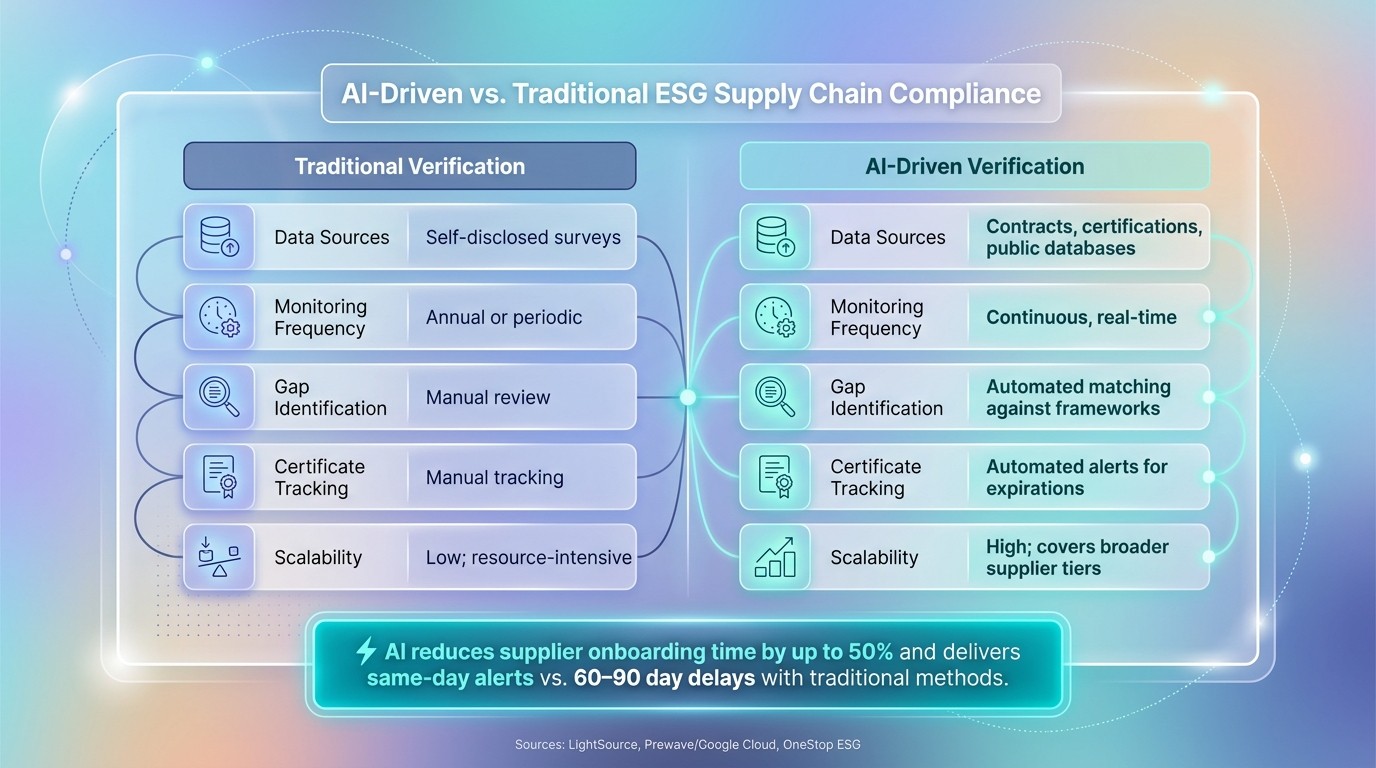
AI vs. Traditional ESG Supply Chain Compliance: Key Differences
Automating Supplier Data Collection
Collecting ESG data manually - using spreadsheets, tracking vendor responses via email, and periodic questionnaires - often leaves room for errors and inefficiencies. In contrast, AI steps in with natural language processing (NLP) and machine learning to automatically pull ESG data from sources like contracts, certifications, and public databases. This approach not only fills gaps but also flags missing information instantly.
By automating these processes, AI has proven to reduce supplier onboarding and qualification times by as much as 50%. This means procurement teams can assess a larger number of suppliers more efficiently, without compromising the accuracy or quality of the data.
AI platforms also create unified supplier profiles by consolidating data from internal systems and third-party sources. These platforms even track document expiration dates, ensuring no critical certifications slip through the cracks. This streamlined data management sets the stage for real-time ESG compliance checks.
Verifying Compliance with ESG Standards
Collecting supplier data is just the first step; verifying that data against ESG standards is where the real challenge lies, especially at scale. AI simplifies this process by comparing supplier information to specific ESG criteria and regulatory frameworks in real time. For example, it can evaluate compliance with regulations like the Corporate Sustainability Reporting Directive (CSRD), the German Supply Chain Due Diligence Act (LkSG), and the EU Batteries Regulation. Any gaps in compliance are flagged immediately.
A compelling example comes from 2024, when the AI platform Prewave used Google Cloud infrastructure to conduct real-time ESG risk analysis throughout deep supply chains. The platform utilized advanced algorithms to detect ESG-related incidents and ensure compliance with international frameworks like the LkSG, eliminating the need for time-consuming manual reviews.
AI also enables continuous monitoring. By constantly scanning news feeds, regulatory updates, and supplier records, AI systems can identify compliance issues as they arise. This shift toward real-time ESG monitoring allows companies to proactively address risks and make better sourcing decisions. As Yuliia Zorina, writing in the Journal of Procurement and Supply Chain Management, noted:
"AI-based ESG monitoring systems significantly enhance transparency, operational resilience, and sustainable procurement practices, ultimately marking a paradigm shift in global supply chain governance." - Yuliia Zorina
The table below highlights how AI-driven verification compares to traditional methods:
Dimension | Traditional Verification | AI-Driven Verification |
|---|---|---|
Data sources | Self-disclosed surveys | Contracts, certifications, public databases |
Monitoring frequency | Annual or periodic | Continuous, real-time |
Gap identification | Manual review | Automated matching against frameworks |
Certificate tracking | Manual tracking | Automated alerts for expirations |
Scalability | Low; resource-intensive | High; covers broader supplier tiers |
Supplier Risk Scoring and Performance Monitoring
Building ESG Risk Scoring Models
Once supplier data is verified, AI steps in to turn that information into actionable risk insights. This process is a cornerstone of using AI to strengthen ESG compliance throughout the supply chain. AI creates dynamic ESG risk scores by pulling in data from a variety of sources, such as logistics feeds, energy usage records, regulatory filings, news sentiment analysis, and even satellite imagery.
What sets these models apart is their ability to predict future risks. By analyzing historical trends and external factors - like geopolitical tensions or extreme weather events - AI can forecast potential disruptions before they happen. This predictive edge isn’t just theoretical; it has been shown to reduce operational costs by as much as 15%.
Transparency plays a crucial role here. Explainable AI (XAI) ensures procurement teams can clearly understand why a supplier received a specific score. This clarity is essential when decisions need to be justified to regulators or internal stakeholders. As LightSource aptly put it:
"The decision gets made in a single meeting because everyone's working from verified data, not competing spreadsheets."
To keep these risk scores accurate and relevant, ongoing data monitoring is a must.
Continuous Monitoring for Policy Violations
After establishing these dynamic risk scores, AI takes things further by continuously monitoring for policy breaches. Unlike traditional methods that might take 60 to 90 days to flag issues, AI provides alerts in real time - often within the same day.
For instance, natural language processing (NLP) engines scan adverse media coverage, regulatory updates, and audit reports from multiple jurisdictions to spot early warning signs of labor or environmental violations. If a supplier's financial standing weakens or a certification expires, the system immediately notifies the relevant teams. The guiding principle here is simple yet powerful:
"Early detection only matters if it leads to action." - JAGGAER
Sourcing Decisions That Balance Cost and ESG Goals
Prioritizing ESG-Friendly Suppliers
After completing risk assessments and compliance checks, procurement teams are now turning to AI for deeper supplier insights. When AI flags a policy violation or highlights a shift in risk scores, it presents procurement teams with a clear choice: take action or dismiss the warning. What makes this process more manageable is AI’s ability to consolidate supplier data - spanning cost, quality, delivery, and ESG factors - into one streamlined view.
Supplier selection plays a critical role in shaping a company's overall carbon footprint. With this in mind, AI-driven platforms now allow suppliers to include emissions data as part of their bids, making carbon intensity an active factor in tender evaluations. This ensures sustainability is considered right from the start.
"AI can serve as a bridge - enabling procurement officials to access, interpret, and apply large volumes of sustainability information throughout the entire procurement lifecycle." - Marta Andhov, Nicole Darnall, and Alexandra Andhov, Frontiers in Sustainability
By defining ESG profiles for suppliers upfront, procurement teams can weigh sustainability metrics alongside financial considerations by comparing products for compliance in their decision-making process.
Balancing Cost and ESG Compliance
As the EU's Carbon Border Adjustment Mechanism (CBAM) fully rolls out in 2026, the carbon embedded in materials like steel and aluminum will shift from being a reporting metric to a direct cost. AI helps procurement teams prepare for this by incorporating carbon costs into Total Cost of Ownership (TCO) calculations. This ensures that a supplier with lower upfront costs doesn’t turn into a costly mistake when regulatory penalties come into play.
"When you combine risk, cost, and carbon data in one view, procurement stops being just cost control and starts driving enterprise value." - LightSource
AI’s predictive capabilities have also proven to be a game-changer for supply chain monitoring. Companies using these tools have reported operational cost reductions of up to 15%, thanks to fewer disruptions, better compliance, and avoiding last-minute supplier changes.
Governance, Auditability, and ESG Reporting
Ensuring Transparent AI Scoring and Decisions
Real-time monitoring and scoring are just the starting points. Effective governance ensures that every decision made by AI systems is both clear and defensible. Hitting ESG goals is only part of the equation - teams also need to justify those decisions to auditors, regulators, and board members with auditable KPIs.
This is where Explainable AI (XAI) becomes a game-changer. Instead of generating a score without context, XAI-powered procurement systems provide detailed insights into the data points behind each rating. This transparency allows procurement teams to trace the logic behind decisions and confidently defend them when questioned.
The move from manual, static compliance checks to AI-driven scoring eliminates inconsistencies in governance. Transparent scoring mechanisms pave the way for stronger ESG disclosures and ensure organizations are ready for audits.
Supporting ESG Disclosures and Audit Readiness
When preparing sustainability disclosures - whether for the Global Reporting Initiative (GRI), the Corporate Sustainability Reporting Directive (CSRD), or standards like ISO 20400 - AI significantly reduces manual work. Throughout the procurement lifecycle, AI continuously builds a structured record of supplier performance, compliance issues, and sourcing decisions, making it easier for teams to report accurately.
By aggregating data continuously, AI not only enhances risk detection but also simplifies compliance reporting.
Traditional Procurement | AI-Enabled ESG Procurement | Audit Benefit |
|---|---|---|
Manual data collection | Automated data aggregation | Improved data accuracy and audit trail |
Subjective supplier evaluation | Consistent ESG criteria weighting | Reduced bias and better auditability |
Reactive compliance checks | Proactive risk architecture | Real-time management of ESG violations |
Fragmented reporting | Automated sustainability disclosures | Easier audit readiness for CSRD/LkSG |
The effectiveness of AI governance depends heavily on its design and oversight. As highlighted by researchers at Frontiers in Sustainability, the "black box" nature of many AI systems can complicate transparency and accountability in public sector applications. To counter this, organizations must adopt strict ethical governance frameworks, ensuring human oversight and regular audits of AI outputs.
"The main practical implication is the imperative for organizations to shift from reactive compliance to a proactive risk architecture, mandating the use of AI tools under strict ethical governance." - Yuliia Zorina, Global Sourcing, Global Leading Media Corporation
When implemented correctly, AI doesn't just speed up ESG reporting - it makes procurement processes more defensible, traceable, and reliable.
How Procright Supports ESG-Ready Procurement

Procright takes the idea of AI-driven governance and applies it practically to procurement processes. It's an AI-powered platform that integrates governance frameworks and transparent scoring directly into daily procurement tools. This bridges the gap between general ESG (Environmental, Social, and Governance) commitments and the specific actions required to meet them.
Procright's Key Features for ESG Compliance
Procright simplifies ESG-focused procurement by automating several key steps:
It creates detailed, category-specific ESG criteria, such as emissions standards for logistics suppliers or labor compliance requirements in regions with higher sourcing risks.
The platform identifies sustainable products and verifies compliance with these criteria.
It generates automated compliance score breakdowns, pulling data from sources like web content, PDFs, and documentation. This level of clarity not only makes audit processes easier but also helps teams make informed decisions more efficiently.
How Procright Simplifies ESG Procurement Workflows
Procright combines ESG performance with other critical factors like price, quality, and service, all within a single, streamlined procurement workflow. Teams can compare products side by side using clear, transparent data, giving them the ability to prioritize suppliers that align with ESG goals. Every decision is recorded in an audit-ready format for future reference.
The platform also supports real-time collaboration and offers templates tailored to specific industries, making it adaptable for teams of various sizes. By weaving ESG criteria into every step of the procurement process, Procright ensures that sustainability and cost considerations work hand-in-hand. This aligns perfectly with the earlier discussion on balancing strategic goals with operational efficiency.
Conclusion: Using AI to Build ESG-Ready Supply Chains
On average, supply chain emissions are 11.4 times higher than a company's direct operational emissions. However, companies leveraging AI-powered predictive models have managed to reduce operational costs by up to 15%. These figures highlight AI's ability to reshape procurement while making ESG compliance a strategic advantage.
"Procurement and supply chain don't support the decarbonization strategy. For most manufacturers, they are the decarbonization strategy." - JAGGAER
The real strength of AI lies in its speed and seamless functionality. Traditional ESG monitoring often involves delays of 60–90 days, but AI can provide same-day alerts for issues like expired certifications or sudden emissions increases. This shift from a reactive to a proactive approach transforms ESG compliance into a competitive edge.
FAQs
What data do I need to start AI-based ESG monitoring?
To kick off AI-powered ESG monitoring, start by gathering data on key areas like supplier performance, risk indicators, compliance status, and sustainability metrics. You can collect this information using automated workflows, surveys, and established frameworks such as GRI, SASB, or CSRD. Prioritize accuracy and thoroughness in your data collection to ensure dependable monitoring and analysis.
How can AI verify ESG claims from suppliers beyond Tier 1?
AI helps ensure ESG claims are accurate beyond just Tier 1 suppliers by leveraging real-time data monitoring, predictive analytics, and automated compliance checks throughout the supply chain. It processes information from various sources, such as logistics data, supplier reports, and even news sentiment, to identify potential risks - like unexpected emissions increases or outdated certifications. By standardizing supplier data and automating the validation process, AI provides continuous risk assessment, making it possible to verify ESG claims across every level of the supply chain.
How do I make AI ESG risk scores audit-ready and explainable?
To ensure AI-generated ESG (Environmental, Social, and Governance) risk scores are ready for audits and easy to explain, organizations should incorporate Explainable AI (XAI) techniques. These approaches boost both transparency and traceability. Here’s how to get started:
Document the decision-making process: Keep a clear and detailed record of how the AI system arrives at its risk scores. This ensures that every step can be reviewed and understood during an audit.
Align outputs with regulatory standards: Make sure the AI’s results meet the latest ESG-related rules and guidelines. This alignment is critical for compliance.
Regularly update the framework: ESG requirements evolve over time, so it’s important to revisit and adjust your AI system periodically to keep up with these changes.
By following these practices, organizations can confidently justify their ESG risk scores during audits and maintain compliance, especially in areas like supply chain management.
Related Blog Posts
Try it on a real buy
Bring one category. Watch where the flags land.
We use a little analytics to see which pages actually help. Nothing else, no ad trackers.