AI in Procurement: Predictive Cost Modeling Explained
AI-based estimates of total cost before sourcing, improving budgets, negotiations, and risk control when specs and data are clean.
In this article
If you only look at the supplier’s quoted price, you’re probably missing the bigger cost picture. I’d sum it up like this: predictive cost modeling uses AI to estimate total cost before sourcing, so you can budget better, question supplier quotes, and spot cost risk earlier.
Here’s the core idea in plain English:
Price is not total cost. Materials, labor, freight, duties, delays, quality issues, and off-contract buying all affect what you end up paying.
The model depends on data quality. Clean PO history, contract terms, specs, supplier data, and live market inputs like commodity prices and FX rates matter.
Should-cost models help with negotiations. They give me a baseline to compare quotes and set a price range before an RFQ goes out.
AI can also flag pricing that looks off. That helps catch unusual POs and weak quotes before they turn into spend problems.
Governance matters. If the model is not updated and traced back to source data, teams won’t trust the output.
Maverick spend is one cost leak to watch. It often makes up about 1.8% of annual purchase value. On $1 billion in annual spend, that’s about $18 million in lost savings.
A few takeaways stand out to me:
Better forecasts start with automated product specifications
Total cost matters more than unit price
AI helps most when used before RFQ and award
Results should be tracked with KPIs like forecast accuracy, savings, cycle time, and supplier price variance
One useful comparison here is manual estimation versus AI-led cost modeling:
Approach | Main Limitation | What It Improves |
|---|---|---|
Manual estimation | Static inputs, weak consistency, hard-to-prove decisions | Works for simple cases, but can miss cost drivers |
AI-driven cost modeling | Needs clean data and review rules | Better cost visibility, tighter budgeting, and stronger quote checks |
So if I had to put the article into one sentence, it would be this: predictive cost modeling helps procurement teams make better sourcing decisions by estimating total cost early, but it only works when the inputs, specs, and review process are clean.
AI-enabled Should Cost Analysis
The Data and Models Behind Predictive Cost Estimates
AI cost models pull from two main buckets of data: internal procurement records and external market signals.
What Data AI Cost Models Need
Inside the company, that usually means clean purchase order (PO) history, contract terms, supplier master data, and detailed item specifications. Outside the company, models need current commodity prices, foreign exchange (FX) rates, freight rates, and tariffs so estimates move with the market.
More advanced models can also take in unstructured data, like product manuals and web pages, to check technical compliance and spot hidden cost drivers. Supplier intelligence matters too. Financial health, reliability, and support reach help procurement teams look past the quoted price and judge total cost of ownership.
There’s also a very practical problem here: unit consistency. In global sourcing, suppliers send data in different units and formats. If that data isn’t normalized, the estimate can drift off course fast.
Data Input Category | Specific Examples | Purpose in AI Modeling |
|---|---|---|
Internal Records | PO history, contract terms, item specs | Establishes baseline and historical benchmarks |
External Drivers | Commodity prices, FX rates, freight rates, tariffs | Adjusts estimates based on market volatility |
Supplier Metrics | Financial health, reliability, support reach | Evaluates long-term viability and support risk |
Unstructured Content | Product manuals, web pages | Verifies technical compliance and reveals hidden cost drivers |
Taken together, these inputs help procurement estimate more than just the quoted price. They also help teams gauge landed cost and supplier risk.
Cost Breakdown and Should-Cost Logic
Once the inputs are normalized, the model can break cost into the main drivers: raw materials, machine time, labor hours, packaging, energy, and transportation.
Should-cost logic gives teams a shared baseline when suppliers build quotes from different assumptions. That matters a lot. Without a common baseline, quote comparisons can turn into apples-to-oranges debates. With it, procurement has a number it can use to challenge quotes and compare suppliers on equal terms.
AI Methods Used in Procurement Cost Modeling
After the inputs are structured, AI can estimate cost in three main ways:
Time-series forecasting follows how external drivers change over time and projects where they may go next
Regression and tree-based models link item specifications to expected cost outcomes
Anomaly detection flags purchase orders where the price looks out of line with past patterns
What makes these methods dependable isn’t the algorithm by itself. It’s the traceability. If a model gives an estimate but can’t show what drove it, procurement ends up with a new headache: no one can defend the number to stakeholders.
The most useful systems show which inputs shaped each estimate. That lets teams trace the result, defend it in discussions, and check whether it holds up. And that’s what makes the forecast usable in sourcing, negotiation, and planning.
Where Predictive Cost Modeling Creates Value
Negotiation, Benchmarking, and Fair-Price Ranges
These forecasts matter most when they change the price a team is ready to accept. The clearest payoff shows up in negotiations: a should-cost baseline gives procurement a defensible price range before supplier talks even start.
Benchmarking products across sectors works the same way. Instead of looking at quotes one by one, AI models help teams compare each supplier’s price against a range built from past spend and current market signals. That range becomes the fair-price window before an RFQ goes out.
Here’s what that looks like in practice:
Use Case | Objective | AI Inputs | Common KPI |
|---|---|---|---|
Should-Cost Negotiation | Establish a baseline for fair pricing based on components | Commodity data, labor rates, logistics costs, historical specs | Price Variance (Actual vs. Should-Cost) |
Technical Benchmarking | Compare products on objective technical compliance | Product manuals, PDF datasheets, user forums | Compliance Score Accuracy |
Fair-Price Range Setting | Define acceptable price windows before RFQs | Historical spend, current market signals | RFQ Cycle Time Reduction |
Risk-Adjusted Budgeting | Improve forecast accuracy by including external risk factors | Supplier financial health, regional instability, fuel costs | Forecast Accuracy (%) |
Budgeting, Demand Forecasting, and Risk Planning
Predictive cost modeling also changes how procurement teams build budgets. When unit cost estimates reflect market direction, supplier reliability, and other live cost inputs, the gap between planned spend and actual spend can get smaller.
That matters because static budgets can fall apart fast. Commodity swings, fuel costs, tariffs, and supplier concentration can all push costs above plan. So the model isn’t just useful for sourcing. It also helps with spend planning and setting risk reserves when the market gets shaky.
Specification Standardization and Compliance Control
Predictive cost modeling depends on clean, consistent specifications. If specs are incomplete or written in different ways, vendors fill in the blanks on their own terms. Then you end up with quotes that don’t match technically, and a cost model working from weak inputs from day one.
Procright automates specification creation, checks vendor claims against those specs, and produces transparent compliance scores. AI-powered specification processes built this way can reduce manual errors by 90%, and that cleaner data supports more reliable cost estimates later in the workflow.
Once the spec data is clean, those estimates can plug straight into sourcing workflows.
How to Implement Predictive Cost Modeling in Procurement
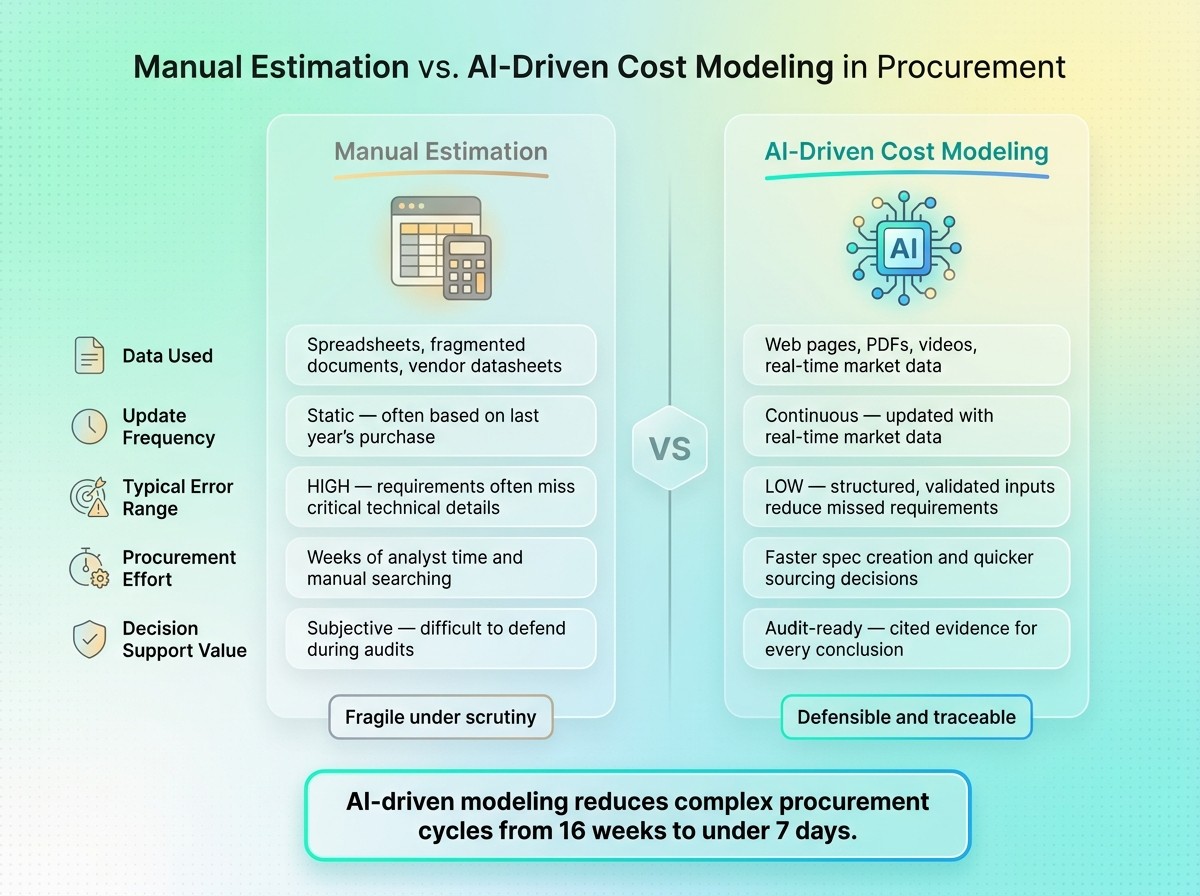
Manual Estimation vs. AI-Driven Cost Modeling in Procurement
Once your specs are clean and your cost drivers are mapped, it’s time to put the model to work.
Start with a Focused Pilot
Begin with one live category and one sourcing event. Keep the scope tight. The goal is simple: see if the model spots gaps your team would have missed.
Before the pilot starts, set a clear business goal and agree on how success will be measured. Good pilot KPIs include:
Cycle time
Forecast accuracy
Savings versus should-cost
Do this early in the process. Use AI to gather subject matter expert input before the RFP goes out. That step can bring hidden requirements to the surface, like load tolerances, compatibility limits, and compliance standards that standard templates often leave out.
Then use what you learn from the pilot to decide exactly where the model should enter the RFQ and review workflow.
Embed Cost Predictions into Sourcing Workflows
A cost model only helps if teams use it before RFQs go out.
Attach a should-cost range to every RFQ. Flag quotes that land outside that range. Set alerts when market shifts move the estimate enough to change the budget picture.
Procright supports this with traceable, item-by-item compliance scores linked to specific source documents, including datasheets, manuals, and product videos. That paper trail helps teams defend decisions during reviews and audits.
Once that workflow is live, the next issue is pretty direct: does decision quality get better, or not?
Manual Estimation vs. AI-Driven Cost Modeling
The difference between spreadsheet-based estimation and AI-driven modeling isn’t just speed. It comes down to input quality, output consistency, and whether the final answer can hold up under scrutiny.
Here’s where the two approaches split in day-to-day procurement:
Manual Estimation | AI-Driven Cost Modeling | |
|---|---|---|
Data Used | Spreadsheets, fragmented documents, and vendor datasheets | Web pages, PDFs, videos, and real-time market data |
Update Frequency | Static; often based on last year's purchase | Continuous; updated with real-time market data |
Typical Error Range | High; requirements often miss critical technical details | Low; structured, validated inputs reduce missed requirements |
Procurement Effort | Weeks of analyst time and manual searching | Faster spec creation and quicker sourcing decisions |
Decision Support Value | Subjective; difficult to defend during audits | Audit-ready; cited evidence for every conclusion |
Manual estimation isn’t wrong. But it is fragile.
It can work fine for a while, then fall apart when one requirement gets missed or a sourcing decision has to be defended in an audit. AI-driven modeling doesn’t remove human judgment. What it does is give that judgment a clear, documented base.
Measuring Results, Managing Risk, and Key Takeaways
KPIs and Governance for Reliable Cost Modeling
Once cost predictions are built into sourcing, you need to track what happens next. If you don't measure the model, you're not managing a system. You're just hoping the numbers are right.
After the model goes live, the job shifts from estimation to proof. The main question is simple: is it helping teams make better sourcing decisions, or is it just producing more numbers? The core KPIs to watch are:
Should-cost accuracy and supplier price variance
Realized savings ($ and %)
Forecast accuracy
Cycle time
Maverick spend
Cycle time is one of the clearest places to look. Complex purchases that used to take 16 weeks can be finished in under 7 days with AI-assisted workflows.
Metrics, though, only help if the model stays current and someone is accountable for it. Here's where the main trade-offs show up:
Benefit | Risk | Mitigation |
|---|---|---|
Reduced Cycle Time | Incomplete specs cause revision cycles | AI-assisted spec writing that flags missing requirements |
Improved Savings | Maverick spend erodes negotiated contract value | Centralizing suppliers through a single approved workflow |
Audit-Ready Decisions | Subjective scoring and weak evidence undermine defensibility | Transparent scoring with cited evidence from manuals and web sources |
Forecast Accuracy | Relying on vendor marketing instead of verified requirements | AI discovery that pulls evidence from independent sources (PDFs, videos) |
Two governance habits matter most: refresh cadence and cross-functional ownership.
Prices move. Supply chains get hit. Requirements change. That means cost models can go stale fast, so a set review cycle needs to be part of the process.
Ownership matters just as much. Procurement shouldn't manage the model in isolation. Route spec sections to the right stakeholders so technical details and compliance requirements are checked before sourcing begins. That step can save a lot of cleanup later.
Key Takeaways for Procurement Leaders
Predictive cost modeling works when inputs are clean and the process is disciplined.
Total cost beats price. A low quote that hides delivery risk, compliance gaps, or missing specs usually costs more over time.
Specification quality drives model quality. If the spec is weak, vendors can fill in the blanks in ways that favor them. That throws off every cost comparison that follows.
Governance keeps results defensible and current. Cited evidence, item-by-item compliance scores, and regular model refreshes are what allow a procurement decision made today to hold up in an audit years later.
Predictive cost modeling only matters when it improves sourcing decisions before RFQ and contract award, not after costs are already locked in.
FAQs
What is predictive cost modeling in procurement?
Predictive cost modeling in procurement uses AI to estimate expenses and spot financial risks before a purchase happens. Unlike spend analytics, which looks at past transactions, it helps teams make better calls in the pre-purchase phase.
It does this by analyzing technical specifications, market trends, and vendor reliability. That gives teams a clearer view of total costs, helps them avoid budget problems, and cuts the risk of expensive implementation mistakes.
What data do AI cost models need?
AI cost models need high-quality historical data to spot patterns and make accurate forecasts.
That usually means pulling from procurement records, accounts payable data, ERP information, market data, supplier performance metrics, and standardized technical specifications. Put together, these inputs help AI analyze cost drivers, flag pricing anomalies, and support budget planning and sourcing decisions.
How do should-cost models improve negotiations?
Should-cost models make negotiations sharper by turning vague requirements into precise, data-based benchmarks. Instead of leaving room for guesswork, they set a clear, measurable baseline. That means vendors can't lean on assumptions or decide for themselves what counts as a match.
The result is a more objective comparison process. Procurement teams also get traceable evidence they can point to when backing up decisions, which helps them make decisions that hold up and match the actual needs of the project.
Related Blog Posts
Try it on a real buy
Bring one category. Watch where the flags land.
We use a little analytics to see which pages actually help. Nothing else, no ad trackers.