Real-Time Insights with AI Supplier Benchmarking
AI supplier benchmarking gives procurement live market pricing, fuller spend visibility, and faster, more accurate negotiations.
In this article
If you benchmark suppliers by hand, you're often negotiating with old numbers. In this piece, I show the main takeaway up front: AI-based benchmarking gives me a live view of supplier pricing, while manual work gives me a delayed snapshot. That gap affects speed, price accuracy, spend coverage, and the odds of hitting savings goals.
Here’s the short version:
Manual benchmarking is slow. A single category can take two weeks to two months to model.
AI updates much faster. It can deliver market insight 70% faster and cut negotiation prep time by 90%.
Manual work misses spend. Many teams review only 10–20 categories, leaving tail spend unchecked.
AI covers more ground. It can review the full spend portfolio and improve spend visibility by 24.4%.
Bad benchmark data costs money.77% of procurement teams miss savings targets when benchmark data is weak.
Negotiation results change too. Benchmark-backed negotiations can deliver 15% to 35% better outcomes.
If I had to sum it up in one line, it’s this: manual benchmarking helps me look back, while AI benchmarking helps me act before costs drift.
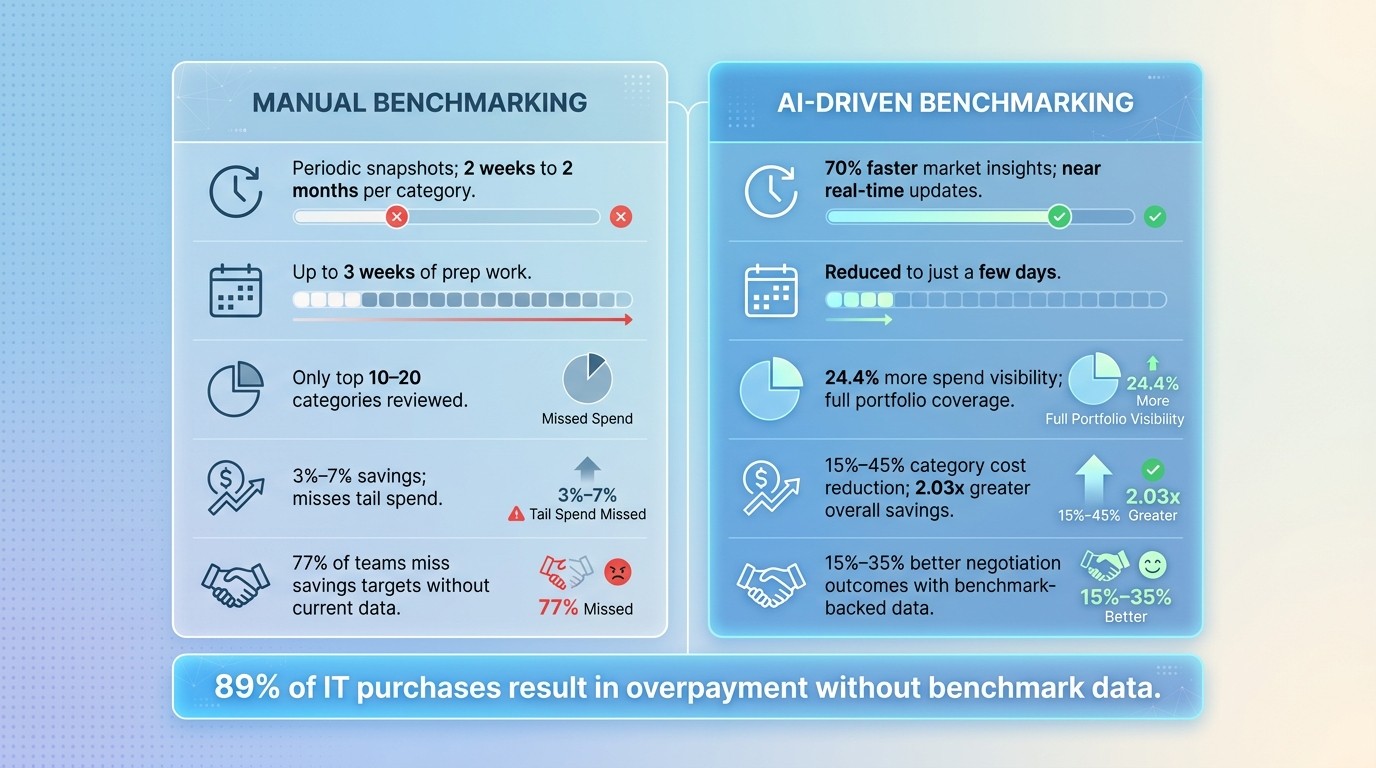
Manual vs. AI Supplier Benchmarking: Key Stats & Performance Gaps
Using Generative AI to empower procurement teams with real-time competitor analysis
Quick Comparison
What matters | Manual benchmarking | AI-driven benchmarking |
|---|---|---|
Update speed | Periodic snapshot | Near real-time updates |
Data work | Spreadsheets, quotes, manual entry | Automated normalization across sources |
Accuracy | More room for input errors and missing landed costs | Better line-by-line comparison and drift checks |
Spend coverage | Often limited to top categories | Can cover the full spend base |
Negotiation prep | Can take weeks | Can drop to a few days |
Cost control | Often reacts after overpayment | Flags pricing issues earlier |
So if I’m trying to control supplier costs in a market that keeps moving, the choice is simple: use current market data, or risk buying against yesterday’s price.
1. Manual Supplier Benchmarking
Manual supplier benchmarking runs on quotes, spreadsheets, and old records. The problem isn't just that it's slow. It's that the slowness gets in the way of day-to-day cost control.
Update Speed
Manual benchmarking gives you a snapshot, not a live view. Building a single cost model can take an analyst two weeks to two months per category. At that speed, most teams can only manage quarterly or yearly sourcing reviews.
And markets don't sit still. Prices shift. Supplier economics change. Tariffs move. So should-cost models can go stale fast.
Data Accuracy
Manual entry leaves room for error at every turn, often requiring AI tools for data validation to maintain integrity. Quotes come in different formats, which makes side-by-side comparison messy. Teams also tend to zero in on unit price and miss landed costs like freight, duties, taxes, and quality incidents.
It gets worse when data is scattered across ERPs, spreadsheets, email, and supplier portals. In that setup, two buyers can pick different suppliers for the same item simply because neither has the full picture.
Cost Visibility
Accuracy is only part of the issue. Coverage is a big one too.
Most organizations benchmark only their top 10–20 categories, which leaves most tail spend without a data-backed baseline.
Decision Quality
When procurement teams don't have current market data, they negotiate against the past instead of the market in front of them. Internal data can answer "Did we do better than before?" But it can't answer "Did we do as well as we could have?"
That's the gap manual benchmarking can't close.
AI-driven benchmarking closes that gap with continuously refreshed market data.
2. AI-Driven Supplier Benchmarking
AI-driven benchmarking keeps supplier pricing current by pulling in and standardizing both internal and market data. These systems take data from internal ERPs, purchase order history, contract terms, and outside market signals, then normalize it so buyers can compare like for like.
Update Speed
When tariffs change or a supplier updates pricing, the system refreshes almost right away. That gives teams market insight 70% faster than manual data gathering.
Of course, speed by itself isn't enough. Fast data is only useful when it's also clean and directly comparable.
Data Accuracy
AI cuts error risk by normalizing inputs across currencies, units of measure, and packaging formats automatically. It can also match invoices to contracts and flag price drift, double-billing, and out-of-spec line items. In one category alone, that process uncovered more than $10 million in leakage.
Across the board, organizations using AI report a 50% improvement in pricing accuracy.
Cost Visibility
This is where AI starts to change the game. Manual benchmarking programs often cover only the top 10 to 20 spend categories. AI can benchmark the full spend portfolio at the same time.
AI-powered spend classification also gives teams 24.4% more spend visibility. That's a big deal in opaque markets like SaaS, where pricing can be all over the map. Two buyers can sign near-identical contracts and still pay wildly different amounts. DocuSign, for instance, showed a 134-point pricing spread between the 25th and 75th percentile of buyers.
Decision Quality
With AI, the benchmark moves away from old internal price history and toward current market evidence. That gives buyers something firmer to work with in negotiations. Instead of relying on gut feel, they can walk in with should-cost models built from transaction data.
That change has a clear payoff: negotiations informed by benchmarking deliver 15% to 35% better outcomes than negotiations done without market data.
That kind of real-time visibility turns benchmarking from a reporting exercise into a direct cost-control tool.
How Each Method Affects Cost Control
The main difference comes down to timing.
Manual benchmarking tends to find problems after the hit has already landed. AI flags issues as they start to show up. In practice, manual methods often uncover cost leaks only after payment, renewal, or a service failure. AI-driven benchmarking gives teams a steady view of pricing and exceptions, so shifts and risks can be spotted early. That gap shows up fast when cost drift starts creeping in.
That matters because organizations overpay for 89% of IT purchases and renewals when they don't have benchmark data.
Dimension | Manual Benchmarking | AI-Driven Benchmarking |
|---|---|---|
Response Time | Reactive; slow to respond to price changes | Continuous; 70% faster market insights |
Negotiation Leverage | Based on stale data or limited peer anecdotes | Backed by real-time market pricing data |
Cost-Risk Detection | Detected after disruption or quality failure | Predictive; flags risks before they escalate |
Cost Reduction | 3%–7% savings; misses long-tail spend | 15%–45% category cost reduction; full portfolio coverage |
So the tradeoff is pretty clear: tighter control on one side, and more process discipline on the other. The next section looks at those gains alongside the limits of each method.
Pros and Cons of Each Approach
Neither method fits every team. The better pick comes down to your supplier-base size, how often you buy, and how much prices move.
Manual benchmarking works for small, stable supplier bases, but it’s slow, narrow, and easy to get wrong.
Once you’re dealing with volatile or more complex categories, manual methods start to crack as the supplier base grows or pricing shifts. In those cases, stale data and limited peer input make cost control much harder.
AI-driven benchmarking scales better: it refreshes pricing in real time, normalizes data, and surfaces overpayments before negotiations. You can see the gap more clearly side by side.
Factor | Manual Benchmarking | AI-Driven Benchmarking |
|---|---|---|
Staffing Effort | High; manual data entry and quote chasing | Low; automated data gathering and normalization |
Data Quality | Stale; often based on internal history or limited peer input | Real-time; transaction-based and current |
Scalability | Limited; difficult across large or global supplier bases | High; scales across thousands of SKUs and regions |
Negotiation Power | Weak; depends on limited peer data | Strong; backed by market-wide transactional evidence |
Best Fit | Smaller supplier bases, infrequent or stable categories | Volatile markets, large operations, and complex spend categories |
The biggest gap shows up in effort, scale, and negotiation leverage. Manual prep for contract renegotiations can take three weeks, while AI-driven platforms can cut that to just a few days.
The timing gap matters just as much. AI sets the baseline before negotiations. Manual benchmarking often sets it after.
Conclusion
Manual benchmarking leaves teams reacting to stale prices. AI benchmarking turns supplier data into current market guidance.
Internal spend history can only show so much. It often misses what’s happening across the market right now. AI-driven benchmarking updates that view up to 70% faster and helps teams achieve 2.03x greater cost savings. That shifts the way teams handle cost control.
The move here is simple: from reactive cost control to forward-looking cost control. Manual methods ask if you beat last year’s price. AI benchmarking asks if you matched what the market can support. This shift highlights why data-driven supplier comparison matters for maintaining a competitive edge. In volatile categories, that gap can be expensive.
The practical takeaway is straightforward. Faster benchmark data gives teams a better shot at acting early. For procurement teams, the choice is plain: benchmark faster, or negotiate with old prices.
FAQs
How does AI keep benchmark data current?
AI keeps benchmark data up to date by connecting straight to ERP systems and other sources, including purchase orders, receipts, shipment notices, emails, and PDFs. It then reconciles and normalizes that data on its own, so teams don't have to handle manual updates or export spreadsheets.
The result is a steady stream of information that refreshes dashboards in real time. That gives organizations a live view of KPIs like price variance and delivery performance, instead of making them wait for static quarterly or annual reports.
When is manual benchmarking enough?
Manual benchmarking can work as a starting point, especially when an organization doesn’t have outside benchmark data and needs to compare current suppliers across business units or regions.
That said, it comes with clear limits. It’s slow, labor-intensive, and more prone to human error. In fast-moving environments, teams can end up making decisions based on data that’s already out of date.
What data do teams need to start?
Teams need centralized, normalized procurement data tied to their ERP system, like SAP, Oracle NetSuite, or Microsoft Dynamics. That gives the AI tool real-time access to key records, including purchase orders, invoices, shipment notices, receipts, and payment schedules.
It should also pull in internal performance history and activity standards, such as products, regions, and quantity requirements. Procright helps here by automating specification creation, so comparison data stays complete, accurate, and compliant.
Related Blog Posts
Try it on a real buy
Bring one category. Watch where the flags land.
We use a little analytics to see which pages actually help. Nothing else, no ad trackers.