Cost Effective Versus Cost Efficient in Procurement
In this article
“Cost-effective means best value, while cost-efficient means lowest cost.” That advice sounds tidy, but it can steer a sourcing team toward the wrong award. A low-price bid may use fewer resources per unit and still fail the specification, miss service levels, or create expensive rework.
The test isn't which phrase belongs in the evaluation report. It's what evidence shows that a cheaper or faster option achieved the outcome the organisation needed. Procurement teams should assess the resources consumed, the output delivered, the outcome achieved, and the cost required to get there.
Decision lens | What it asks | Procurement example |
|---|---|---|
Cost effectiveness | Which alternative achieves the required outcome at the lowest comparative cost? | Cost per server that meets the specification and acceptance criteria |
Cost efficiency | How well do inputs produce outputs? | Labor hours or processing cost per accepted deliverable |
The award test | Did the supplier meet the business need, and what resources did that take? | Compare compliance and service results alongside price and implementation effort |
Table of Contents
Why This Procurement Distinction Matters More Than the Wording
Treating cost effectiveness and cost efficiency as interchangeable isn't harmless shorthand. It changes what buyers reward. If an evaluation gives too much weight to unit price or speed, a bid can appear efficient while delivering less support, weaker resilience, or a lower level of compliance than the organisation requires.
That's how a cheaper award becomes an expensive failure. The quoted price may be lower, but the team still has to account for rejected deliverables, downtime, rework, or gaps in warranty coverage. Those consequences matter because a cost reduction achieved by accepting less output isn't automatically an efficiency gain. The UK Government's efficiency framework makes that distinction explicitly: reducing costs by delivering less isn't efficiency.
The Australian Productivity Commission also distinguishes cost effectiveness from broader economic efficiency. An option can have the lowest cost per specified output and still fail to deliver benefits greater than its total costs. In procurement terms, winning on a narrow measure doesn't prove the award makes economic sense.
The award decision needs outcome evidence
The practical question isn't whether a supplier offers a lower price. It's whether the supplier can deliver the required output at that price and achieve the outcome the business bought. For two sourcing strategies that both provide compliant servers with equivalent performance, compare the total cost per server that meets the specification, not just the headline quote.
This distinction matters across enterprise procurement, IT, finance, and operations. A buyer may track processing time, staff effort, or transaction cost to understand efficiency, but still needs evidence that the purchased service met acceptance criteria or maintained the required service level.
Advisor's rule: Don't call a bid efficient until you've defined the output. Don't call it cost-effective until you've shown that the output achieved the intended result.
The Two Definitions You Actually Need
Cost effectiveness compares alternatives that achieve the same or a closely comparable outcome. It asks: which option delivers that outcome at the lowest comparative or incremental cost? In a sourcing event, that could mean comparing the cost per accepted deliverable, compliant capability, or operational hour across bids that meet the same requirement.
Efficiency measures the relationship between inputs and outputs. It asks whether the supplier or process can produce the same output with fewer resources, or more output with the same resources. Relevant evidence may include labor hours, processing time, operating cost, or units delivered.

Keep the two tests separate in the evaluation. A supplier can be efficient on unit price or implementation speed, yet not cost-effective if it misses acceptance criteria, causes rework, or weakens the business outcome. A higher-priced offer may prove more cost-effective over the contract if it produces better reliability, compliance, or service results for the same requirement.
What the evaluation must record
For an auditable decision, capture an outcome measure and a resource measure in the same sourcing event. The outcome measure explains what success means, such as a compliant transaction or an accepted deliverable. The resource measure shows what it took to achieve that result, such as staff effort or total operating cost.
A clear specification gives bidders the same target. A clear evaluation record shows how each bid performed against it. Buyers looking at manufacturing or production economics can also use this American Additive Manufacturing cost guide as contextual reading, then apply their own sourcing requirements and evidence standards.
A Compact Side-by-Side Comparison
A comparison table is useful only if it tells the category manager what to measure and where to find the evidence. The following format can be adapted for an evaluation template. It distinguishes the question behind each metric from the documents needed to support the answer.
Cost-Effective vs Cost-Efficient at the Sourcing Decision
Criterion | Cost-Effective | Cost-Efficient |
|---|---|---|
Decision question | Which option achieves the required outcome at the lowest incremental cost? | Which option produces the defined output with the fewest or least costly inputs? |
Primary measure | Cost per achieved outcome, accepted deliverable, or compliant capability | Resource use per output, such as labor hours, processing time, or operating cost |
Evidence to collect | Locked specification, acceptance results, compliance record, outcome data, and total or incremental cost | Quote, implementation plan, resource assumptions, time records, processing data, and delivered quantities |
What it can miss | Whether the result is worth its total cost if broader benefits and costs aren't considered | Whether the output is adequate and achieves the intended business outcome |
Best use | Comparing alternatives expected to deliver equivalent outcomes | Improving a defined process or comparing resource use for the same output |
A quote can help establish price, but it doesn't prove that the supplier met the requirement. The specification defines the target; acceptance records and service evidence show whether the delivered output met it. If a bid changes the scope, service level, or warranty, the team must account for that difference before comparing costs.
Make the evidence traceable
Record the source for each scored claim. Use the supplier response or commercial schedule for price and assumptions, the specification for required performance, and post-award evidence for the result. If a team scores implementation speed, it should also state what counts as completion and what happens if the promised schedule doesn't produce an accepted service.
This is more useful than labelling one supplier “more efficient” without showing the calculation. It also keeps price, output, and outcome visible in the same decision rather than burying service risks in narrative notes.
Three Real Sourcing Scenarios That Expose the Gap
Consider a software RFP with concurrent licensing. The lowest licence fee per seat may look efficient on price, but usage caps can force the organisation to buy more seats than the actual operating model needs. A higher-priced option may prove more cost-effective if its licensing terms better match concurrent demand and the required access model. The buyer should test the proposed licence structure against the intended use, rather than treating seat price as the whole decision.

MRO spares and downtime exposure
In an MRO spares contract, a supplier can offer the cheapest price per part while carrying longer lead times or less dependable availability. The unit cost may be attractive, but the sourcing decision still needs to test whether the spare will arrive when the maintenance plan requires it. If downtime is material to the business, compare the offer against availability, delivery commitments, and the cost of operational disruption.
That's also why buyers should model costs beyond the purchase order. A practical guide to total cost of ownership in procurement can help structure those cost categories before award.
Professional services and the cost of rework
For professional services, the low bid may rely on limited review time or a narrow delivery team. That can make the proposal look efficient, but if the work fails acceptance or needs substantial rework, the original price stops being a reliable indicator of value. Compare the bids against deliverable quality, acceptance criteria, support, and the effort required to correct defects.
The measurement gap is visible in public procurement. OECD evidence reports that in 2024, 24 of 35 OECD countries, or 69%, used efficiency indicators, while earlier OECD evidence found that only 30% of OECD countries had established KPIs measuring procurement outcomes against predefined targets (OECD procurement recommendation104/en/pdf)). Tracking savings without tracking results tells buyers what they paid, not whether the purchase worked.
The Four-Field Decision Record for Every Sourcing Event
Use a decision record that separates four questions. This keeps the evaluation from collapsing resource use, delivered work, business results, and spend into a single score.
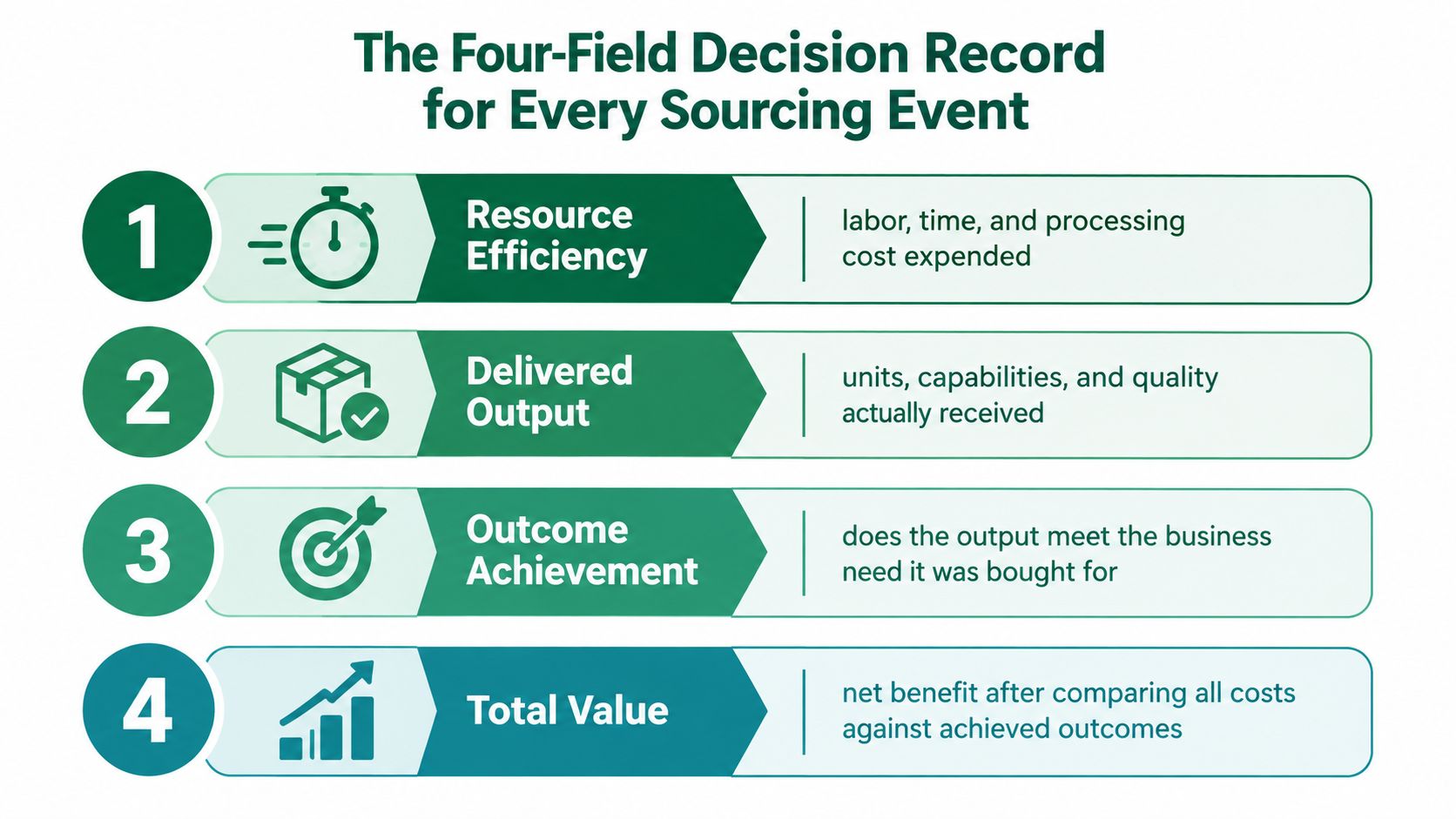
Field | Decision question | Evidence to retain |
|---|---|---|
Resource efficiency | What labor, time, processing effort, or operating resources were used? | Supplier assumptions, implementation plan, time or process records |
Delivered output | What units, capabilities, or service hours did the organisation actually receive? | Contract, delivery records, service reports, acceptance documentation |
Achieved outcome | Did the output satisfy the business need, compliance conditions, and acceptance criteria? | Compliance checks, acceptance results, operational or post-award review |
Incremental cost | What total or marginal spend was required for the result? | Quote, commercial terms, change records, and relevant cost documentation |
The fields work together, but they shouldn't be merged. A supplier may use fewer implementation hours while delivering less capability. Another may deliver the required service but at a higher total cost. The record makes those differences visible so reviewers can understand the trade-off and challenge assumptions before the award.
Build the evidence trail at the same time as the scoring model. A weighted scoring model can help organise criteria, but the team still needs to define what evidence supports each score and how acceptance will be verified after signature.
Why Cutting Costs Harder Can Quietly Reduce Effectiveness
Efficiency drives can undermine the outcome when teams cut resources that support delivery. Reducing supplier count, thinning a specification, removing support coverage, or compressing implementation time may lower an immediate cost measure. It can also leave the organisation more exposed to missed service levels, rework, or compliance gaps.
The World Bank notes that an intervention can be cost-effective yet become cost-ineffective when it is implemented inefficiently (World Bank guidance on costing and cost-effectiveness). The procurement lesson is that efficiency and effectiveness interact. Better resource use doesn't guarantee a better result, and a cost-cutting move can weaken the conditions needed to achieve that result.

Run a downside check before award
Ask what changes if service levels are missed, demand shifts, implementation slips, or a requirement is only partially met. Buyers don't need to pretend they can predict every failure; they do need to test whether the preferred bid remains credible under plausible delivery problems.
For freight sourcing, for example, compare more than the rate per mile. A low rate may not be attractive if reliability doesn't meet the delivery need and missed deadlines create operational consequences. Teams reviewing courier options can use a resource on finding a cheap courier in Australia as a starting point, then verify service commitments and performance evidence against their own requirements.
Which Metric to Prioritize in Different Sourcing Scenarios
Prioritize cost effectiveness when the outcome is difficult to reverse, compliance-heavy, or tied to a long contract. That includes IT licensing with audit exposure, regulated purchases, and multi-year services where a short-term price advantage can be outweighed by failure to meet the required result. Define the outcome first, then compare compliant alternatives on the cost of achieving it.
Prioritize efficiency when the specification is tight, the output is measurable, and suppliers can meet the same standard. Commodity hardware, routine MRO purchases, and transactional services may fit this pattern. A lower resource requirement or unit cost is meaningful when the team can confirm that the supplier delivered the same required output.
Use both when price and outcome are inseparable
For complex sourcing events, report both measures. Show the resources consumed and the output produced, then show whether that output achieved the intended outcome and what it cost. The decision should make clear why the winning bid is acceptable, not why it scored well on price or speed.
A practical one-minute rule is: if bids don't deliver an equivalent outcome, prioritize cost effectiveness and test the outcome; if the output is tightly defined and comparable, prioritize efficiency; if either condition is uncertain, report both. Procurement teams can also track procurement cycle-time metrics alongside outcome measures, so a faster process doesn't get mistaken for a better purchase.
Frequently Asked Questions
Can the terms be used interchangeably? No. Keep resource efficiency and outcome achievement distinct in the decision record.
Is a cheaper award automatically more efficient? No. Compare resources against a defined output.
How do I defend a higher price to finance? Show the outcome, evidence, and incremental cost. For vendor evaluation context, see this guide to how to choose tech vendors.
What belongs in the audit trail? The specification, quote, scoring evidence, acceptance results, and cost changes.
Procright supports sourcing workflows with specification refinement, supplier discovery, evidence-based comparisons, and cited decision records. If your team needs to show why the selected bid was both affordable and fit for purpose, visit Procright to review how the platform supports that process.
Try it on a real buy
Bring one category. Watch where the flags land.
We use a little analytics to see which pages actually help. Nothing else, no ad trackers.