Global Supply Chains: Risks, Resilience Strategies
In global supply chains, the question shifted from lowest cost to proving where supply comes from and what could interrupt it before the contract is signed.
In this article
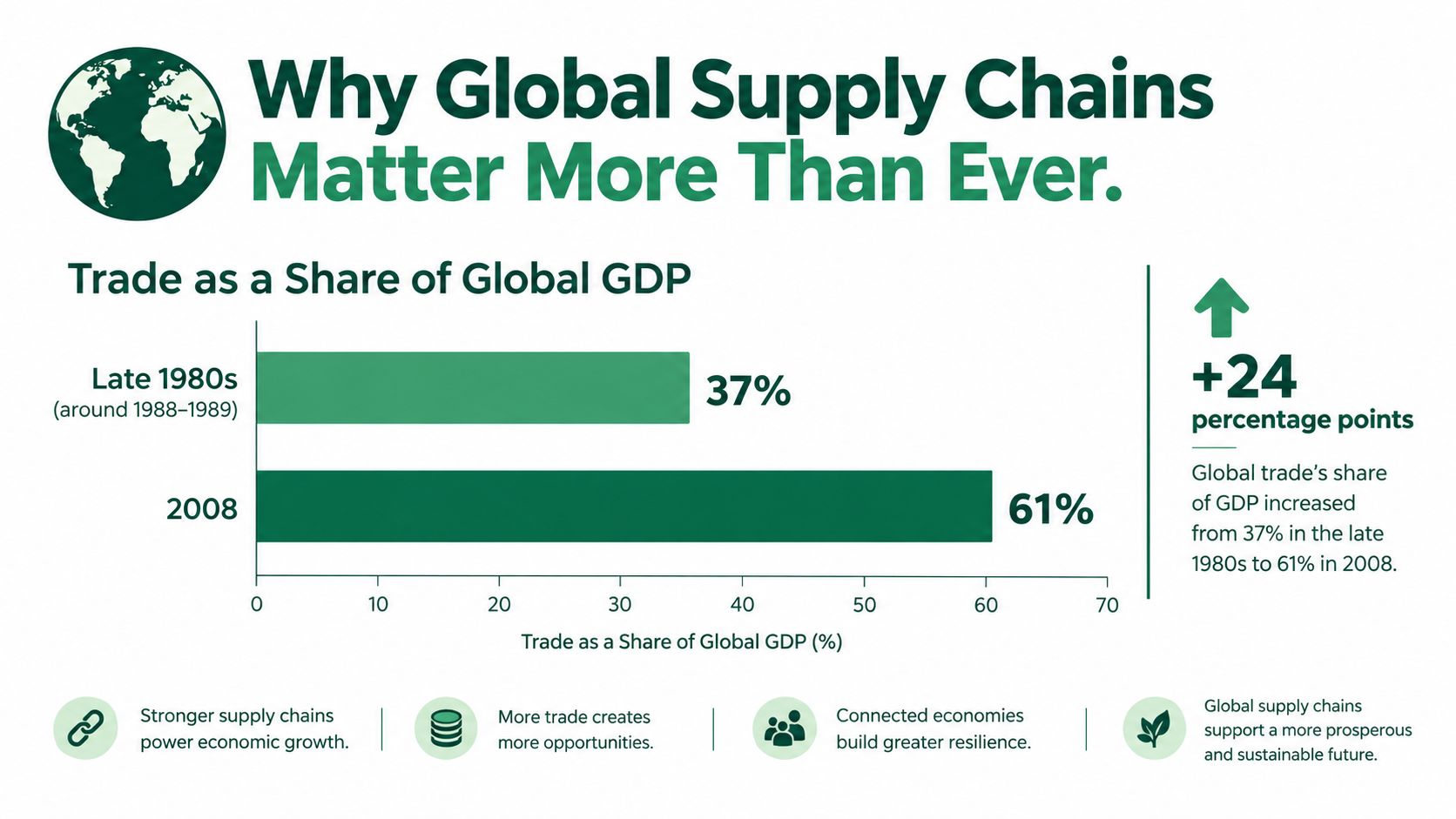
Trade as a share of global GDP rose from 37% to 61% in the two decades to 2008, according to the World Bank's analysis of global value chains. That shift changed procurement permanently. Companies no longer buy from isolated suppliers. They coordinate materials, manufacturing, finance, transport, compliance, and data across networks that can span several countries and multiple supplier tiers.
The old supply-chain question was simple: can we buy this at the lowest total cost? The practical question now is harder: can we prove where the supply comes from, identify what could interrupt it, and make a defensible decision before the contract is signed?
Table of Contents
Why Global Supply Chains Matter More Than Ever
Information technology cut the cost of coordinating production across borders, making fragmented manufacturing viable at scale. Trade as a share of global GDP rose from 37% to 61% in the two decades to 2008, reflecting how quickly companies connected suppliers, factories, logistics providers, and customers across countries. The World Bank source on global value chains describes this shift as part of a wider transformation in cross-border production.
Foreign direct investment followed the same pattern. Flows increased from about 0.5% of global GDP in the 1970s and 1980s to 5% or more by the mid-2000s. Companies were distributing design, components, assembly, ownership, and working capital across borders rather than just importing finished goods.
That model delivered commercial advantages, including access to specialized capacity and lower production costs. It also created new exposure. Concentrated suppliers, upstream dependencies, border procedures, data restrictions, and regulatory requirements can undermine a sourcing decision even when the contracted vendor appears financially sound.
The procurement decision has become a network decision
A first-tier supplier may depend on an undisclosed manufacturer, processor, logistics provider, or raw-material source. A low unit price can therefore conceal single points of failure and evidence gaps. Diversifying suppliers may reduce one dependency while increasing regulatory friction, qualification work, or the difficulty of proving origin and compliance.
Procurement teams need a decision-grade record of supplier entities, locations, dependencies, specifications, delivery assumptions, and supporting evidence. A structured supplier spend overview establishes the commercial baseline. A supply-chain resilience framework helps connect that baseline to operational risks and response choices.
Practical rule: Treat every major sourcing decision as network design, not vendor-price selection.
Strong teams do not try to remove global complexity. They make it testable. They define the evidence required before award, record why suppliers were included or excluded, and verify that the final offer still matches the specification, origin, and compliance basis used to approve it.
Hidden Cost of Supply Chain Disruptions
A delivery delay changes more than the arrival date. It affects inventory, production, financing, and customer service at the same time.
A synthesis of evidence from 2020 to 2022 found that temporary increases in delivery delays lowered U.S. industrial production by about 6% to 12%, reduced goods consumption by 4% to 6%, raised consumer prices by 8% to 12%, and increased stockouts by up to 20 percentage points. The 6% to 12% industrial production estimate and the other findings are reported in the CEPR analysis of supply-chain disruptions.
The mechanism matters more than any single headline figure. As lead times lengthen, buyers may need more inventory in transit and more safety stock at the destination. Goods remain exposed longer to depreciation, financing charges, storage requirements, and changing demand. Downstream production also becomes less likely to receive the required input when it is needed.
Why delay variability beats a small freight saving
Procurement teams often compare freight quotations as if transport cost were the main variable. That works when capacity is available and delivery times are stable. Near capacity, a modest increase in lead-time variability can create a larger operating cost than a small freight-rate difference.
Consider two offers. One has a lower freight charge but an uncertain delivery window. The other costs more to transport but provides a more dependable replenishment pattern. The second may require less precautionary inventory, cause fewer production interruptions, and reduce emergency purchasing.
The CEPR synthesis explains that delay costs spread across tiers. Longer lead times raise carrying costs and increase the chance that downstream firms miss their inputs. A procurement model should therefore test variability, concentration, and regulatory friction alongside the quoted transport price. Diversification can reduce reliance on one supplier while leaving the buyer exposed to the same port, route, jurisdiction, or upstream processor.
A practical evaluation should include:
Lead-time range: Record the expected window and the conditions that could extend it.
Tier exposure: Identify upstream inputs that could prevent the supplier from fulfilling the contract.
Inventory response: Estimate additional stock or expediting if delivery becomes unreliable.
Customer impact: Connect interruption risk to production schedules, service commitments, and substitution options.
Evidence trail: Record the supplier entities, origin details, dependencies, and supporting documents behind the award.
Teams formalizing these controls can consult guidance on managing supply chain risk in 2026. The procurement lesson is direct: a resilient award may cost more on the purchase order and less across the operating system.
Where Visibility Gaps Create Hidden Risk
Logistics costs average about 13% of GDP worldwide, compared with roughly 8% in highly efficient economies such as the United States and the Netherlands, and as high as 25% in the least efficient countries, according to the World Bank discussion of global logistics performance.
The visibility gap sits inside that cost structure. Separate industry reporting says only 6% of organizations have full visibility into tier-2 and tier-3 suppliers, while 90% of supply-chain leaders reported encountering supply-chain challenges in 2024. Those figures need direct evidence in the sourcing record, not a general reference to risk research. Procurement teams should attach the original reporting, survey method, and date to any decision that relies on them.
A buyer can maintain detailed records for the contracted supplier and still lack reliable information about the organizations that make delivery possible. That gap weakens origin claims, compliance checks, capacity assumptions, substitution planning, and disruption response. It also makes diversification look stronger on paper than it is in operation.
Diversification doesn't remove concentration risk
Adding suppliers can reduce dependence on one direct vendor. It may leave the buyer dependent on the same port, customs route, logistics provider, data environment, raw-material processor, or upstream manufacturer.
Supplier count therefore provides only a partial view of exposure. Procurement teams should map concentration and regulatory friction alongside commercial relationships, then test whether a second source actually changes the dependency.
A decision-grade supplier map should show:
Physical dependencies: Facilities, routes, ports, and logistics providers supporting delivery.
Regulatory dependencies: Approvals, border controls, and data rules that could delay performance.
Commercial dependencies: Supplier relationships or capacity commitments that limit substitution.
Evidence quality: Primary documents supporting each claim, plus gaps that remain unverified.
This structure turns traceability into a sourcing control rather than a static diagram. It also gives reviewers a clear basis for challenging unsupported origin, capacity, or compliance assumptions.
Vendor scoring becomes more useful when it captures these dependencies instead of reducing risk to a financial rating. A structured approach to vendor risk scoring can help teams compare exposure consistently, provided each score remains tied to underlying evidence.
Port Performance as an Early Warning Signal
Port congestion often becomes visible only after a disruption has spread through the network. World Bank CPPI analysis supports a more useful procurement signal: vessel time in port. Longer dwell and turnaround times reduce the number of voyages a ship can complete over a fixed period, constraining effective capacity before carriers formally withdraw services.
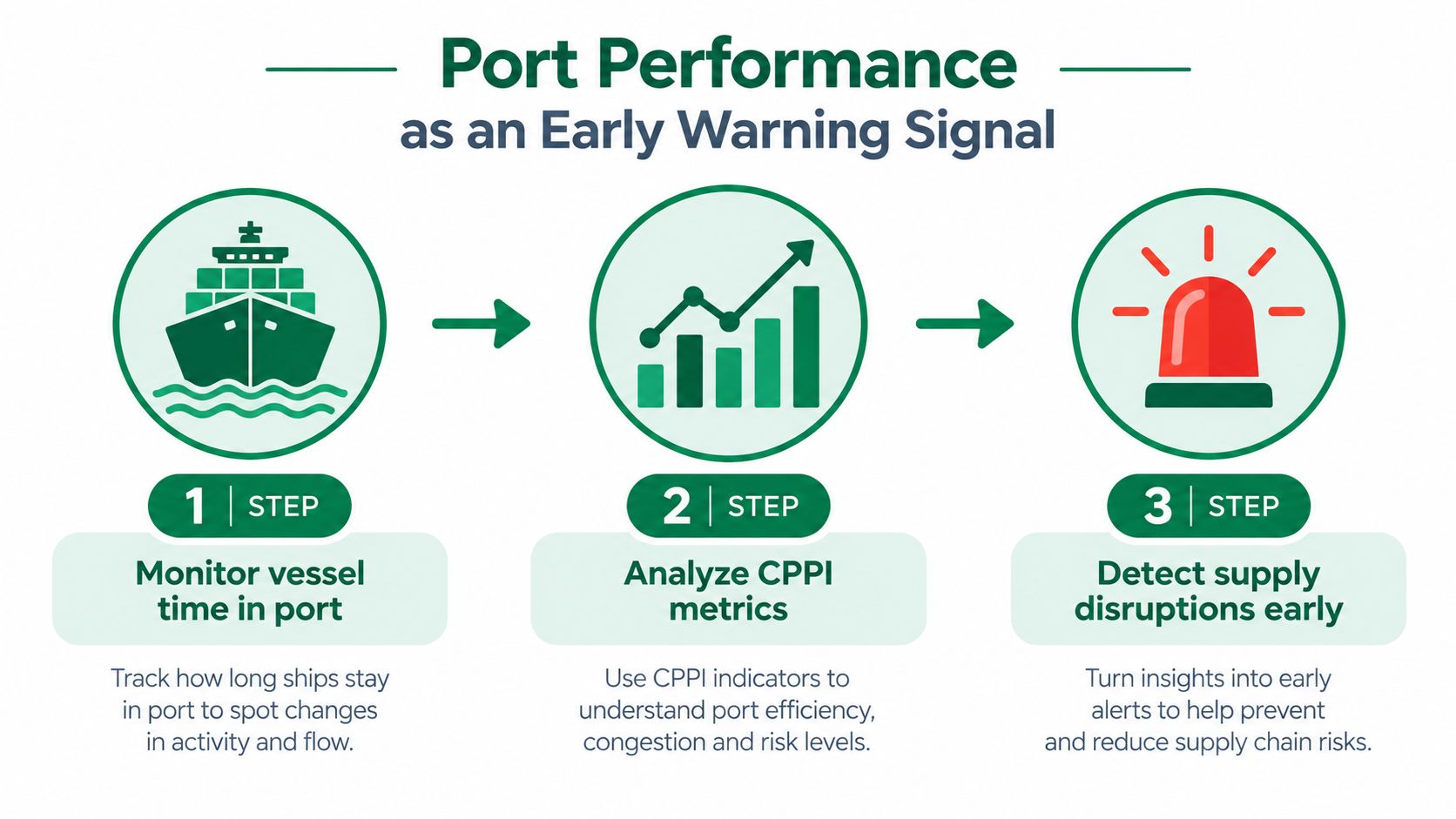
The Container Port Performance Index analysis connects longer vessel times with supply-chain stress and shows how weak port performance delays later port calls. For procurement, that creates a delayed-capacity penalty. A route can lose usable shipping capacity while published service schedules still appear unchanged.
A practical monitoring routine should:
Track vessel time in port on lanes serving critical categories.
Compare current performance with the route's normal pattern, rather than relying only on a carrier's promised transit time.
Escalate rising dwell times where substitution is limited or replenishment takes longer.
Review purchase timing and inventory decisions before delayed freight becomes a production issue.
Port data also needs a sourcing context. The Economist's 2025 trade report describes supply-chain restructuring through diversification and localisation in its report on supply-chain restructuring. That shift can reduce direct supplier dependence while leaving concentration at shared ports, border crossings, logistics providers, or processing hubs. Procurement teams should therefore record the route, gateway, and evidence supporting each supplier's continuity assumptions.
Use port metrics in supplier selection, lane design, order timing, and contingency planning. A dashboard that logistics reviews but procurement ignores cannot expose regulatory friction or concentration risk early enough to change a sourcing decision.
Rethinking Diversification and Concentration Risk
Diversification sounds like resilience because it reduces dependence on one supplier. In practice, it can produce only cosmetic resilience if several suppliers depend on the same external system.
The OECD's 2025 Supply Chain Resilience Review identifies rising concentration as an important concern and draws attention to three structural bottlenecks: customs and border procedures, transport and logistics services, and cross-border data-flow rules. A sourcing team that adds suppliers without checking these constraints may increase administrative workload without meaningfully improving continuity.
Build traceability into the sourcing workflow
Resilience improves when the decision record makes dependencies visible before the award. The workflow should connect the specification, market research, supplier evidence, compliance assessment, commercial offer, and final approval.
A workable sequence looks like this:
Lock the requirement deliberately: Identify performance, acceptance, service-level, compliance, delivery, and documentation requirements before comparing offers.
Test market accessibility: Flag requirements that only one supplier can plausibly satisfy, then decide whether that restriction is necessary.
Map the evidence chain: Link every material supplier claim to a manual, certificate, contract term, facility record, or other source.
Record elimination reasons: A supplier shouldn't disappear from the shortlist without a documented reason tied to the requirement or risk model.
Monitor for drift: Compare the final quote, terms, and supporting documents with the specification used for evaluation.
Procright fits as one implementation option. It supports specification refinement, supplier discovery, evidence-based compliance comparison, weighted scoring, document ingestion, and a traceable decision record that procurement teams can use for review.
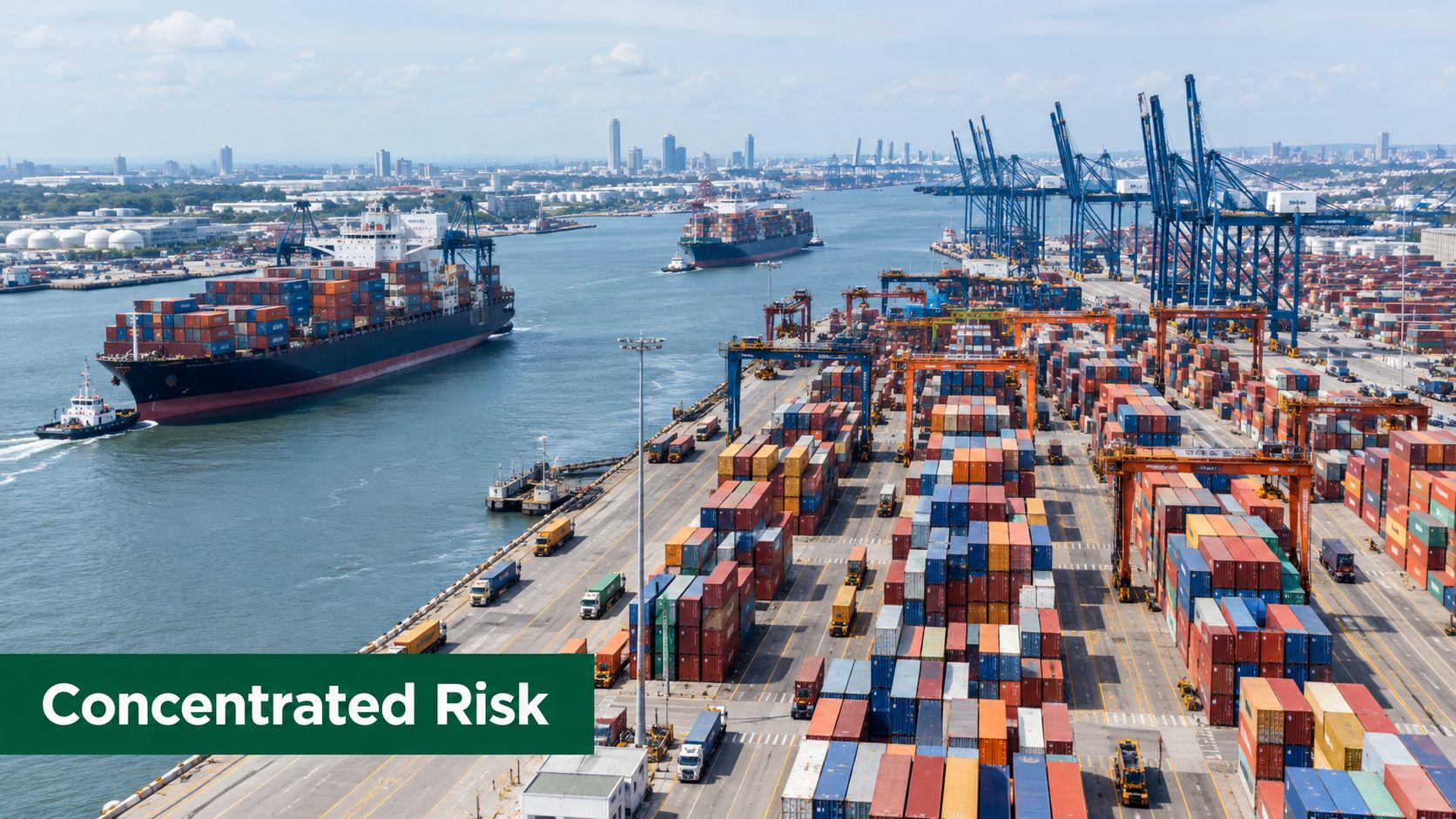
The goal isn't to produce more documents. It's to preserve the reasoning behind the decision. If regulatory friction or shared logistics dependency later becomes a concern, the team should be able to identify which assumption supported the original award and whether that assumption still holds.
Where Value Chains Are Shifting
An automotive supplier moving production closer to its customers may reduce transit exposure while leaving battery materials, specialist components, or compliance dependencies tied to distant markets. That is why nearshoring cannot be assessed by factory location alone. The change may involve regional assembly, shared logistics infrastructure, digital coordination, or services that support several markets.
Recent trade analysis describes firms reconfiguring supply chains through diversification and localisation. Longer-run value-chain changes also include regional hubs, digitalisation, services, and the reorganisation of automotive and electric-vehicle production, with developments across Latin America, the Caribbean, and Africa.
The procurement question is not, “Which country should replace the current source?” It is, “Which part of the value chain is moving, and what capability is being added at the new location?”
Compare the alternatives by value-chain function
Sourcing choice | What it can improve | What it can leave unresolved |
|---|---|---|
Localisation | Proximity, communication, and certain delivery risks | Upstream concentration and limited specialist capacity |
Regional hubs | Coordination across nearby markets and shared infrastructure | Border processes and regional logistics dependencies |
Supplier diversification | Direct-vendor dependence | Common ports, processors, standards, or data rules |
Digitalised coordination | Document access, monitoring, and collaboration | Physical bottlenecks and weak underlying evidence |
Services integration | Flexible operating models and specialist support | Contract complexity and cross-border regulatory exposure |
A product specification can confirm technical fit while concealing these operating differences. A decision-grade specification requires evidence of where capability sits, which services support delivery, how materials and components move, and what regulatory obligations apply when production changes location.
Concentration risk can persist after a supplier switch. Two vendors may offer technically similar products, yet rely on the same port, processor, certification system, or data-transfer route. Diversification has reduced exposure only when those shared dependencies are identified and tested.
The lowest technically compliant bid may still carry greater operational and regulatory exposure. Compare the full operating model, then record the evidence supporting the choice.
Decision test: Compare the complete operating model, not just the factory address.
Building Evidence-Based Sourcing Workflows
Cost optimisation alone produces weak decisions when the buyer can't explain why a supplier was considered safe, compliant, and deliverable. A risk-aware workflow puts evidence beside the commercial comparison, so the team can see both the price and the assumptions supporting it.
Start before the specification locks
The first control belongs in specification creation. Procurement, technical, legal, and operational stakeholders should identify missing requirements before the document reaches the market.
Useful checks include:
Gap analysis: Find missing acceptance criteria, service levels, escalation duties, warranty terms, delivery requirements, and compliance evidence.
Single-bidder detection: Identify wording that may unintentionally exclude credible alternatives or describe one vendor's solution too closely.
Clause suggestions: Add practical language for acceptance, remediation, service-level penalties, documentation, and change control.
Requirement ownership: Assign each critical requirement to a reviewer who can confirm what acceptable evidence looks like.
This is more effective than waiting for supplier questions to reveal weaknesses. Once bids arrive, an ambiguous requirement can become a dispute about interpretation, scope, or price.
Build the market view from evidence
Supplier discovery should produce a shortlist that survives the locked specification, not a collection of familiar names. For each candidate, record the evidence reviewed and the reason for inclusion or elimination.
A useful shortlist distinguishes between:
Capability evidence, such as product documentation, service descriptions, and delivery commitments.
Compliance evidence, such as certifications, policies, and contractual assurances.
Operational evidence, such as support locations, implementation capacity, and logistics dependencies.
Commercial evidence, such as quote validity, payment terms, exclusions, and price assumptions.
Compliance comparison should answer each requirement as yes, no, or partial, with a direct citation to the supporting source. That format exposes uncertainty instead of hiding it inside a single overall score.
Protect the decision through evaluation and award
Weighted scoring helps teams make trade-offs explicit. The weights should reflect business exposure, not just what is easiest to measure. A critical delivery requirement may deserve more attention than a minor feature difference, while a compliance gap may be disqualifying even when the price is attractive.
Document ingestion and structured supplier responses reduce the risk of comparing different interpretations of the same requirement. Collaboration workspaces, role-based access, and external review links help technical, finance, legal, and operations stakeholders work from the same record.
Audit-ready practice: Preserve the source, the answer, the evaluator, and the reason for the decision.
Finally, run spec drift detection before signature. Quotes, manuals, and terms can introduce different delivery windows, warranties, exclusions, or commercial conditions after the technical evaluation has finished. A final comparison should flag those deviations and connect them to their commercial or operational impact.
This workflow changes procurement from a price-ranking exercise into a defensible risk decision. It also gives stakeholders a concrete basis for approving exceptions, rejecting unsupported claims, and revisiting assumptions when global supply chains change.
Turning Audit-Readiness Into Competitive Advantage
Audit-readiness is often treated as paperwork added after the sourcing decision. Strong procurement teams use it as a control during the decision itself.
A defensible record should show what the organization asked for, which suppliers were considered, what each supplier proved, how the team scored compliance, and why the award made sense. That record matters when a supplier disputes an evaluation, a stakeholder challenges an exclusion, or an operational problem exposes an assumption that nobody documented.
Catch changes before they become obligations
Spec drift detection is one of the most practical controls. It checks quotes, manuals, and contractual terms against the locked specification and highlights deviations before signature.
Look for changes in:
Delivery commitments, including windows, lead-time assumptions, and responsibilities.
Acceptance conditions, including testing, inspection, and remedies.
Warranty and support, including response obligations, exclusions, and service coverage.
Commercial terms, including payment conditions, escalation language, and additional charges.
Compliance representations, including evidence that is missing, expired, or narrower than the requirement.
These checks protect more than compliance. They prevent the organization from awarding on one set of assumptions and signing another.
Make review faster without weakening control
Collaboration workspaces and role-based access allow reviewers to work from a shared record while limiting unnecessary changes. External sharing links can give suppliers or advisors access to the relevant material without creating uncontrolled document copies.
Reporting and export also matter. A decision record that can be reviewed internally and exported for formal audit is more useful than a dashboard that only the original project team can interpret. Teams should retain source citations, activity history, scoring logic, supplier responses, and approved exceptions together.
The supply-chain due-diligence evidence guide provides a useful reference for structuring that evidence. The principle is simple: every important conclusion should remain understandable after the original sourcing team has moved on.
Global supply chains reward organizations that can act quickly without abandoning control. When procurement can connect requirements to evidence, evidence to scoring, and scoring to the signed terms, audit-readiness becomes a competitive capability rather than a defensive obligation.
Procright supports procurement teams with specification refinement, supplier discovery, evidence-based compliance comparison, weighted scoring, and spec drift detection in one sourcing workflow. Visit Procright to test how a traceable, audit-ready decision record can help your team manage supply-chain risk before the award and before signature.
Try it on a real buy
Bring one category. Watch where the flags land.
We use a little analytics to see which pages actually help. Nothing else, no ad trackers.