Managing Supplier Risk: A Five-Stage Process
In this article
Supply disruptions can cost far more than procurement saves at award. McKinsey Global Institute's analysis of 325 companies across 13 industries modeled average losses of approximately 42% of one year's EBITDA over a decade, accounting for disruption probability and frequency. Managing supplier risk means making that exposure visible, deciding what protection is worth buying, and keeping evidence that explains the decision.
Table of Contents
Why Supplier Risk Hurts More Than Procurement Expects
In 2025, fewer than 8% of businesses said they had full control over supply-chain risks, and 63% reported higher-than-expected losses, according to WTW's Global Supply Chain Risk Report. A completed assessment plainly isn't the same as controlled exposure.
Say your direct supplier passes its annual questionnaire. Its finances look sound, its certifications are current, and its account manager confirms continuity arrangements. But its only source for a specialty component sits deeper in the network at a single factory, outside the questionnaire's scope.
The cost sits outside the questionnaire
When that factory stops, operations can't use the supplier's compliance score to keep production running. Finance faces lost contribution margin, expedited freight, idle capacity, and customer commitments that procurement didn't price into the award.
The commercial test: Ask what failure would cost, how long recovery would take, and which evidence supports the recovery assumption.
This isn't an isolated concern. In RapidRatings' 2025 Annual Risk Survey, 81% of supply-chain professionals said their businesses had been affected by supplier disruptions during the previous two years, while 68% expected supply-chain risks to escalate.
Treat supplier failure as a recurring financial-control issue, not an occasional operational inconvenience. Procurement should establish the exposure, finance should challenge the loss estimate, and operations should confirm whether the proposed fallback works.
For a companion operational checklist, F1Group's practical steps to reduce supplier risk can support the discussion. The useful outcome isn't another completed form. It's the ability to name the suppliers whose failure would hurt most, identify risks needing a written plan, and defend the evidence behind each decision.
The Five-Stage Supplier Risk Process at a Glance
Run supplier risk as a repeating loop: map, assess, score, mitigate, and monitor with escalation. Don't commission a mapping project that finishes without funding or ownership for the decisions it exposes.
The table below is a practical operating template, not a prescribed industry standard. Adopt its review cadence as a starting policy, then tighten it where a supplier's criticality or changing circumstances justify more attention.
Supplier risk process stages, outputs and owners
Stage | Core question | Output on file | Typical owner | Review cadence |
|---|---|---|---|---|
1. Map | Who supplies what, and who do they depend on? | Supplier hierarchy with critical tier-two links | Category manager with supplier data | Once at setup, then at each new award |
2. Assess | What evidence do we hold on financial, cyber and continuity risk? | Evidence file with source and date per supplier | Risk or compliance analyst | Yearly for standard suppliers, quarterly for critical ones |
3. Score | How likely is failure, and how bad would it be? | Residual risk rating per supplier | Procurement with finance input | Each review cycle |
4. Mitigate | Which control brings the risk within tolerance? | Written treatment plan with owner and date | Category manager with operations | Until the risk is within tolerance |
5. Monitor and escalate | What has changed since the last review? | Trigger log and escalation decision | Supplier relationship owner | Continuous, against defined triggers |
Start with critical requirements and single-source lines. Spend helps prioritize the workload, but a cheap component that stops production deserves more attention than an expensive, easily replaced service.
Use a shared register with linked documents before buying another system. Excel or an existing supplier-management workspace can hold the initial hierarchy, evidence references, ratings, and actions. What matters is whether another reviewer can follow the reasoning without asking the original buyer to reconstruct it.
Procurement coordinates the loop, but shouldn't approve every assumption alone. Finance owns the credibility of financial exposure estimates. Operations confirms switching constraints and recovery capability, while security and legal assess their respective controls.
Each output must support the next decision. A supplier hierarchy without supporting evidence can't justify a confident rating; a rating without an action owner won't change the exposure. Assign a named person to every row, put review dates in the working calendar, and make overdue actions visible to the category head.
How to Map Suppliers Beyond Tier One
A direct supplier list shows who invoices you, not necessarily who can interrupt your business. In McKinsey's 2024 supply-chain risk survey, 95% of respondents had visibility into at least tier-one supplier risks, but only 42% extended visibility to tier two or beyond.
Build the map around the requirement
Use the flow below to organize discovery, then attach evidence to the links that affect continuity.
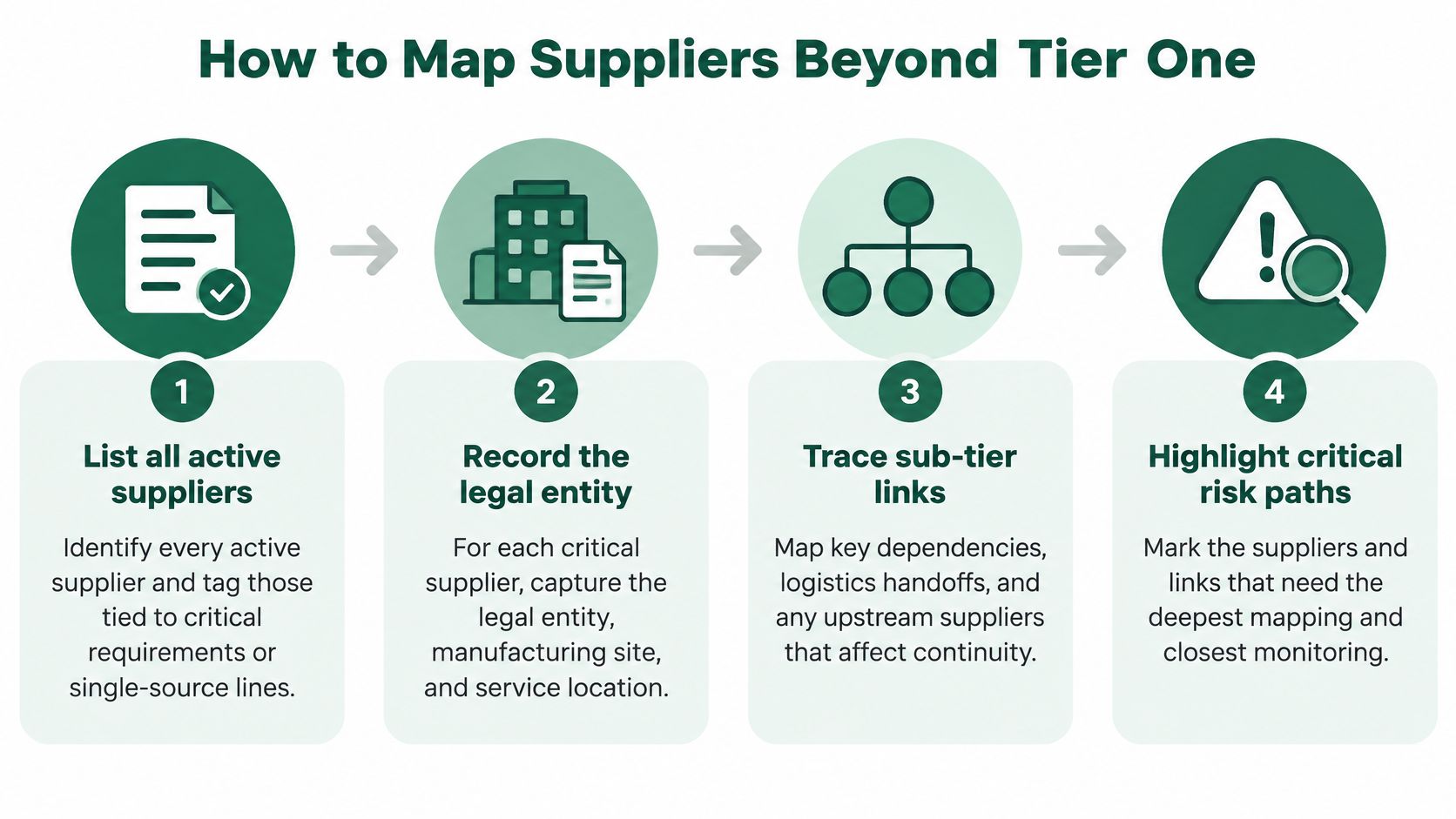
List active suppliers and tag critical requirements. Export the supplier master and reconcile it against current contracts and purchase activity. Mark single-source items and services whose loss would interrupt an essential process.
Record the actual delivery entities. Capture the contracting legal entity, production site, service location, and main subcontractors. A group-level company name doesn't establish which facility performs your work.
Trace product-specific upstream dependencies. Ask who supplies the key component, raw material, hosting service, or logistics handoff for your requirement. Don't request an entire global supplier directory when a targeted dependency question will resolve the exposure.
Attach documents to important claims. Collect ownership records, capacity information, financial evidence, relevant security documentation, and continuity arrangements. Record what each document covers, not just that someone uploaded it.
Measure verified coverage. Divide mapped critical spend by total critical spend in scope, or use critical business processes as the denominator. Keep the denominator consistent so leadership can distinguish genuine progress from changes in scope.
Flag undisclosed or contradictory links. Record which dependency remains unknown, why it matters, and the evidence requested. Conflicting factory addresses or subcontractor statements need resolution, not an average confidence score.
Decide which unknowns require action
Missing evidence isn't proof of failure, but it isn't evidence of safety either. Record evidence confidence separately as verified, partially supported, or unknown.
A missing upstream dependency requires a written plan when it affects a single-source line, a critical spend category, or a supplier with weak financials.
The plan needs an owner, a due date, and a specific route to closure. That might mean confidential document review, supplier follow-up, an independent verification, or a compensating control if disclosure remains impossible.
For a substitutable, low-spend item that isn't operationally critical, record the gap as an accepted assumption and recheck it at the next review. Don't spend the same investigative effort on replaceable stationery and an irreplaceable control module.
How to Score Risk and Set Your Tolerance
A useful score distinguishes likelihood, impact, and recovery capability. McKinsey's risk-resilience framework uses those dimensions to prioritize exposure and test resilience against disruption scenarios.
Establish the scoring rules before reviewing suppliers
The scales and thresholds below are a proposed internal model, not published benchmarks. Finance and operations should approve the definitions before buyers apply them.
Estimate likelihood on a scale from 1 to 5. Anchor the endpoints in documented conditions, from stable performance with no material warning signals to active distress or repeated disruption. Use incident history, financial signals, and dependency concentration, not account-manager reassurance.
Estimate impact on the same scale. Define bands using your organization's lost-margin exposure, stopped-production time, customer commitments, or essential-service interruption. Finance should calculate the exposure; procurement shouldn't substitute contract value for business impact.
Assess recovery capability explicitly. Record the time needed to activate substitutes, release stock, restore service, or qualify replacement material. An alternate supplier counts only if its capability, capacity, and upstream independence have been checked.
Calculate inherent and residual risk. Multiply likelihood by impact for the inherent score. Then reassess those dimensions after verified controls and multiply again for the residual score, rather than subtracting arbitrary points for having a policy.
Agree tolerance and overrides. Use the residual rating to route routine decisions, but let critical evidence gaps trigger a written plan regardless of the arithmetic. Don't allow a low likelihood estimate to conceal an intolerable consequence.
Stress test the highest exposures. Test force majeure, geopolitical or macroeconomic shock, cyberattack, and financial failure. Name who acts, what they need, and where the recovery assumption breaks.
For software purchases, Rite NRG's risk assessment KPIs for SaaS can inform the specialist discussion. Keep service availability, security, and recovery evidence tied to the exact requirement rather than accepting a generic vendor rating.
Residual risk ratings and required actions
Residual rating | Score (1-25) | Typical signal | Required action |
|---|---|---|---|
Low | 1-6 | Stable finances, several qualified sources, strong evidence | Standard review on the normal cycle |
Medium | 7-12 | One weak area, such as a thin continuity plan | Owner records a fix and rechecks within two quarters |
High | 13-19 | Single source or unverified sub-tier dependency | Written treatment plan with owner, date and assessed alternate source |
Critical | 20-25 | Single point of failure with weak financials or no disclosure | Executive sign-off and a tested contingency before the next award |
Treat the signals as review prompts, not automatic mathematical results. For requirement-level comparisons, the vendor risk scoring guide provides a related reference. Preserve the reasons behind the rating so another reviewer can challenge the assumptions.
Choosing Mitigations That Fit Each Risk
Choose controls against a defined failure mode. A tougher contract won't create replacement capacity, and extra inventory won't restore a compromised hosting environment.
Review the agreement alongside the operational fallback, rather than treating them as separate approvals.

Match the control to the failure
Contract clauses should specify delivery windows, service levels, audit rights, appropriate step-in rights, and data-residency obligations. Legal and the category manager must confirm enforceability; a penalty against an insolvent supplier provides little operational protection.
Qualified alternatives suit items that operations can switch. Trial the material or service before calling the source ready. Splitting every award is different: blanket multi-sourcing can increase qualification work, weaken volume advantages, and introduce quality or cyber exposure.
Stock and capacity buffers buy time. For a hypothetical long-lead facilities component, finance and operations should compare buffer cost with expected interruption loss, including shelf life and demand changes. For component sourcing, supply risk planning with MA Hydraulics is a relevant companion resource.
Use the following video as a discussion prompt, then ask owners to identify which controls they can execute.
Mitigation controls and when they fail
Control | Best for | Fails when | Approver |
|---|---|---|---|
Contract clauses | Enforceable delivery windows, penalties and audit rights | Supplier is insolvent or clauses can't be enforced | Legal and category manager |
Qualified alternate source | Substitutable items with realistic switching | Qualification takes too long or quality drifts | Operations lead |
Blanket multi-sourcing | High-scoring lines with enough volume to split | Qualification costs rise, leverage weakens, or quality and cyber exposure increase | Category head with finance |
Safety stock or capacity buffer | Long-lead items | Demand shifts, shelf life limits, or cash cost outweighs protection | Finance and operations |
Supplier financial monitoring | Fragile counterparties with thin margins | Warning signals lag actual collapse | Credit or risk analyst |
Tested continuity plan | Single-site dependencies | Nobody exercises the documented response | Business continuity owner |
Nearshoring or onshoring | Geopolitical or lead-time exposure | Unit cost rises and the replacement base has its own concentration | Executive sponsor |
Financial monitoring should connect a warning to an action, such as limiting advance payments or preparing a transfer. The credit or risk analyst needs authority to escalate, not merely distribute alerts.
A tabletop continuity exercise should test access to tooling, data, people, and transport. Relocation needs equally hard scrutiny: an executive sponsor should approve the total cost and check whether the supposedly local replacement still imports the same critical input.
Use the supply-chain resilience guide to support broader continuity planning. In each treatment plan, record the chosen controls and why the team rejected the alternatives.
Monitoring Changes Between Renewals and Escalating Fast
An annual questionnaire is a snapshot, not continuing assurance. A supplier can change ownership, hosting arrangements, or subcontractors immediately after signing, without changing the answer stored in your assessment file.
An ISC2 supplier-risk survey found that 28% of respondents had experienced a cybersecurity incident originating from a third-party supplier in the previous two years, while 70% assessed third parties on a regular schedule such as renewal or annually. A clean scheduled review doesn't establish what happened between reviews.
Define signals that open a review
Give the supplier relationship owner a trigger list linked to named specialists:
Ownership or delivery changes. Acquisition, new subcontractors, or a different service location require procurement and operations to check who now performs the obligation.
Technology or security changes. Hosting changes, altered data flows, breach notices, and lapsed certifications go to security and the relevant data owner.
Operational deterioration. Repeated missed service levels, late deliveries, or adverse incidents require operations to test the effect on current commitments.
Financial warnings. Late filings, credit downgrades, or requests for unusual advance payments go to finance or credit risk.
Commercial changes. Renewal quotes with altered prices, exclusions, warranties, or terms require a comparison against the awarded requirement.
Set cyber-related triggers to open a review within the same week as an internal response rule. An active incident affecting your systems or data belongs in the incident-response process immediately, not in a routine procurement queue.
Follow a fixed response sequence
Detect and validate the signal, then identify the affected supplier entity, requirement, contract clause, and quote. A news item about a parent company doesn't automatically establish an impact on your service, but the relationship owner should resolve the connection.
Next, quantify the operational or commercial effect and request targeted evidence. For a hosting change, ask about the actual service location, data handling, recovery arrangements, and subcontractor responsibilities. A broad security certificate may not answer those questions.
Escalation rule: The category manager owns coordination, but the business owner owns the consequence of accepting unresolved exposure.
Route critical cases through the category manager to the risk committee, with security, legal, finance, and operations contributing where relevant. If the committee isn't immediately available, use a pre-authorized executive route rather than leaving the decision unowned.
Close the review with the previous position, new evidence, revised assessment, approval, and action deadline. Keep the original record intact so reviewers can distinguish what was known at award from what changed later.
Confirm the Decision Record Before You Sign
A defensible award record explains why the organization accepted the supplier, not merely who approved the purchase. It should hold the category scope, candidates assessed, evidence with sources and dates, residual ratings, treatment plans, approvals, and supplier-specific monitoring triggers.
That record matters when an auditor questions the award or a dispute turns on a delivery promise. A reviewer needs to establish what the team knew at signature, which assumptions remained open, and who accepted them. The practical case for procurement traceability is that decisions remain explainable after the original buyer moves on.
Start with the suppliers that matter most
Select the suppliers whose failure would hurt most. Ask operations to identify the business consequence, then have finance check the exposure.
Trace their critical dependencies into the sub-tiers. Record missing evidence explicitly and distinguish confirmed links from supplier assertions.
Score the exposure and assign treatment. Require an owned, dated plan for high or critical risks before the award proceeds through approval.
Using Procright's process produces a structured, auditable procurement decision before a purchase order is raised. The customer remains responsible for the final supplier selection.
Copy this pre-award checklist
Scope recorded, including critical requirements and exclusions.
Suppliers scored, with reasons for selection and elimination.
Evidence dated, sourced, and attached to the relevant requirement.
Residual ratings set, with control assumptions documented.
Treatment plans owned and dated, including unresolved evidence gaps.
Triggers listed, with a named monitoring owner.
Approvals signed, including any explicit risk acceptance.
Run the checklist on your first category this week. File the completed decision record before the next award, and send unresolved actions to the people authorized to accept or reduce the exposure.
Procright offers a free test run with a choice of end-to-end sourcing or gap analysis, so you can work through a live category or identify weaknesses in an existing specification. Visit Procright and choose the route that fits your supplier-risk review; we'll reply with scope and timing, usually the same day.
Try it on a real buy
Bring one category. Watch where the flags land.
We use a little analytics to see which pages actually help. Nothing else, no ad trackers.