Manual vs AI Compliance Workflows: Comparison
AI-led compliance beats manual review on speed, consistency, and audit-ready traceability—humans keep final judgment.
In this article
If you want the short answer: AI-led compliance workflows beat manual workflows on speed, consistency, recordkeeping, and staff time - while people still need to handle judgment calls and final sign-off.
From what I see in this comparison, the split is simple:
Manual workflows rely on emails, spreadsheets, document review, and follow-ups
AI-led workflows run repeat checks across PDFs, web pages, and manuals, then log the source for each result
The article compares 5 areas: review time, error risk, policy checks, traceability, and team effort
For U.S. procurement teams, this matters because manual major-purchase reviews can take 16 weeks, and off-contract buying can cost about 1.8% of annual spend - or $18 million on $1 billion in yearly purchasing
The best fit is not all-human or all-AI. It is a human-in-the-loop setup: software handles repeat review, and people handle gray areas, supplier judgment, and approval
My takeaway: if your team spends too much time comparing products for compliance, chasing missing details, and rebuilding records for audits, AI can remove a large share of that work.
Quick Comparison
Factor | Manual | AI-Led |
|---|---|---|
Review time | About 16 weeks for major purchases | Often under 7 days |
Error risk | More room for missed clauses, old templates, and copy-paste problems | Lower error rate through automated gap checks |
Policy checks | Often static and done late | Can run through the process and flag missing standards early |
Traceability | Proof spread across inboxes, drives, and sheets | One record with cited source links |
Team effort | Heavy staff time spent on follow-up and admin | Staff focus shifts to exceptions and final decisions |
So if I had to sum up the full article in one line, it would be this: manual review can still work, but AI-led workflows are better for high-volume compliance checks that need speed, consistency, and audit-ready records.
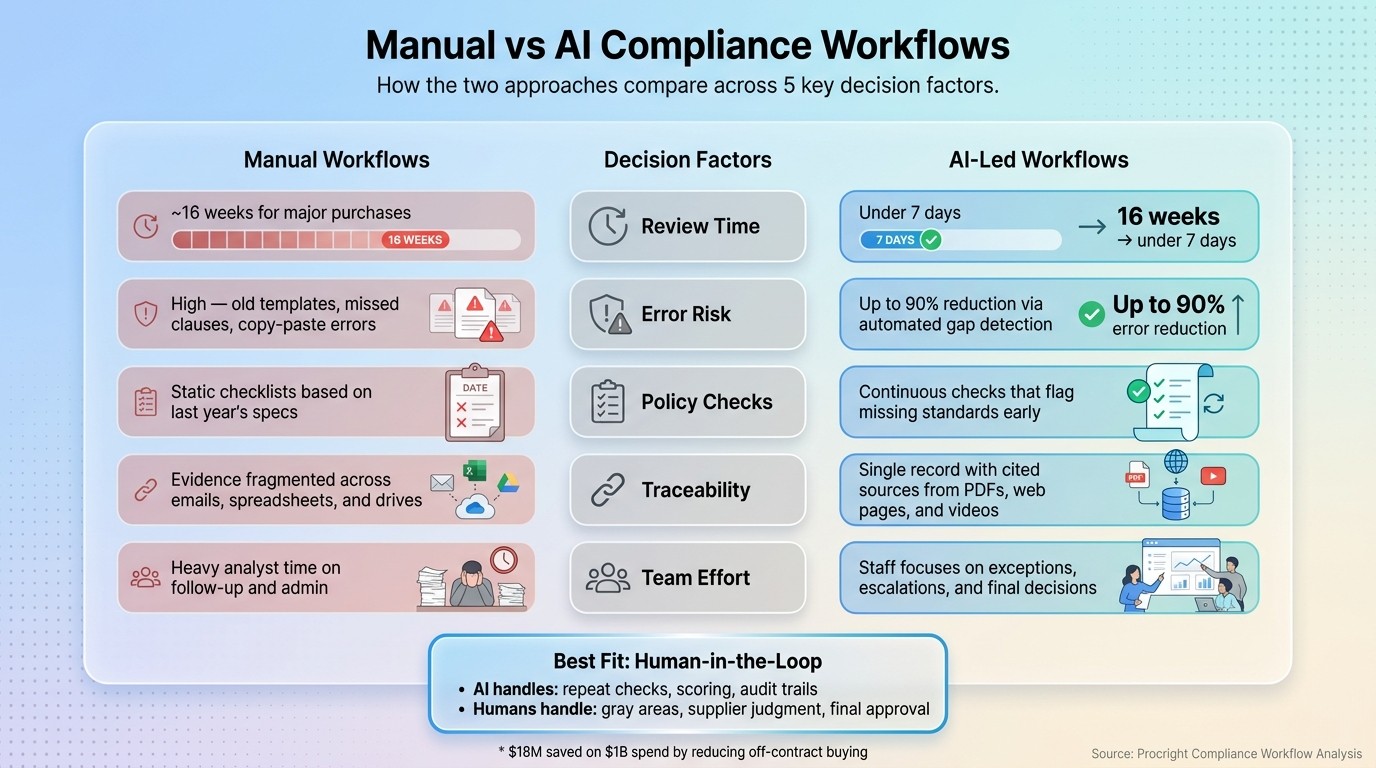
Manual vs AI Compliance Workflows: Side-by-Side Comparison
How AI Is Transforming Compliance Workflows
Manual Compliance Workflows: Strengths, Limits, and Team Time Costs
Manual compliance workflows depend on people to gather requirements, review vendor documents, ask follow-up questions, and pull together approval records.
Review Time, Error Risk, and Policy Coverage in Manual Review
In most manual reviews, analysts go through datasheets one at a time and compare them against requirements copied from older specs or templates. That sounds workable on paper. In practice, it often means the review starts with guesswork. And when the starting point is fuzzy, scoring gets inconsistent and gaps slip through.
Weak requirements create problems before anyone even opens a vendor file. If a requirement says something like "enterprise-grade security" but never defines what that means, vendors tend to fill in the blanks with assumptions that work in their favor. At that point, the review is already on shaky ground. Add copy-paste mistakes and missed clauses, and the risk grows fast. One overlooked line can turn into a compliance problem.
Those same weak spots also make it much harder to explain a decision later.
Traceability and Team Effort in Manual Workflows
Slow review cycles are only part of the issue. The other problem is scattered evidence. In manual workflows, proof often lives across inboxes, shared drives, and spreadsheets, which makes audits hard to reconstruct.
The team burden gets heavier as volume climbs. Procurement and compliance staff spend a lot of time following up, sending emails for vendor clarifications, and nudging approvers in other teams. As Procright puts it: "In a typical enterprise RFP, buyers spend more time chasing vendor clarifications than they do evaluating the actual products."
Ownership is often split. Engineering, IT, or health-and-safety may control the specs, while procurement owns price, compliance, and supplier risk. Managing these threats effectively often requires supplier risk monitoring with AI tools to move beyond static manual audits. When those groups aren't lined up, approvals can drag on for months. Manual workflows also create more rework because evidence is spread across too many tools and too many people, though custom procurement workflows can solve these visibility and speed issues.
When Manual-Only Review Still Makes Sense
Manual review still has a place when judgment matters.
One case is ambiguous regulatory interpretation. If a rule is unclear or depends on context, a compliance officer or legal stakeholder has to make the call. No automated system can do that with steady accuracy. Human judgment matters for reading unclear rules, checking sources, handling exceptions, and approving implementation details a system might miss.
Another case is high-stakes approvals that involve ethical calls or big cost-risk trade-offs. In those situations, final sign-off from subject-matter experts and legal stakeholders still matters.
When checks are repetitive and the rules are explicit, automation can take care of the routine work.
AI-Led Compliance Workflows: Faster Checks, Less Repeat Work, Better Records
AI-led workflows cut out the repeat work that slows manual review.
How AI Improves Review Speed and Consistency
AI can pull evidence from vendor PDFs, technical manuals, and videos, then map each answer to a requirement line in minutes. Work that may take 30 days by hand can be done in minutes. That changes the pace of a procurement cycle in a big way.
Speed gets most of the attention. But consistency matters just as much.
Manual reviews can shift from one reviewer to another. People get tired. Standards drift. AI applies the same rules to every vendor every time, scoring each spec line against the same criteria.
It can also spot issues earlier. Instead of waiting for a vendor to submit a document built on assumptions, AI agents can flag missing technical details and compliance standards before the specification is finalized.
Policy Checks, Audit Trails, and Team Effort at Scale
Continuous policy checking is one of the clearest upsides of AI-led workflows. Instead of doing a one-time review at the end of a cycle, AI can surface contradictions in vendor claims and flag missing data throughout the process.
AI also records each score on its own. Every compliance score links back to a specific source, such as a page in a manual, a timestamp in a video, or a line on a web page. That gives teams a defensible record. Manual records are often incomplete because they take time to compile.
The impact on team effort is just as important. Procurement staff spend less time chasing clarifications and filling in templates. They can put more time into exception handling and analysis.
How Procright Supports AI-Led Procurement Compliance
Procright is built around this model. The platform automates specification creation, product discovery, and compliance verification in a single record.
Its AI scores each requirement as Yes, Partially, No, or Not Found and ties each score to cited evidence.
Teams can also assign importance levels to specific requirements, so the final compliance score reflects what matters for that purchase. Real-time collaboration keeps engineering, IT, and procurement in one spec, which helps cut version conflicts.
These differences stand out even more in the side-by-side comparison below.
Manual vs AI Compliance Workflows: Side-by-Side Comparison
Across five decision factors, the gap is pretty clear:
Comparison Table Across 5 Decision Factors
Decision Factor | Manual Workflows | AI-Led Workflows | Implications for U.S. Teams |
|---|---|---|---|
Review time | Major purchases typically take 16 weeks | Can be completed in under 7 days | Faster approvals on major buys |
Error risk | Old templates miss requirements | Up to 90% reduction in errors via automated data validation | More confidence in technical compliance before a vendor is selected |
Policy checks | Static checklists based on last year's specs | AI collects stakeholder input to surface missing standards before final approval | Teams adjust faster when internal policies or regulations shift |
Traceability | Evidence fragmented across emails, spreadsheets, and drives | Single record with cited evidence from PDFs, web pages, and videos | Audit evidence is already assembled |
Team effort | Heavy reliance on analysts and expensive consultants | Staff shifts to exceptions, escalations, and final decisions | Specialists spend more time on exceptions |
What These Differences Mean for Day-to-Day Operations
These differences show up in the daily grind. They affect how fast teams approve purchases, how they deal with issues, and how much pain an audit creates.
The jump from 16 weeks to under 7 days isn't just about looking faster on paper. It's about cutting the back-and-forth that slows everything down - document-by-document review, vendor follow-up, and waiting on missing details. Every delay pushes purchasing further out.
Traceability is often where the gap hits hardest during audits. With manual workflows, teams often have to piece records back together from old emails, spreadsheets, and shared drives. That's slow, messy, and easy to get wrong. AI-led workflows log each check and connect it to a source, so the record is ready when audit time comes.
The shift in team effort matters just as much. In manual workflows, buyers spend too much time chasing vendor clarifications instead of judging the products in front of them. AI pushes more of that work toward what people are best at: handling exceptions, making escalations, and deciding the final call.
Choosing the Right Workflow Mix and Key Takeaways
A Hybrid Model for Procurement Teams
Given the trade-offs above, most teams need a hybrid workflow, not a fully manual setup or a fully AI-run one.
For most U.S. procurement teams, the best fit is human-in-the-loop: AI handles repeat checks, and people handle judgment. AI is well-suited for high-volume, repeatable work like drafting specifications, searching web pages, PDFs, and videos for evidence, running item-by-item compliance scoring, and producing audit-ready records.
People step in where judgment matters most. That includes reviewing edge cases when the data conflicts, managing supplier relationships, and signing off on purchases where the final call needs to stand up to scrutiny.
This mix makes the most sense for high-value purchases, complex technical categories, and buys that are likely to face audits. Platforms like Procright are built around this model. They automate specification creation, product discovery, and compliance verification while keeping humans in charge of the final call.
Final Summary of the Comparison
Across review speed, risk, policy checks, traceability, and effort, the same pattern shows up again and again. AI-led workflows reduce repeat work, cut specification errors, and keep audit trails usable over time. At the same time, neither side can do the whole job alone.
Workflow Stage | Best Handled By AI | Best Handled By Humans |
|---|---|---|
Requirements drafting | ✓ | Goal setting |
Gap identification | ✓ | Difficult clarifications |
Compliance scoring | ✓ | Reviewing contradictions |
Audit trail generation | ✓ | Final accountability |
High-risk final approval | - | ✓ |
For procurement leaders looking at workflow changes right now, the starting point is simple: find where your team spends the most time on repeatable tasks, then test whether AI can take that work off their plate.
FAQs
When should compliance reviews stay manual?
Manual compliance reviews matter when the final call needs human judgment or internal knowledge that an automated system just can’t apply on its own.
AI can take care of the repetitive work: scanning documents, flagging missing requirements, and scoring compliance. But people still need to stay in the loop for the parts that carry more weight. That includes checking high-stakes assumptions, getting stakeholders on the same page, and making sure the final auditable recommendation fits the organization’s exact situation.
What tasks should AI handle in a hybrid workflow?
In a hybrid workflow, AI should take the repetitive, data-heavy work that drives procurement decisions. That includes:
Drafting specifications by spotting missing requirements and checking whether the category is fully covered
Scanning web pages, PDFs, and videos to find products that match the need
Verifying compliance by matching requirements to product data, scoring the results, and flagging contradictions
How does AI make audits easier?
AI makes audits a lot easier because it creates one traceable record for each procurement decision. Instead of digging through scattered emails and spreadsheets, teams get a clear audit trail that links every compliance score back to its source, whether that’s a manual, product video, or technical document.
That source-level citation matters. When each requirement is backed by documented evidence, teams can explain and defend their decisions later using objective data instead of memory or guesswork.
Related Blog Posts
Try it on a real buy
Bring one category. Watch where the flags land.
We use a little analytics to see which pages actually help. Nothing else, no ad trackers.