Privacy Monitoring Checklist for Vendor Reviews
Five-step vendor privacy checklist: define data scope, limit use, set retention, vet subprocessors, and require breach notice proof.
In this article
Most vendor privacy reviews fail for one simple reason: teams check different things, at different times, with different proof.
I’d boil this checklist down to five checks you should make before approval: define the data scope, limit how the vendor can use that data, set clear retention and deletion dates, review subprocessors and cross-border access, and lock down breach notice terms with source documents. It also makes one point that’s hard to ignore: only 17% of leaders say they have high confidence in the data behind their third-party risk programs.
If I were using this checklist, I’d make sure it covers:
What data the vendor touches
Why the vendor needs each data type
Who can access it and from where
How long data, logs, and backups stay in place
Which subprocessors are involved
What transfer method covers cross-border data movement
When breach notice must be sent
Which proof documents are needed for sign-off
A simple way to read the article is this: privacy review is not just a contract check. It’s a documented review of data use, access, retention, transfer, and proof files that teams can reuse at onboarding, renewal, and reassessment.
That’s the core takeaway of the article below.
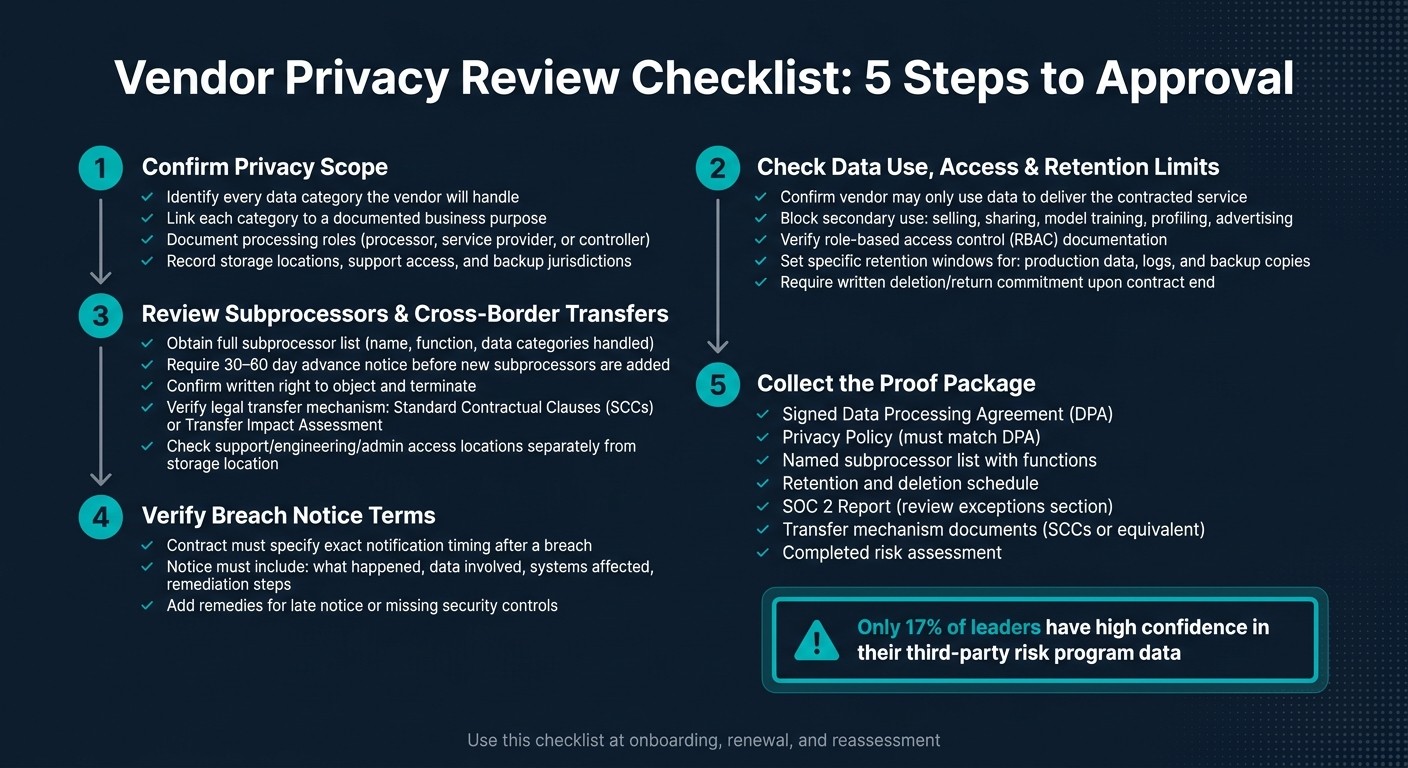
Vendor Privacy Review Checklist: 5-Step Process
Assessing Vendor Risk: A Deeper Dive Webinar
1. Confirm Vendor Privacy Scope
Once the approval threshold is set, pin down the exact data in scope. Before the contract is signed, identify every data category the vendor will handle and the business purpose tied to each one. If a scope does not link each data category to a documented business purpose, reject it.
List the Data Categories and Business Purpose
Review each type of data the vendor will receive and ask a simple question: does the service actually need it? That means separating personal data, employee data, customer records, usage logs, support content, and sensitive data, then tying each category to a clear business reason. From there, map each category to one service function.
If a vendor asks for data that does not map cleanly to a service function, treat that as a warning sign before moving ahead. It’s much easier to catch unapproved data expansion now than after the contract is in place.
After the scope is clear, verify who processes the data and where that processing happens.
Document Processing Roles and Locations
Confirm whether the vendor acts as a processor, service provider, or controller for each activity, and get that in writing. Document where data is stored, where it is processed, and where it can be accessed. Record both the hosting location and any remote access location.
U.S.-based hosting does not rule out foreign remote access. That gap matters when you need the full picture of processing and access paths.
Processing Detail | What to Verify |
|---|---|
Processing role | Processor, service provider, or controller status for each activity |
Primary storage location | U.S.-based data center vs. international hosting |
Support access | Whether support staff can access live data and from which locations |
Administrative access | Any non-U.S. personnel with system-level access |
Backup locations | Where backup copies are stored and under what jurisdiction |
Don’t accept vague labels. Require specific, written processing details. Do not approve vendors that cannot document roles, storage locations, and access paths.
2. Check Data Use, Access, and Retention Limits
Once you’ve confirmed roles and locations, the next step is simple: check what the vendor is allowed to do with your data and how long they can keep it. Start with use limits, then move to retention. Those two points set the boundaries after access is approved.
Verify Permitted Use and Internal Access Restrictions
The contract should say, in plain terms, that the vendor may use your data only to deliver the service you’re paying for. It should also clearly block secondary use like selling, sharing, model training, profiling, or advertising unless you give written approval.
Then look at internal access. It’s not enough for a vendor to say access is restricted. You want proof that access inside the company is controlled through documented role-based access control (RBAC), and that support access is limited to people who need it to do their job. Ask for named access controls, not vague marketing claims.
Access rights can drift over time. A vendor may start with a small group, then add more teams later. That’s why the contract should require notice when the scope of access changes.
Confirm Retention, Return, and Deletion Timeframes
Each in-scope data category should have its own retention window. Don’t settle for one broad policy that covers everything. Check for specific limits on production data, logs, and backups. Log retention, in particular, should be tied to an actual service need, with a clear maximum period.
When the contract ends, the vendor should commit in writing to return or delete your data within a set timeframe. That should include backup copies too, not just live production systems. Ask for written confirmation as part of the final proof package.
Data Type | What to Require |
|---|---|
Production data | Defined retention period tied to service need |
Logs | Maximum retention period; no secondary use |
Backup copies | Deletion deadline after account closure |
Next, verify subprocessors, transfer paths, and contract flow-downs.
3. Review Subprocessors, Cross-Border Transfers, and Contract Terms
Subprocessors and remote access can push data past the main vendor, so you need to review both the vendor chain and the transfer path, or compare products for compliance to streamline the process.
Validate the Subprocessor List and Flow-Down Obligations
Most vendors use subprocessors. Ask for the current subprocessor list, then check that it does more than just name companies. It should spell out who each entity is, what it does - such as hosting, analytics, or customer support - and which data categories it handles. A list with names and no context doesn't tell you much.
Two contract terms matter most.
The vendor should give you advance notice, usually 30 or 60 days, before adding a new subprocessor.
You should have a written right to object and terminate if that objection isn't resolved.
Without those terms, a vendor can slip in a risky subprocessor between review cycles.
You also want the vendor to bind subprocessors to the same privacy and security standards in the main contract. Don't settle for a verbal assurance. Ask to review the subprocessor agreement template itself. Then check the exceptions section of the vendor's SOC 2 report. If it says subprocessor controls were ineffective, that's a plain red flag. You can also use AI tools for supplier risk assessment to monitor these flags continuously.
After that, find out whether any of those parties - or their support teams - move data across borders.
Check Storage, Support Access, and Transfer Mechanisms
Storage isn't the only transfer issue. Support access matters too. Those are two separate checks. A vendor may keep data in one region, but if support, engineering, or admin staff access it from another country, you may still have a transfer risk.
Confirm the legal transfer mechanism for any international data movement. Look for Standard Contractual Clauses (SCCs) or a documented transfer impact assessment. If the vendor says it offers regional hosting, verify what that means in practice. Does it limit support, engineering, or admin access as well, or does it only pin down where the data sits?
Checklist Item | What to Verify | Goal |
|---|---|---|
Subprocessor list | Name, function, and data category for each entity | Full downstream visibility |
Advance notice period | 30- or 60-day notice before new subprocessors go live | Time to evaluate new risks |
Flow-down obligations | Subprocessor agreement template with matching standards | No gaps in the accountability chain |
Legal transfer basis | SCCs, transfer assessments, or equivalent legal basis | Valid legal basis for cross-border movement |
Support access locations | Countries where support, engineering, or admin staff access data | Catch transfer risk from remote access |
After you confirm subprocessors and transfer paths, move on to breach-notice terms and the proof package.
4. Verify Breach Notice Terms and Proof Documents
Check Breach Notification Timing and Required Details
Once you've confirmed subprocessors and transfer paths, move to breach notice terms and the proof you need for sign-off.
The contract should state exactly when the vendor must notify you after a breach. It should also spell out what the notice must include, such as what happened, which data was involved, what systems were affected, and what the vendor is doing next.
This can't be vague. And it shouldn't show up later as a side note after you've already picked the vendor. Breach terms need to be in the contract from day one. It's also smart to add clear remedies if notice comes in late or if required security controls aren't in place.
Collect the Final Proof Package for Approval
Ask for written proof for every privacy claim. Before approval, collect and review these documents:
Document | What to Verify |
|---|---|
Data Processing Agreement (DPA) | Signed, current, and covers all in-scope data categories |
Privacy Policy | Matches the DPA and actual use case |
Subprocessor List | Named entities, functions, and data categories handled |
Retention and Deletion Schedule | Specific timeframes that match regulatory requirements |
SOC 2 Report | Review the exceptions section before approval |
Transfer Mechanism Documents | SCCs or equivalent for all cross-border movement |
Completed Risk Assessment | Completed risk assessment tied to the review decision |
"The SOC 2 report is filed away the moment it arrives, nobody reads the exceptions section, and the same vendor is reapproved on autopilot the following year. Meanwhile, that vendor's subprocessors change... and nobody notices until an incident traces back to a fourth party." - Olajide Olaniran, CISA CISM CRISC
Conclusion: Use the Checklist as a Repeatable Review Standard
A privacy vendor review is not a one-and-done task. This checklist gives you a standard process you can use every time: define privacy scope, limit data use and access, confirm retention and deletion terms, review subprocessors and transfer mechanisms, and require documented breach terms plus proof files.
That kind of consistency matters. Only 17% of leaders report high confidence in the data behind their third-party risk programs. A repeatable checklist gives you a clean record of what was reviewed, when it was reviewed, and what evidence backed the decision.
Treat the finished checklist as a living record. Vendor risk changes over time. Organizations are increasingly using supplier risk monitoring with AI tools to move from annual audits to real-time alerts. Certifications expire, subprocessors change, and cloud infrastructure shifts. The checklist you complete today becomes the starting point for the next review.
FAQs
Who should own the vendor privacy review?
Vendor privacy review needs clear ownership from day one. But it shouldn’t be handled like a box you check once and move on.
Vendor risk can shift over time. A provider may change its data practices, add new subprocessors, or roll out new features that affect how personal data is handled. That’s why teams need a documented, traceable record of privacy compliance and should review it on a regular basis throughout the relationship.
How often should vendor privacy reviews be updated?
Vendor privacy reviews shouldn't stop at a once-a-year check or a one-time assessment. Risk can shift at any moment.
Instead, use continuous monitoring and trigger-based reassessments. That way, you can spot changes such as new subprocessors, cloud infrastructure updates, or lost security certifications before the next scheduled review.
What if a vendor refuses to share proof documents?
Treat it as a major red flag.
Procurement decisions should rest on proof you can check, not sales promises. If a vendor can't back up compliance claims, you don't have a clear, auditable baseline for the relationship.
Try to confirm those claims through public product docs, technical manuals, or third-party audits. If you still can't verify them, the vendor may fall outside your organization's risk tolerance or transparency standards.
Related Blog Posts
Try it on a real buy
Bring one category. Watch where the flags land.
We use a little analytics to see which pages actually help. Nothing else, no ad trackers.