Purchase Price Variance Definition: Formula and Examples
Purchase price variance is the gap between the actual unit price paid and the standard unit price, multiplied by the actual quantity of items purchased.
In this article
Purchase price variance is the difference between the actual unit price paid and the standard unit price, multiplied by the actual quantity purchased. If a report shows a large variance, did the supplier really raise its price, or did two documents describe different things? That question matters because a quote, a purchase order, a receipt and an invoice can each carry a different price for what looks like the same item. Until you know which price should be compared with which standard, the number can mislead you. The definition is simple. Proving that the result reflects a real price change takes more care.
Table of Contents
What Purchase Price Variance Means
The purchase price variance definition is this: it is the gap between the actual unit price paid for a purchased item and its predetermined standard or budgeted unit price, multiplied by the quantity bought. It's a price measure. It doesn't tell you whether production used too much material, and it isn't just a comparison between a quote and an invoice.
Your team usually sets the standard during budgeting or planning, often before anyone places the order. By the time goods arrive, supplier pricing, freight, exchange rates, market conditions, order size or a buying decision may have moved the price away from that earlier figure. PPV puts a money value on that price movement for the quantity you purchased.

Who Uses the Figure and Why
Procurement teams use it to review buys and check supplier performance. Finance teams use it for budget control and to explain why material costs differ from plan. Analysts use it to spot material price movements that may affect future forecasts.
Those uses only work if you keep price separate from quantity. Usage variance is about how much material production consumed compared with the standard quantity. PPV is about what you paid per unit for what you purchased, even if production hasn't used it yet.
Key Terms That Sit Alongside Purchase Price Variance
Term | Meaning | Relationship to PPV |
|---|---|---|
Standard cost | Predetermined expected cost of an item | PPV measures the price gap against this figure |
Actual cost | Price posted from matched invoices and receipts | The actual side of the comparison |
Usage variance | Gap between quantity used and standard quantity | Separate from PPV, which uses quantity purchased |
Landed cost | Price plus freight, duties and handling | Included in PPV only if the standard includes these elements |
Price break | Lower unit price at a higher order quantity | Often explains why small orders show unfavorable PPV |
Two labels appear on almost every report. A favorable variance means you paid less than standard. An unfavorable variance means you paid more. Don't read either label as a final judgment until you've checked what the standard includes and whether the item, unit and terms stayed the same.
Read PPV as a question, not a verdict. It tells you where the price differed from plan, then asks you to find out why.
PPV Formula and Worked Calculations
PPV = (Actual Unit Price minus Standard Unit Price) × Actual Quantity Purchased
That single line is the whole calculation. The Amazon Business guide to purchase price variance uses that formula. As an illustrative example, a company purchases 10,000 units at $12.40 each while its standard price is $12.00, giving an unfavorable PPV of ($12.40 minus $12.00) × 10,000 = $4,000.
Work through it slowly. First, find the unit gap, which is $0.40. Then multiply that gap by the quantity purchased. You aren't multiplying by the quantity you planned to buy, and you aren't multiplying by the quantity production later used.
Adding the Percentage
A money figure alone is hard to compare across items. Convert it to a percentage by dividing the unit gap by the standard price. In that first example, ($0.40 ÷ $12.00) × 100 = 3.33% above standard.
The percentage answers a different question. The $4,000 tells finance how much money is involved in that buy. The 3.33% tells you how far the unit price moved, so you can compare a cheap fastener with an expensive motor on the same scale.
A Second Unfavorable Example
Say a manufacturer sets an annual standard of $50.00 for a component and buys 2,400 units at $52.25. The unit gap is $2.25. Multiply it by 2,400 and you get $5,400 unfavorable, which is 4.5% above standard.
Notice the pattern. You don't need the total invoice value first. You need three inputs you can check on documents: actual unit price, standard unit price and actual quantity purchased.
A Favorable Example
Now reverse the direction. Say you buy 5,000 units at $11.50 against a $12.00 standard. The unit gap is -$0.50, so the result is -$0.50 × 5,000 = -$2,500.
The minus sign means you paid less than standard. In reports, teams often show that as $2,500 favorable. Keep the sign in your working notes, because it prevents errors when you add favorable and unfavorable lines together.
Worked PPV Calculations by Scenario
Scenario | Actual unit price | Standard unit price | Quantity purchased | PPV result |
|---|---|---|---|---|
Bulk metal order, unfavorable | $12.40 | $12.00 | 10,000 | +$4,000 (3.33% above standard) |
Annual component buy, unfavorable | $52.25 | $50.00 | 2,400 | +$5,400 (4.5% above standard) |
Cheaper supplier, favorable | $11.50 | $12.00 | 5,000 | -$2,500 |
Price matches standard | $12.00 | $12.00 | 5,000 | $0 (on standard) |
Two Rules That Prevent Most Errors
Use quantity purchased or received: Use the quantity for the period you're analyzing, not the quantity later issued to production. That keeps the price effect separate from how efficiently production used the material.
Match the cost basis: Include freight, duties or handling in the actual price only if your standard includes those same elements. If the standard excludes freight, a freight charge on the invoice isn't part of PPV.
Check your inputs first: If the unit price, quantity or cost basis is wrong, a correct formula will still produce a wrong answer.
Check the sign convention in your own system before you compare reports. Some texts reverse the subtraction, so their favorable results appear positive. The economics don't change, but the sign does.
Choosing the Right Price When Documents Disagree
Start by fixing the standard basis. Write down the standard unit price, the landed cost elements it includes, such as freight, duties and handling, plus the currency and date of that standard. If you can't state those four points, you don't yet have a reliable comparison.
Then build the actual side from matched, posted documents only. A helpful way to see how the documents connect is to review how an invoice for a purchase order should tie back to the order and receipt before payment.
Four Steps in Order
Treat the PO price as provisional: Label PO-based estimates clearly and reconcile them when the invoice is matched and posted. Follow your accounting policy and ERP rules for recording any receipt-stage PPV.
Use the invoiced unit price for PPV: Strip out freight or duties when the standard excludes them, and report those amounts separately. Mixing them into the unit price creates a false supplier increase.
Post the receipt in the right period: Assign the goods receipt to the period in which it was posted. A delivery posted late can pull last month's price effect into this month's report.
Convert currency on a consistent basis: Use the exchange-rate basis required by your accounting policy and ERP configuration. Keep price variance separate from exchange-rate variance where the system does so, and record the rates and dates used so a reviewer can repeat the calculation.
A Worked Case Where PPV Is Zero
Say a component has a $50.00 standard that excludes freight. You order it at $50.00, but the invoice shows $52.25 per unit, including $2.25 of freight, across 2,400 units.
The invoice total is $5,400 above the standard goods value, but PPV is $0. The supplier's goods price didn't change. That $5,400 is a freight variance, and it belongs in a separate line where logistics can explain it.
Contract index clauses follow the same logic. If a documented index in the contract drives a price rise, you have an explained cause you can cite. If a PO price rises with no clause, quote or approval behind it, you have an unexplained rise that needs investigation.
Reading Favorable and Unfavorable Results
With the formula used here, a positive PPV is unfavorable because you paid more than standard. A negative PPV is favorable because you paid less. That wording confuses many readers at first, since positive numbers usually sound good. In cost reports, paying more is the unfavorable outcome.
Check the convention before you act. Some accounting texts reverse the formula, which reverses the sign. If you're comparing two reports, confirm both calculate actual minus standard, or you'll read a saving as an overrun.
Put the Money Figure in Scale
A $4,000 variance means more when you compare it with the standard spend. On 10,000 units at a $12.00 standard, the standard total is $120,000, so $4,000 is 3.33%. That percentage lets you compare items with very different prices and volumes without being misled by size alone.
For a wider view of how actual results should be read against a budget, the budget analysis insights from AmbitionCFO are a useful companion to a PPV report. They help you separate a one line price gap from the wider budget story.
A large one off gap: It deserves a document check, but it may not change next month's forecast if the cause won't repeat.
A small steady drift: It can matter more, because it repeats on every order and slowly makes the budget and product costs wrong.
A favorable result from a lower spec: It isn't a saving if quality, warranty or pack size changed with the price.
Why Zero Is Not Always the Target
A near zero PPV is a sensible aim only when your standards are current and price variability is low. In a stable category with a fixed contract price, repeated variance should prompt questions. In a volatile category, prices will move away from an annual standard even when buyers negotiate well.
Pushing every category to zero can hide real market movement. It can also push teams to lock in poor terms just to match an old standard, or to delay a needed standard update because the variance looks like failure. A explained variance with current standards is more useful than a forced zero.
A sign never proves performance on its own: You still need the cause, the trend and proof that you compared like with like.
Read the result in three layers. First the sign, then the percentage, then the pattern over time. Only after that should you judge a supplier, a buyer or a standard.
Common Causes of Purchase Price Variance
The most common cause is a genuine supplier list price change. You'll usually see the unit price rise and stay at the new level across repeat orders. But don't assume that explanation first, because several other causes leave a very similar number.
The diagram below groups the causes buyers meet most often.

Freight and duties are a frequent trap. If those charges sit outside the standard but appear inside the invoice unit price, the line looks like a supplier increase. Currency works the same way when a foreign invoice is converted at a different rate from the one used in the standard.
Order size matters too. A small order may miss the supplier's price break for larger volumes, so you pay a higher unit price even though the price list hasn't changed. Spot buying outside a contract can also produce a one off premium, especially when a team needs goods quickly. Learning to break down price into goods, freight, fees and volume tiers helps you see which part moved.
Causes of PPV, Their Signals and the First Check
Cause | What it looks like | What to check |
|---|---|---|
Supplier list price increase | Unit price rises across repeat orders | Contract index clause and supplier price-change notices |
Freight or duties outside the standard | Invoice total higher than the PO unit price | Whether landed-cost elements belong in the standard |
Currency movement | Foreign-currency invoices differ from standard in local currency | Accounting-policy and ERP exchange-rate basis; price variance versus exchange-rate variance |
Small-order premium | Low quantities priced above standard tiers | Order quantity against the supplier's price-break table |
Spot buying outside contract | One-off purchases above contract price | Whether a contract existed and why it was bypassed |
Stale standard | Variance appears every period with no market cause | Date and approval of the current standard cost |
Scope or unit mismatch | Price looks different because pack size or specification changed | Unit of measure and specification version |
Timing can imitate a price change. The PO price may have changed, the invoice may include extra charges, or the receipt may be posted in another period. Each cause needs a different fix, so naming the right one matters before you contact the supplier.
Test causes in a fixed order. Start with specification and unit of measure, because a pack of ten priced against a standard for a pack of twelve creates a false variance that no supplier action will fix. Then check landed cost, currency and period. Only then test whether the supplier's goods price really changed.
How PPV Flows Into Financial Reports
Follow one purchase from receipt to sale and the accounting becomes clearer. Say your team buys material and records a $4,000 unfavorable PPV. That amount doesn't always hit profit in the month you buy the material. Where it sits depends on where the material sits.
Under standard costing, inventory is often recorded at standard cost and the difference goes to a materials purchase price variance account. The Principles of Accounting guide to variance analysis explains that if that variance is recorded in such an account, it may later need allocation across raw materials inventory, work in process, finished goods, and cost of goods sold.

Following the Material
Raw materials inventory: If the material is still in stores at period end, its share of the variance stays linked to inventory. It hasn't yet reduced the period margin through cost of sales.
Work in process: Once you issue the material to production, the related share moves with that job. The goods aren't finished, so the effect sits in work in process rather than in sold goods.
Finished goods: When production completes the item but you haven't sold it, the share sits in finished goods inventory. The cost is complete, but the sale and margin haven't happened yet.
Cost of goods sold: When you sell the finished item, its share moves into cost of goods sold. That's when an unfavorable variance reduces reported margin for the period, and a favorable variance improves it.
That path explains a common source of confusion in budget reviews. Procurement may report a price gap in the month of purchase, while finance sees the margin effect later when the goods sell. Both can be right. They're looking at the same variance at different points in its life.
The same variance can sit in inventory on one reporting date and in cost of sales on another. Ask where the material is before you ask why margin moved.
Because timing matters, investigate PPV alongside purchase dates, quantities, contract terms, exchange rates and inventory status. If you look only at the variance account balance, you may blame this month's buying for material that was bought earlier and sold now, or miss a current price rise because the goods are still in inventory.
Keep the operational and financial views connected. Procurement needs the price signal early, when it can still renegotiate or change supplier. Finance needs the allocation to be accurate at period end, so inventory and margin aren't misstated. A clear purchase record serves both needs.
Using PPV to Judge Suppliers and Standards
A repeat unfavorable PPV can support a real sourcing decision, but only after you've tested it. It may justify renegotiation, a re-bid or moving volume to another supplier. A repeat favorable result at the same specification may support keeping the current contract. The pattern matters more than one invoice.
Say a supplier bills $12.40 against a $12.00 standard on order after order. Each 10,000 unit buy produces the same $4,000 gap. That's a strong reason to talk, but it isn't yet proof the supplier is overcharging.
Test the Standard Before You Blame the Supplier
First confirm the standard and specification. Ask when finance last approved the standard, what cost elements it includes, and whether engineering changed the item. If the standard is too low, a fairly priced supplier will look expensive every month. If it's too high, it will hide overpricing and make weak buying look favorable.
Compare like with like: Compare suppliers only for the same item, specification, pack size, delivery term and warranty. A lower price for a different scope isn't evidence of better performance.
Look for persistence: A variance that repeats across periods with no matching market explanation points to either a supplier issue or a wrong standard. Both need action, but not the same action.
Check contract compliance: Confirm the invoiced price matches the contract price and any index clause. A supplier billing above its own contract is a compliance issue, not just a market movement.
When a price change is permanent and documented, reset the standard through the normal approval route. Keeping an old standard after a contract has been renegotiated guarantees meaningless variance in every future period. The report will keep flagging a known price as if it were a surprise.
Use the result at category level as well. Categories with repeat unfavorable PPV from supplier increases need tighter contracts, clear index clauses and notice periods for price changes. Categories where variance comes mainly from planning errors need better budgeting, more current standards and clearer cost bases, not tougher supplier talks.
Don't score a supplier with a standard you wouldn't defend in the room. If you can't explain how the standard was set, fix that first.
PPV is strongest as a trigger for a documented decision. It tells you which supplier, item or standard to examine, and the documents tell you whether to renegotiate, re-bid, keep the contract or revise the plan.
Audit Trails That Make PPV Defensible
A reviewer will ask one central question. How do you prove that PPV represents a real price change rather than a scope, timing, or landed-cost mismatch? The Oracle documentation on calculating purchase price variance defines PPV against standard material and landed costs using actual costs from matched, posted vouchers, which is why your evidence has to show that match line by line.
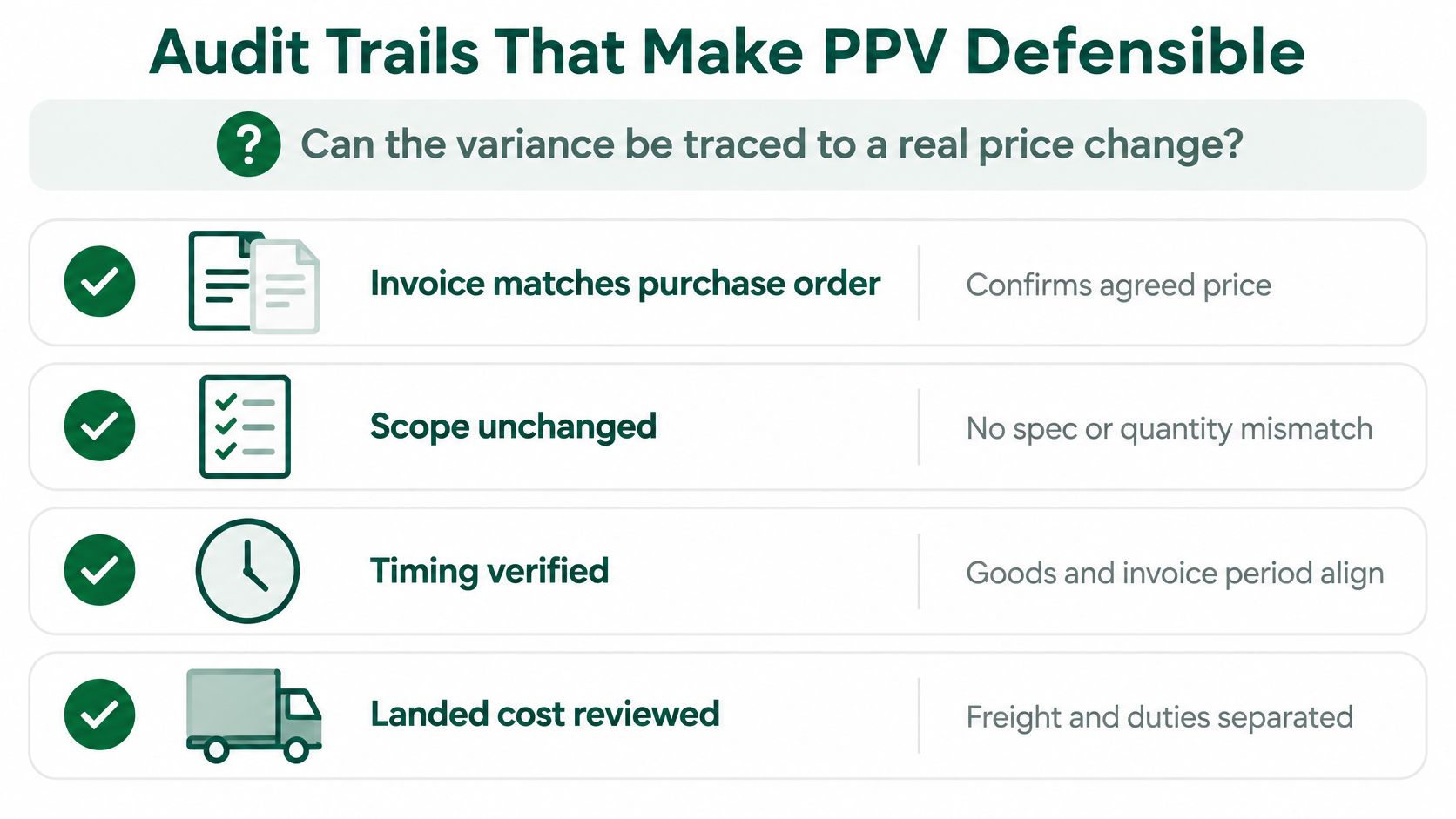
Evidence a Reviewer Asks For
Keep these items together for each purchase line, in this order:
Locked requirement: The specification version that was approved before sourcing, including unit of measure and pack size.
Supplier quote: The quoted unit price, terms, validity date and any price break table.
Purchase order: The price your team authorized, with delivery terms that show who pays freight and duties.
Goods receipt: The quantity received and the posting date that places it in the right period.
Invoice: The invoiced unit price, with freight, duties and fees shown separately where they aren't part of the goods price.
Index clause and currency basis: The contract clause behind any indexed rise, plus the exchange rates and effective dates used for the standard, purchase order and invoice.
Approval history for the standard: Who approved the standard price, when it took effect and what it replaced.
That last item is often missing. Your standard must be version controlled and dated, so an auditor can see which price applied on the purchase date. If finance changed the standard mid year, a variance calculated with the new price against an old purchase will be wrong.
Understanding why traceability is important helps here, because a PPV figure is only as strong as the chain of documents behind it. Each number should point to a source a reviewer can open.
A near zero result needs evidence too. Before you accept it, show that standards are current and price variability is low. Otherwise zero may mean the standard was moved to match the invoice, which removes the control the report is meant to provide.
Build a source cited decision record as you go. For each material line, note the price used, the document it came from, any amount you excluded and why, and the action you took. That record stays usable years after signature, when the people who made the buy may have moved on.
Confirm the Variance Before You Act
Use a short sequence every time a PPV line looks material. Don't start with the supplier call. Start with the comparison itself.
A Three Step Decision Sequence
Confirm the comparison is like for like: Check that the standard is current and approved, and that the unit of measure, specification, pack size and cost basis match the purchase. If they don't match, correct the record or the standard first.
Name the source of the gap: Decide whether it came from goods price, freight, currency, timing or order quantity. Use the quote, contract, receipt and invoice, not memory.
Choose the action that fits the cause: Accept a justified variance and update the standard if the change is permanent. Investigate the supplier when a price rise has no documented cause. Correct the standard or posting when the variance came from a mismatch.
Timing depends on the pattern. A single small line can wait for the next scheduled review, provided you've logged the cause. A repeat pattern on one supplier or item shouldn't wait, because every new order repeats the gap and makes product costs less reliable. That pattern should trigger renegotiation or a re-bid once your evidence is complete.
Start with the largest unfavorable line this period. Pull its source documents, test it against the three steps, and sign off only when each figure traces to a document. That one exercise will show you whether your PPV report is measuring prices or measuring paperwork differences.
When you need that document level proof for a sourcing decision, Procright helps you lock the specification, compare suppliers against it with cited evidence, and keep an audit ready record of why each supplier was kept or eliminated. Visit Procright to run your next purchase with prices, specification checks and approval evidence tied together from the start, so your variance figures stand up in review.
Try it on a real buy
Bring one category. Watch where the flags land.
We use a little analytics to see which pages actually help. Nothing else, no ad trackers.