Sole Source vs. Single Source Procurement Explained
Labeling a procurement decision sole source when single source is the correct classification raises the evidence burden and creates avoidable audit challenge risk.
In this article
A buyer selects an incumbent vendor because the team knows its systems, trusts its delivery record, and wants to avoid disruption. The requisition goes forward as sole source. During review, an auditor asks a simple question: “Which other suppliers did you rule out, and what evidence proves they couldn't meet the requirement?” The team has no market scan, no technical comparison, and no written finding that alternatives were impossible.
That file has a classification problem, not a vocabulary problem. The buyer may have made a defensible single-source choice, but labeling it sole source raises the evidence burden and creates avoidable challenge risk. Procurement teams that treat the terms as interchangeable often turn a preference into an unsupported claim of market exclusivity.
This issue appears in technical purchases, from replacement equipment and industrial systems to software licensing and factory automation. Teams evaluating AI for real-world factory outcomes should apply the same discipline to procurement specifications, especially when compatibility or operational continuity influences the preferred solution.
Table of Contents
Introduction Why This Distinction Decides Your Audit Outcome
An audit can turn on one classification. A sole-source justification asserts that only one supplier can meet the requirement. A single-source justification acknowledges that multiple suppliers could qualify, then documents why the buyer selected one. Treating those terms as interchangeable changes the evidence an approval file must contain.
Consider an enterprise replacing components in an installed production environment. The original manufacturer offers a compatible replacement without modification. Engineering prefers it because alternatives would require testing, integration work, and carry operational risk. That record may support a single-source decision if another supplier could meet the technical requirement. It supports sole source only when the buyer can establish that no other supplier can satisfy the complete requirement.
The specification often determines the outcome. Requirements limited to performance, compatibility, licensing, delivery, service, security, and acceptance conditions can reveal whether exclusivity is real. Requirements built around a named manufacturer, proprietary interface, or incumbent's familiar process can create an avoidable single-source result while appearing to prove sole-source necessity. Teams assessing AI for real-world factory outcomes should apply the same discipline to technical requirements and procurement records.
The classification affects the award file:
Approval burden: Sole source requires a clear finding of supplier exclusivity.
Market evidence: The buyer must show why capable alternatives do not exist, rather than why one vendor is familiar.
Audit exposure: A reviewer may challenge a sole-source label when the specification appears designed for one supplier.
Remediation: A weak classification can trigger added approvals, corrective documentation, or a new competition.
The practical test: Did the buyer lack a viable choice, or did it choose not to use available choices?
Use that answer to set the documentation standard before issuing the award. Procurement, finance, compliance, and technical teams should preserve the requirement, market evidence, selection rationale, and approvals in one record. A defensible file should remain understandable after the project team changes.
What Sole Source and Single Source Actually Mean
A defensible classification starts with the requirement, not the vendor. Define what the organization must receive, including technical performance, compatibility, licensing, delivery, service, security, and acceptance conditions. Then test whether another supplier could satisfy the complete requirement.
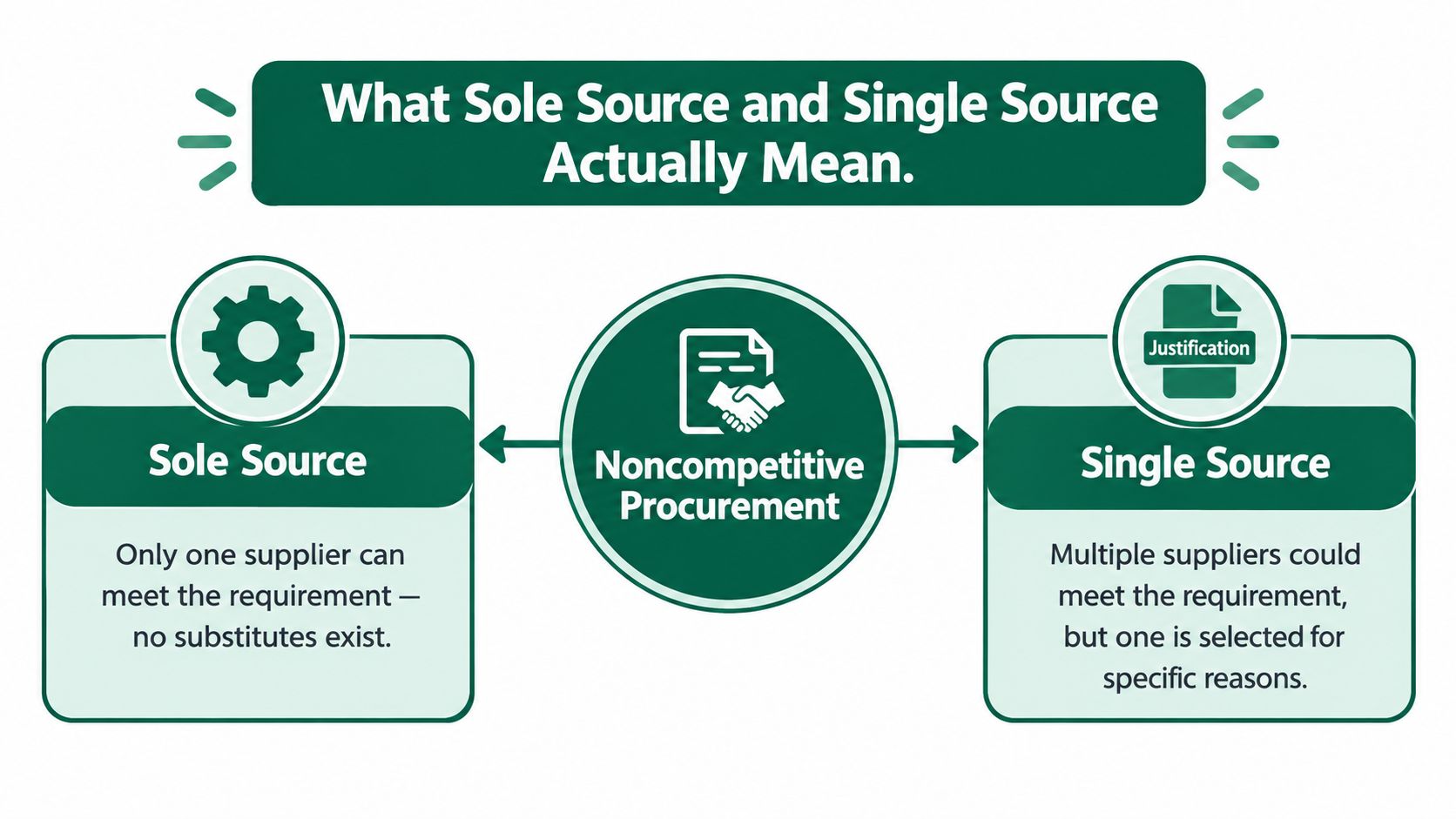
Sole source means only one supplier can meet that requirement. Public procurement guidance from Oregon, Washington, and South Carolina uses closely related language, describing a noncompetitive award where one known supplier can fulfill the need. The New York State procurement glossary states the central test: only one supplier can meet the requirement.
Single source means multiple suppliers could meet the need, but the buyer selects one. Expertise, prior experience, continuity, standardization, or another documented commercial reason may support that choice. The buyer is exercising a preference among capable suppliers, not documenting a factual monopoly.
Separate necessity from preference
Apply this sequence before requesting approval:
Define the complete need. A supplier may be the only source for an exact branded part, but that does not prove it is the only source for the business requirement.
Identify possible substitutes. Assess compatible parts, authorized alternatives, equivalent services, and suppliers that can meet the required performance outcome.
Test the selection reason. If continuity, institutional knowledge, or convenience drives the choice, the facts point toward single source.
Document the conclusion. If no viable alternative exists, record the technical and market reasons. If alternatives exist, explain why the selected supplier is preferable.
Specification design often creates the audit problem. Naming a proprietary interface, exact product family, or incumbent-specific process can leave one bidder without proving that the underlying need is exclusive. Separate a genuine technical constraint from a requirement written around a familiar supplier.
Sole source rests on factual exclusivity. Single source rests on strategic selection. The approval path and evidence file must match the conclusion the facts can support.
Sole Source vs Single Source Side by Side Comparison
The fastest way to classify a purchase is to compare the buyer's actual facts against the decision criteria. The table below is a working screen, not a substitute for the governing procurement policy.
Criteria | Sole Source | Single Source |
|---|---|---|
Competition status | No viable supplier alternative exists | Multiple suppliers could meet the requirement |
Core rationale | Factual exclusivity or unique capability | Deliberate preference among capable suppliers |
Buyer's position | Necessity limits the buyer's choice | The buyer retains a choice |
Evidence required | Proof that no alternate source can satisfy the requirement | Evidence explaining why one capable supplier was selected |
Typical justification | Proprietary replacement part, unique technical fit, exclusive rights | Standardization, continuity, expertise, or commercial preference |
Main audit question | Why can nobody else meet the need? | Why wasn't competition used or why was this supplier preferred? |
Challenge risk | Unsupported exclusivity claim | Unsupported bypass of available competition |
Best control | Market research and supplier-exclusivity evidence | Comparative analysis and documented selection rationale |
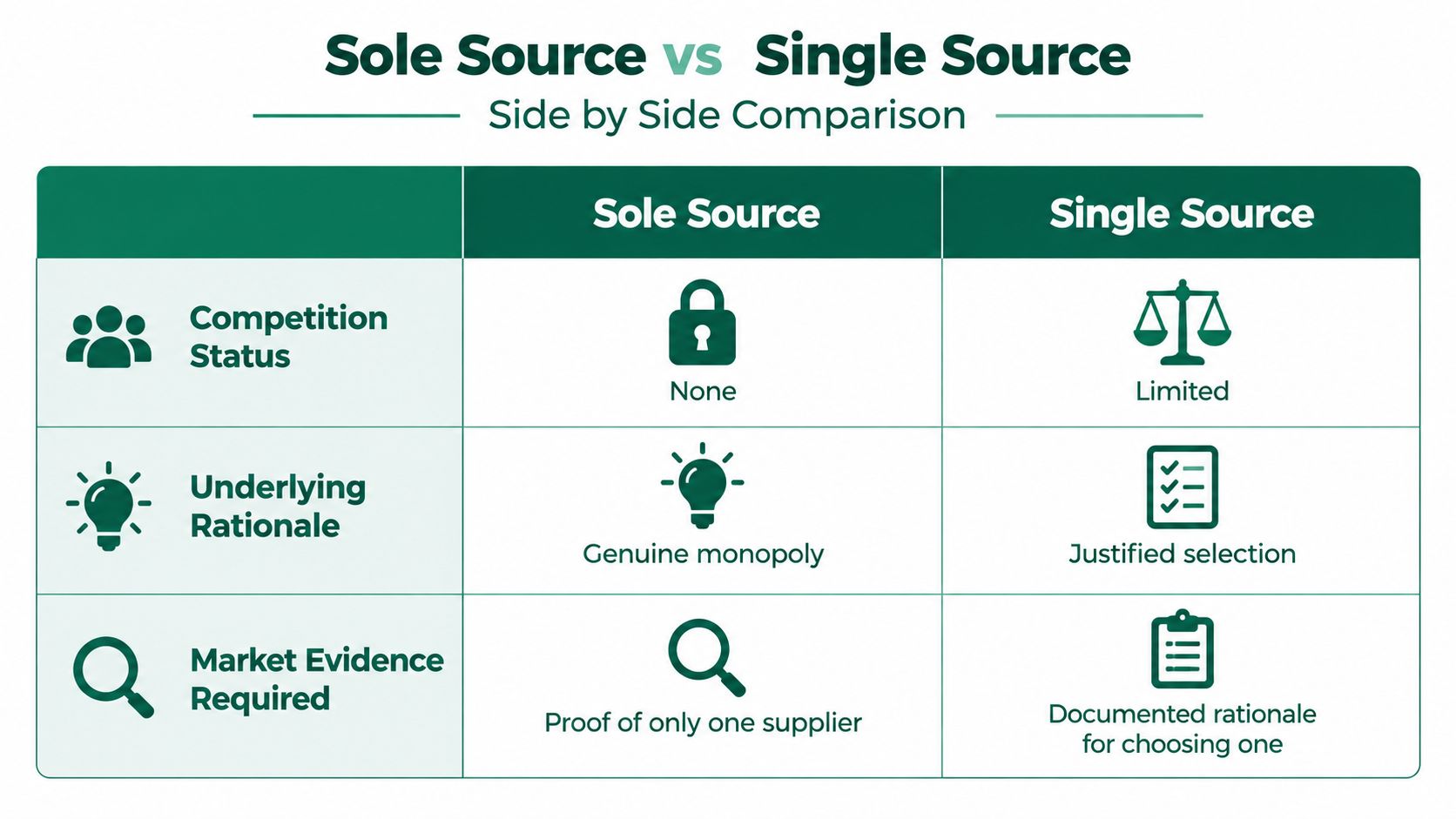
Sole source means the market leaves no viable choice. Single source means the buyer makes a choice despite viable alternatives.
That distinction should control the approval narrative. A sole-source file that merely says “the incumbent understands our environment” is weak because familiarity doesn't prove exclusivity. A single-source file that says “we selected the incumbent” is incomplete because it doesn't explain why the buyer rejected competition.
Compare the evidence, not just the vendors
For a single-source decision, the buyer should compare the selected supplier with realistic alternatives. The analysis can address transition effort, implementation knowledge, standardization, service continuity, total commercial impact, and operational consequences. It doesn't need to pretend that every alternative is equally attractive. It does need to show that alternatives existed and explain why the selected option won.
For a sole-source decision, the buyer must go further. The file should demonstrate that alternatives were considered and eliminated because they couldn't satisfy the requirement, not because they were inconvenient, unfamiliar, or slower to onboard. The RFP, RFI, and RFQ guide can help teams choose the appropriate market-engagement method when the facts don't support immediate noncompetitive procurement.
The terminology also affects review behavior. Auditors typically test whether the buyer's label matches the market facts, whether the specification embeds a preferred supplier, and whether the justification was written before or after the award. A precise classification makes those questions easier to answer.
Legal and Risk Implications You Must Understand
Under U.S. federal-style compliance framing, sole source and single source are generally handled as noncompetitive procurement, rather than as completely separate legal categories. Both must fit an authorized exception to full and open competition. The procurement comparison guidance from CASRAI frames the practical distinction around the justification threshold: sole source requires proof that no alternate source exists, while single source requires proof that alternatives exist but were bypassed for a documented reason.

The compliance risk isn't identical.
A sole-source claim is vulnerable when the file relies on broad assertions such as “only this vendor has the expertise” without identifying the requirement that makes that expertise unique. Reviewers may ask whether the buyer contacted the market, checked alternative technologies, examined licensing rights, or separated mandatory features from preferences.
A single-source decision faces a different challenge. Since alternatives exist, a reviewer may ask why the organization didn't compete, negotiate with more suppliers, or use a structured solicitation. The justification should explain why the selected approach was reasonable and commercially defensible under the applicable policy.
Where award files fail
Several patterns create unnecessary exposure:
Supplier-led specifications: The requirement mirrors one vendor's product instead of describing the organization's outcome.
Retrospective reasoning: The team writes the justification after selecting the supplier, making the rationale look predetermined.
Unverified exclusivity: A vendor claims it's the only authorized provider, but the buyer keeps no supporting documentation.
Incomplete alternatives analysis: The file lists no other suppliers and therefore cannot show whether the market was tested.
Contract disconnect: The approval memo uses one rationale while the final procurement contract contains different scope, licensing, or service terms.
Technical procurement adds another layer of risk. A team may need to connect supplier exclusivity to software ownership, product liability, security obligations, or support boundaries. For purchases involving AI-enabled products or software, procurement and legal teams may also benefit from reviewing AI product liability and software considerations before finalizing the requirement and responsibility allocation.
The rule is direct: the label never carries the justification by itself. The facts, evidence, approvals, and contract terms must tell the same story.
Real World Use Cases and When to Use Each Approach
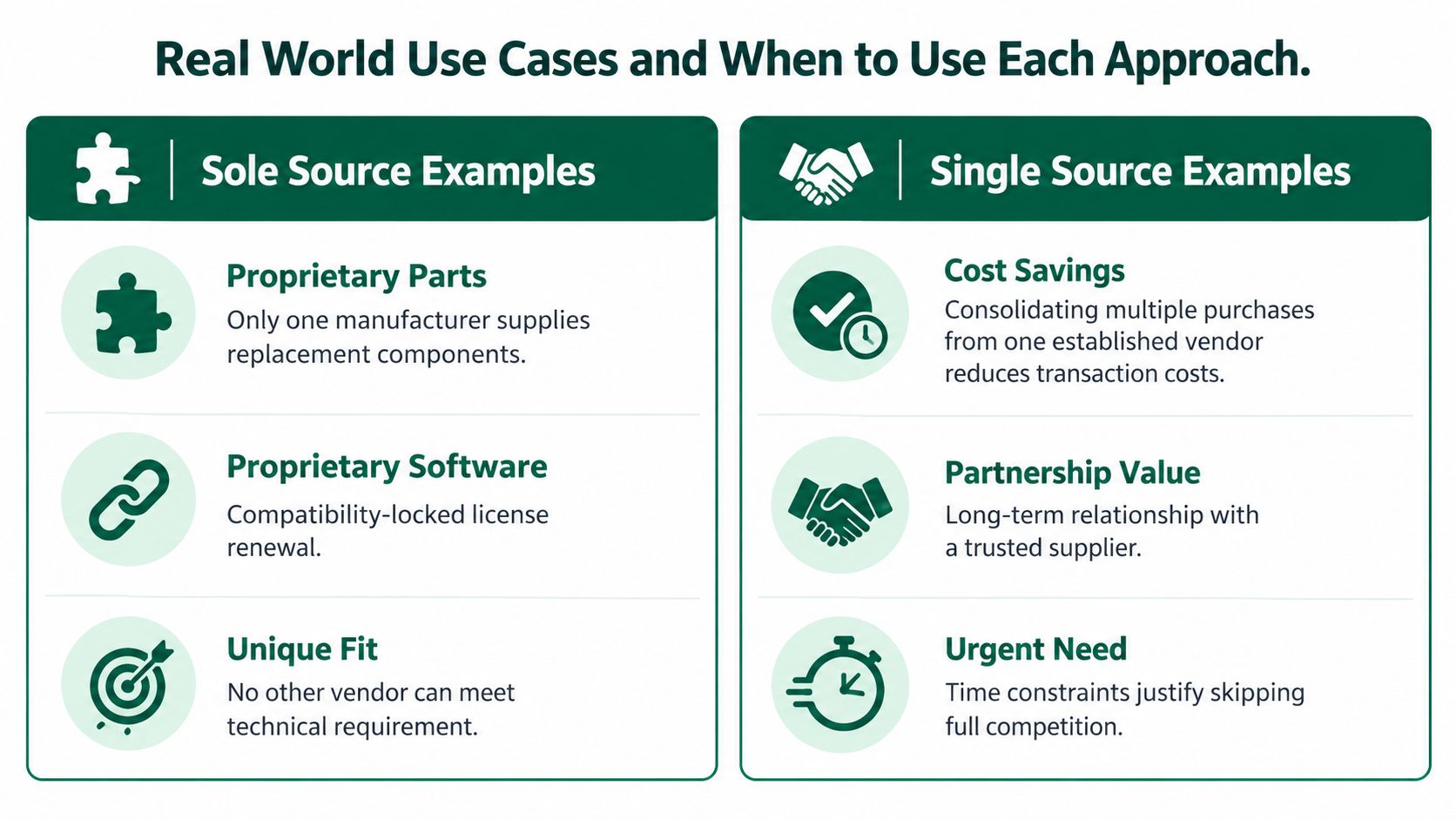
A replacement part illustrates the difference better than an abstract definition. If a machine manufacturer owns the design and only it can supply a compatible replacement component, the facts may support sole source. If other suppliers can produce a compliant component but the manufacturer's part avoids validation work and reduces integration risk, the decision is more likely single source.
The National Association of State Procurement Officials guidance describes sole source as a formal exception to competition used when competition isn't possible. It also emphasizes that the term refers to the supplier, not to a commodity. That matters because a product may be distinctive without making its original manufacturer the only supplier capable of meeting the business requirement.
Situations that can support sole source
A sole-source approach can be appropriate where the evidence supports genuine supplier exclusivity, such as:
Proprietary replacement parts: The part's design, authorization, or required compatibility is controlled by one supplier, and no alternative can satisfy the requirement.
Compatibility-locked licensing: A license must operate with an existing proprietary platform, and another supplier cannot provide the required rights or integration.
Unique technical fit: A supplier alone can meet a defined technical, regulatory, or performance requirement that isn't merely a preferred feature.
Exclusive rights: The supplier holds the necessary intellectual property, distribution authority, or service authorization.
The buyer must still distinguish “only this supplier sells this exact item” from “only this supplier can solve the problem.” The first statement may reflect a narrow specification. The second requires a broader market finding.
Situations that usually indicate single source
Single source is the better classification when capable alternatives exist but the buyer has a defensible preference:
Standardization: The organization wants one platform, interface, or service model across an existing environment.
Continuity: The incumbent already supports a live operation, and transition risk is a material factor.
Specialized expertise: The selected supplier has relevant knowledge, but other suppliers could perform the work.
Commercial practicality: Consolidation, implementation effort, or service coordination favors one supplier without eliminating alternatives.
An urgent need may justify an expedited or noncompetitive process under the governing policy, but urgency alone doesn't prove sole-source exclusivity. The file should identify the emergency rationale separately from the supplier-capability analysis.
How to Justify and Document a Defensible Decision
A defensible file answers four questions in order:
What does the organization need?
Why must the solution satisfy these specific conditions?
Why can only one supplier meet them, if claiming sole source?
How did the buyer verify that conclusion?
The U.S. Office of Justice Programs sole-source fact sheet emphasizes this evidence problem. A justification should explain the requirement, the necessary solution characteristics, the reason only one vendor can meet them, and the verification method. That standard is especially important for replacement parts, compatibility, licensing, and unique technical fit.
Build the record before supplier selection
Begin with a specification review. Separate mandatory requirements from preferences, identify supplier-specific wording, and flag any clause that could reduce the market unnecessarily. If a line names a brand, interface, certification, or proprietary architecture, record why the organization needs it and whether an equivalent outcome could satisfy the requirement.
Then conduct market verification:
Search the market: Identify plausible suppliers, authorized distributors, substitute technologies, and service providers.
Test each alternative: Record whether each candidate fails on capability, authorization, compatibility, compliance, delivery, or another mandatory condition.
Preserve source evidence: Keep product manuals, licensing terms, manufacturer notices, distributor statements, technical correspondence, and relevant market research.
Separate facts from opinions: “The supplier stated it is exclusive” is not the same as “the buyer verified exclusive rights through authoritative documentation.”
Record the date and owner: A future reviewer should know who performed the research and when the market conclusion was reached.
Explain operational risk without overstating exclusivity
A technically possible alternative may create meaningful integration, validation, training, or service risk. That fact can support a single-source preference, but it doesn't automatically establish sole source. State the distinction plainly: alternatives exist, yet the selected supplier offers the most defensible path under the documented business constraints.
For sole source, include an elimination matrix. Each alternative should have a reason for exclusion tied to a requirement. Avoid vague entries such as “not suitable.” Use precise explanations, such as lacking the required authorization, failing a compatibility condition, or being unable to provide the required service rights.
A practical workflow should also check for specification drift. If the final quote, manual, license, or contract differs from the approved requirement, update the analysis before signature. Tools such as the vendor due diligence checklist can support a consistent record of supplier verification and unresolved issues.
Choosing the Right Approach and Next Steps
Use a simple decision rule.
Compete when multiple suppliers can satisfy the requirement and the organization has no strong, documented reason to bypass competition. Competition is the default control because it tests price, capability, terms, and market interest rather than assuming the preferred answer.
Use single source when alternatives exist but one supplier is demonstrably preferable for continuity, standardization, expertise, or commercial reasons. Document the alternatives, compare the consequences, and obtain the approvals required for a noncompetitive selection.
Use sole source only when the evidence supports supplier exclusivity. The file should show that the requirement is necessary, alternatives were considered, and no other supplier can satisfy the complete need. If the evidence says “another supplier could do it, but switching would be difficult,” stop calling it sole source.
The strongest control happens before the specification locks. Reviewers should look for single-bidder lines, supplier-specific clauses, unsupported compatibility claims, and gaps between technical requirements and commercial terms. Keep the approval memo, market research, scoring, correspondence, and final contract connected in one traceable decision record.
Procright is one platform option for this workflow. It supports specification gap analysis, single-bidder detection, supplier discovery, source-backed compliance comparisons, elimination reasons, and spec-drift checks across quotes and contract documents.
Procright can help your team distinguish genuine supplier exclusivity from an avoidable single-source outcome, while keeping requirements, evidence, comparisons, and approvals connected. Visit Procright to review how its procurement analysis workflow can support your next audit-ready sourcing decision.
Try it on a real buy
Bring one category. Watch where the flags land.
We use a little analytics to see which pages actually help. Nothing else, no ad trackers.