Value Chains Versus Supply Chains: A Practical Guide
In this article
Most advice on value chains versus supply chains starts with a harmless simplification: the terms are different, but companies should manage both together. That's true, but it doesn't answer the decision procurement leaders face. The difficult question isn't which definition belongs in a presentation. It's who owns the decisions that determine margin, exposure, and the ability to change course when conditions shift.
A supply-chain lens follows flow, coordination, service, and execution across multiple firms. A value-chain lens examines how activities inside and around a company create and capture customer value. That difference becomes more important as software, data, design, intellectual property, and after-sales services carry a larger role in production. The procurement and supply chain relationship therefore needs more than shared terminology. It needs clear decision rights.
The practical answer is a governance model. Procurement should own the commercial and capability choices that shape value capture, while supply-chain operations should run the daily flow. Both teams need shared measures, but they shouldn't optimize the same horizon or accept the same risks.
Table of Contents
The Core Question Behind Value Chains Versus Supply Chains
Treating the two concepts as synonyms can make a company look efficient while reducing its ability to differentiate. Delivery reliability and logistics cost may improve even as product performance, service quality, supplier innovation, or long-term margin weaken. The issue is therefore a governance choice under structural volatility: which decisions procurement owns, which operations executes, and which capabilities the company must protect.
Michael Porter introduced the modern value-chain concept in 1985 in Competitive Advantage. His framework describes linked activities for designing, producing, marketing, delivering, and supporting a product or service. It separates primary activities from support activities, including procurement. A supply chain reaches beyond the firm, connecting suppliers, producers, logistics providers, distributors, and customers across organizational boundaries. The distinction is summarized in this overview of supply-chain and value-chain definitions.
Governance, not vocabulary
Procurement leaders should set decision rights through four questions:
Where is customer value created? A component can be inexpensive to move yet determine product performance, reliability, or future design.
Who controls the relevant decision? Operations may control shipment execution, while procurement controls commercial terms, supplier qualification, and switching rights.
Which risk is being optimized? Lower landed cost can increase concentration exposure, qualification delays, or dependence on one technical platform.
What evidence will prove value capture? Purchase price variance does not show whether a supplier contributes to design, software, service, or continuity.
The World Trade Organization's 2025 Global Value Chain Development Report places the decision in a broader context. Global value chains account for about 46.3% of world trade in value-added terms, and services contribute more than one-third of value added in manufacturing exports (WTO Global Value Chain Development Report). Physical-flow measures alone can therefore miss where margin is created, especially when services and software carry more value than the shipped item.
Procurement should own the commercial, technical, and supplier choices that determine value capture. Supply-chain operations should execute the daily flow against agreed cost, service, quality, continuity, and change metrics.
Practical rule: Use the supply-chain lens to run the network. Use the value-chain lens to decide which activities deserve control, investment, and protection.
This allocation separates ownership from orchestration. Procurement owns decisions that shape capability, switching options, and supplier economics. Operations orchestrates the network that delivers them. The result is a measurable governance model rather than a vocabulary exercise.
Definitions That Actually Change Decisions
A definition is useful only if it changes a manager's decision or measurement. The value chain is the connected set of activities a firm performs or coordinates to create customer value and earn margin above input cost. Porter's 1985 model covers inbound logistics, operations, outbound logistics, marketing and sales, and service, supported by infrastructure, human resources, technology development, and procurement (Porter's value-chain distinction).
The supply chain is the broader, multi-firm network that moves materials, components, information, and finished goods from origin to customer. It includes suppliers, manufacturers, distributors, logistics providers, retailers, and other participants. Its operating question is whether coordinated handoffs deliver the required product or service at acceptable cost, speed, quality, and reliability.
The different unit of analysis
Value-chain analysis begins with the firm. It examines how each activity contributes to customer value, differentiation, and margin, including activities performed by partners that affect those outcomes. Supply-chain analysis begins with the network and examines how reliably and efficiently participants coordinate flow.
That difference changes procurement's brief. A supplier offering a low unit price and dependable delivery may improve supply-chain performance. The same supplier can weaken value capture if its specification restricts product functionality, creates software dependence, or makes future redesign difficult. A technically capable supplier may require more coordination and perform less efficiently on a shipment-level dashboard, while protecting product economics over a longer horizon.
Dimension | Value Chain | Supply Chain |
|---|---|---|
Scope | Firm activities and strategically important partners | Multiple firms and network handoffs |
Primary objective | Customer value, differentiation, and margin | Efficient, reliable, responsive flow |
Typical owner | Strategy, commercial leadership, procurement, and product teams | Operations, planning, logistics, and supplier execution teams |
KPI emphasis | Value added, margin contribution, total cost to serve, and capability | Lead time, delivery reliability, quality, inventory, and cash flow |
The KPI distinction is reflected in supply-chain performance guidance, which emphasizes total supply-chain cycle time, order lead time, supplier lead time against industry norms, defect-free delivery, buyer-supplier partnership, and cash-flow time (supply-chain performance measures). Value-chain analysis instead examines where activities add customer value and competitive advantage, with financial value added as its strategic objective (value-chain analysis research).
Use the supply-chain lens to govern execution. Use the value-chain lens to decide which capabilities, relationships, and activities procurement should own, protect, or redesign. That division prevents a low purchase price or reliable shipment from being treated as proof of value capture.
Side-by-Side Comparison Across Four Criteria
The choice between value-chain and supply-chain analysis is a governance decision. Each lens assigns different boundaries, owners, incentives, and evidence requirements.
Scope determines what gets counted
The value chain is firm-centric. It may include external partners, but the analysis starts with the company's activities and the customer value they create. The supply chain is network-centric, covering organizations that extract, transform, store, move, sell, or support the product.
That distinction changes procurement's field of view. A supply-chain map can show a component's origin and route to a plant. A value-chain map also identifies who owns the design, controls the software, performs the service, and captures the economics. Because this section addresses scope rather than the location of global value, the relevant BEA source is retained in the later section on where value accumulates.
KPIs create the operating bias
Supply-chain teams govern service, flow, and execution. Value-chain teams assess contribution, differentiation, and strategic position. Each lens answers a different management question.
Criterion | Value Chain Lens | Supply Chain Lens |
|---|---|---|
Scope | Firm activities and strategically important partners | End-to-end network across firms |
KPI emphasis | Margin contribution, value added, differentiation, and cost to serve | Lead time, delivery reliability, defects, inventory, and cash flow |
Time horizon | Repositioning capabilities and relationships over the longer term | Capacity, inventory, transportation, and delivery decisions over shorter cycles |
Decision owner | Strategy, procurement leadership, commercial, product, and finance | Operations, planning, logistics, and supplier management |
A value-chain decision can take years to mature. Supplier co-development, technical qualification, product architecture, and service redesign all affect the company's future ability to capture margin. Supply-chain decisions usually operate on shorter planning cycles, adjusting orders, inventory, routes, capacity, and delivery priorities.
The trade-off has a direct governance implication. Optimizing only the supply-chain layer can reduce visible operating cost while eroding value-chain margin. Redesigning the value chain without dependable execution can leave the customer with none of the intended benefit.
Procurement should therefore own decisions that shape specifications, supplier access, commercial exposure, contract flexibility, and critical capability. It should orchestrate execution decisions with operations, planning, and logistics. The boundary can be tested through metrics: flow performance for operational control, and margin contribution or cost to serve for value capture.
The right question isn't which chain matters more. It's which decision requires a margin lens, which requires a flow lens, and where the two must be governed together.
Where Value Now Accumulates in Global Chains
Physical movement remains part of production economics, but it does not show where all customer value is created. Services, engineering, embedded software, data, financing, branding, maintenance, and support may determine differentiation and margin even when the purchased item is a physical component. Procurement that measures only freight, inventory, and unit price can therefore misread both value capture and exposure.
A product may cross borders as one object while its economic contribution is distributed across several activities and countries. As noted earlier, global value-chain analysis separates the contributions embedded in production rather than treating the finished product as a single source of value. The operating question is specific: which activity increases the customer's willingness to pay, protects continuity, or constrains substitution?
The procurement implication
Category strategy should distinguish physical inputs from service and intellectual-property layers. A supplier with a modest component price may control a design interface, proprietary data format, repair capability, or maintenance network. A logistics provider may meet delivery targets while the company remains dependent on its software platform or operating data.
Production Stage | Typical Share of Value Captured | Procurement Lens Required |
|---|---|---|
Physical materials and components | Varies by product and industry | Unit economics, quality, continuity, and substitution |
Assembly and production execution | Varies by operating model | Process capability, yield, capacity, and service reliability |
Design, software, and intellectual property | Often strategically significant | Ownership rights, interoperability, roadmap access, and switching cost |
Marketing, support, and after-sales service | Can materially shape customer value | Service outcomes, lifecycle cost, data access, and contractual accountability |
The table avoids false precision. Value shares differ by product and industry, so procurement should test the layers that influence customer outcomes instead of applying one allocation across every category.
Evaluation should include R&D intensity, software content, service attach, data rights, and roadmap influence where those factors affect the offer. A should-cost model remains useful when it covers lifecycle services, integration, switching, and support, rather than stopping at purchase price. A should-cost analysis framework can structure that logic. Teams assessing dependencies across tiers can also consult this practical visibility guide.
Governance should follow value concentration. Procurement owns specifications, rights, access, commercial exposure, and contract flexibility where those decisions determine future margin. It orchestrates operational execution with the functions that manage flow. Measure value capture through margin contribution, lifecycle cost, service outcomes, data access, and switching exposure, not through purchase price alone.
The cheapest physical flow may not be the lowest-cost route to customer value. Where software and services carry more margin, contracts and supplier reviews must govern those layers explicitly.
Two Sourcing Scenarios That Play Out Differently
Consider a commodity component with stable demand, established specifications, and a supplier base concentrated in one region. Under a conventional supply-chain approach, the sourcing event centers on unit price, cost variance, on-time delivery, defect-free delivery, inventory position, and cash-flow time. The supplier that offers the lowest compliant bid receives the award, and the operating team monitors execution through the ERP and supplier-management system.
That approach can be rational when substitution is easy and the component has limited influence on product differentiation. It becomes fragile when the region is exposed to tariffs, policy changes, capacity constraints, or a disruption that makes qualification of an alternative slow. A purchase-price saving then needs to be evaluated against continuity risk, expedite costs, idle capacity, and lost customer value.
Scenario A and the efficiency lens
In Scenario A, procurement uses a single-region source and rewards short-term price performance. The dashboard reports:
Cost variance: Actual purchase price compared with the negotiated baseline.
On-time delivery: Whether supplier shipments meet the agreed date.
Inventory turns: Whether stock moves efficiently through the business.
Defect-free delivery: Whether received material meets requirements without corrective action.
The arrangement may perform well while conditions remain stable. But it has limited optionality. If a tariff or regional disruption changes the economics, the organization may have to pay more for emergency supply, carry higher inventory, or accept a delay while another source completes technical qualification.
Scenario B and the value-chain lens
In Scenario B, the same component becomes part of a broader value-chain decision. Procurement evaluates dual sourcing, regional alternatives, supplier co-design, specification flexibility, and the supplier's ability to influence the product roadmap. The dashboard adds total cost of ownership, resilience-adjusted cost, time to qualify an alternate, contribution to design, and continuity under a disruption scenario.
The second model may produce a higher nominal purchase cost. That doesn't automatically make it inferior. The relevant comparison is between the full economic exposure of the two designs, including switching time, qualification work, logistics changes, service impact, and the value of preserving supply.
The demand signal hasn't changed. Governance has. Scenario A treats the component as a transaction. Scenario B treats the supplier relationship as a capability and risk decision.
Use ERP and SRM data to compare the award you made with the exposure you accepted.
A sourcing manager can test both scenarios without inventing a new measurement system. Pull delivery, quality, lead-time, inventory, price, supplier concentration, qualification status, and contract-flexibility data from existing systems. Then ask finance to connect those operating measures to margin, cost to serve, and customer consequences.
Resilience and Optionality Under Structural Volatility
Efficiency and resilience aren't opposing philosophies. They're different allocations of economic capacity. A lean, single-threaded network minimizes redundancy, but it also limits the organization's ability to switch volume, specifications, suppliers, or geographies. Optionality preserves those choices, even when maintaining them costs more in the short term.
The World Economic Forum describes global value chains as entering an era of structural volatility and reports that 60% more business leaders now view resilience and agility as core to competitive advantage than they did five years ago (World Economic Forum outlook). EY's 2026 update shows why headline conditions can mislead. The Global Supply Chain Pressure Index eased to 1.25 in June, while trans-Pacific freight rates remained up 234% and 231% since February, and truck spot rates were up 45% to 51% year over year (EY supply-chain update). These figures describe an uneven environment, not a simple return to normal.
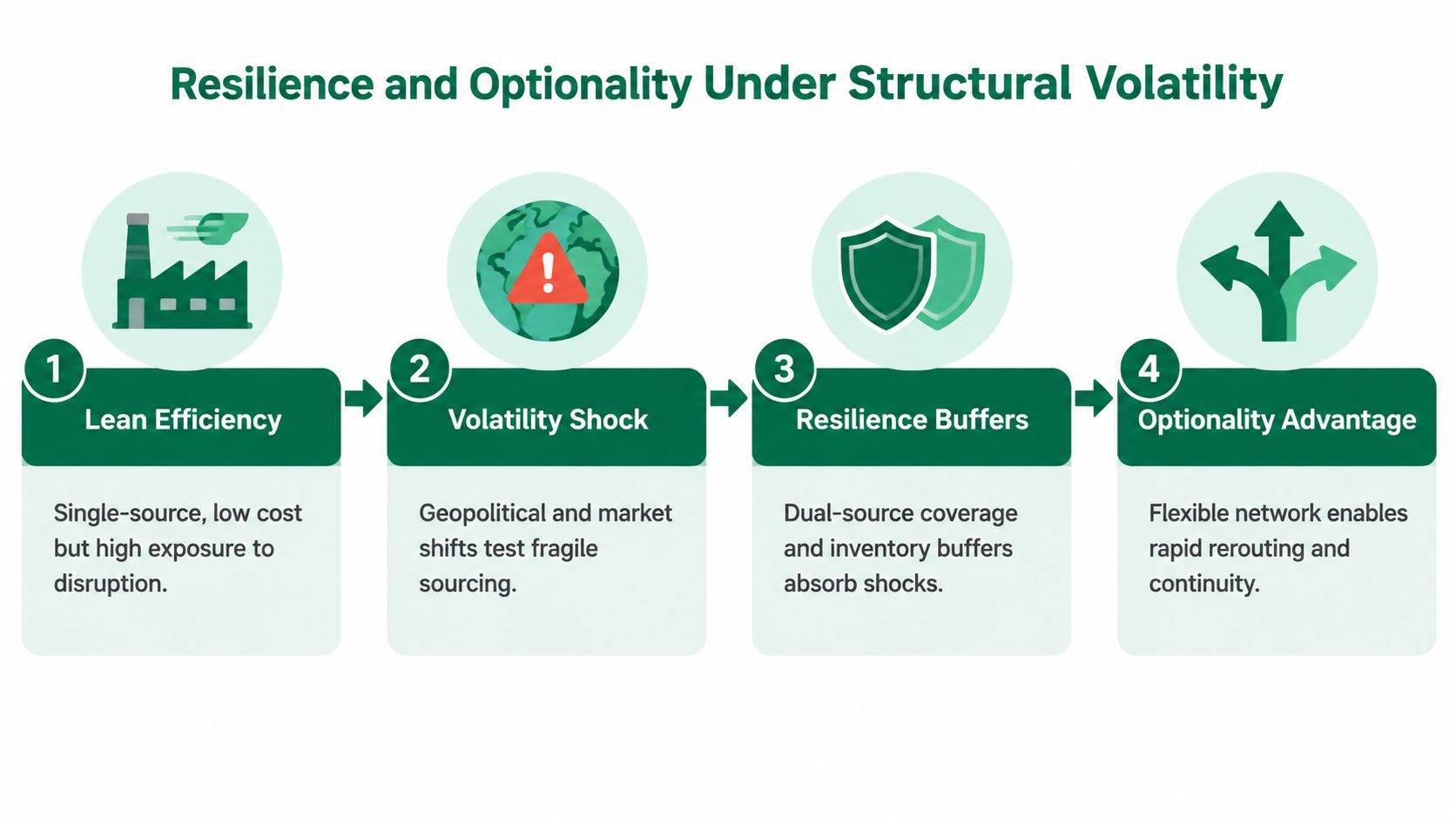
A decision rule for procurement
Use the value-chain frame when structural exposure threatens the firm's ability to preserve customer value. Measure that exposure through observable indicators:
Dual-source coverage: The share of critical requirements with a qualified second source.
Alternative qualification time: The time needed to approve a replacement supplier or specification.
Regional concentration: The share of supply dependent on one geography or corridor.
Contract switching rights: The ability to move volume, access data, or use compatible alternatives.
Continuity impact: The commercial consequence if supply stops or service quality falls.
If those indicators show that a disruption could damage continuity, product differentiation, or customer commitments, procurement should trade some efficiency for optionality. If substitution is easy, exposure is low, and the category contributes little differentiation, the supply-chain lens can remain dominant.
For practical contract measures that reduce dependence on a single provider, procurement teams can review this guide on how to avoid vendor lock-in. Teams can also use supply-chain resilience planning to connect sourcing decisions with operational continuity.
A numeric example must remain tied to verified evidence, so the rule should be applied through the organization's own thresholds rather than an invented universal percentage. Finance can set the exposure threshold using margin at risk, interruption cost, and qualification lead time. The decision then becomes auditable: below the threshold, optimize flow; above it, buy optionality and measure the value preserved.
A Layered Governance Model for Procurement
Procurement shouldn't take over logistics execution. Supply-chain operations should continue to own daily delivery, planning, inventory decisions, transportation, and cost to serve. Procurement should own the decisions that establish the conditions for reliable execution and durable value.
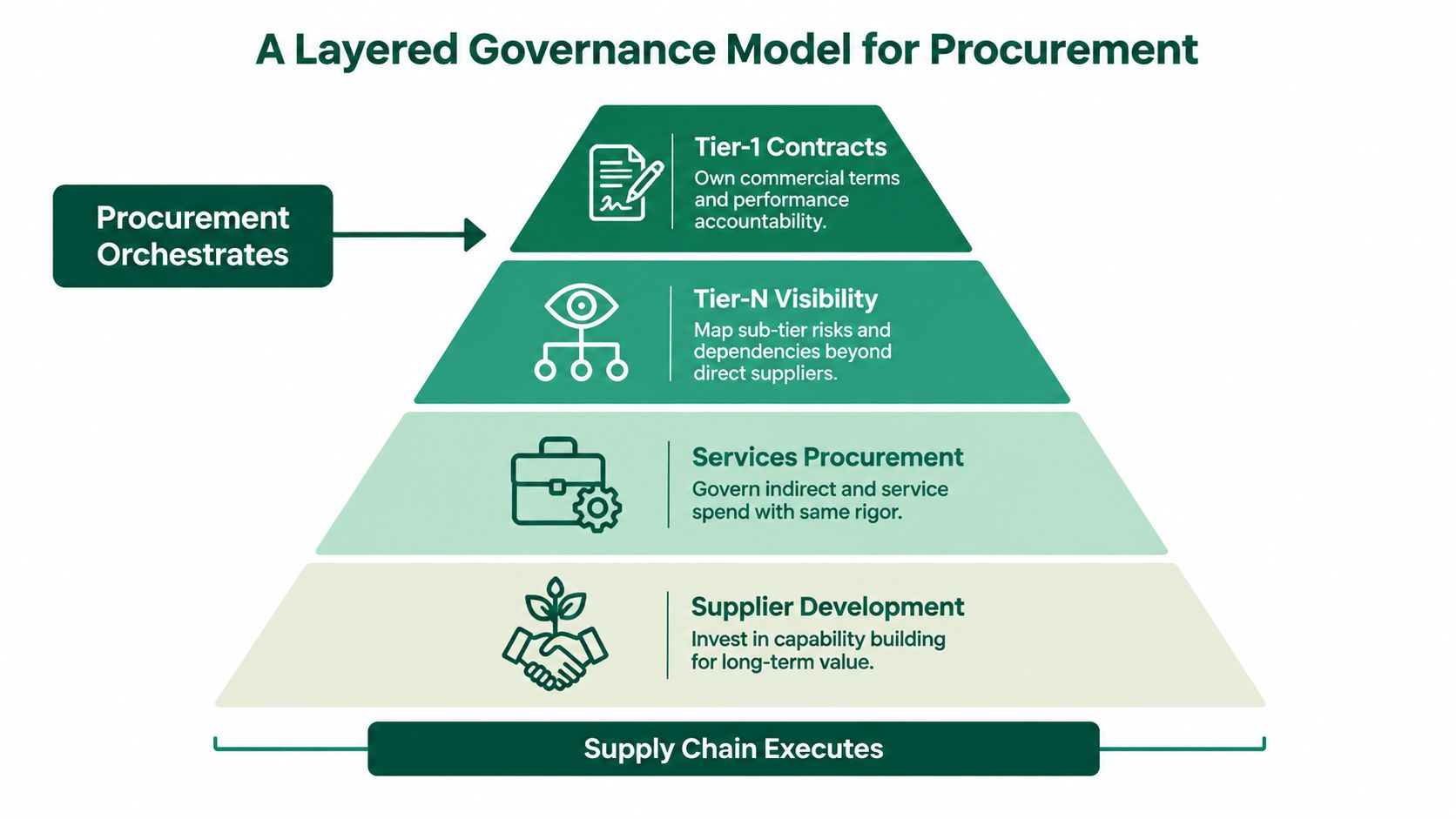
That means governing four layers:
Tier-one contracts: Set commercial terms, service levels, performance remedies, data rights, flexibility clauses, and accountability.
Tier-n visibility: Identify sub-tier dependencies, geographic exposure, technical bottlenecks, and alternate-source constraints.
Services procurement: Apply structured sourcing to software, engineering, maintenance, consulting, support, and other service layers that can carry customer value.
Supplier development: Build capabilities with strategically important suppliers where qualification, quality, innovation, or resilience cannot be bought through a one-time bid.
The counterargument is that supply-chain execution should remain centralized because fragmented ownership creates duplicate processes. That concern is valid if procurement starts directing routes, production schedules, or warehouse decisions. It isn't valid when procurement focuses on contracts, data, supplier capability, and decision rights.
Separate horizons, connect controls
Daily execution belongs with operations. Strategic cost modeling, supplier capability, contract flexibility, and alternative qualification belong with procurement, finance, engineering, and commercial stakeholders. The teams should meet through a control loop rather than compete through overlapping authority.
A quarterly value-capture review should examine contribution margin by supplier category, service and software exposure, performance against total cost assumptions, and time to qualify alternative sources. That review links the value-chain question, where is margin created, with the supply-chain question, can the network deliver it reliably?
The model is practical because it assigns ownership without splitting accountability. Procurement orchestrates the conditions. Supply chain executes the flow. Finance verifies whether the combined system is capturing value rather than merely reducing visible purchase cost.
Checklist for Your Next Sourcing Cycle
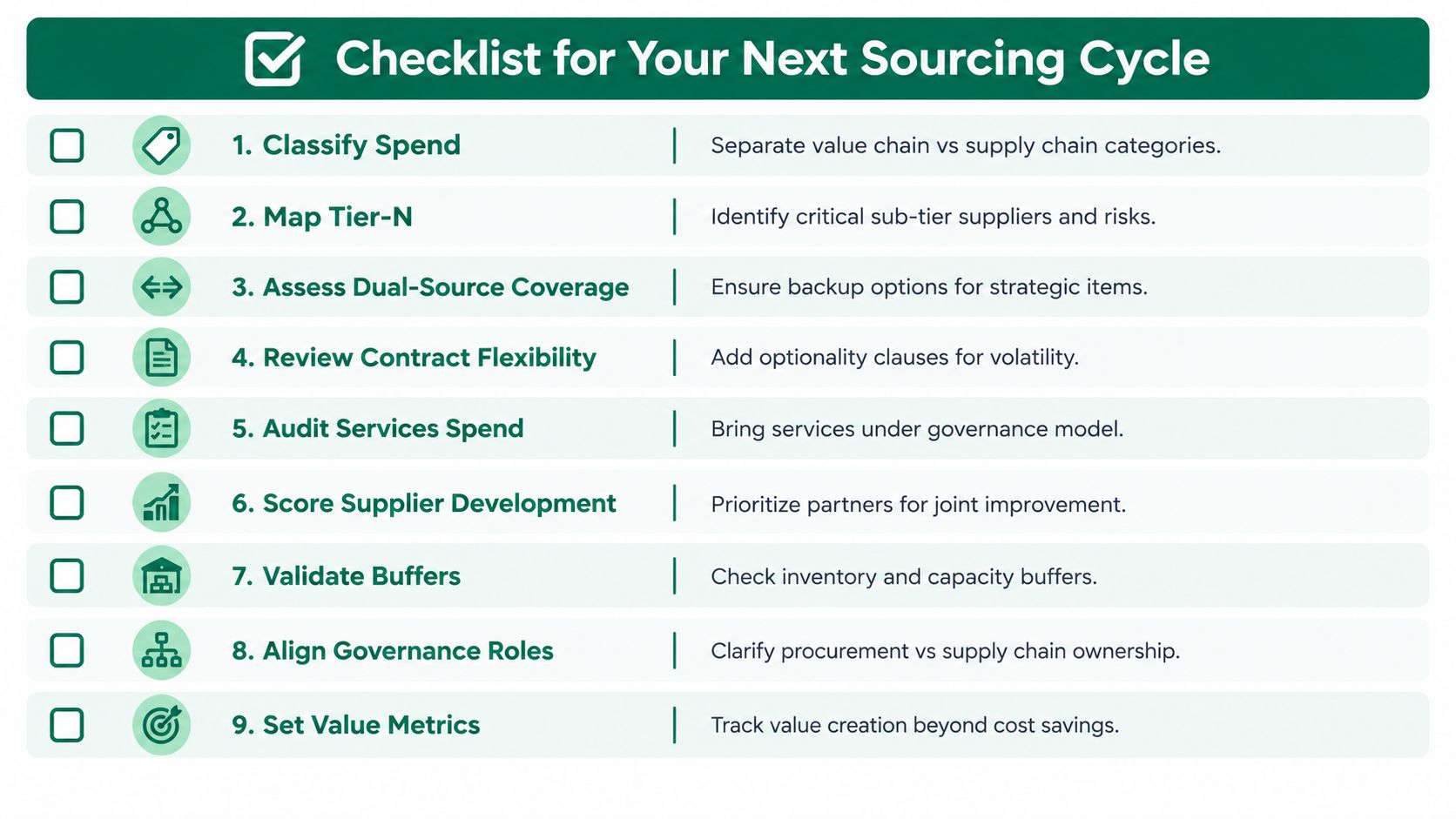
Use this checklist before the next sourcing event closes:
Classify spend: Separate physical, service, software, and intellectual-value layers.
Map tier-n exposure: Identify critical sub-tier dependencies and regional concentration.
Assess dual-source coverage: Record which strategic requirements have qualified alternatives.
Review contract flexibility: Check switching, data, volume, termination, and compatibility rights.
Audit services spend: Bring support, maintenance, software, and professional services into the category view.
Score supplier development: Identify partners that affect quality, innovation, qualification, or continuity.
Validate buffers: Review inventory, capacity, lead time, and alternate-source readiness.
Align governance roles: Assign daily execution to operations and strategic orchestration to procurement.
Set value metrics: Pair supply-chain measures such as delivery and inventory with value-chain measures such as cost to serve, should-cost variance, margin contribution, and qualification time.
Procright supports sourcing teams with specification creation, supplier discovery, evidence-backed compliance comparison, weighted scoring, and traceable decision records. Use Procright to connect commercial governance with defensible supplier decisions before the next award locks in cost, risk, and optionality.
Try it on a real buy
Bring one category. Watch where the flags land.
We use a little analytics to see which pages actually help. Nothing else, no ad trackers.