How AI Powers Multi-Source Product Data Aggregation
AI transforms fragmented supplier feeds into standardized, audit-ready product data that enables proactive procurement.
AI simplifies the complex process of gathering and organizing product data from multiple sources like supplier websites, PDFs, and ERPs. It eliminates manual errors, saves time, and ensures consistent, reliable data for procurement teams. By automating tasks like data extraction, normalization, and enrichment, AI helps teams make faster and more accurate decisions.
Key takeaways:
Unified Data: AI consolidates product data (attributes, specs, pricing) into one system for easy comparison.
Error Reduction: Automates data cleaning and standardization, ensuring consistency across formats and units.
Time Savings: Processes thousands of SKUs quickly, cutting manual workload by up to 90%.
Compliance Assurance: Keeps data current and flags regulatory risks with real-time updates.
Traceability: Ensures every data point is verifiable with page-level citations.
AI-powered tools like Procright are transforming procurement by turning fragmented data into actionable insights. With AI, procurement teams can focus on decisions, not data wrangling.
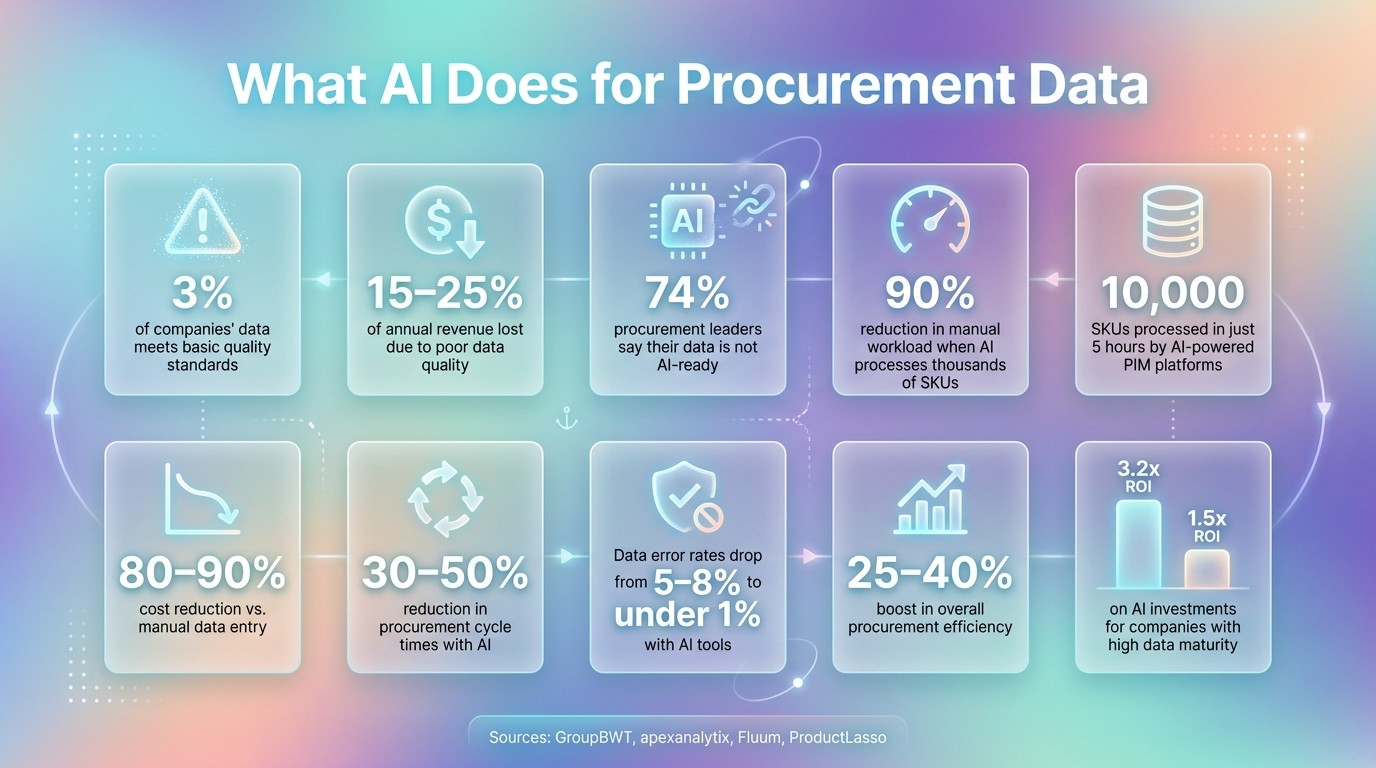
AI in Procurement: Key Stats & Impact on Product Data Aggregation
AI in Procurement: Smarter Sourcing, Contracts, & Supplier Management
Key Challenges in Multi-Source Product Data Aggregation
Aggregating product data from multiple sources is no easy task. The process is often bogged down by fragmented systems and inconsistent data standards, making it both time-consuming and complex.
Data Silos and Inconsistent Formats
Procurement data tends to be scattered across various platforms - ERPs, procurement tools, supplier portals, and even spreadsheets. These systems often operate in isolation, with minimal integration between them. Adding to the complexity, vendors provide product information in a wide range of digital formats.
The challenges don’t stop at formats. Even within the same product category, vendors may use different units, terms, or measurement standards. For example, one vendor might report storage performance using 4K random reads, while another opts for 8K mixed workloads. Neither approach is incorrect, but without normalization, comparisons between them are essentially meaningless. This leads to a lengthy and tedious reconciliation process.
"The first sign that a procurement pipeline is in trouble isn't an alert - it's a QA analyst opening a portal manually and finding a contract that isn't in our system." - Alex Yudin, Head of Scraping, GroupBWT
Messy and Incomplete Data
Beyond formatting issues, data quality poses another significant challenge. Shockingly, only 3% of companies' data meets basic quality standards. This often results in missing attributes, duplicate records, and conflicting information that undermine trust in the final output. Poor data quality doesn’t just slow things down - it costs businesses between 15–25% of their annual revenue.
General-purpose AI tools can unintentionally make things worse. When faced with fragmented or incomplete data, these systems often "fill in the blanks" with plausible-sounding but entirely fabricated values. This can lead to incorrect numbers, made-up page references, or silent calculation errors that skew vendor rankings without anyone noticing.
"When procurement AI hallucinates, it produces results that seem plausible but aren't actually supported by real supplier data... AI fills gaps in fragmented, outdated, or inconsistent source data... with guesses rather than facts." - Danny Thompson, Chief Product Officer, apexanalytix
Keeping Up with Market Changes
Even if structural and quality issues are addressed, keeping data current remains a daunting task. Product catalogs are updated quarterly, compliance certificates expire yearly, and contract amendments often occur mid-cycle. As a result, data can become outdated within just 60 days of collection. If a spend analysis lags by 90 days or more, it’s virtually impossible to catch price anomalies or identify risks in time.
Adding to the urgency, 74% of procurement leaders report their data is not "AI-ready" due to silos and inconsistencies. Meanwhile, procurement workloads are expected to increase by 8% by 2026, even as budgets and headcounts shrink. Without real-time tracking, teams relying on manual processes will struggle to keep up. Real-time visibility is no longer a luxury - it’s quickly becoming a baseline expectation.
How AI Improves Multi-Source Product Data Aggregation
Fragmented systems, inconsistent data, and ever-changing market demands make managing product data a massive challenge. AI steps in to tackle these issues head-on, offering a combination of speed and precision that traditional methods simply can't match.
AI-Powered Data Ingestion and Source Discovery
AI tools are designed to handle data from a wide variety of sources, including structured formats like APIs, CSV files, JSON, and systems like ERP or PIM, as well as unstructured formats like PDFs, scanned invoices, and Word documents. Using Retrieval-Augmented Generation (RAG), these systems index supplier documents through vector databases, ensuring they retrieve verified content while minimizing the risk of fabricated outputs. Optical Character Recognition (OCR) plays a key role here, converting scanned or legacy text into machine-readable formats for further processing.
What sets enterprise-grade AI apart is its ability to attach page-level citations to every extracted data point. This means procurement teams can easily trace each value back to its original document, creating a clear audit trail for verification before making decisions. This efficient ingestion process lays the groundwork for accurate data normalization and enrichment.
Schema Matching, Normalization, and Deduplication
Once data is ingested, AI takes on the task of standardizing it. Supplier inputs rarely align perfectly, so AI uses canonical schema mapping to bring everything into a consistent format.
Here’s how normalization works:
Normalization Type | What It Does | Example |
|---|---|---|
Standardization | Cleans up casing and punctuation | "navy blue" → "Navy Blue" |
Unit Harmonization | Converts measurements to standard units | "12 inches" → "304.8 mm" |
Value Translation | Maps synonyms to a single standard term | "XL", "Extra Large" → "XL" |
Identifier Normalization | Validates and formats product codes like GTIN/UPC | Removes non-digits from EANs |
Deduplication complements normalization by identifying and merging duplicate records. For products with shared identifiers like UPC, EAN, ASIN, or MPN, AI automatically consolidates them. Even when these identifiers are missing, machine learning models compare titles and attributes to detect duplicates across vast datasets. This approach shifts the focus from fixing data issues later to preventing them right at the point of ingestion, ensuring cleaner data throughout the process.
Automated Attribute Extraction and Enrichment
After normalization, AI dives deeper to enhance the data by extracting and filling in missing attributes. Using natural language processing (NLP) and computer vision, AI can pull technical specifications, certifications, and warranty details directly from datasheets and vendor documents - tasks that would otherwise require extensive manual effort. Some platforms achieve up to 99% accuracy when extracting structured technical specifications.
When attributes are entirely absent, AI steps in to enrich the data. By crawling manufacturer websites and documents, AI can add dozens of fields per SKU, all while citing sources for transparency. For example, one AI-powered PIM platform processed 10,000 SKUs in just 5 hours, slashing costs by 80–90% compared to manual data entry. This automated enrichment ensures procurement teams have access to more complete and reliable product records, enabling faster and better-informed decisions.
"The challenge isn't automation speed - it's protecting catalog quality during automation." - ProductLasso
Platforms like Procright integrate these AI-driven processes seamlessly into procurement workflows. By analyzing specifications from sources like websites, PDFs, and even videos, these tools deliver clean, comparable product data without the need for manual extraction. Together, ingestion, normalization, and enrichment form a solid foundation for smarter procurement decisions.
Building AI-Driven Procurement Workflows
Clean, well-organized product data is only as valuable as its ability to fuel the right processes at the right time. AI-driven procurement workflows take this data and connect it directly to the daily decisions procurement teams face. By doing so, they turn raw data into actionable steps, amplifying the benefits of clean, normalized data.
Specification Creation and Product Discovery
Learning how to write a technical procurement specification manually can be a slow, error-prone process. AI simplifies this by converting raw purchase requirements into structured technical specifications. These specifications include details like delivery terms, payment conditions, and evaluation criteria, all formatted using customizable templates. This ensures that every stakeholder receives clear, decision-ready information.
AI also revolutionizes product discovery. Autonomous discovery agents work around the clock, scanning global databases, commercial registers, and certification bodies. They identify and qualify suppliers based on factors like ESG performance, compliance status, and financial stability. By removing the friction of manual searches, AI allows procurement teams to focus on higher-value tasks.
Another key feature is gap analysis. AI can automatically detect missing details - such as vendor information or unstated capabilities - that might cause integration or compliance issues later. For instance, manually analyzing a 10-vendor response to a 50-spec RFP might take 20–40 hours. AI can handle the same task in just minutes. Tools like Procright take this even further, analyzing specifications from diverse sources like websites, PDFs, and videos to deliver comparable, citation-backed product data without manual input. This seamless combination of discovery and specification creation highlights how AI not only organizes data but also drives procurement efficiency.
Compliance Verification and Monitoring
With enriched data in place, AI steps in to enhance compliance processes. Checking compliance manually has always been a time-intensive task, but AI embeds compliance rules directly into search and selection workflows. This ensures users are guided toward approved products while blocking non-compliant options before purchase orders are issued.
AI also keeps up with changing regulations. By monitoring databases and regulatory bodies, it flags updates from organizations like the FDA or changes in ESG legislation. It then highlights potential risks in current sourcing practices. Every compliance value extracted by AI includes page-level citations, enabling procurement teams to verify claims with confidence. Companies leveraging AI for compliance have reported productivity boosts of 25% or more.
"The most dangerous specifications aren't the ones that fail to meet your requirements. They're the ones that aren't there at all." - Priya Sharma, Procurement Technology Lead, SpecLens
Real-Time Data Updates and Insights
Outdated supplier data can cause major disruptions, but AI-driven workflows automatically refresh catalog information from live supplier sources. This eliminates the delays caused by manual update cycles, where critical details might sit in inboxes for weeks.
Conclusion: What AI-Powered Data Aggregation Means for Procurement
AI-powered procurement tools are transforming the way procurement teams operate. By cutting cycle times by 30–50%, reducing data transfer error rates from 5–8% to under 1%, and boosting overall efficiency by 25–40%, these tools are reshaping procurement processes in profound ways.
But it's not just about doing things faster. It's about making smarter decisions with clean, standardized, and current data. When AI takes over the heavy lifting - like gathering, matching, and enriching product data from various sources - it allows procurement teams to shift from reacting to problems to anticipating them. This kind of proactive decision-making is made possible by platforms designed to integrate AI into everyday operations.
"The real value isn't just reducing manual work. It's surfacing decisions that weren't possible before." - Fluum Editorial Team
Take Procright, for example. This platform analyzes product specifications from websites, PDFs, and even videos, delivering comparable and audit-ready data without requiring manual input. Every piece of extracted information is fully traceable, an essential feature for maintaining audit compliance in procurement.
Organizations that prioritize data quality as a core element of their strategy are better equipped to harness the power of AI. Companies with high data maturity see a 3.2x return on AI investments, compared to just 1.5x for those still struggling with fragmented data. The tools are already here - are you ready to take full advantage?
FAQs
What sources can AI pull product data from?
AI can gather product data from a variety of sources, such as vendor PDFs, datasheets, product URLs, websites, online marketplaces, supplier portals, and structured formats like CSV or JSON files. It can even handle unstructured formats, including images and plain text. By leveraging tools like document analysis, web scraping, and machine learning, AI can efficiently match and enhance product data.
How does AI prevent bad or “hallucinated” product data?
AI helps reduce inaccurate or "hallucinated" product data by requiring source attribution, meaning every piece of information can be traced back to a specific document and page. Additionally, it leverages specialized specification intelligence platforms to verify and standardize data. This approach minimizes the chances of fabricated or unverifiable details.
How do page-level citations help with audits and compliance?
Page-level citations play a crucial role in audits and compliance by offering a clear, source-specific reference for every claim. This approach ensures transparency, allows for manual verification, and reinforces accountability in both documentation and decision-making processes.