AI Risk Monitoring for Manufacturing Procurement
Continuous AI monitoring of supplier finance, delivery, price, and compliance to prevent production disruptions.

If you only review supplier risk every quarter, you're already late. In manufacturing, risk can shift in days, not months.
I’d sum it up like this: if I want fewer line stoppages, fewer surprise freight costs, and fewer compliance misses, I need AI to watch supplier health, price moves, delivery risk, and compliance flags all the time. That means feeding it clean internal data, adding outside risk feeds, setting clear alert limits, and making sure each alert goes to one person with one action.
Here’s the article in plain English:
What AI should monitor:supplier finance, delivery issues, pricing swings, sanctions, ESG/labor exposure, and quality drift
What data I need: ERP records, POs, contracts, quality reports, logistics feeds, credit data, customs data, and watchlists
What breaks the model:duplicate supplier IDs, missing lead times, mixed units, weak part records, and siloed systems
What the process should look like: rank suppliers by risk, set score weights, route alerts by owner, and require human review for high-risk cases
Why this matters: supply chain disruptions often add 3% to 5% to manufacturing costs and cut sales by about 7%
A simple way to think about it: AI is not there to replace buyer judgment. It is there to spot change early so you can act before a supplier issue turns into a production issue.
Bottom line: I’d use AI risk monitoring as a live warning system, not a reporting tool. The goal is simple: clean data in, clear alerts out, human decisions at the end.
The Main Risk Types AI Monitors in Manufacturing Procurement
Supplier Financial and Operational Risk
Financial trouble usually doesn’t show up with a warning label. A supplier’s credit rating can drop, ownership can change, or cash flow can get tight long before your procurement team hears a word. AI tools for supplier risk assessment watch these signals all the time. It pulls from credit reports, bankruptcy filings, business licenses, and financial news feeds, then combines them into a supplier risk score that shifts as conditions change.
Operational data matters just as much. On-time delivery rates, defect trends, response times, and capacity pressure all help paint the picture. If a supplier starts missing delivery windows or taking longer to respond, that pattern often appears in the data before it turns into a plant-floor issue. AI can also flag public warning signs like layoffs, lawsuits, and security incidents.
These signals affect both cost risk and delivery risk, and in manufacturing supply chains, those two often rise together.
Price, Delivery, and Logistics Risk
For U.S. manufacturers, commodity and freight risk can change fast. AI tracks market indices, live RFQ data, and route-level benchmarks to spot pricing outliers and inflated freight rates before they show up on purchase orders.
Logistics risk moves alongside that. Port congestion, carrier capacity shifts, weather disruptions, and trucking delays all shape lead times. AI pulls from real-time cargo location data, carrier APIs, satellite weather data, and customs filings to predict delays and keep audit trails in place before disruptions hit production. Supply chain disruptions typically increase manufacturing expenses by 3% to 5% and decrease sales revenue by an average of 7%, so early warning on logistics can matter just as much as watching supplier finances.
Beyond cost and timing, AI also checks whether suppliers stay compliant and eligible to ship.
Compliance, ESG, and Regulatory Risk
Compliance risk includes sanctions, export controls, certification tracking, product safety, OSHA adherence, and forced labor exposure. AI helps teams watch certification status and expiration dates, classify HS and ECCN codes, and check compliance signals across the supply base.
Sanctions screening is especially time-sensitive. AI platforms screen against global sanctions and Politically Exposed Persons (PEP) lists in real time, including OFAC watchlists. An ownership change at a supplier - even at a sub-tier level - can create an immediate compliance issue.
ESG duties add one more layer. The Uyghur Forced Labor Prevention Act (UFLPA) requires procurement teams to confirm that no goods in their supply chain come from forced labor regions. AI maps Tier 2–4 suppliers to flag geographic exposure.
Risk Type | AI Signals Used | Primary Data Sources | Typical Alert Types |
|---|---|---|---|
Financial | Credit score drops, ownership changes, bankruptcy filings | Due diligence reports, financial news, business licenses | Credit downgrade; change-in-control alert |
Operational | On-time delivery rates, response times, defect trends | ERP data, supplier portals, IoT sensors | Delivery delay warning; capacity strain alert |
Compliance | Sanction list matches (OFAC/UN), PEP status, HS code errors | Global watchlists, customs databases | Sanctioned entity match; non-compliant HS code |
ESG/Labor | Forced labor region mapping (e.g., Xinjiang), incident reports | UFLPA/WRO lists, NGO reports, social media | Forced labor risk flag; environmental violation |
AI in Procurement & Supply Chain Risk Management | Analytics and Supplier Intelligence | Uplatz
The Data Required for Reliable AI Risk Monitoring

AI Risk Monitoring: Data Maturity Levels in Manufacturing Procurement
Internal Enterprise Data That Should Feed the Model
AI risk monitoring runs on clean, connected data. The goal is simple: pull ERP, procurement, finance, and quality data into one model so it can spot trouble early.
Start with ERP, procurement, and finance records. That includes POs, contracts, supplier master records, payment timing, and credit exposure. These inputs help score financial, operating, and delivery risk. Quality and operating data matter just as much. Non-conformance reports (NCRs), inspection results, and production downtime tied to specific supplier parts help the model catch performance-based risk before it turns into an operating issue.
Technical specs also play a big part. Load tolerances, compatibility standards, and certifications help AI flag gaps at the part level, not just the supplier level. In plain English, the model can check whether what was ordered matches what was approved and what was shipped.
Taken together, these records create the baseline for supplier, part, and contract risk scoring.
External Data Feeds That Strengthen Risk Visibility
External data gives you early warning signs that ERP data alone just can't show.
The most useful outside sources fall into four areas:
Financial health: credit reports, M&A activity, and bankruptcy indicators
Logistics: GPS and telematics, port congestion, weather patterns, and natural disaster alerts
Compliance: sanctions lists, ESG reports, and regulatory databases, which feed into compliance and price risk scoring
Market conditions: commodity prices, tariffs, and currency exchange rates
Public forums and social media can also surface labor, security, or workplace issues before they appear in formal reports. That kind of signal can be messy, sure, but it can still point to risk before the usual channels catch up.
When you layer these feeds with PO and quality data, supplier- and part-level risk detection gets much sharper.
These feeds work best when supplier IDs, part records, and units are normalized across systems. If one system says one thing and another says something else, the model ends up comparing apples to oranges.
Data Quality, Normalization, and Governance Requirements
Raw data feeds won't save you if your master data is a mess.
Even if you have the right sources, fragmented or inconsistent data will weaken your risk scores. The most common problems are duplicate supplier IDs across ERP, finance, and quality systems; vague PO descriptions with missing lead times; and part records that don't line up across business units or subsidiaries.
The first fix is standardizing supplier IDs. Each supplier needs one consistent identifier across every system so the AI builds one complete risk profile instead of several incomplete ones. After that, part records and BOM data need to be reconciled so the model compares like-for-like components. U.S. number formats also need to stay consistent, including decimal points and thousand separators. And when specs mix metric and imperial units, those units need to be normalized before the AI can compare them with any confidence.
The table below shows the gap between teams that get steady AI risk output and teams that don't:
Category | Low Data Maturity | High Data Maturity |
|---|---|---|
Supplier Master | Incomplete records, duplicate IDs, manual updates | Standardized IDs, live ESG and financial enrichment |
PO Quality | Vague descriptions, missing lead times, ad-hoc | Detailed specs, accurate delivery dates, linked to BOM |
Quality Data | Paper-based, siloed non-conformance reports | Real-time digital inspections linked to supplier risk scores |
External Feeds | Limited to news or basic credit scores | Integrated logistics, ESG, sanctions, and commodity price feeds |
Governance | Spreadsheet-based, periodic manual reviews | Automated workflows, continuous monitoring, auditable trails |
Governance is what keeps inputs consistent and risk scores auditable. Without it, duplicate IDs, missing lead times, and mismatched units slowly chip away at model accuracy.
How to Set Up an AI Risk Monitoring Process
Once your data is clean and normalized, the next step is simple: turn that data into monitoring rules and clear response paths. In plain English, you need to decide what to watch, when to flag it, and who steps in.
Define Scope, Criticality, and Risk Thresholds
Start by ranking suppliers based on where they sit in your value chain, their lead times, their financial health, and whether you have backup options. A single-source supplier providing a safety-critical part needs much closer attention than a commodity vendor you can swap out with little pain.
Don’t stop at Tier-1 suppliers. Shared Tier-2 and Tier-3 inputs can create hidden single points of failure. If several suppliers depend on the same upstream source, one disruption can ripple across your operation. That’s why early dependency mapping matters. It shows you where your tightest alert thresholds should sit.
For single-source or safety-critical parts, stricter limits make sense because a failure there can stop production almost at once. Use that supplier ranking to shape your score weights and alert levels.
Configure Risk Scores, Alerts, and Review Cadence
Each risk type should be weighted based on your manufacturing exposure. Here’s a practical scoring model:
Dimension | Example Metrics | Suggested Weight | Trigger |
|---|---|---|---|
Financial Stability | Credit scores, debt-to-equity ratio, payment history | 20–30% | Significant credit rating drop or 30+ day payment delay |
Delivery & Logistics | On-time delivery (OTD) rate, lead time variability, tariff changes, regional instability | 25–35% | OTD below 95% or change in trade status |
Compliance & ESG | Sanctions list hits, forced labor flags (UFLPA), geopolitical exposure | 20–30% | Any match on restricted entity lists (immediate) |
Quality | Defect rates, recall history, ISO certification status | 10–15% | 2% increase in defect rate or expired certification |
Review timing should match supplier criticality. Critical and single-source suppliers need continuous, real-time monitoring with immediate alerts. High-spend or strategic suppliers are usually best handled through weekly automated dashboard reviews. Standard commodity suppliers can often sit on monthly or quarterly automated compliance checks.
That tiered setup helps keep the signal-to-noise ratio under control. Otherwise, buyers get buried in alerts and start tuning them out.
Only send threshold breaches into procurement, compliance, or engineering workflows. If every minor fluctuation becomes a case, the system turns into background noise.
Connect Alerts to Procurement Actions and Human Review
Every alert should have one owner and one next step. If a supplier shows signs of financial stress, route it to procurement for a sourcing review. If there’s a sanctions hit, send it straight to legal and compliance. If the issue is a specification gap, engineering or quality should review it.
Human review isn’t optional here. AI can flag risk, but people need to decide what happens next. Require human sign-off for ownership changes, sanctions hits, and other material shifts. Then feed those outcomes back into the system so future thresholds get sharper over time.
Closing the AI Risk Monitoring Playbook
How Procright Supports Specification and Compliance Risk Control
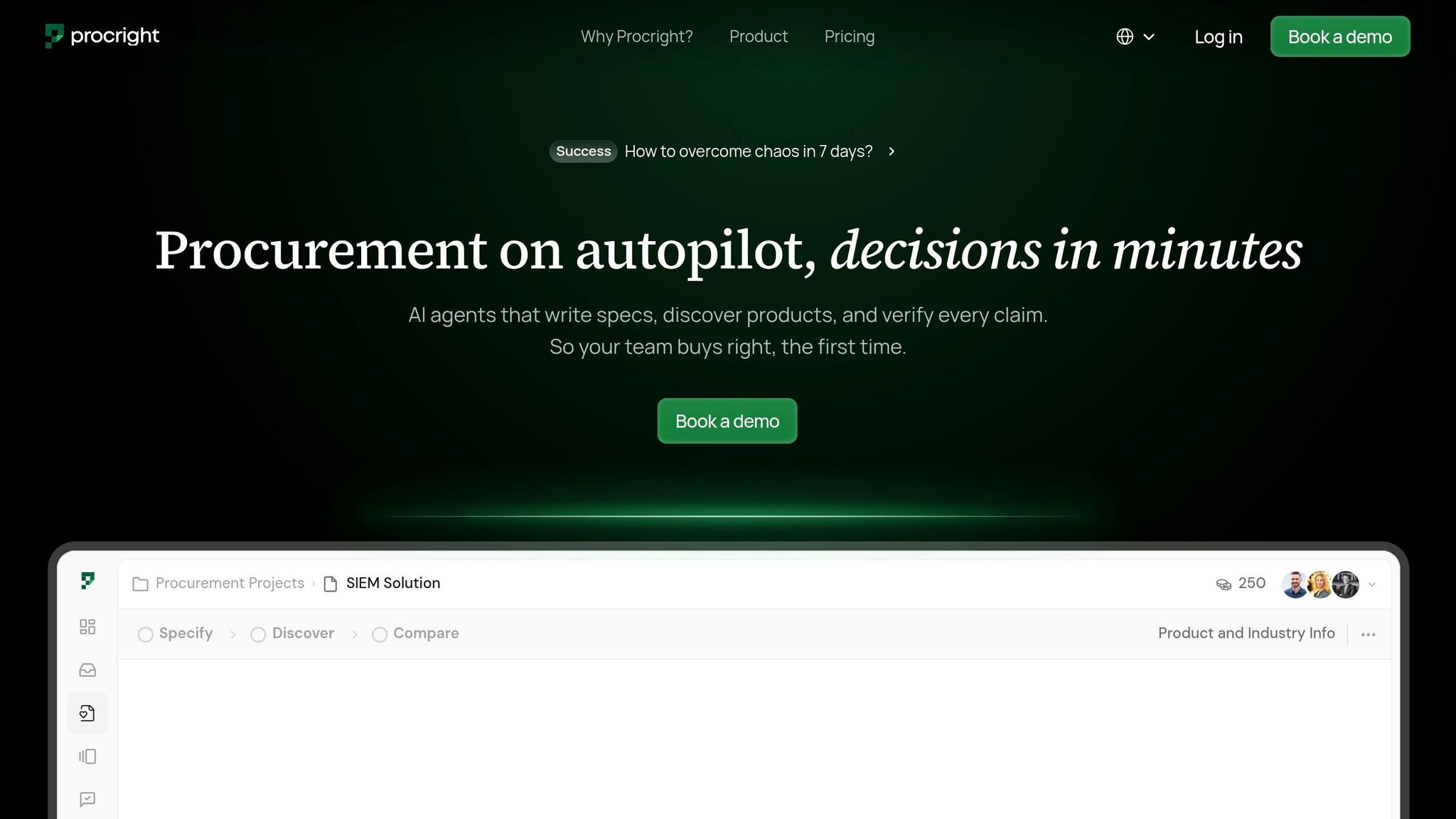
Once risk feeds and alert rules are set up, the next checkpoint is the specification.
Procright puts risk controls in place before sourcing starts by checking for specification gaps before the RFP goes out. Its AI agent asks procurement teams structured questions to bring missing load tolerances, compatibility requirements, and applicable compliance standards to the surface. On top of that, its industry-specific templates help cut down on specification errors.
After the specification is finalized, the platform checks each requirement, labels it Yes, Partially, No, or Not Found, and ties each result back to the source document for auditability. That traceability gives teams a clear paper trail. It also helps improve downstream risk scores.
Cleaner specs lead to cleaner risk signals. And when the signals are cleaner, downstream monitoring becomes more dependable.
Key Takeaways for Building a Monitoring Program That Scales
Effective monitoring connects supplier, price, delivery, and compliance signals to one priority model. Build the program around the supplier and category risks that matter most, then match your data feeds and alert thresholds to those risks.
It also helps to blend internal performance data with external risk feeds and weight scores so routine noise doesn't set off reviews. This approach is central to predictive analytics for supplier risk management, allowing teams to anticipate issues before they escalate.
Each alert should go to one owner with one next step. AI surfaces the signal; people decide what to do.
Strong specifications, continuous monitoring, and documented workflows make manufacturing procurement decisions more reliable and easier to defend.
FAQs
How do we start AI risk monitoring with messy data?
Start by fixing the information gap before procurement begins. When data is scattered, missing, or half-filled, teams often end up guessing their way through the process by hand.
An AI-powered platform like Procright can help clean that up. It can flag missing requirements, suggest the technical details you still need, and check for completeness early in the process.
The result is a clear, measurable, and auditable requirements document before you go to market or speak with a vendor.
Which suppliers should be monitored in real time first?
Prioritize real-time monitoring for critical suppliers - the ones that could slow down or shut down production if they fail. That usually includes single-source component suppliers, cloud infrastructure providers, and financial processors.
Use a criticality analysis to rank suppliers based on their role in your value chain, how much you depend on them, and whether you have other options. Start with the highest-risk suppliers so you can spot financial, security, or delivery problems early.
How can we reduce false alerts without missing real risk?
Cut false alerts by shifting from reactive monitoring to tighter pre-purchase validation. With Procright, teams can lock in complete, standards-aligned specs before sourcing. That helps remove vague requirements, which often lead to misleading or non-compliant vendor data.
Its AI comparison engine then spots gaps and maps vendor claims to your requirements with source citations. In plain terms, you can tell the difference between full and partial compliance more easily and make decisions based on data you can verify.