How AI Simplifies Procurement Standardization
AI automates data normalization, standardizes workflows, and enforces compliance to cut errors, time, and procurement costs.
AI is transforming procurement by solving three major challenges: fragmented systems, inconsistent data, and manual compliance processes. By automating data normalization, standardizing workflows, and improving specification accuracy, AI reduces errors, saves time, and lowers costs. Organizations that integrate AI into procurement can cut manual processing by 40–60%, reduce compliance violations by 70%, and achieve cost savings of 15–30%.
Key takeaways:
Automation: AI uses tools like NLP in procurement and OCR to extract, clean, and structure procurement data.
Consistency: AI ensures uniform workflows and data accuracy across teams.
Savings: Companies report millions saved by eliminating errors, consolidating suppliers, and improving compliance.
AI is not just a tool - it’s a necessity for efficient, cost-effective procurement in today’s complex landscape.
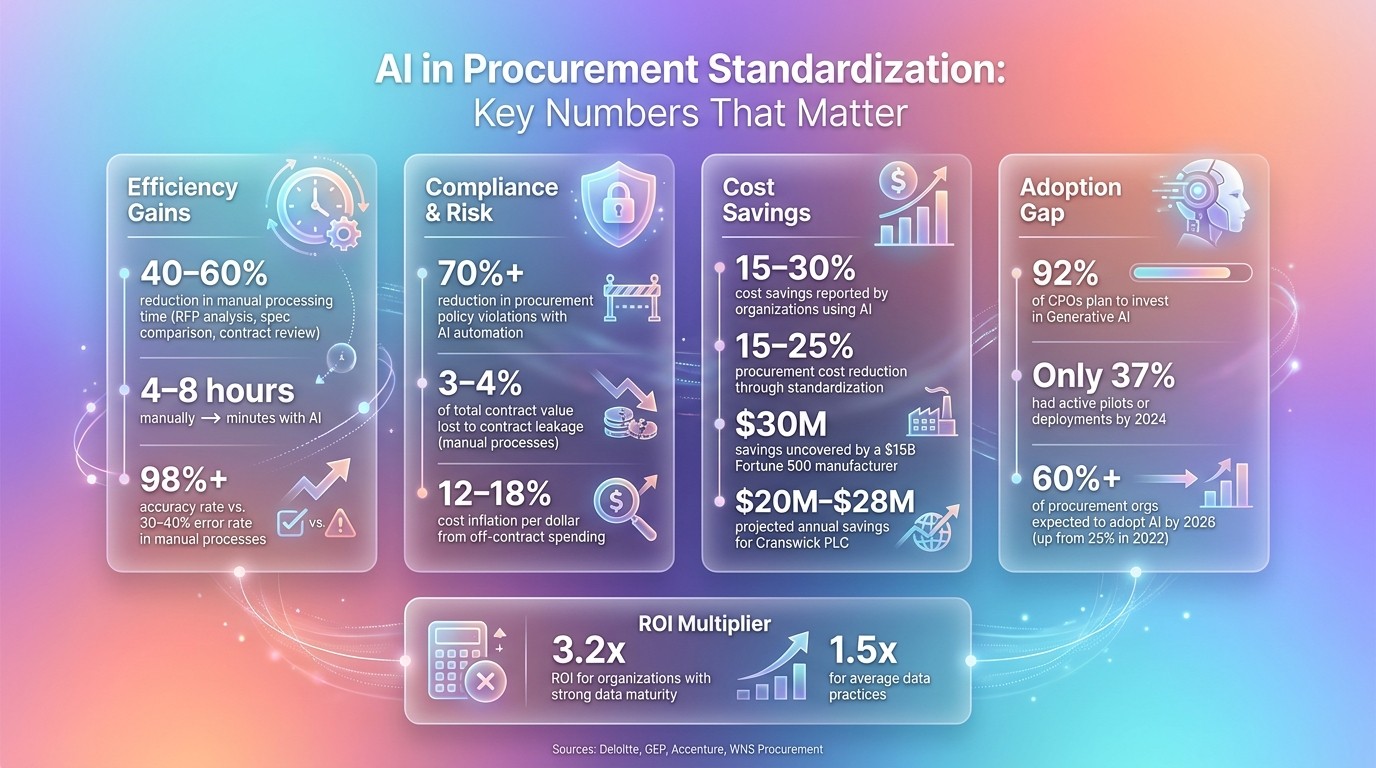
AI in Procurement: Key Stats & Benefits at a Glance
AI in Procurement: Smarter Sourcing, Contracts, & Supplier Management
Key Challenges in Procurement Standardization
Procurement standardization might sound straightforward, but in reality, it’s anything but. Organizations often grapple with three major hurdles: disconnected systems, unreliable data, and compliance processes bogged down by manual effort. These issues - fragmented workflows, inconsistent data, and cumbersome compliance - can seriously hinder procurement efficiency. Tackling these challenges is crucial for enabling AI-driven solutions.
Fragmented Processes and Silos
Procurement teams often rely on multiple systems to manage their operations. Data is scattered across ERPs, sourcing platforms, contract management tools, and even regional spreadsheets. This patchwork approach makes it nearly impossible to get a clear and consistent view of spending, suppliers, or contract terms.
"Without a unified taxonomy, cross-entity visibility remains out of reach. The data exists, but not in the form that systems or analysts can trust." - GEP
The result? Inflated supplier counts and missed opportunities for consolidation. On top of that, resistance to change only deepens the fragmentation. Breaking down these silos is a critical first step toward leveraging AI to streamline procurement workflows. Understanding the complete procurement lifecycle is essential for identifying where these silos exist.
Inconsistent Specifications and Data
Even when teams share the same system, data inconsistencies can still wreak havoc. For instance, one team might refer to a supplier as "ABC Ltd.", while another uses "ABC Trading." Similarly, differing units of measurement or formatting errors can create headaches, requiring manual reconciliation before any analysis can begin.
Shockingly, between 40% and 60% of supplier questions during an RFX process are tied to common procurement template issues like unclear or inconsistent requirements. In large organizations, the problem is amplified by Technical Data Packages that can span thousands of pages, filled with nested references and cross-referenced standards. All of this makes accurate data parsing a monumental challenge. And it’s not just data - manual processes also drag compliance efforts down.
Manual Compliance and Policy Enforcement
Ensuring purchases align with internal policies and external regulations is a labor-intensive process when done manually. Compliance data is often scattered across systems, and critical requirements are buried in lengthy documents. Errors creep in when stakeholders, unsure of the data’s purpose, make incorrect entries - like selecting the wrong commodity code. These small mistakes can snowball, corrupting spend analysis.
The financial implications are hard to ignore. Contract leakage - losses from unapproved terms or missed clauses - can account for 3–4% of total contract value. On top of that, manual processes struggle to keep up with evolving regulations like GDPR and CCPA, increasing the risk of audit failures and legal penalties. As procurement teams grow and handle more complex categories, manual compliance checks simply can’t keep up. AI offers a way to automate these checks, ensuring policies are followed and reducing the burden on human teams.
How AI Simplifies Procurement Standardization
The hurdles of fragmented systems, inconsistent data, and manual compliance share a common origin: lack of structure. AI tackles this head-on by introducing automation and pattern recognition into procurement workflows. The outcome? A streamlined and reliable process that doesn’t rely on teams manually ensuring everything is done correctly. These automated processes help establish a foundation for standardized workflows.
Automating Specification Creation
Creating specifications manually is prone to errors. AI changes the game by leveraging Natural Language Processing (NLP) and Optical Character Recognition (OCR) to extract and structure data from vendor files like PDFs, Word documents, and Excel spreadsheets.
Using semantic normalization, AI identifies that terms like "operating temperature" and "thermal range" refer to the same concept, mapping them accurately across scattered data sources. It even manages unit conversions, seamlessly reconciling imperial and metric measurements. This reduces the error rate from 30–40% in manual processes to over 98% accuracy.
"The power of generative AI in procurement lies not only in the technology itself but also in the strength and quality of the data that fuels it." - Mita Gupta, Business Unit Head, WNS Procurement
Platforms such as Procright take automation further by pulling data from various sources - including web pages, PDFs, and even videos - to create specifications end-to-end. This means teams can focus on analyzing the insights these specs provide instead of building them from scratch. By simplifying spec creation, AI naturally promotes consistency in procurement workflows.
Keeping Workflows Consistent
Procurement inconsistencies often arise from process gaps - teams following different steps, using mismatched tools, or making decisions that should be standardized. AI eliminates these inconsistencies by embedding logic directly into workflows.
Instead of waiting weeks for new data transformation rules, modern AI platforms allow procurement analysts to implement and verify standardization logic in just hours using visual interfaces. This self-service model not only ensures consistency across teams but also significantly reduces cycle times. Organizations using AI report a 40–60% reduction in manual processing time, a benefit that grows exponentially in high-volume categories. With consistent workflows in place, AI further enhances data reliability through automated normalization.
Data Normalization and Deduplication
Clean and consistent supplier data is critical for sound procurement decisions. AI replaces occasional manual cleanups with continuous, automated normalization, ensuring records are standardized as they enter the system. This directly addresses the fragmented and inconsistent data issues mentioned earlier.
AI excels where traditional systems fall short. For example, it can identify that "ABC Ltd." and "ABC Corp." refer to the same supplier by recognizing subtle patterns. The same applies to product descriptions: AI maps terms like "notebook", "laptop", and "portable PC" to a single category using taxonomies like UNSPSC, giving procurement teams a clear view of spending across the organization.
"LLMs can be trained on procurement-specific terminology and industry data to recognize and standardize inconsistent entries, and to identify and remove duplicative entries even when exact matches are not present." - Deloitte
AI also performs data imputation, filling in missing details such as prices or units of measure based on historical purchasing trends. This ensures that incomplete records don’t stall analysis. The result is a cleaner, more reliable data foundation that enhances every subsequent procurement decision.
What Research Says About AI in Procurement Standardization
Research backs up the benefits of AI-enabled standardization with measurable results, showing how these tools enhance both efficiency and accuracy in procurement processes.
Efficiency Gains and Fewer Errors
AI significantly cuts down the time needed for procurement tasks. For example, a specification comparison that typically takes 4–8 hours manually can be completed in just minutes using AI-powered workflows, achieving an accuracy rate of over 98%. Studies show that AI-driven workflows reduce manual processing time by 40–60% across activities like RFP analysis, specification comparison, and contract review. By 2026, more than 60% of procurement organizations are expected to pilot or adopt AI solutions, a sharp rise from 25% in 2022. These time savings also lead to better compliance and improved risk management.
Better Compliance and Risk Management
AI has a clear impact on compliance. Automated tools for policy checks and data validation reduce procurement violations by more than 70%, replacing manual oversight with real-time enforcement. This is particularly critical for large organizations, where off-contract spending can inflate costs by 12–18% per dollar spent.
Contract management is another area prone to risks. As Accenture points out:
"Contracts are one of the biggest sources of hidden value loss in the supply chain. Fragmented clause standards, limited visibility into risky terms, manual reviews and 'evergreen' auto-renewals lead to compliance gaps."
AI-powered contract lifecycle management tools address these issues by using NLP to monitor agreements, flag risky terms, and standardize clauses automatically. This reduces compliance gaps and helps prevent value losses that manual processes often overlook, leading to considerable cost savings.
Cost Savings Through Standardization
The financial benefits of AI in procurement standardization are well-documented. Organizations using AI have reported cost savings between 15% and 30%. For instance, a $15 billion Fortune 500 manufacturer leveraged AI-driven spend optimization to clean and reclassify spend data, uncovering $30 million in savings by eliminating duplicates and tightening price controls.
In January 2025, UK-based food producer Cranswick PLC adopted a three-component AI classification model to automate spend analysis. This approach processed unstructured spend data, accurately categorized suppliers, and identified missed savings opportunities, leading to projected annual savings of $20 million to $28 million. These examples highlight how AI-driven standardization transforms procurement into a more strategic, cost-effective function.
Steps to Implement AI-Driven Procurement Standardization
The examples and research above highlight the potential of AI in procurement standardization. Turning this potential into reality involves three key steps.
Define Your Standardization Goals
Before introducing any AI tools, it's essential to clarify what you aim to standardize. This could include technical procurement specifications, supplier qualifications, approval workflows, or all of the above. Without a clear focus, AI may simply streamline existing inefficiencies.
Start by assessing your current processes. Measure key metrics like time spent on manual data entry, error rates in extracting specifications, and the average duration of your sourcing cycles. These benchmarks are critical for evaluating the impact of AI after implementation. For instance, standardization efforts can cut procurement costs by 15–25% through demand bundling and economies of scale. However, you'll only see these benefits clearly if you know where you began.
Here’s an example: A mechanical engineering company discovered it was managing 2,500 different screw types in its procurement catalog. By analyzing usage patterns, they consolidated this to 300 standard variants and negotiated a framework agreement with a primary supplier. The results? 20% cost savings and a 40% reduction in inventory levels.
Once your goals are defined, the next step is to ensure your data is ready to support AI initiatives.
Build a Foundation of Clean Data
Data quality is often the stumbling block for AI implementations. As Deloitte points out:
"Poor-quality data will likely lead to flawed recommendations and suboptimal decision-making in procurement processes with even the most advanced AI-based capabilities."
AI won't fix messy data - it will amplify the problems. Duplicate supplier records, inconsistent units of measure, or mismatched product attributes across systems will carry over into AI workflows, undermining results.
The solution lies in data discipline. Standardize critical data fields used to compare suppliers, products, and quotes before introducing AI tools. Assign clear ownership of data - for instance, Procurement might manage supplier identity fields, while Finance oversees payment terms - to maintain quality over time. Focus on cleaning essential fields for supplier comparisons and reorder decisions, rather than attempting to overhaul your entire historical database.
Platforms like Procright are designed to work with structured data, using AI to analyze specifications, compare products, and highlight compliance scores. However, these tools are only as reliable as the data they process.
Start with a Pilot, Then Scale
Once your goals are set and your data is clean, test your approach on a small scale.
Although 92% of CPOs plan to invest in Generative AI, only 37% had launched pilots or deployments by 2024. This hesitation often stems from uncertainty about where to begin. The solution? Start small and specific.
Choose a category with high transaction volume, such as office supplies or IT hardware. Run the AI process alongside existing workflows for 2–4 weeks before fully integrating it, allowing you to identify and address any gaps without disrupting operations. Use this pilot to measure success metrics like automation rates, error reduction, and compliance improvements.
The rewards for getting this right can be substantial. Organizations with strong data maturity see a 3.2x ROI on AI investments, compared to just 1.5x for those with average data practices. A well-executed pilot not only proves the concept but also builds the confidence needed to scale AI standardization across the organization.
Conclusion: Using AI to Strengthen Procurement Standardization
Standardizing procurement has always been a smart move, but it’s historically been a slow, cumbersome process. Teams often get bogged down by fragmented data, inconsistent specifications, and time-consuming compliance checks. AI is changing that dynamic.
The numbers back this up: companies that standardize procurement can reduce costs by 15–25%. AI helps make this possible by simplifying and speeding up the standardization process. It ensures data is consistently normalized as it enters your system, flags inconsistencies that manual reviews might overlook, and keeps workflows aligned across teams and regions - all without requiring a massive upfront overhaul.
Experts in the field stress the importance of acting now:
"The time to build a foundation of best practices to prepare for the advancement of GenAI and help enhance end-to-end procurement operations is now." - Deloitte
Platforms like Procright are designed to take on these challenges. They automate tasks like creating specifications, standardizing product comparisons with clear compliance scores, and providing tools for data-driven decision-making. The goal isn’t to replace procurement professionals but to free them from repetitive tasks to improve procurement productivity, allowing them to focus on high-value activities like negotiation, supplier management, and strategic planning.
However, there’s still a gap between intention and action. While 92% of CPOs plan to invest in AI, only 37% were actively piloting or deploying it by late 2024. Closing this gap is vital for staying ahead. Teams that embrace AI now will be better equipped to tackle future challenges, including increasing complexity, tighter regulations, and growing demands for efficiency.
FAQs
What procurement data should we standardize first?
Begin with master data - things like supplier profiles, catalog items, and service descriptions. This data is critical for accurate spend analysis, compliance checks, and effective reporting. Once that's in place, focus on standardizing transactional data such as contracts, purchase orders, and invoices. This step helps uncover spending trends and patterns. Tools like Procright simplify the process by automating tasks like specification creation and compliance verification, ensuring your procurement decisions are built on a solid, consistent foundation.
How clean does our data need to be before using AI?
Your data doesn’t have to be flawless to start leveraging AI. What matters is having enough dependable signals to drive meaningful decisions, flag potential risks, or activate workflows. Focus on using trustworthy data from specific spend categories to develop your first use cases. As you integrate AI into your daily operations, it can assist in identifying data gaps and enhancing quality over time, streamlining procurement processes and boosting accuracy.
What’s a good first AI pilot for procurement standardization?
Automating quote comparison is an excellent way to kick things off. AI simplifies this task by standardizing currencies, units, and item descriptions, presenting them in a straightforward, side-by-side format. This removes the need for manual reconciliation of vendor data, cutting down on time and effort. It’s a smart first step that not only provides quick results but also helps lay the groundwork for more comprehensive procurement standardization.