Best AI Procurement Tools in 2026: A Roundup
Compare top AI procurement tools, use cases, and integration tips to reduce manual work and boost savings.
AI is now a must-have for procurement teams in 2026. U.S. organizations are managing more spend with fewer resources, making automation essential. AI tools streamline tasks like vendor sourcing, spend analysis, and contract management while cutting manual work by 69%. Teams using these tools report 20–30% cost savings and faster cycle times.
Key takeaways:
Top tools: Procright, Coupa, SAP Ariba, Ivalua, Suplari, Zip, Opstream, and Tonkean.
Applications: Demand forecasting, supplier discovery, contract review, and risk monitoring.
Challenges: Data readiness is critical - 74% of leaders admit their data isn’t AI-ready.
To choose the right tool, focus on your team’s needs, clean your data, and test solutions with a pilot program. Proper implementation can deliver up to 3.2x ROI compared to less mature organizations.
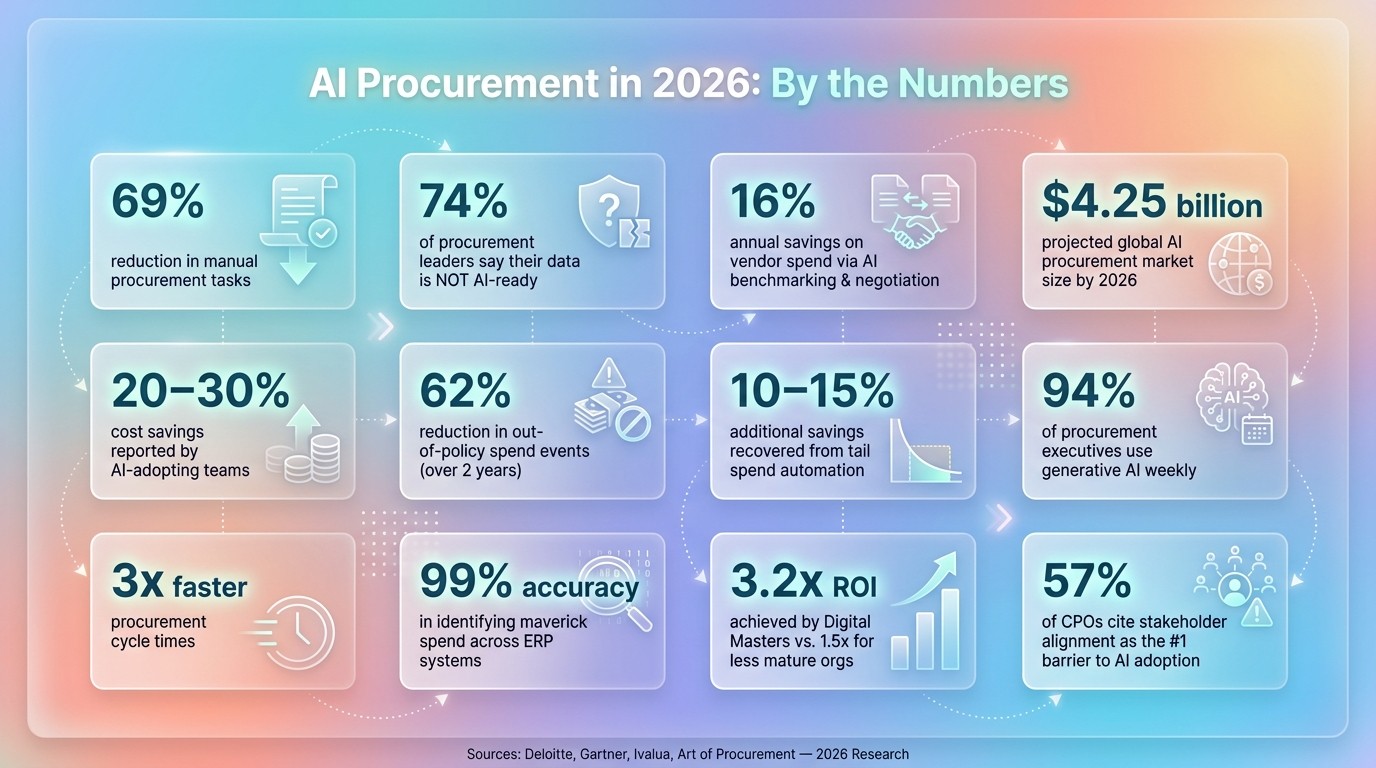
AI Procurement Tools in 2026: Key Stats & ROI Impact
The Best AI Procurement Tools in 2026 (And the Specific Problems Each One Solves)
How AI Changes Procurement in 2026
AI is reshaping procurement by speeding up workflows and improving procurement accuracy. Teams using modern AI tools report three times faster cycle times and a 69% reduction in manual tasks. Additionally, organizations leveraging AI for spend analysis and supplier management have achieved cost savings of 20% to 30%. For U.S. procurement teams, often working with tighter budgets and smaller teams, these changes are game-changing. Here’s how AI is making an impact across procurement processes.
Key Applications of AI in Procurement
AI's influence spans the entire purchasing lifecycle, delivering efficiency and precision at every stage:
Application | Function |
|---|---|
Automatically categorizes spend to detect anomalies and prevent overspending | |
Supplier Discovery | AI agents identify suppliers, create RFx documents, and evaluate responses in minutes |
RFQ/RFP Handling | Autonomous bots handle the RFQ process, including bid assessments and award optimization |
Contract Reviews | NLP tools highlight risky clauses - like unlimited liability - and identify compliance gaps |
Risk Monitoring | Continuously tracks financial health, news sentiment, and ESG signals to anticipate supplier failures |
Take Jabil as an example: by using AI-powered sourcing optimization, they cut a 13-month sourcing cycle by one month and saved $13 million across three sourcing events. This showcases how AI can deliver measurable results.
Benefits for U.S.-Based Procurement Teams
AI offers U.S. procurement teams practical solutions to common challenges. For instance, automated enforcement reduced out-of-policy spend events by 62% over two years, tackling compliance issues head-on. AI also identifies maverick spend across multiple ERP systems with up to 99% accuracy, catching violations before they escalate.
On the cost side, AI tools for benchmarking and negotiation have delivered 16% annual savings on vendor spend. When it comes to managing tail spend - the smaller, often overlooked transactions - AI automates bidding processes, recovering an additional 10–15% in savings. These savings add up, especially in high-volume indirect spend categories.
What You Need Before Implementing AI
To unlock AI's potential in procurement, a strong data foundation is non-negotiable. The biggest hurdle? Data readiness. A striking 74% of procurement leaders admit their data isn’t yet "AI-ready". Issues like incomplete vendor records, inconsistent spend categories, and fragmented ERP data can hinder AI performance.
Before rolling out AI tools, focus on these essentials:
Clean up vendor master data: Eliminate duplicate suppliers and standardize naming conventions to give AI models a reliable starting point.
Standardize spend taxonomy: This ensures AI can accurately classify and benchmark your spend data.
Ensure ERP integration: Whether you use SAP, Oracle, Microsoft Dynamics, or NetSuite, your AI tools must connect seamlessly to avoid creating new data silos.
Getting these basics right is the foundation for successful AI implementation and long-term benefits.
Procright: AI-Powered Procurement Platform
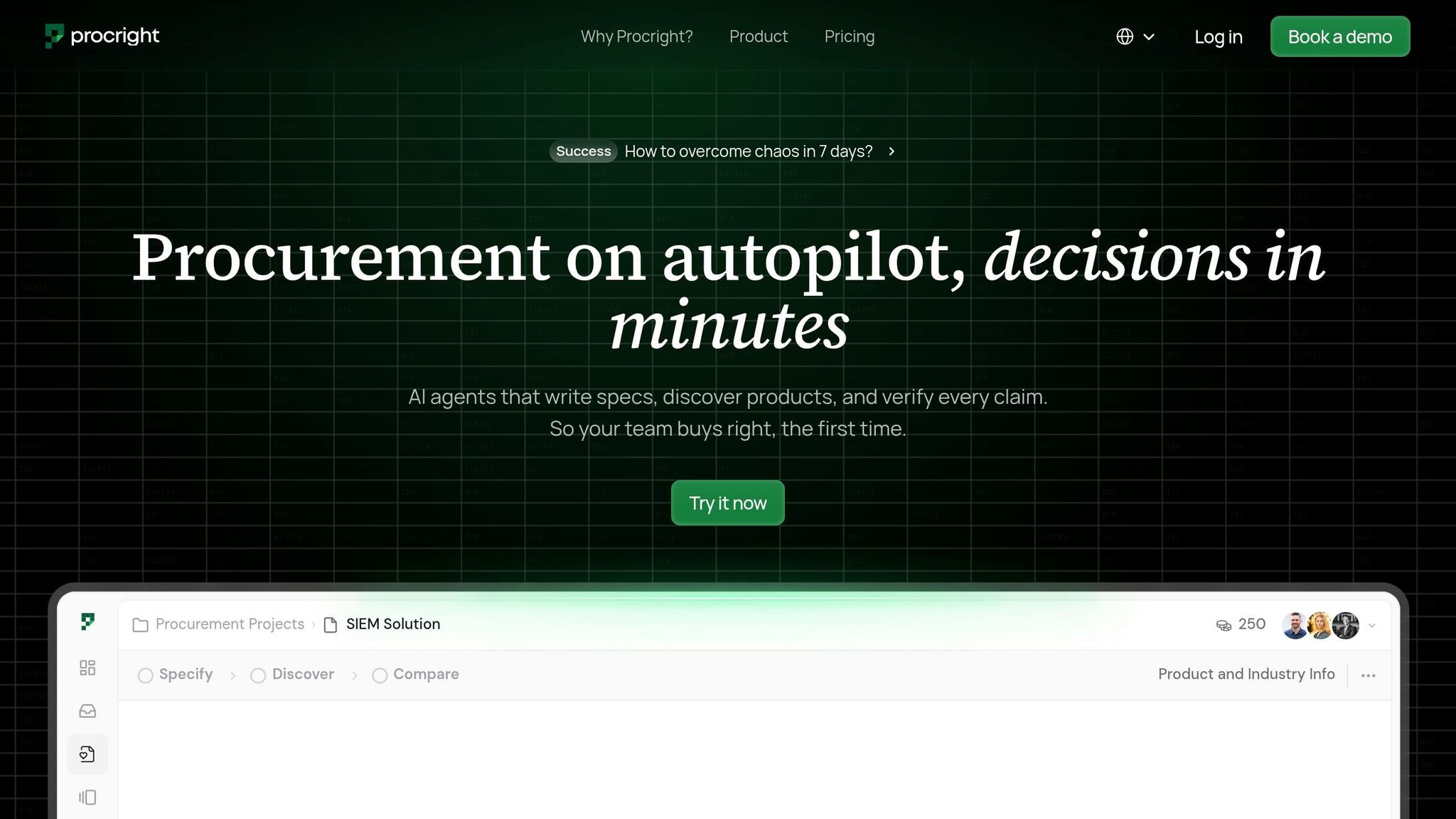
Procright simplifies and speeds up the procurement process by automating critical steps like creating detailed technical specifications, finding compliant products, and verifying vendor claims. This streamlined approach ensures faster and more traceable purchasing decisions through automated compliance checks, making Procright stand out in the AI-driven procurement space.
Use Cases and Target Environments
Procright is particularly effective in settings where precise technical specifications are crucial. It addresses gaps in specifications quickly, helping to avoid non-compliant purchases and project delays. The platform shines in managing complex, multi-item sourcing events by transforming raw input data into well-structured specifications in just minutes. This capability directly tackles the challenges posed by technical precision gaps in procurement.
Key Features and Capabilities
Procright offers several standout features:
AI-Driven Specification Creation: Converts intricate inputs into detailed specifications while identifying any missing requirements.
Smart Product Discovery: Analyzes web pages, PDFs, and videos to find products that match the generated specifications and provides detailed item-by-item comparisons.
Transparent Sourcing: Ensures every product match is backed by clear, traceable data, giving teams insight into why each option was ranked.
Automatic Compliance Verification: Evaluates vendor claims against your specifications and delivers straightforward, actionable results.
The platform also includes integrated collaboration tools, allowing teams to review and refine results in real time without needing to switch between different applications.
To complement these features, Procright offers flexible plans that adapt to the needs of growing organizations.
Plans, Pricing, and Deployment
Plan | Best For | Notable Features |
|---|---|---|
Basic | Small teams | AI specification creation, product discovery, and compliance verification |
Professional | Mid-sized teams | All Basic features plus real-time collaboration and industry-specific templates |
Enterprise | Large organizations | All Professional features plus advanced analytics and custom integrations |
Pricing for the Basic and Professional plans is available upon request, while Enterprise pricing is tailored to specific needs. To get a precise quote based on your team size and requirements, you can contact Procright directly. The onboarding process typically involves connecting your existing data sources, setting up user roles, and selecting the most relevant templates for your procurement activities.
Other Types of AI Procurement Tools
The world of AI procurement tools includes a variety of categories, each designed to tackle specific challenges. By understanding these tools, you can pinpoint gaps in your current processes and explore how AI can enhance your procurement operations beyond the basics.
Intake-to-Pay and Guided Buying Platforms
These platforms act as a centralized hub for managing procurement requests. Instead of juggling emails or relying on unstructured workflows, intake-to-pay tools streamline the process with AI-driven automation. They enforce policy rules, autofill forms using past data, and route requests to the appropriate approver. Tools like Zip, Opstream, and Tonkean excel in this area. For example, Opstream boasts a 4.9/5 rating on Gartner Peer Insights and integrates seamlessly with ERP systems, allowing for deployment in as little as 30 to 90 days.
This category doesn't stop at simplifying procurement requests. These tools also provide actionable insights and support the entire procurement lifecycle.
Spend Analytics and Supplier Intelligence Tools
Procurement data is often scattered across ERP systems and accounts payable platforms, leading to inconsistent categorization and missed opportunities. Spend analytics tools solve this by organizing raw data, identifying patterns, and surfacing insights like duplicate payments, pricing discrepancies, and areas for supplier consolidation. By using AI for spend analysis, organizations can achieve savings of up to 20%.
Take Suplari as an example. It offers over 175 prebuilt insights, a 90-day deployment timeline, and a 4.8/5 rating on Gartner Peer Insights. Beyond cost savings, these tools monitor supplier health in real time, using financial metrics, ESG data, and news sentiment to flag potential risks.
End-to-End Source-to-Contract Platforms
For teams looking to manage the entire procurement lifecycle in one place, full-suite platforms like Coupa, SAP Ariba, and Ivalua are the go-to solutions. These systems handle everything from drafting RFx documents and evaluating bids to managing contracts and processing invoices. They also harness AI for tasks like automated bid analysis, scenario modeling, and extracting key contract clauses - using natural language processing to spot deviations from approved legal terms.
However, implementing such platforms requires careful planning. Enterprise-wide deployments often take 6 to 12 months and need dedicated administrative resources. As Ivalua notes:
"AI effectiveness depends heavily on a unified S2P data model."
In other words, the success of these platforms hinges on having clean, consolidated data. For large organizations aiming to unify sourcing, contracting, and payment processes into a single system, the investment can yield significant returns. But it’s important to assess whether this is the right fit for your team’s current needs and scale.
How to Choose the Right AI Procurement Tool
Building on earlier discussions about preparing your data, selecting an AI procurement tool that aligns with your AI-native procurement team's immediate needs is essential for maximizing the value AI can bring to procurement.
Mapping Your Procurement Needs
Start by tracking your team's activities over the course of a week to identify where inefficiencies arise and which data areas are most critical. Are they losing hours on purchase order (PO) follow-ups, chasing supplier quotes, or manually categorizing spend? The answer to this question will guide your decision-making. This is the first step toward making data-driven procurement decisions that yield long-term savings. For example, a team bogged down by intake requests will require a different solution than one grappling with disorganized spend data.
Philip Ideson from Art of Procurement offers practical advice: focus on cleaning the data specific to your key use case instead of waiting for perfect, comprehensive data. This targeted approach ensures you can move forward without unnecessary delays.
Once you've outlined your needs, set clear evaluation criteria that directly address these priorities.
Criteria for Evaluating Tools
Establishing evaluation criteria is crucial to ensure that each tool is assessed based on your unique procurement challenges. The table below outlines critical questions to guide your evaluation process:
Evaluation Criteria | Key Question to Ask |
|---|---|
ERP Integration | Does it write data back in real-time, or does it require manual exports? |
Supplier Adoption | Does it require suppliers to log into a portal or create an account? |
AI Architecture | Is AI embedded in the data model, or is it added onto a legacy system? |
AI Explainability | Can it provide an audit trail explaining its recommendations? |
Security & Compliance | Is it SOC 2 Type II certified? Where is the data stored? |
Scalability | Does the pricing model penalize growth (e.g., per-transaction fees at scale)? |
Supplier adoption is a critical but often overlooked factor. Eshani Mehta of Lumari highlights the challenge:
"Your fastener distributor in Ohio is not adopting your new platform. Neither is the sheet metal shop in Guangdong."
If your supply chain includes small or regional vendors, tools requiring portal sign-ups can create unnecessary friction.
Additionally, be mindful of hidden costs. For instance, enterprise suite implementations can cost $500,000 or more in onboarding fees alone. These expenses are separate from the annual license fee. Always request a detailed breakdown of costs, including implementation, middleware for integration, and support tiers, before making a commitment.
Using Comparison Tables to Decide
Once you've prioritized your criteria, create a comparison table to evaluate your options objectively. This side-by-side assessment helps you identify which tool best meets your needs. For example, if your ERP is central to your operations, give more weight to integration depth and AI architecture. On the other hand, if you manage a diverse vendor base, supplier adoption might carry more weight.
A critical step in this process is running a 60- to 90-day pilot using your company's actual data. Vendors unwilling to agree to this should raise concerns. Pilots with real data can uncover integration issues, categorization errors, and workflow mismatches that won't surface in a controlled demo environment.
Procurement teams that choose the right AI tools can achieve up to 3.2 times greater ROI on their AI investments compared to their peers.
Conclusion
AI has transitioned from being a luxury to an essential part of how procurement teams operate. With the global AI procurement market expected to hit $4.25 billion by 2026 and 94% of procurement executives using generative AI weekly, the focus has shifted. It’s no longer about whether to use these tools - it’s about finding the right ones to tackle your organization’s specific challenges.
One common pitfall? Chasing flashy features instead of addressing real issues. As highlighted in this roundup, the best tool for your team depends on your specific bottleneck. Whether you’re struggling with internal requests, managing spend data, or speeding up supplier responses, a tool tailored for one workflow won’t necessarily work for another.
The divide between organizations that harness AI effectively and those that don’t is striking. Deloitte reports:
"Digital Masters achieve 3.2X ROI on GenAI investments, compared to just over 1.5x for less mature organizations."
Success ultimately comes down to alignment. Matching the right tool to your workflow, ensuring your data is clean and ready, and gaining internal support across IT, Finance, and Legal are critical steps. In fact, 57% of CPOs cite stakeholder alignment as the main barrier to unlocking AI’s full potential. This shows that internal challenges often outweigh technical hurdles.
Focus on your biggest pain point first. Run a pilot using real data, measure the outcomes, and then scale up. This disciplined, results-driven approach - more than the AI’s sophistication - sets apart teams that achieve meaningful results from those still waiting for success.
FAQs
What data should we fix first before using AI in procurement?
To make smarter decisions and streamline automation, it's crucial to prioritize data quality, accuracy, and completeness. Tackling these aspects early on ensures you get the most out of AI in procurement workflows.
How do we prove ROI from an AI procurement tool in 60–90 days?
To show ROI within 60–90 days, start with quick-win use cases like contract review and redlining. These can deliver early savings and tangible results. Automating processes such as supplier vetting, spend analysis, and approval workflows can cut cycle times by more than 40%. Focus on setting clear objectives, prioritizing high-impact tasks, and tracking metrics like cost savings and time reductions to make your ROI case strong.
What should we ask vendors about ERP integration and security?
When evaluating vendors, make sure to discuss their ERP integration capabilities. Specifically, ask how their system will work with your current enterprise resource planning platforms. It's also crucial to address security concerns. Inquire about their measures to safeguard procurement data, such as compliance with industry standards, use of data encryption, and the implementation of access control mechanisms. These factors are key to ensuring a seamless and secure partnership.