Top 5 Procurement Challenges and How to Fix Them
AI, automation, multi‑sourcing and real‑time analytics to fix supply disruptions, rising costs, compliance gaps, data silos, and slow tech adoption.
Procurement in 2026 is more complex than ever. Rising costs, supply chain disruptions, compliance risks, poor data visibility, and slow tech adoption are the top challenges procurement teams face today. These issues impact budgets, efficiency, and risk management. But there’s good news: practical solutions exist.
Key Challenges and Fixes:
Supply Chain Disruptions: Geopolitical issues and climate risks demand multi-sourcing strategies and predictive analytics for supplier risk to stabilize operations.
Rising Costs: Inflation pressures can be countered with real-time analytics, vendor comparisons, and competitive bidding tools.
Compliance Risks: Automating compliance checks and audit trails reduces errors, fines, and legal risks.
Poor Spend Visibility: Centralized dashboards and AI-driven data integration improve decision-making and uncover cost-saving opportunities.
Slow Tech Adoption: Custom procurement workflows and AI-based automation streamline processes and reduce manual errors.
Quick Comparison of Challenges and Fixes:
Challenge | Solution | Impact |
|---|---|---|
Supply Chain Disruptions | Multi-sourcing + predictive analytics | Reduced risks, stable supply |
Rising Costs | Real-time benchmarking + bidding tools | Lower costs, better budgeting |
Compliance Risks | Automated checks + audit trails | Fewer errors, reduced fines |
Poor Spend Visibility | Centralized data + AI dashboards | Better insights, cost savings |
Slow Tech Adoption | AI workflows + user-friendly tools | Faster processes, fewer errors |
Procurement teams can achieve better outcomes by adopting smarter tools and strategies.
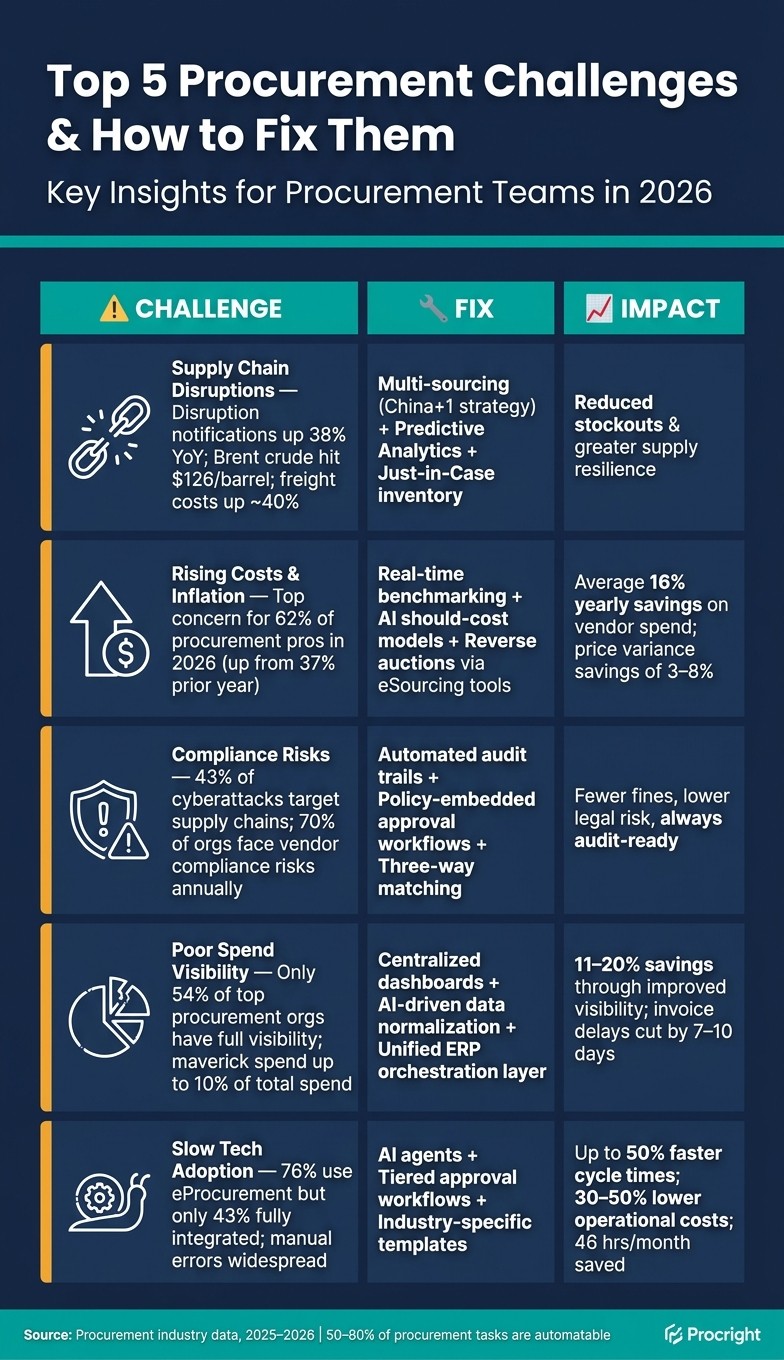
Top 5 Procurement Challenges: Problems, Fixes & Impact (2026)
Webinar: 2026 Procurement Agenda and Key Priorities
Challenge 1: Supply Chain Disruptions
Supply chain disruptions have become a persistent issue. In 2025 alone, disruption notifications surged by 38% compared to the previous year. A mix of geopolitical tensions, extreme weather events, cyber threats, labor disputes, and stricter regulations is fueling this ongoing instability.
How Geopolitical and Logistical Issues Affect Procurement
The 2026 Iran war created the largest energy supply disruption ever recorded. With about 20% of the world’s oil flowing through the Strait of Hormuz now at risk, the impact has been profound. Brent crude prices hit $126.41 per barrel in May 2026. Diesel costs for domestic freight have jumped by roughly 39%, while transpacific ocean freight rates have climbed approximately 40%. These changes have permanently altered cost benchmarks.
The ripple effects extend beyond energy. Taiwan, responsible for about 90% of the world’s advanced semiconductor production, faces critical vulnerabilities due to airspace restrictions. This has left electronics manufacturers heavily exposed. Additionally, printed circuit board (PCB) costs have soared by as much as 40% due to material shortages.
A particularly dangerous trend is what experts call "accidental concentration", where companies unknowingly become overly dependent on a single supplier or region.
"Single sourcing isn't always a decision; sometimes it's just what happens over time." - Mary Ruth Williamson, CEO, Sourcing IQ
These escalating risks underscore the need for immediate and diversified sourcing strategies.
Fix: Multi-Sourcing and Demand Forecasting
The solution lies in diversifying suppliers before a crisis forces action. Companies should adopt multi-country sourcing strategies like "China+1" or "Middle East+2" by qualifying vendors in regions such as India, Vietnam, and Eastern Europe. Combining this approach with a "Just-in-Case" inventory model helps secure critical components without overstocking non-essential items.
AI tools can play a pivotal role here. By integrating geopolitical data with AI-driven demand forecasts, procurement teams can identify and address risks early. For instance, Procright’s automatic source analysis feature pulls data from web sources, PDFs, and videos to provide a comprehensive view of supply dependencies. This helps uncover hidden vulnerabilities and reduce reliance on single sources.
"Supply risk used to feel event-driven... Now it feels continuous - not because every day is a crisis, but because the system has more embedded fragility." - Mary Ruth Williamson, CEO, Sourcing IQ
Challenge 2: Rising Costs and Inflation
After navigating supply chain challenges, procurement teams now face a different beast: the steady climb of costs. Unlike the sudden disruptions of supply chains, rising costs quietly but persistently erode budgets. Inflation has become the top concern for 62% of procurement professionals in 2026, a sharp increase from 37% the previous year.
How Rising Costs Lead to Budget Overruns
The cost of materials, logistics, and energy continues to rise. As older contracts locked in at lower rates expire, procurement teams are forced to renegotiate at today's much higher prices. This alone puts pressure on budgets, but internal inefficiencies like maverick spending and outdated manual processes make things worse.
Tom Mills from Procure Bites explains the problem with traditional procurement goals:
"Traditional targets are all about savings metrics... it also ignores inflation and other economic realities. It drives the wrong behavior that focuses on short-term impact."
The result? Budgets that look solid on paper but fail to hold up in practice. These challenges highlight the need for digital tools that offer real-time insights and help teams make smarter vendor choices.
Fix: Real-Time Analytics and Vendor Comparisons
To combat inflation, spend visibility is essential. By correcting data inaccuracies and consolidating spend information, organizations can achieve savings of 11% to 20%.
AI-powered tools take this a step further. For instance, price variance analysis can flag supplier quotes that stray from market benchmarks, uncovering potential savings of 3–8%. Similarly, AI-driven "should-cost" models provide fact-based insights that strengthen negotiating positions. Tools like Procright’s transparent product comparisons and scoring features enable teams to evaluate vendors side by side using consistent, transparent criteria, making decision-making more structured and reliable.
Competitive tactics also make a difference. Using eSourcing tools to run reverse auctions - where suppliers bid against each other in real time - can result in lower prices, even during inflationary periods. Additionally, automated three-way matching (linking purchase orders, invoices, and receipts) helps teams capture early-payment discounts and avoid late fees. This transforms accounts payable from a cost center into an opportunity for savings.
Challenge 3: Compliance and Governance Risks
Compliance in procurement is a tricky area that often leads to mistakes. Regulations are constantly evolving, internal policies can be overlooked, and relying on tools like email and spreadsheets makes it easy for audit trails to break down. These gaps don’t just create administrative headaches - they can result in costly fines, legal trouble, and significant damage to a company’s reputation.
Changing Regulations and Audit Gaps
The compliance landscape is more complicated than ever. For example, new regulations like the EU’s Corporate Sustainability Due Diligence Directive (CSDDD) and U.S. forced labor laws require procurement teams to dig deeper into their supply chains, going far beyond just their direct suppliers. Meanwhile, cyber threats are on the rise. Supply chains are now the target of 43% of cyberattacks, and incidents like invoice fraud and data breaches have doubled, reaching 26 attacks per month in 2025.
Relying on informal tools like email often means approvals aren’t properly documented, which weakens compliance efforts. Manual processes also fail to create a dependable audit trail, leaving organizations vulnerable to audit gaps that only come to light when it’s too late to fix them.
"Nearly 70% of organizations face vendor-related compliance risks each year, often because teams outside procurement don't follow established policies." - Deloitte
The risks don’t stop there. With 52% of enterprise SaaS subscriptions operating without IT’s approval, unchecked software spending introduces further regulatory, operational, and data privacy concerns.
To combat these challenges, automating compliance processes can link strategic goals to operational efficiency.
Fix: Automated Compliance Verification
Embedding compliance checks directly into procurement workflows can ensure policies are followed automatically.
Procright’s automated compliance verification system is designed to do just that. Every purchase request is routed through policy-based approvals, where factors like spending limits, risk levels, and department-specific rules determine who needs to sign off. This system eliminates unauthorized spending (or "maverick spend") by design, rather than relying on reminders. Plus, a digital audit trail records every decision, approval, and vendor interaction, so teams are always prepared for audits without scrambling for documentation.
Another critical layer of protection comes from automated three-way matching, which ensures purchase orders, delivery receipts, and invoices align. This reduces fraud and prevents overpayments. Additionally, automated tools can collect essential supplier documents - like SOC 2 certifications, ESG declarations, and GDPR compliance records - allowing procurement teams to stay ahead of vendor risks.
By integrating automation into compliance workflows, these vulnerabilities can be addressed effectively, while also streamlining efforts across the board.
Compliance Area | Automated Control | Benefit |
|---|---|---|
Internal Policies | Role-based approval routing and budget validation | Prevents unauthorized spending |
External Regulations | Automated document collection (GDPR, SOC 2, ESG) | Reduces fines and legal risks |
Contractual Obligations | Automated PO-to-contract price matching | Ensures compliance with negotiated terms |
Audit Readiness | Digital timestamps and immutable activity logs | Eliminates audit gaps and manual effort |
It’s worth noting that over 30% of purchase order discrepancies are caused by manual data entry or inconsistent processes. Automating these controls not only reduces compliance risks but also tackles the root cause: human error.
Challenge 4: Poor Spend Visibility and Data Silos
Once compliance is automated, another major challenge surfaces: fragmented spend data. Procurement teams often face a lack of visibility when essential information is scattered across disconnected systems. When spend data lives in ERPs, spreadsheets, P-cards, and contract tools that don’t integrate, it becomes nearly impossible to get a clear picture of where the money is actually going.
What Happens When Data Is Fragmented
The heart of the problem lies in the inability to consolidate spend data into one system. Different departments often use their own tools and naming conventions, which leads to inconsistencies. For instance, a vendor might be listed as "Acme Corp" in the ERP but as "Acme Ltd." in contract records. A single legal entity can appear multiple times in an uncleaned vendor master, making it very difficult to aggregate spend accurately.
This fragmentation has real consequences. Only 54% of top-tier procurement organizations achieve full enterprise spend visibility, while 57% of supply chain professionals cite limited visibility as a major operational hurdle. When vendor lookup is cumbersome, off-system purchases rise, increasing maverick spend by up to 10% of total spend. These off-contract purchases often bypass negotiated agreements, creating inefficiencies that go unnoticed.
Fragmented data also undermines forecasting accuracy. Without a unified view, teams spend more time searching for numbers than taking meaningful action. This disjointed approach can delay invoice cycles by an average of 7 to 10 days and causes organizations to miss out on savings opportunities - such as leveraging volume consolidation for up to 15% in cost reductions.
"Data silos are more than an inconvenience - they're a barrier to value creation." - Timothy Harfield, ORO Labs
Fix: Centralized Data and Spend Dashboards
The solution doesn’t require replacing every tool in your arsenal - it’s about connecting them. Modern procurement platforms use an orchestration layer to pull data from ERPs, sourcing tools, and spreadsheets into one unified system. AI-driven normalization then categorizes spend data and eliminates duplicate supplier records, creating a data-driven procurement strategy.
Procright’s spend visibility dashboards go even further by offering real-time, cross-dimensional analytics. Teams can analyze data by category, supplier, or department instantly, without waiting weeks for manual reports. These dashboards highlight consolidation opportunities, flag unusual spending patterns, and track budget usage in real time. Combined with Procright’s collaboration tools and standardized intake workflows, every purchase request flows through a single structured channel, effectively reducing maverick spend at its origin.
Impact of Data Silos | Consequence for Procurement |
|---|---|
Inconsistent Information | Data cannot be trusted for strategic decisions |
Slow Decision-Making | Teams waste time searching for data instead of acting on it |
Increased Risk Exposure | Hidden financial or ESG risks in the supply chain |
Missed Opportunities | Overlooked chances for volume consolidation or leverage |
Process Bottlenecks | Extended cycle times due to manual reconciliation |
Centralized data is the foundation for AI-driven demand forecasting, allowing procurement teams to move from reactive to proactive sourcing strategies. As Supplier.io notes: "AI depends entirely on structured, trusted data to function. Without it, AI doesn't just produce mediocre outputs. It produces confidently wrong ones." In short, getting the data right isn’t just about organization - it’s the key to unlocking predictive, AI-powered procurement strategies that can transform operations.
Challenge 5: Slow Technology Adoption and Manual Processes
Even with centralized data and automated compliance measures in place, many procurement teams still struggle due to resistance to adopting new technology. This resistance remains one of the most persistent challenges in modern procurement.
How Manual Processes Slow Down Procurement
While 76% of organizations report using eProcurement systems, only 43% have fully integrated them into their daily workflows. This often means teams are running new software alongside outdated processes, creating unnecessary friction. When a tool feels overly complex or doesn’t align with how employees naturally work, people tend to revert to familiar methods like spreadsheets, email chains, and manual data entry.
The impact is clear. Manual errors continue to plague procurement workflows. For example, treating a $60 office supply order with the same level of approval scrutiny as a six-figure contract renewal creates delays. This inefficiency can frustrate employees, leading them to bypass the system entirely - a practice known as maverick spend. As with other challenges, the reluctance to fully embrace new tools undermines procurement efficiency and highlights the need for automation.
"The issue usually isn't the people managing procurement. It's the systems they're forced to use." - PlanetBids Learning Center
Resistance to new technology is often less about stubbornness and more about complexity. Jason Kim, Senior Director of Product Management at Coupa, explains:
"Procurement has become increasingly complex, with many options and optimization strategies unfamiliar to typical users."
When a tool requires too much effort to learn or use, adoption often grinds to a halt.
Fix: Automation and AI-Driven Workflows
Addressing these operational bottlenecks requires targeted automation. By removing friction from manual tasks, organizations can unlock significant time savings. For example, AI agents can eliminate up to 46 hours of manual purchasing work per month, taking over tasks like vendor due diligence, three-way invoice matching, and compliance checks.
Streamlining approval processes is another key step. Low-value, low-risk requests should need only a single sign-off, while multi-step reviews should be reserved for high-value or high-risk purchases. This approach can reduce approval cycle times by as much as 60%. When procurement technology is aligned with actual workflows - rather than forcing teams to adapt to rigid new systems - efficiency gains of 15% to 30% are often achieved.
Procright tackles this adoption gap by offering industry-specific templates and AI-powered specification creation. These tools guide users through a structured intake process without requiring technical expertise. Pre-built, category-specific templates reduce the learning curve and ensure that every request captures the necessary data, minimizing errors that can derail workflows later. This approach not only accelerates processes but also helps organizations leverage AI to address key procurement challenges. Matteo Perondi, Chief Procurement Officer at Bulgari, summed up the ideal solution:
"We wanted a tool that is as easy as installing a mobile app."
Manual Process Issue | Automation Fix | Impact |
|---|---|---|
Hand entry errors | AI-powered OCR & three-way matching | 30% reduction in PO discrepancies |
Email-based approvals | Tiered automated workflow routing | Up to 50% faster cycle times |
Inconsistent intake | Standardized AI-guided request forms | Fewer errors, full audit trail |
Slow sourcing cycles | AI-generated specs and templates | Reduced from months to days |
Conclusion
Procurement in 2026 is grappling with a mix of pressing challenges: supply chain disruptions, rising costs, compliance gaps, fragmented data, and slow adoption of technology. These issues not only strain budgets but also slow down teams and amplify risks. The good news? There are practical solutions rooted in better data, smarter automation, and tools that fit seamlessly into daily workflows.
Key Takeaways
Here’s a quick breakdown of the five main challenges and their practical fixes:
Challenge | Core Fix | Key Impact |
|---|---|---|
Supply Chain Disruptions | Multi-sourcing + predictive analytics | Fewer stockouts and greater resilience |
Rising Costs and Inflation | Real-time benchmarking + competitive bidding | Average 16% yearly savings on vendor spend |
Compliance and Governance Risks | Automated audit trails + policy-embedded workflows | Lower legal risks and quicker audit readiness |
Poor Spend Visibility | Centralized dashboards + unified data | Potential 11–20% savings through improved visibility |
Manual Processes | AI agents + tiered approval workflows | Up to 50% faster cycle times and 30–50% lower operational costs |
The data makes one thing clear: integrating AI and centralizing information can transform procurement. With 50%–80% of tasks being automatable, manual processes are a costly bottleneck that teams can no longer afford.
That’s where Procright steps in. Its AI-driven tools - like automated compliance checks, industry-specific templates, and specification creation - are designed to eliminate friction at every stage. Best of all, these tools work within existing workflows, so teams don’t need to reinvent the wheel. The goal? Empower procurement professionals with the tools they need to make faster, smarter, and more defensible decisions.
"AI (artificial intelligence) will do more than just help. It will start to handle whole tasks by itself, from the first request to picking the final supplier." - ProcureKey
The future isn’t far off - it’s already taking shape. Procurement teams that embrace centralized data, automation, and purpose-built tools will be the ones setting the pace for the industry.
FAQs
Where should we start if our procurement data is messy and siloed?
To get the most out of your procurement processes, start by organizing and refining your data. Bring together information from various sources, such as ERP systems, supplier portals, and spreadsheets, into a single, centralized database. Standardize this data to maintain consistency and set up clear data governance rules to keep everything in check. By breaking down silos and ensuring your data is clean and accessible, you'll create a solid base for using tools like automation, AI, and analytics effectively.
How do we set approval tiers that cut cycle time without increasing risk?
To cut down cycle times without adding risk, implement automated, parallel approval workflows. This approach allows stakeholders like legal, finance, and procurement to review requests at the same time, eliminating the bottlenecks caused by sequential approvals.
Using no-code tools, you can set up workflows that adapt based on the context - such as the request's value or category. Most approvals can be handled automatically, leaving manual reviews only for exceptions. This ensures compliance stays intact while speeding up the overall process.
What procurement tasks can AI automate first for the fastest ROI?
AI makes it easier to handle tasks like spend analytics, helping businesses uncover opportunities such as grouping tail spend, standardizing supplier names, and spotting duplicate suppliers or unauthorized purchases. It can also perform price variance analysis to highlight unusual price increases and improve demand forecasting for better inventory management. By automating these processes, companies save time, reduce manual work, and make more informed decisions - leading to quicker returns on their investments.