Common Procurement Issues Solved by AI Frameworks
How AI frameworks standardize specifications, automate data extraction, cut manual work, and enforce compliance to speed procurement.
Procurement teams face recurring problems like mismatched requirements, inconsistent data, and compliance risks. These issues waste time, increase costs, and expose businesses to legal risks. AI frameworks solve these problems by automating data handling, standardizing specifications, and ensuring compliance.
Key Takeaways:
Misaligned Requirements: Engineers and procurement teams often miscommunicate, leading to errors and delays.
Inconsistent Data: Fragmented templates and vague specifications make vendor comparisons difficult.
Manual Processes: Outdated tools and manual workflows slow procurement cycles.
Compliance Risks: Missing certifications or details can lead to regulatory issues.
How AI Helps:
Automates data extraction and standardization.
Creates precise, measurable specifications.
Reduces manual effort by up to 96%.
Ensures compliance with built-in checks.
Platforms like Procright streamline procurement by automating tasks like specification drafting and vendor comparisons. Teams save time, reduce errors, and focus on high-value tasks instead of chasing data.
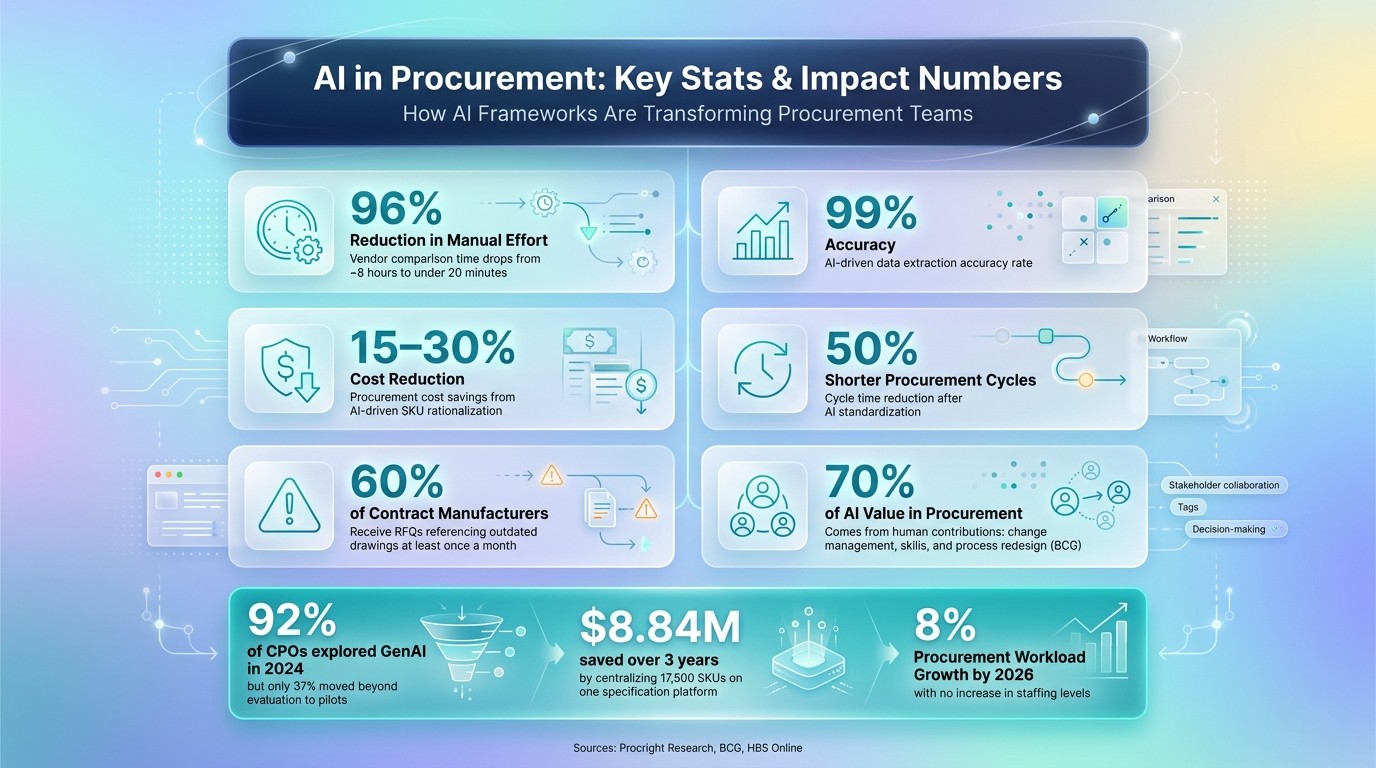
AI in Procurement: Key Stats & Impact Numbers
AI in Procurement: Smarter Sourcing, Contracts, & Supplier Management
Common Procurement Issues
Procurement problems often creep in unnoticed, only to surface later as delays, rejected shipments, or compliance headaches. Pinpointing where these issues arise is the first step toward resolving them.
Misaligned Requirements and Stakeholder Expectations
Procurement teams and engineers often speak different "languages." Engineers focus on technical specifics like GD&T callouts, material grades, and revision histories, while procurement prioritizes lead times and cost. Without clear communication, the gap between what’s needed and what’s sourced grows fast.
For instance, buyers may unknowingly source parts using outdated drawing revisions because engineering change orders (ECOs) didn’t make it into the procurement system. A vague specification like "aluminum" instead of "6061-T6" forces suppliers to guess - and wrong guesses can lead to rejected batches. In fact, fewer than 25% of rapid quotes in custom manufacturing are accurate, with quoting errors ranked as the top challenge in the sourcing process.
"The most dangerous specifications aren't the ones that fail to meet your requirements. They're the ones that aren't there at all." - Priya Sharma, Procurement Technology Lead, SpecLens
This disconnect creates inconsistent specifications across departments, compounding the problem.
Inconsistent and Nonstandard Specifications
When different teams create their own specification templates, the result is fragmented, inconsistent data. One team might measure power in horsepower, while another uses kilowatts. One might describe a surface finish as "smooth", while another specifies Ra 1.6μm. These inconsistencies make vendor comparisons a tedious, error-prone task. On average, resolving specification-related rework and supplier disputes consumes 12–18% of procurement labor hours.
The situation worsens when manual processes are added to the mix, though AI specification tools are increasingly used to mitigate these risks.
Manual and Error-Prone Data Handling
Many procurement teams still rely on outdated tools and processes to manage specifications. Out-of-date files and missed emails can disrupt entire sourcing cycles. Sixty percent of contract manufacturers report receiving RFQs referencing outdated drawings at least once a month. Reviewing responses from 10 vendors for 50 specifications can take as much as 40 hours. On top of that, 88% of procurement leaders say employees must access at least two external systems for every procurement request, increasing friction and the likelihood of errors.
Hidden Compliance and Risk Exposure
Incomplete specifications don’t just slow things down - they can also lead to compliance and legal risks. Missing details like safety certifications, environmental ratings, or ESG requirements mean vendors may only meet minimum standards, exposing the business to unnecessary risks. These risks span several areas:
Risk Category | Omitted Detail | Business Impact |
|---|---|---|
Technical | Missing material grades or tolerances | Rejected batches and production delays |
Compliance | Absent safety or ESG certifications | Regulatory violations and legal liability |
Operational | Unstated compatibility or API limits | Integration failures during peak demand |
Financial | Omitted warranty or maintenance terms | Higher total cost of ownership |
Data | PDF-locked or siloed specifications | 12–18% of labor hours lost to manual data handling |
These aren’t isolated hiccups - they’re the predictable outcomes of neglecting proper specification management, which should be treated as a critical part of procurement strategy.
How AI Frameworks Change Procurement Processes
Procurement challenges often boil down to inconsistent specification data and disjointed workflows. AI frameworks tackle these issues by automating the way specification data is extracted, organized, and maintained. These tools work together to bring order to fragmented procurement data, creating a more streamlined process.
Core Technologies in AI Specification Frameworks
AI specification frameworks rely on four key technologies:
Core Technology | Function |
|---|---|
OCR & Document Parsing | Converts scanned documents into machine-readable text |
NLP & LLMs | Understands context, identifies key fields, and drafts RFP narratives |
Rules Engines | Enforces company standards, commercial terms, and compliance requirements |
Vector Databases | Stores past RFQs and supplier data for quick retrieval and comparison |
These technologies turn a chaotic mix of vendor PDFs, Word documents, and Excel files into well-structured, comparable data. The rules engine plays a crucial role by ensuring outputs align with internal standards and flagging missing compliance fields before documents are sent to suppliers.
Data Inputs and Standardization
AI frameworks draw from both internal and external data sources. Internally, they use historical purchase orders, past tender documents, specification templates, and compliance requirements. Externally, they pull from vendor datasheets, capability decks, and bill of materials files.
Data inconsistencies are a common hurdle - for instance, a vendor might report power in horsepower while internal standards use kilowatts, or describe uptime as "high availability" when the requirement specifies "99.9% uptime." AI resolves these inconsistencies by normalizing units and mapping terminology to a standard format. This process eliminates the need for manual rework and ensures compliance, directly addressing earlier challenges.
Rhea Kapoor's insights on data quality highlight a critical point: flawed data can undermine any AI tool. The reliability of the framework hinges on the quality of the data it processes. This foundation is essential for making data-driven procurement decisions that impact the bottom line.
Automated Specification Creation and Updates
Once data is structured, AI takes procurement a step further by automating the creation and updating of specifications. Using historical sourcing data and category-specific templates, AI tools can generate RFIs, RFPs, and RFQs tailored to the type of purchase - whether it’s raw materials, components, or services.
Platforms like Procright enhance this process by generating specifications and verifying compliance in real time. When requirements change, the system updates all related specifications automatically, eliminating the need for manual corrections. AI-driven extraction achieves 99% accuracy, and the time spent comparing vendor responses drops dramatically - from about 8 hours to under 20 minutes, reducing manual effort by 96%.
Procurement Problems AI Frameworks Can Solve
AI frameworks are transforming procurement by making processes more efficient, improving procurement accuracy, and ensuring compliance. They help refine requirements, streamline data, speed up document drafting, and ensure adherence to regulations.
Clearer Requirements and Better Stakeholder Alignment
Vague requirements often lead to misunderstandings, costly revisions, and delays. AI tools address this by using guided templates that require precise, measurable definitions. For example, instead of a vague term like "high availability", AI can help teams define it as "99.9% uptime." Automated gap analysis ensures no RFP requirements are overlooked, shifting procurement teams from chasing down missing data to focusing on strategic tasks. This approach aligns all stakeholders around a single, verified set of requirements, reducing confusion and rework.
Standardizing Specifications Across Business Units
AI frameworks consolidate specification data, eliminating silos and inconsistencies. As Frank Ardite, Global Quality & Digitization Director at BASF, explained before adopting a structured system:
"We have some island systems today that do some of these things, but all of those challenges – disconnected systems, arguments about data… these things just don't make sense now."
AI tools can identify duplicate specifications across departments, which helps companies rationalize SKUs and consolidate spending. This not only reduces procurement costs by 15–30% but also shortens procurement cycles by 50%. For instance, a company managing 17,500 SKUs could save an estimated $8.84 million over three years by transitioning to a centralized specification platform. Standardization also speeds up processes and minimizes errors, making procurement more efficient overall.
Faster Specification Drafting with Fewer Errors
Drafting procurement documents can be a time-consuming task, especially when starting from scratch. AI-powered tools, like GenAI drafting co-pilots, can generate initial drafts of RFPs, statements of work, and supplier communications based on short briefs. This reduces manual drafting time by up to 95%. Platforms such as Procright also verify compliance in real time, catching mistakes early - before documents are sent to suppliers. A Senior Director of Strategic Sourcing at a Fortune 500 manufacturing company highlighted the impact:
"Manual specification comparison is the single biggest time sink in modern procurement. Teams that spend 6–8 hours per RFP cycle building vendor spreadsheets have no bandwidth left for strategic sourcing."
By automating these tasks, procurement teams save time, improve accuracy, and free up resources for higher-value activities.
Stronger Compliance and Risk Management
AI frameworks integrate compliance checks directly into procurement workflows. Regulatory requirements, such as GDPR, LkSG, and the EU AI Act, are embedded into templates, ensuring documents are compliant from the start. Automated tools create an audit-ready trail with page-level citations, reducing the need for time-intensive post-audit corrections. This proactive approach is critical, as organizations often lose about 11% of procurement value due to missed savings or unenforced terms. AI-driven contract reviews can cut cycle times by 45–90% and reduce disputes after contracts are signed by 60%.
Best Practices for Adopting AI in Procurement
Define Scope and Prioritize Spend Categories
When implementing AI in procurement, resist the urge to overhaul everything at once. The most successful teams focus on a single, clearly defined spend category to start - particularly one bogged down by manual, time-consuming processes. For example, categories requiring extensive document reviews or those with high levels of "miscellaneous" spend can hide untapped savings.
Complex areas like Enterprise IT or healthcare capital equipment are excellent starting points. These categories often involve inconsistent vendor documents that are difficult to compare. By narrowing the focus to one region or one category, you can validate AI outputs and fine-tune the model before expanding further. Interestingly, while 92% of Chief Procurement Officers were exploring GenAI capabilities in 2024, only 37% had moved beyond evaluation to actual pilots or deployments. A small, focused scope can be the difference between making progress and staying stuck in endless assessments. Once the scope is set, the next step is to ensure clean data and proper governance. This foundation enables real-time spend analysis to identify immediate savings.
Maintain Data Quality and Governance
AI systems are only as good as the data they process. That’s why clean, reliable data is non-negotiable. Before rolling out an AI framework, conduct a quick data audit. Aim for 85%+ spend coverage, a 90%+ classification rate, and 95%+ supplier deduplication. Organizations with mature data practices see a 3.2x return on their AI investments, compared to just 1.5x for those that skip this critical step.
Start by cleaning up supplier master data and adopting a standard taxonomy like UNSPSC at the data entry point. Additionally, make sure your most important contracts are stored in machine-readable formats, not trapped in scanned PDFs. These steps lay the groundwork for AI to deliver accurate, actionable insights.
Integrate AI Frameworks with Existing Systems
Once your data is sorted, the next priority is integrating AI tools with your current systems. Replacing your entire ERP system isn’t necessary. Instead, consider adding modular AI layers that connect via APIs. These layers can handle specific tasks such as spend classification, specification normalization, or compliance checks without disrupting your core processes. Tools like Procright excel at this, pulling data from various sources (websites, PDFs, etc.) to streamline tasks like specification creation and compliance verification within your existing workflows.
During the initial rollout, run AI-enabled workflows alongside your legacy processes. This parallel approach helps identify integration issues and allows you to compare results before fully transitioning. For critical tasks like purchase order issuance, maintain rule-based controls while using AI for interpretation-heavy activities, such as supplier recommendations or drafting documents.
Train Teams and Manage the Change Process
AI implementation isn’t just about technology - it’s also about people. According to BCG, 70% of the value AI generates in procurement comes from human contributions, such as effective change management, skill development, and process redesign. Ignoring team readiness can be a costly mistake.
With nearly 70% of C-suite executives prioritizing AI proficiency for procurement teams, it’s clear that upskilling is essential. Shift employees away from repetitive tasks like data entry and toward higher-value activities such as exception management and validating AI-driven insights. Start small by using AI as a drafting tool for RFPs and statements of work. Early on, establish clear governance: define who is responsible for AI-generated outcomes, when human review is required, and how escalations will be handled. This foundation ensures smoother scaling beyond the pilot phase.
Conclusion: Getting More Out of Procurement with AI
Organizations adopting AI in procurement are seeing more than just time savings - they’re achieving measurable outcomes. For instance, a mid-sized company managed to reduce procurement cycle times by an impressive 40% through automation. These kinds of results aren’t rare; they’re a glimpse into what’s possible when AI tools are applied to tackle procurement challenges at their core.
The success of these frameworks lies in their ability to address fundamental procurement issues. Whether it’s misaligned requirements, inconsistent specifications, manual errors, or compliance gaps, AI tools target these problems at their source. Features like automated data extraction, unit normalization, gap analysis, and page-level citations streamline processes, enabling procurement teams to operate more effectively.
Ally Heinrich from HBS Online underscores this point:
"Procurement teams don't lose value because they negotiate poorly. They lose it because they rarely have time to negotiate at all." - Ally Heinrich, HBS Online
Platforms such as Procright exemplify this shift. They automate critical tasks like creating specifications, verifying compliance, and providing clear scoring systems. This allows teams to focus on strategic decision-making rather than getting bogged down in data collection. With procurement workloads projected to grow by 8% by 2026, while staffing levels remain unchanged, moving away from manual tasks to higher-level oversight is becoming increasingly necessary.
Interestingly, the most successful teams aren’t necessarily those with the largest budgets. Instead, they start with clean data and specific use cases to build a strong foundation. This combination of good data practices and the right AI framework transforms procurement from a cost-heavy function into a strategic advantage, addressing long-standing challenges head-on.
FAQs
What data is needed before using AI for specifications?
To make the most of AI for specifications, you need well-organized, high-quality data. This should cover everything from product and packaging requirements to standards, characteristics, and vendor documentation. It's also crucial to centralize this information and ensure it's available in real time for AI to work efficiently.
How does AI keep specs consistent across teams and templates?
AI helps maintain consistency in specifications by standardizing terminology, converting units where necessary, and identifying conflicting details. Additionally, it creates a well-organized comparison matrix, ensuring every specification is easily traceable back to its original source for greater clarity and precision.
How do AI compliance checks work in RFQs and contracts?
AI-driven compliance checks simplify the process of managing specifications and requirements from vendor documents. These tools automatically extract and standardize the details, making it easier to compare them against compliance standards. They also identify gaps, such as missing or incomplete information, and create structured, auditable matrices. Each specification is linked back to its original source, ensuring both traceability and verification throughout the compliance process.