Real-Time Collaboration for Compliance in Specs
Live co-authoring, templates, and AI checks catch spec errors early, reduce RFIs and rework, and create auditable records.

Bad specs cost money fast. In the research covered here, poor project information drives 22% of U.S. construction rework, and one missed clause on a $50 million project can cost $180,000 to $420,000.
If I had to boil the article down to one point, it’s this: when teams write, review, and approve specs in one live workspace, they catch compliance issues earlier, cut version mix-ups, and keep a clean record for audits. Add AI checks during drafting, and teams can flag vague terms, missing requirements, and old code references before release.
Here’s the short version:
Live collaboration helps find issues early before bidding or construction starts
Version control and audit logs reduce confusion over which spec is current
Templates and required fields stop incomplete specs from moving forward
AI review can flag missing, unclear, or outdated requirements in draft form
Governance metrics like RFIs, rework hours, delays, and audit-log coverage show if the process is working
A few numbers stand out:
38% of firms struggle with version coordination
40% report spec-and-drawing mismatches
Live co-authoring in one project cut RFIs by 37%
The same approach cut publishing delays by 50%
Centralized document exchange can cut cycle time by 40% to 60%
What this means for you is simple: email chains, static spreadsheets, and file-copy reviews make compliance harder. A shared drafting process with line-by-line tracking gives buyers, engineers, and reviewers one current spec, one approval path, and one record of what changed.
That is the core message of the article: better collaboration leads to fewer late fixes, lower risk, and cleaner compliance records.
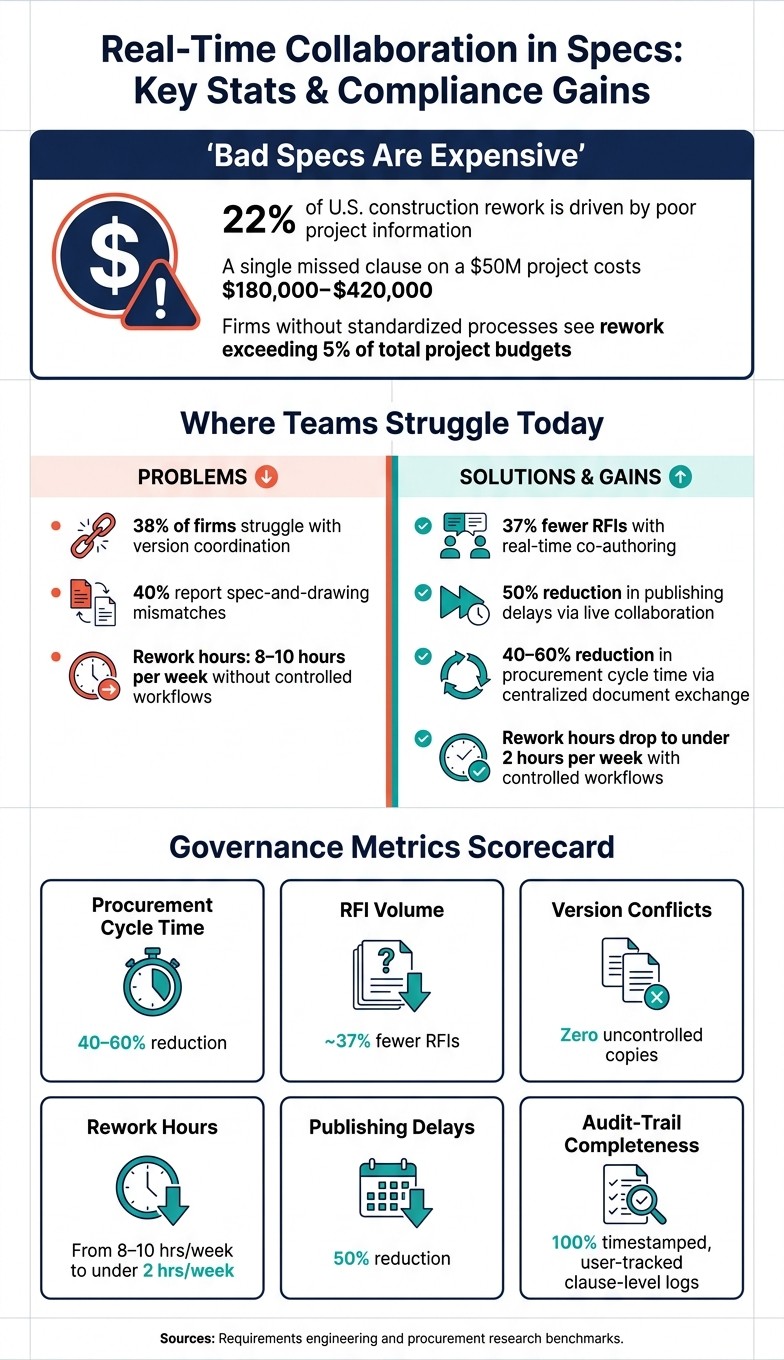
Real-Time Collaboration in Specs: Key Stats & Compliance Gains
What Research Shows About Collaboration and Compliance
Findings from Requirements Engineering and Document Control Studies
Real-time review catches specification conflicts that siloed workflows miss. When people review documents together, they can spot unclear wording, repeated clauses, and overlapping requirements before the document is locked in.
Research in requirements engineering points to a common problem: requirements documents and technical specs depend on each other, but teams often review them as if they live in separate worlds. Tröls argues that specs and requirements are often reviewed separately, which lets inconsistencies hang around until they turn into costly mistakes.
Collaborative platforms help fix that by using automated consistency checks. In plain English, different stakeholders can compare their own artifacts against each other before anything is finalized. A centralized setup also keeps edits controlled, traceable, and visible to every reviewer. That matters most during pre-tender review, when teams still have time to correct compliance gaps before release.
Evidence from Procurement and Pre-Tender Workflows
Pre-tender review is the last low-cost chance to catch compliance gaps. Early specification reviews help teams find erroneous provisions before construction or bidding starts by comparing products for compliance, which lowers the risk of noncompliance and cost overruns. Research on pre-tender involvement also points to the value of a three-party review that includes buyers, providers, and internal users. That mix helps bridge stakeholder needs and define technical properties and clarify your procurement process with more accuracy. If teams work from separate versions or depend on async edits alone, conflicting details are more likely to slip through.
At the $130 million Civic Center Redevelopment Project, six consultants in four cities used real-time co-authoring and weekly clause reviews across 1,200+ clauses, cutting RFIs 37% and publishing delays 50%.
That’s the day-to-day payoff of real-time collaboration: earlier compliance checks and fewer late-stage fixes.
How Real-Time Collaboration Improves Compliance Verification
Real-time collaboration helps teams catch compliance problems during drafting, before a spec ever goes out.
Shared Editing, Comments, and Live Issue Resolution
A lot of compliance gains happen while the specification is still being written. If teams can flag vague wording, repeated clauses, or conflicting requirements in real time, they can fix those problems before a supplier or reviewer sees them. That’s very different from emailing Word files back and forth and hoping a later review catches everything. Specs shape what gets priced, bid, and installed.
Clause-level comments make this much easier to manage. Each comment includes the author’s name and a timestamp, so teams don’t have to play detective to figure out why a change happened. Technical questions, like material tolerances, can be worked out live inside the platform, and the clarification stays logged for accountability.
A shared live document also keeps code updates and clause changes visible to every reviewer.
Once teams log issues live, the next job is keeping a clear approval record.
Version Control, Traceability, and Audit Trails
Automated versioning gets rid of silent version drift, where different teams are unknowingly working from different file versions. File names like "Final_v3_UPDATED_USE_THIS.xlsx" aren’t version control. Real-time platforms replace that mess with automated versioning, timestamped edits, and a clear record of who approved what and when.
This matters most when something goes wrong. A chronological audit trail that shows who updated a specification, when they updated it, and whether the engineer of record approved it can help reduce liability during disputes. Amendments should be stored as tracked changes tied to the base spec, so the original state stays intact and the audit trail shows exactly what changed and when.
Live review is even stronger when the document itself checks the rules.
Structured Templates and Embedded Compliance Rules
Mandatory fields, standard language, and automated flags can help you write a procurement specification that actually gets approved. That shifts compliance from a late-stage review step to something that happens throughout drafting. Put simply, mandatory fields and automated flags keep gaps from slipping through, which cuts avoidable rework for teams that don’t have standardized specification processes.
The next step is automating those checks inside the drafting workflow.
Where AI and Procright Fit in the Workflow
AI-Assisted Compliance Checks During Specification Drafting
Once collaborative drafting is in place, AI can review the text while people are writing it. That helps teams catch problems before the specification goes out.
AI lowers drafting risk by spotting missing, vague, or outdated requirements before release. It can flag missing requirements, fuzzy terms like "high-speed" or "efficient", and outdated code references before issuance. It can also shrink gap analysis from hours to minutes.
How Procright Supports Collaborative, Auditable Specification Work
Procright supports real-time co-authoring, which means team members can work on the same specification at the same time and see updates right away. In plain terms, everyone stays on one live draft instead of passing around copies and trying to figure out which version is current.
On the compliance side, Procright checks each specification item against source documents and media, then returns a clear verdict - "Yes", "Partially", "No", or "Not Found" - with source citations that show exactly which document or media supports the match. That kind of visibility gives teams an auditable trail they can follow line by line. Procright also applies templates inside the compliance workflow, which helps reduce the risk of outdated or non-standard language slipping through.
Put together, Procright brings co-authoring, automated gap detection, template-based drafting, item-level compliance scoring, and source-linked audit trails into one workflow. The next section shows which governance metrics confirm these controls are working.
Governance Metrics and Conclusion
Metrics That Show Whether Collaborative Compliance Is Working
To show that these process changes are paying off, track a small set of governance metrics. The table below focuses on the measures that show whether collaboration is improving compliance checks in U.S. procurement workflows:
Governance Metric | What to Measure | Research Benchmark |
|---|---|---|
Days from spec draft to approved release | 40–60% reduction through centralized document exchange | |
RFI Volume | Number of clarification requests per project | About 37% fewer RFIs when ambiguities are resolved early |
Version Conflicts | Outdated or conflicting specification versions in circulation | No uncontrolled copies in circulation |
Rework Hours | Staff hours spent correcting spec errors post-release | Reduced from 8–10 hours per week to under 2 hours per week |
Audit-Trail Completeness | Percentage of changes with timestamps, user IDs, and clause-level logs | Timestamped, user-tracked digital signatures and clause-level logs that record every change and approval |
Publishing Delays | Time between final review and spec issuance | 50% reduction via live co-authoring and consensus |
Two day-to-day signals matter just as much as the main metrics: the exception queue and team confidence that the released spec is the current, approved version.
The exception queue is the list of specs that are missing required metadata or approval. When that queue starts shrinking, that’s a plain sign that governance controls are getting better.
Key Takeaways for U.S. Procurement Teams
For procurement teams, the practical test is governance quality, not just drafting speed.
Email-based or folder-based spec workflows often lead to version conflicts, missed requirements, and audit gaps. Firms without standardized processes see rework that regularly exceeds 5% of total project budgets. That’s not a small leak. It’s the kind of drag that keeps showing up long after a spec is released.
Early cross-functional collaboration, backed by controlled digital workflows, goes straight at that problem. It gets stakeholders aligned before a specification goes out, not after something breaks. That shift matters because late fixes tend to cost more, take longer, and create more friction across teams.
AI adds another layer here. It can automate the extraction of submittal requirements, product specs, and testing criteria, which moves people away from repetitive extraction work and toward higher-value verification.
The cost of missing one clause can be steep. On a $50 million project, a single missed specification clause can cost between $180,000 and $420,000 in direct and indirect costs.
Procright supports real-time collaboration, templates, and automated compliance verification, helping teams keep specifications aligned and auditable.
FAQs
How does real-time collaboration reduce compliance risk?
Real-time collaboration cuts compliance risk by giving teams one source of truth. That means fewer mix-ups, fewer old versions floating around, and far less chance of people working from conflicting information. When everyone works in the same shared document, updates happen live, alignment is easier, and the audit trail stays clear.
Procright adds another layer here. It uses AI to flag missing requirements and check product compliance in real time, so teams can sort out unclear points fast and catch errors before they turn into bigger problems.
What should teams measure to prove the process is working?
Focus on outcomes you can measure:
Lower RFI volume
Stronger compliance scores
Clear version tracking and audit logs
These signals point to less ambiguity, fewer coordination bottlenecks, clearer accountability, less rework, and proof that decisions are being made from the latest approved data.
How can AI catch spec issues before release?
AI can catch specification issues before release by continuously monitoring data, flagging discrepancies, and spotting missing details before they slip through.
Procright supports this process by analyzing requirements, suggesting the technical standards that may be needed, detecting discontinued products or benchmark mismatches, and checking item compliance against vendor data. It also shows transparent scores and source citations, so teams can see exactly where each finding comes from.