How to Reduce Costly Procurement Errors
Reduce procurement losses with AI-driven invoice matching, standardized controls, and KPI tracking to prevent duplicates and maverick spend.
Procurement errors drain budgets through issues like duplicate payments, missed discounts, and mismatched invoices. These mistakes often stem from manual processes, siloed systems, and data-driven procurement decisions. Here's how to fix them:
AI Solutions: AI reduces errors by automating tasks like invoice matching, fraud detection, and contract reviews. It flags inconsistencies in real time, cutting losses by up to 40%.
Common Errors: Duplicate payments, maverick spending, price inconsistencies, and invoice mismatches are the most frequent and costly issues.
Prevention Strategies: Standardized intake forms, three-way matching, and proper data governance help eliminate errors at their source.
Key Metrics: Track KPIs like purchase order accuracy (>95%), maverick spend (<15%), and straight-through processing (98–99%) to measure improvement.
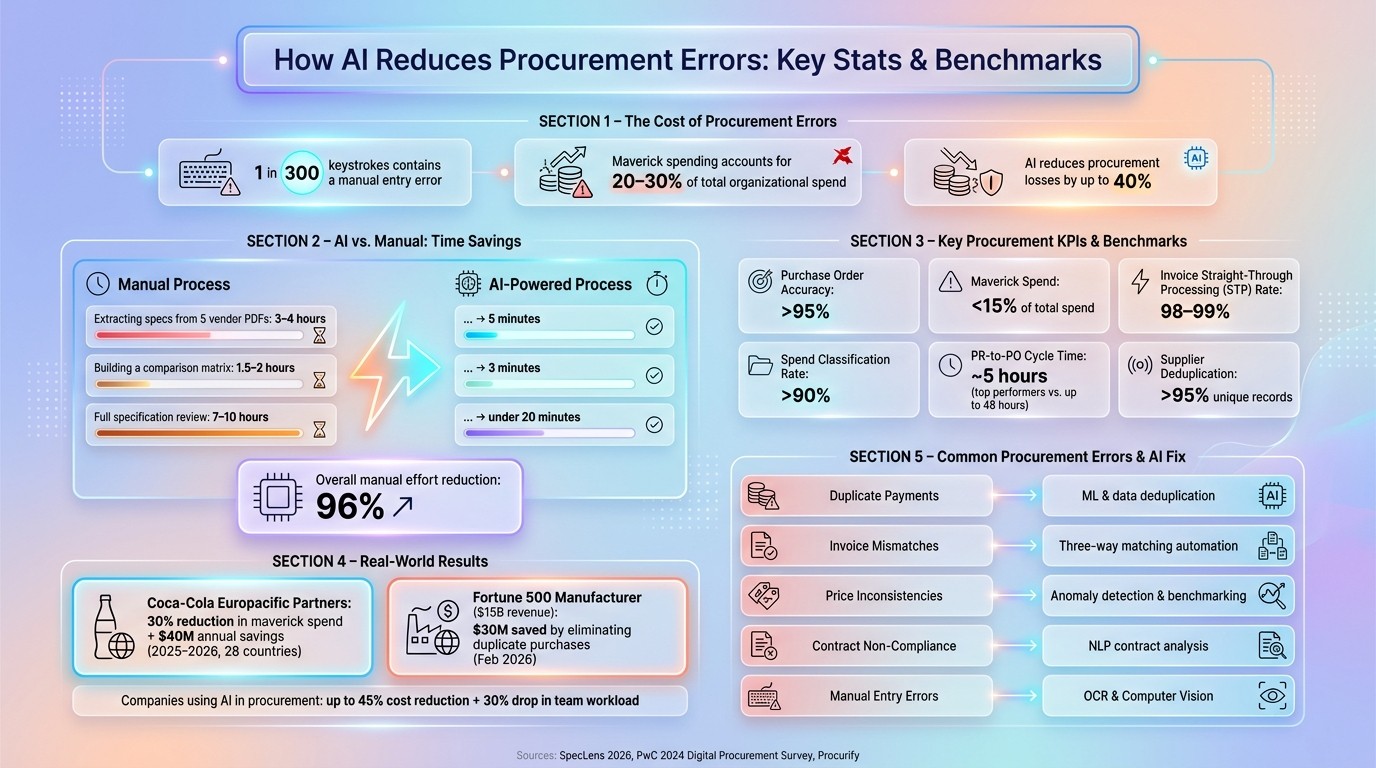
AI vs. Manual Procurement: Key Metrics & Error Reduction Stats
Common Procurement Errors and Their Root Causes
Types of Procurement Errors
Procurement missteps can take many forms, including duplicate payments, maverick spending, invoice mismatches, and price inconsistencies. Let’s break these down:
Duplicate payments: These occur when the same order is submitted by multiple team members, often due to a lack of centralized tracking.
Maverick spending: This happens when employees sidestep official purchasing processes, opting for personal cards or informal deals. It’s typically a process issue rather than a compliance failure - slow or overly complex workflows push employees to seek faster alternatives.
Invoice mismatches: These arise when the purchase order, delivered items, and supplier invoices don’t align. Resolving these discrepancies often requires manual intervention, clogging up accounts payable queues.
Price inconsistency: Different offices within the same company may pay varying prices for identical items. Without a shared purchasing history, these disparities go unnoticed.
One often-overlooked issue is missing early payment discounts embedded in PDF invoices. These discounts, when ignored, quietly chip away at potential savings.
Procurement Error | Typical Root Cause | Financial Impact |
|---|---|---|
Maverick Spend | Slow or overly complex workflows | Loss of volume discounts; unmanaged spend |
Duplicate Payments | No centralized PO/invoice tracking | Direct cash loss; recovery costs |
Price Inconsistency | Siloed purchasing data | Overpaying for common items |
Invoice Exceptions | Manual data entry; no three-way match | Late fees; missed early payment discounts |
Inventory Waste | Decentralized inventory visibility | High carrying costs; unnecessary write-offs |
What Causes These Errors
These errors often stem from broken systems and processes rather than individual mistakes. When procurement, finance, and accounts payable rely on separate tools patched together with spreadsheets and emails, inconsistencies are bound to emerge. Supplier records get duplicated, spend data becomes unreliable, and no one has a complete view of company-wide purchases.
Manual data entry compounds the problem. Studies show that one in every 300 keystrokes contains an error. In high-volume environments, even a small mistake - like a misplaced decimal or incorrect product code - can lead to costly overpayments or delays that take weeks to resolve.
"The uncomfortable truth is that AI doesn't fail in procurement because the AI is bad. It fails because AI amplifies whatever it's given - and most procurement data is a tangled mix of duplicates, inconsistent taxonomies, siloed systems, and PDF-locked information." - Rhea Kapoor, Head of Procurement Research, SpecLens
Another major challenge is data locked in PDFs and emails, which prevents systems from accurately comparing vendors or catching mismatches before purchases are finalized. These systemic issues highlight why automation and AI are essential for reducing procurement errors and improving efficiency.
Using AI to Reduce Procurement Errors
How AI Detects Procurement Errors
Procurement errors often stem from challenges like siloed systems, manual data entry, and information locked within PDFs. These are precisely the gaps where AI steps in to make a difference. Instead of waiting for monthly audits to catch issues like duplicate payments or pricing discrepancies, AI works continuously, monitoring transactions in real time and flagging potential problems as they arise.
AI achieves this through a combination of machine learning (ML), optical character recognition (OCR), and natural language processing (NLP). ML analyzes purchase histories to identify irregular patterns that might otherwise slip through the cracks. OCR and Computer Vision extract data directly from scanned invoices and purchase orders, reducing the risk of manual entry errors. Meanwhile, NLP reviews contracts in real time, highlighting clauses that deviate from agreed-upon terms.
Here’s a breakdown of how AI tackles common procurement errors:
Error Type | AI Detection Capability | How It Prevents the Error |
|---|---|---|
Pricing Inconsistencies | Anomaly detection & predictive analytics | Flags unusual pricing and compares against market benchmarks |
Duplicate Payments | ML & data deduplication | Identifies duplicate invoices and vendor entries to avoid overpayments |
Contract Non-Compliance | NLP & automated contract analysis | Highlights deviations from negotiated terms or missing clauses |
Manual Entry Errors | OCR & Computer Vision | Extracts data from scanned documents to eliminate human errors |
Supplier Risk | Predictive analytics & deep learning | Monitors supplier financial health and external risks for early warnings |
For instance, AI can recognize that "DHL" and "DHL Express" refer to the same supplier, grouping their records to prevent duplicates and improve overall spend visibility. Beyond error detection, AI also refines the specification matching process, ensuring the right products meet the right requirements.
Better Specification Matching with AI
Errors in specifications - like ordering the wrong item, misinterpreting units of measure, or selecting products that don’t meet technical needs - can be some of the costliest mistakes to correct. AI simplifies this process by automating the comparison of vendor specifications, reducing the chances of misorders.
"Manual specification comparison is the single biggest time sink in modern procurement. Teams that spend 6–8 hours per RFP cycle building vendor spreadsheets have no bandwidth left for strategic sourcing." - Senior Director of Strategic Sourcing, Fortune 500 Manufacturing Company
One standout feature is unit normalization, which converts different vendor formats (e.g., metric vs. imperial) into a standardized comparison, reducing manual calculations. AI tools can also perform gap analysis, quickly identifying missing specifications or unique offerings from suppliers.
The time savings are impressive. A 2026 SpecLens analysis found that manually extracting specifications from five vendor PDFs takes 3–4 hours, but AI can do it in just 5 minutes. Building a comparison matrix drops from 1.5–2 hours to about 3 minutes. Overall, the entire specification review process is reduced from 7–10 hours to under 20 minutes - a 96% reduction in manual effort.
Platforms like Procright take this a step further by automatically sourcing and analyzing specifications from various sources, such as the web, PDFs, and videos. These platforms then score and rank products based on defined requirements, streamlining the entire process.
Automating Compliance Verification
AI doesn’t stop at error detection and specification matching - it also strengthens compliance to avoid costly mistakes. Even when the right product is chosen at the right price, compliance failures - such as using unapproved vendors or bypassing established policies - can still lead to unnecessary costs. Custom procurement workflows ensure these gaps are closed at the source.
AI-powered intake forms guide employees to approved catalog items and contracted prices, blocking unauthorized spending before it happens. For invoices already in the system, AI performs three-way matching, linking each invoice to its corresponding purchase order and receipt. Any discrepancies in price or quantity are flagged automatically.
Compliance monitoring doesn’t end once an invoice is approved. AI continues to check actual spending against contract terms, verifying rate compliance, volume discounts, and adherence to payment terms. This real-time monitoring ensures potential leaks are caught immediately, reducing financial risks.
Procright exemplifies this approach by providing real-time compliance scores, giving procurement teams instant visibility into how well they’re adhering to their standards. This proactive approach minimizes risks and ensures smoother procurement operations.
Building Standardized Procurement Controls
Controls That Prevent Procurement Errors
To make the most of AI in procurement, having a solid and uniform control framework is a must. AI tools perform best when built on well-structured processes. Without this foundation, automation can end up speeding up flawed workflows instead of fixing them. By addressing these basics, procurement teams not only prepare for AI integration but also improve their overall efficiency.
"Implementation failures are usually not caused by the platform alone. They happen when process design, governance, data, and user behavior are not ready for automation." - Michele Kerr, Procurify
The first move is to replace informal request methods - like emails or verbal approvals - with standardized digital forms. These forms should require key details such as vendor name, product, quantity, and business justification. By making these fields mandatory, incomplete or unclear purchase requests are blocked from being submitted. This ensures clean, structured data for AI to process and route requests effectively.
Another critical step is establishing master data governance. This involves maintaining a single, verified source for supplier IDs, tax details, banking information, and catalog items. Such governance helps avoid duplicate records and incorrect payment terms, which are common pitfalls. It's worth noting that maverick spending - unapproved purchases - can account for 20–30% of an organization’s total spend. Making compliance easier than bypassing the system is an essential control.
Role-based approval workflows and segregation of duties are also vital. These measures ensure no single user can initiate, approve, and pay for the same purchase order, reducing the risk of fraud and easing audit processes. Approval thresholds should align with spending levels and category responsibilities, with automated escalation paths for situations where primary approvers are unavailable.
Here’s a quick summary of the core control components and their benefits:
Control Component | Primary Outcome | Key Mechanism |
|---|---|---|
Standardized Intake Forms | Clean data at the source | Mandatory fields with hard stops |
Three-Way Matching | Fewer AP exceptions | Line-by-line comparison of PO, receipt, and invoice |
Segregation of Duties | Reduced fraud risk | Dynamic approval chains tied to spend thresholds |
Master Data Governance | Accurate transaction data | Verified tax IDs, banking info, and legal entities |
Defining variance thresholds for three-way matching is another important step. For instance, allowing a ±3% price variance up to $1,000 can let minor discrepancies close automatically without manual review, while still flagging significant issues. Best-in-class procurement processes aim for exception rates below 10% by setting clear, standardized rules. While AI excels at identifying errors, these standardized controls provide the stable groundwork needed to fully harness its capabilities.
Measuring the Results of Error Reduction
Key Metrics for Procurement Performance
Once AI and standardized controls are in place, the next step is to measure their impact. Tracking specific KPIs not only validates the improvements but also shines a light on any lingering challenges. These metrics help justify investments while keeping teams focused on continuous improvement.
Some of the most important KPIs to monitor include:
Purchase order accuracy: This measures whether suppliers are delivering the correct goods on time. Top-performing teams achieve accuracy rates above 95%.
Maverick spend: This tracks how often buyers bypass contracts. Keeping this below 15% of total spend is a solid benchmark.
Straight-through processing (STP) rate: This reflects how many invoices are fully automated. AI-driven systems often reach STP rates of 98–99%.
PR-to-PO cycle time: This measures the efficiency of converting purchase requisitions to purchase orders. High-performing teams complete this in about 5 hours, while slower processes can take up to 48 hours.
The table below links each KPI to the procurement errors it addresses, providing a clear roadmap for tackling inefficiencies:
KPI | Targeted Procurement Error | Success Benchmark |
|---|---|---|
Purchase Order Accuracy | Incorrect items, quantities, or pricing | >95% accuracy |
Maverick Spend % | Unauthorized/off-contract buying | <15% of total spend |
Invoice STP Rate | Manual entry errors and discrepancies | 98–99% |
Spend Classification Rate | Data entry and categorization errors | >90% classified |
PR-to-PO Cycle Time | Process bottlenecks and administrative delays | ~5 hours (top performers) |
Exception Rate | Policy violations and manual overrides | Consistent reduction over time |
Supplier Deduplication | Duplicate vendor records | >95% unique records |
These KPIs not only confirm the benefits of AI and control systems but also uncover areas where further refinement is needed.
For instance, Coca-Cola Europacific Partners (CCEP) rolled out an AI-powered procurement platform across 28 countries in 2025–2026. This initiative slashed maverick spending by 30% and delivered $40 million in annual savings.
Here’s a small but crucial detail: ensure your data is up-to-date. Real-time spend analytics should reflect transactions within 7 days to maintain relevance. Additionally, aim for at least 70% of contracts to include machine-readable metadata. Without this, automated compliance tracking could falter.
"Automation simultaneously improves speed, control, and visibility when it is implemented with the right guardrails." - PwC 2024 Digital Procurement Survey
Begin by focusing on cycle time and exception rates during pilot implementations. As your data systems mature, expand your dashboard to capture a fuller picture. This approach ensures you can clearly demonstrate reductions in errors while pinpointing areas still needing attention.
Your Suppliers Are Failing You (Here's How AI Fixes It)
Conclusion: Smarter Procurement with AI and Standardization
Procurement mistakes aren't just minor hiccups - they pose real risks to strategy and operations. Manual workflows, scattered data, and inconsistent oversight can drain budgets and reduce team efficiency.
AI steps in to streamline these challenges by automating tasks like data entry, identifying compliance issues, matching specifications, and keeping tabs on supplier performance in real time. As Boston Consulting Group explains, "Of the total value that AI generates, just 10% comes from the algorithms themselves and 20% from the data and technology platforms. The remaining 70% comes from people's motivation to adopt new ways of working, learn new skills, and change day-to-day behaviors."
The numbers back this up. Companies using AI in procurement have reported up to a 45% reduction in costs and a 30% drop in team workload. For example, in February 2026, a Fortune 500 manufacturer with $15 billion in revenue introduced agentic AI systems for spend optimization. The result? They saved $30 million by eliminating duplicate purchases and enforcing consistent price controls across their global supplier network.
"The real power of AI is its ability to help you elevate your procurement team from a cost-avoidance function to a strategic business driver." - Alexia Cooley, Amazon Business
When paired with standardized processes, these AI-driven improvements amplify savings and operational efficiency. Tools like Procright bring all these benefits together by automating product specification creation, ensuring compliance, and evaluating products against your exact needs. Add in a focus on data quality, strict controls, and KPI tracking, and you’ve got a recipe for smarter, error-free procurement.
FAQs
What procurement tasks should we automate first?
Start by tackling those tasks that often feel like a drain on time and resources - like purchase order (PO) matching and invoice processing. These processes are not only repetitive but also prone to errors. By integrating AI into PO matching, you can cut discrepancies by up to 92%, drastically improve the speed of invoice processing, and save millions every year by reducing error-related expenses. Automating these workflows doesn’t just streamline operations; it also minimizes human error and significantly improves accuracy and efficiency across the board.
How clean does our procurement data need to be for AI?
Procurement data for AI needs to provide reliable insights that aid decision-making, identify potential risks, and reveal opportunities to save costs. While achieving perfect data quality isn't necessary, the information should still offer consistent and actionable patterns, even if it hasn’t been fully reconciled across every system.
How can we prove AI is reducing procurement errors?
AI significantly cuts down procurement errors by achieving error rate reductions of up to 92% through automated purchase order matching. It also speeds up invoice processing, completing tasks in under 2 minutes per invoice, while delivering cost savings of up to 75% in processing expenses. On top of that, AI-powered spend analytics improve data accuracy by cleaning and reclassifying as much as 35% of miscategorized data. This results in fewer errors and more informed decision-making.