How AI Tracks Supplier Performance Metrics
Real-time AI monitoring of supplier KPIs—clean data, OTIF, defects, price compliance, alerts, and scorecards for faster action.

AI helps me track supplier performance with current data instead of waiting 30 to 90 days for old reports. It pulls data from ERP, AP/P2P, quality, logistics, contracts, and outside risk sources to flag delivery, quality, cost, risk, and compliance issues early.
Here’s the core idea in plain English:
I set 6 to 10 clear KPIs
I tie each KPI to one source, one owner, and one formula
I clean supplier IDs, dates, units, and $USD values through multi-source data aggregation first
I use AI to spot late deliveries, defect spikes, price drift, and compliance gaps
I push those results into scorecards, alerts, supplier reviews, renewals, and CAPA workflows
I keep scores accurate with 6–12 months of history, review cycles, and model checks like MAPE
A few numbers show why this matters:
A 5% price variance on $10,000,000 in spend can cost $500,000
Top teams often target 95%+ on-time delivery
Many also target 98%+ price compliance
Defect goals can sit below 500 DPMO
The main lesson: AI is not just for scoring suppliers. I use it to spot change early, find the cause, and feed that into sourcing, reviews, and compliance work.
Area | What I track | Example target |
|---|---|---|
Delivery | OTIF, lead time adherence | 95%–98%+ |
Quality | Defect rate, inspection results | <500 DPMO |
Cost | Price variance, invoice accuracy | 98%+ price compliance |
Risk | Capacity signals, outside risk feeds | Alert on drift |
Compliance | Contract terms, sanctions, ESG checks | 100% pass on gated items |
If I do the setup right, AI gives me a live view of supplier performance instead of a stale scorecard.
ChatGPT for Supplier Analysis - Analyze Performance and Pricing with AI Insight
Define the Supplier Metrics AI Should Track
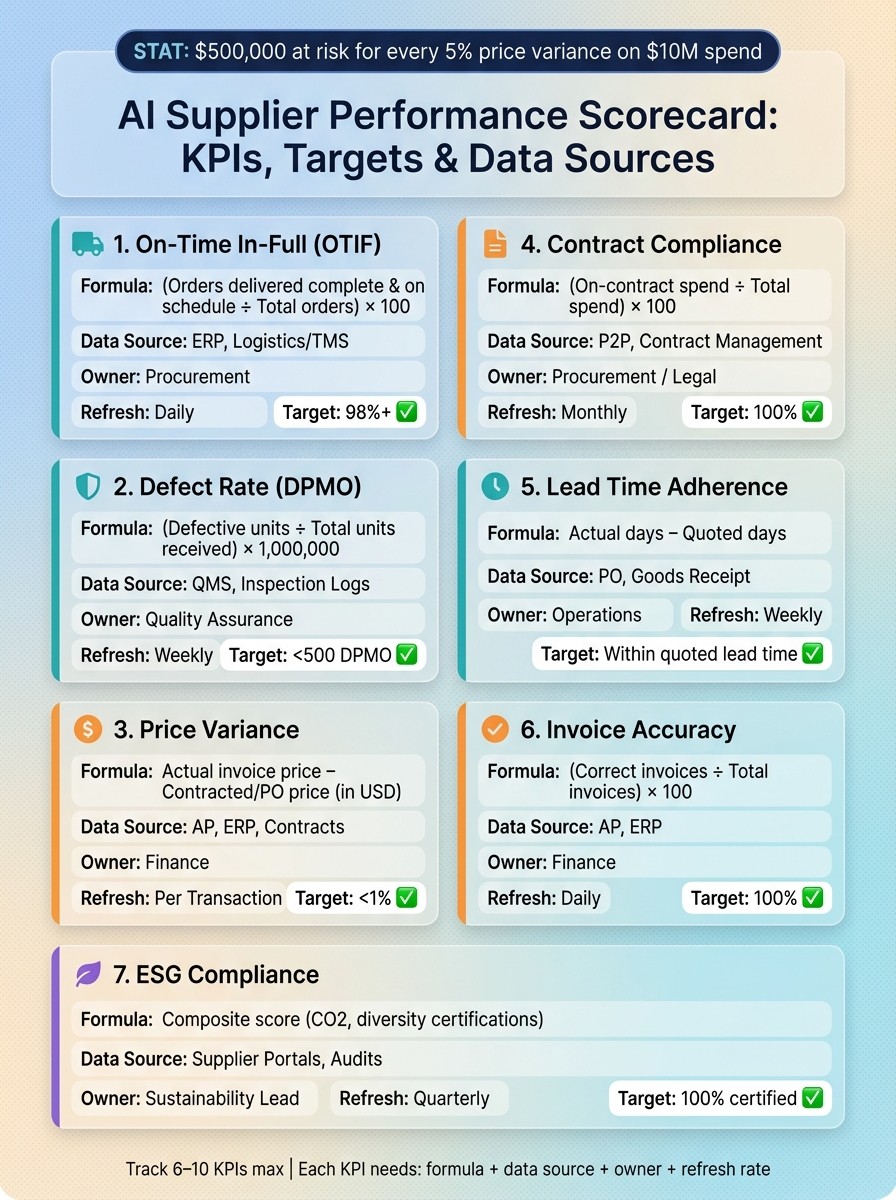
AI Supplier Performance Scorecard: KPIs, Targets & Data Sources
Decide what AI should measure and why. KPI definition is the base of AI monitoring, not just a setup task. If your metrics are vague, AI will scale those mistakes and turn them into shaky supplier scores. These definitions become the rules the system uses to score suppliers the same way every time.
Align KPIs with business goals and governance
Match each KPI to one business outcome. Cost ties to price compliance. Service ties to OTIF. Supply assurance ties to lead time adherence. ESG ties to building ESG-ready supply chains.
Give each KPI one owner. Define who can approve score changes. Set clear escalation thresholds. That builds accountability, not just admin work.
Segment suppliers before you build scorecards. Review strategic suppliers every month, with more weight on risk and innovation. Score transactional vendors mostly on cost and delivery.
Standardize core supplier KPIs for AI analysis
Start small. Track 6 to 10 high-impact KPIs so you don't clog the system with low-value measures. Every metric needs four things before AI touches it:
a clear formula
a named data source
an owner
an update frequency
KPI | Formula | Data Source | Owner | Refresh | Target |
|---|---|---|---|---|---|
On-Time In-Full (OTIF) | (Orders delivered complete and on schedule ÷ Total orders) × 100 | ERP, Logistics/TMS | Procurement | Daily | 98%+ |
Defect Rate (DPMO) | (Defective units ÷ Total units received) × 1,000,000 | QMS, inspection logs | Quality Assurance | Weekly | <500 DPMO |
Price Variance | (Actual invoice price − contracted/PO price) in USD | AP, ERP, Contracts | Finance | Per transaction | <1% |
Contract Compliance | (On-contract spend ÷ Total spend) × 100 | P2P, Contract Management | Procurement/Legal | Monthly | 100% |
Lead Time Adherence | (Actual days − quoted days) | PO, Goods Receipt | Operations | Weekly | Within quoted lead time |
Invoice Accuracy | (Correct invoices ÷ Total invoices) × 100 | AP, ERP | Finance | Daily | 100% |
ESG Compliance | Composite score (CO2, diversity certifications) | Supplier portals, audits | Sustainability Lead | Quarterly | 100% certified |
One more point on critical indicators: safety and regulatory compliance KPIs should work as gates, not weighted inputs. If a supplier fails a compliance control, they shouldn't still earn a strong overall score just because their delivery numbers look good.
Once the KPI set is locked in, map each metric to clean internal and external sources.
Map internal and external data sources
Map every KPI to its source. Internal sources include ERP, AP, QMS, and logistics/TMS data. External sources include third-party risk feeds, ESG ratings, and supplier portals.
Before any data goes into an AI model, standardize it. For U.S. organizations, that means dates in MM/DD/YYYY format, money in USD ($), and the same unit-of-measure rules across business units. If supplier IDs don't match across ERP, AP, and contract systems, your performance view gets split up and the scores go off track. Fix those hierarchies first.
With KPIs and data sources defined, the next step is clean capture, analysis, and scoring.
Set Up AI to Capture, Analyze, and Score Supplier Data
Prepare clean, standardized supplier data
Before AI can score supplier performance, it needs clean, consistent data. That starts with structured feeds from your ERP, procurement/AP, QMS, and logistics systems, all shaped for model input.
One common problem shows up fast: the same supplier can appear in different systems under different names. If you score that data as-is, performance gets split and the picture goes blurry. Fix supplier hierarchies first. Map aliases and parent-child records to one master supplier ID.
Then standardize the basics before scoring:
Use one date format
Convert currency to a single standard
Align units of measure
Set one source of truth for each KPI
When source data is clean and each metric has a clear owner, AI can spot patterns instead of wasting time sorting out mismatched records.
Apply machine learning, NLP, and anomaly detection
Once the data is cleaned up, AI can do the heavy lifting. Machine learning, NLP, and anomaly detection each play a different role.
AI Method | Primary Use | What It Uncovers |
|---|---|---|
Machine Learning | Trend prediction | OTIF and defect-rate forecasts, capacity risks |
NLP | Unstructured data ingestion | Contract obligations, signals from emails and PDFs |
Anomaly Detection | Exception management | Lead-time drift, price non-compliance, defect spikes |
AI Agents | Root cause analysis | Whether failures stem from supplier issues or internal volatility |
Machine learning helps forecast OTIF decline, defect trends, and capacity risk.
NLP pulls obligations and compliance signals from contracts, emails, and PDFs. That matters because some of the most important supplier signals don't live in neat rows and columns.
Anomaly detection flags lead-time drift, pricing mismatches, and defect spikes. In plain terms, it helps teams catch the stuff that looks off before it turns into a bigger mess.
AI agents can connect ERP, quality, and logistics signals to explain why a score changed. That extra layer matters. A late shipment, for example, may come from a supplier issue, or it may trace back to internal demand swings or planning noise.
Those signals should flow straight into weighted scorecards and role-based dashboards.
Build AI-driven scorecards and dashboards
Model output only matters if business teams can use it. So take those signals and turn them into supplier scores people can act on.
Build composite supplier ratings from scored data, then weight each KPI pillar by supplier category and business priority. Quality usually carries 20% to 35% of the weight. Delivery often gets 20% to 30%. Cost compliance usually lands at 15% to 20%. Contract adherence tends to sit at 10% to 15%. Responsiveness usually falls between 5% and 15%.
The weights should shift by context. In pharma or chemicals, quality should carry more weight, up to 40%. In retail, delivery reliability should take priority. The main thing is to lock weights by supplier category and business priority so teams aren't changing the rules midstream.
Role-based dashboards make those scores useful across the business. Executives need category roll-ups and spend-performance correlations. Procurement teams need OTIF trends, exception queues, and corrective action triggers. Quality teams need PPM/DPMO trends and inspection results. Finance needs price variance and invoice accuracy by supplier.
Each dashboard should show:
Trends over time
Drill-down views
Forecasted risk
A static score isn't enough. Teams need to see what changed, why it changed, and where risk is heading next.
These dashboards turn supplier performance into a live input for procurement decisions.
Use AI Insights to Manage Suppliers and Procurement Decisions
Once scorecards are live, use them to drive action: alerts, root-cause checks, reviews, and workflow updates. That’s how you move from simple monitoring to actual intervention.
Trigger alerts and identify root causes earlier
AI changes supplier management from reactive fire-fighting to early action. Your team gets notified the moment performance slips out of range, like OTIF dropping below 95% or defect rates going above 500 PPM.
Send those alerts straight into Slack, Microsoft Teams, or email so the right person sees the issue right away.
Then comes the part that matters most: figuring out why the issue happened. A late shipment isn’t always the supplier’s fault. Sometimes the problem starts inside your own operation, like a late PO revision or planning changes. That check helps your team decide whether to escalate the issue to the supplier or fix an internal planning problem first.
Use scorecards in supplier reviews and corrective action plans
Use the same ERP-derived scorecards in supplier reviews so both sides work from one shared data set.
If a supplier misses a threshold - for example, OTIF stays below target for two straight months - automatically trigger a CAPA, assign an owner, and set a due date. The system can also assign follow-up tasks on its own, which cuts down on manual chasing.
For quarterly business reviews (QBRs), share the full scoring rubric with suppliers ahead of time. When suppliers know exactly how they’re being measured, the conversation gets a lot more productive. It also makes corrective actions more likely to stick.
Connect AI metrics to sourcing and compliance workflows
Supplier performance scores should flow straight into sourcing events, contract renewals, and volume allocation decisions. High performers can earn preferred status and better terms. Suppliers that are falling short should be flagged before a renewal decision happens.
AI can also verify supplier credentials, monitor sanctions lists, and flag compliance risk on a continuous basis. Procright can standardize specifications and surface compliance scores against agreed requirements.
In plain English, these insights shouldn’t sit on a dashboard. They should shape sourcing and compliance decisions as they happen.
Procurement Step | AI Capability | Business Impact |
|---|---|---|
Sourcing events | Ranks suppliers against historical and category data | Identifies best-fit vendors faster |
Contract renewals | Monitors price compliance, MOQ adherence, and SLA performance | Provides verifiable data for renegotiation |
Volume allocation | Scores and ranks suppliers by reliability and quality | Rewards high performers with more business |
Compliance checks | Continuously checks credentials and sanctions lists | Reduces audit risk and regulatory exposure |
CAPA triggers | Triggers CAPAs when thresholds are breached | Shortens resolution time and assigns clear ownership |
Maintain Accuracy and Drive Continuous Improvement
Once supplier scorecards are live, the work shifts to keeping them right.
Set baselines, targets, and review cycles
Before an AI model can spot problems, it has to understand what "normal" looks like. That usually means backfilling 6–12 months of historical data to build starting baselines for each supplier.
From there, set targets that fit both business goals and the category you’re managing. Common benchmarks include:
OTIF of 95–98% or higher
Defect rate below 500 DPMO
Price compliance of 98% or higher
After baselines are in place, review cadence keeps the process grounded. Monthly ops reviews focus on delivery issues, quality incidents, and open CAPAs. Quarterly business reviews step back and look at cost variance, innovation, risk roadmaps, and allocation decisions. In between those meetings, AI can flag anomalies in real time, similar to how AI forecasting improves supply chain resilience by predicting disruptions.
It also helps to give more weight to recent performance. For example, data from the last 30 days can count at 100%, while data older than 180 days drops to 25%.
Those targets only matter if the data stays clean and the model stays in tune.
Monitor model accuracy and data quality
Fragmented data leads to bad scores at scale, so it makes sense to automate range checks and source-of-truth rules across ERP, P2P, and quality systems. Supplier names, IDs, and units of measure should all tie back to one master record.
On the model side, track Mean Absolute Percentage Error (MAPE) to compare predicted outcomes with actual results. AI ensemble models can bring MAPE down to 8–15%, compared with 35–50% for manual methods.
Ownership should be clear too. A RACI framework helps here: the Category Manager owns individual scorecards, while the Procurement Lead is accountable for the full program. Every scorecard update and rating change should be logged with timestamps and user attribution. That audit trail helps with dispute resolution.
With baselines, reviews, and validation in place, the process becomes easier to run again and again.
Conclusion: Build a repeatable AI-based supplier performance process
The point isn’t just to score suppliers. It’s to explain performance clearly enough that teams can act on it and improve over time.
"Scorecards alone don't manage performance - interpretation does. Most supplier programs fail not because metrics are wrong, but because they lack the context needed to explain why results change."
Procright can help by standardizing specifications and surfacing compliance scores from cleaner inputs.
FAQs
How do I choose the right supplier KPIs?
Choose supplier KPIs that match your business goals, current priorities, and how much each supplier matters to the business. A strategic supplier usually needs more attention than a transactional one.
Keep the set small and useful. Focus on a few KPIs across quality, cost, delivery, and compliance. Mix lagging indicators with leading indicators so you can track past results and spot trouble before it hits.
Define every KPI in plain terms, assign a clear owner, and cut any metric that doesn’t lead to a decision or action.
What data do I need to train AI models?
Train AI models with clean, centralized data pulled from systems like ERPs, procurement platforms, logistics tools, and quality management systems.
That data should include structured inputs such as purchase orders, delivery timelines, cost variances, invoice details, and contract terms. It should also cover unstructured sources like emails, PDFs, and audit logs.
External risk factors and stakeholder evaluations add more context, which helps build a clearer picture of supplier performance.
How often should supplier scores be reviewed?
Review supplier scores in real time instead of waiting for quarterly or annual snapshots. That way, problems don’t slip through the cracks between review periods.
For governance, stick with a tiered cadence: monthly reviews for core suppliers and quarterly business reviews for strategic partners. With Procright, teams can monitor objective compliance scores and step in as soon as issues appear.