Supply Chain Risk Management: A Practical Guide
Resilience depends on knowing where exposure sits, judging how much uncertainty the business can accept, and acting before disruption narrows the options.
In this article
A procurement manager opens the latest supplier update and sees that a critical component comes from a single plant in a region struck by a natural disaster. The direct supplier is still answering emails, but no one can confirm whether its own upstream source is operating. The immediate question isn't just whether the order will arrive. It's whether the organization can make a defensible sourcing decision with the information it has.
That's the practical challenge at the heart of supply chain risk management. Resilience depends on knowing where exposure sits, judging how much uncertainty the business can accept, and acting before an award or disruption makes the options harder to change.
Table of Contents
Why Supply Chain Risk Management Matters Now
Supply chain risk management has shifted from a cost-efficiency exercise toward systematic resilience planning. The shift shows up in the sourcing choices organizations are making: in the National Association of Manufacturers' fourth-quarter 2023 survey, 86.2% of manufacturers said they had worked to de-risk their supply chains during the preceding two years. Economist Impact's Trade in Transition 2024 research found that 97% of surveyed companies were reconfiguring supply chains at the end of 2023, up from 92% in 2022 (Deloitte's analysis of supply-chain resilience).
That response reflects practical pressures, not a passing interest in risk. Geopolitical tension can change the viability of a sourcing region. Transportation constraints can turn a seemingly reliable route into a bottleneck, while supplier concentration can make one company's production problem an operational emergency for its customers. Organizations exploring how international sourcing networks are structured can also review this overview of global supply chains.
The response isn't always to move production closer or hold more stock. Both choices can reduce some exposures while adding cost or creating new dependencies. A second supplier is useful only if it can meet the specification and doesn't rely on the same upstream plant, region, or transport route as the incumbent.
For transport-dependent supply chains, supplier continuity is only part of the picture. Delivery plans also rely on safe, compliant fleet operations, which is why practical DOT compliance and fleet safety tips can help teams consider the transportation leg alongside sourcing risk.
Practical rule: A mitigation plan is only as credible as the information behind it. Resilience requires both alternate options and reliable knowledge of where critical dependencies actually sit.
Understanding the Main Types of Supply Chain Risk
A risk category helps teams ask better questions, but it doesn't predict where a disruption will start. One supplier event can create several problems at once: a production stoppage, a missed delivery, a cash-flow squeeze, and a cybersecurity exposure if systems or data are involved.
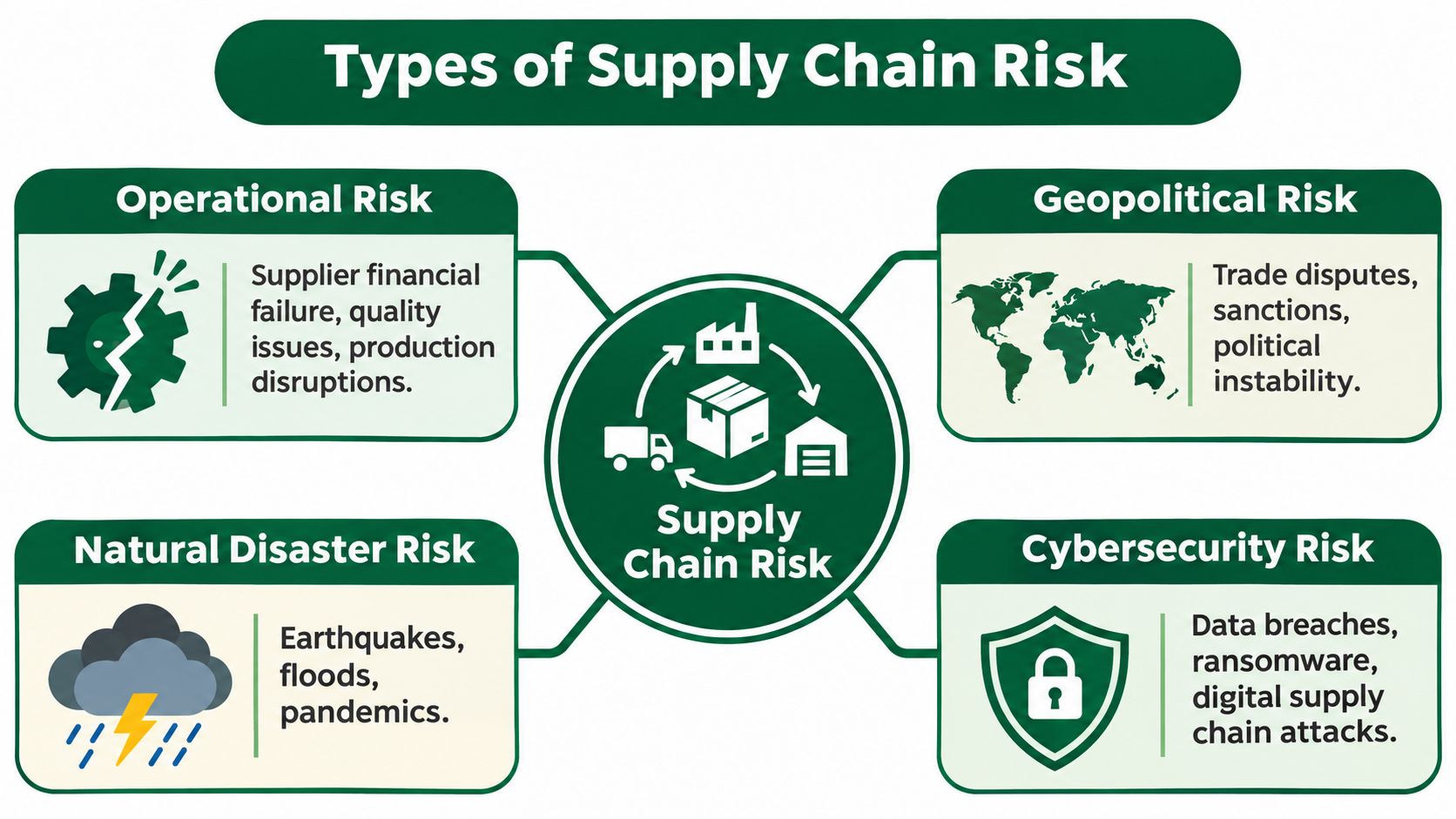
Operational risk includes supplier financial failure, quality problems, capacity limits, and production interruptions. In an empirical study of 147 firms, researchers recorded 261 supply interruptions during 2010–2019 and identified supplier financial default as the most frequent cause, implicated in nearly half of reported cases (the study on supplier financial default and supply interruptions). That finding makes a supplier's continuing financial health relevant after onboarding, not just during qualification.
Geopolitical and geographic risk includes trade disputes, sanctions, political instability, and overreliance on one region. Natural-disaster risk covers events that damage production sites or interrupt transport. These categories often overlap: a regional shock can affect several suppliers if they share facilities, infrastructure, or logistics corridors.
Cybersecurity risk travels through suppliers' software, hardware, services, and access to data. A provider's compromised system can become an indirect route into the buyer's operations, so a security questionnaire alone can't establish that exposure is controlled. Organizations evaluating digital infrastructure may find this overview of data center supply chain threats useful when considering how facility dependencies and technology providers intersect.
Demand-side risk matters too. Forecasts can diverge from actual orders, product requirements can change, or a market shift can make a supplier's planned capacity a poor fit. Categorize each exposure, then consider how it could trigger other risks. A cyber incident at a supplier, for example, may interrupt production and delay deliveries even when the physical supply network is intact.
Mapping Your Supply Chain and Finding Hidden Dependencies
A supplier list shows who sells to you. A supply-chain map shows which dependencies could stop delivery. The distinction matters most beyond tier one, where buyers often have limited information about upstream manufacturers, raw materials, and shared production sites.
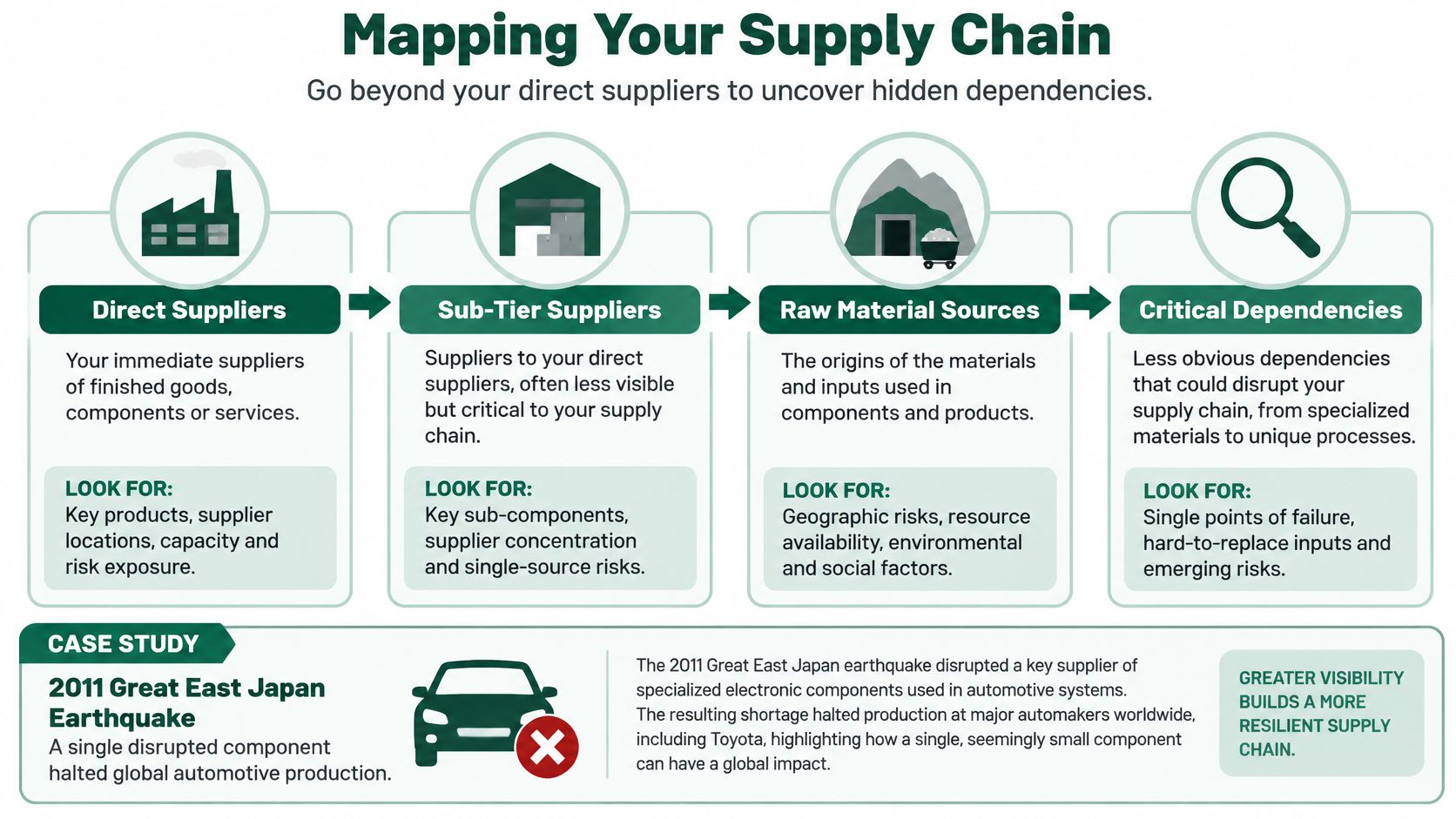
The Great East Japan earthquake and tsunami showed how a disruption at specialized suppliers can cross borders and industries. After the 11 March 2011 earthquake, two Japanese plants representing about 25% of global silicon-wafer supply were closed. A Hitachi facility that produced roughly 60% of the world's airflow sensors also shut down. Toyota temporarily halted operations at all 12 of its main Japanese assembly plants, with approximately 140,000 vehicles of lost production reported at the time (the Congressional Research Service account of the 2011 disruption).
Map the dependencies that can change an award
Start with the part, service, or material that would be hardest to replace. Ask the direct supplier to identify its critical sub-tier sources, manufacturing locations, and key logistics dependencies. Then test whether apparently separate suppliers depend on the same parent company, production site, raw-material processor, or route.
A map doesn't need to pretend every upstream detail is known. Record the source of each claim, how recently it was confirmed, and what remains uncertain. If a supplier can't disclose a commercial relationship, ask for decision-useful information instead, such as whether the source is unique, whether a qualified alternative exists, and what recovery arrangements apply.
Escalate according to consequence
Treat a hidden dependency as more urgent when a failure would interrupt an essential operation and substitution would take time. Compare the cost of qualifying an alternative with the potential consequences of relying on an unknown source. The result may be dual sourcing, a contingency clause, a buffer for a critical component, or a documented decision to accept the exposure.
Assessing and Monitoring Supplier Risk Effectively
A supplier assessment is useful only if it changes what the organization does. A completed questionnaire isn't a control by itself, and a score that hides missing evidence can make a risky supplier look reassuring.
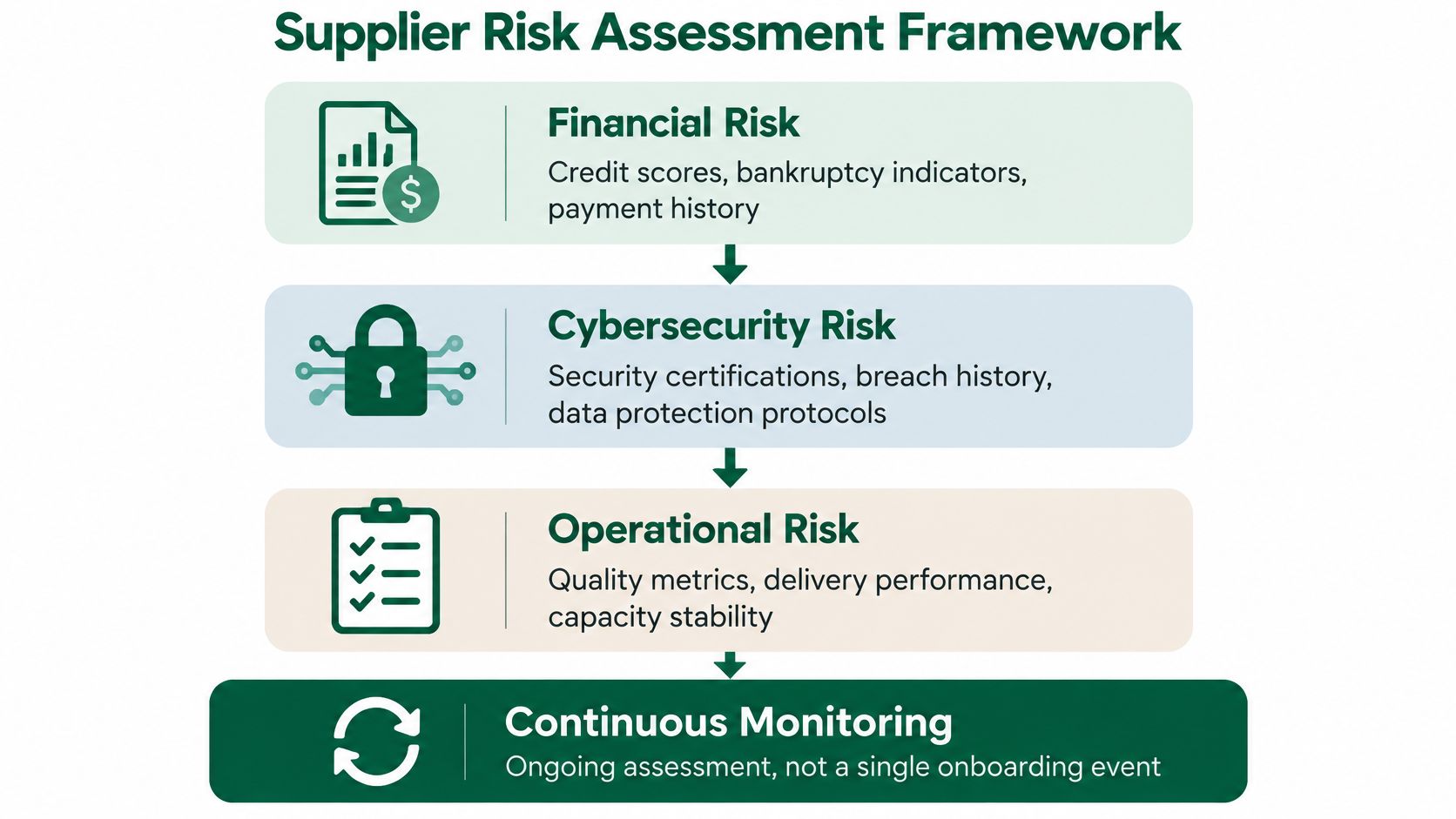
For financial risk, check indicators such as liquidity, debt levels, payment behavior, credit exposure, ownership changes, and dependence on a narrow customer or lender base. Refresh the assessment during the contract, because a supplier's condition can change after the award. Where warning signs arise, ask for a continuity plan and evidence of an alternative source; consider concentration limits or inventory protection when the component is critical.
Cybersecurity needs life-cycle attention as well. NIST defines cybersecurity supply-chain risk management across design, development, distribution, deployment, acquisition, maintenance, and destruction. It recommends recording, prioritizing, assessing, responding to, and monitoring third-party risks throughout the relationship (NIST's cybersecurity supply-chain risk management guidance).
Score evidence, not assurances
For critical suppliers, connect the assessment to assets, data flows, software or hardware dependencies, access controls, incident notification, vulnerability disclosure, and recovery responsibilities. Ask for evidence that matches the risk, and retain the supporting documents so reviewers can see why a conclusion was reached.
Use distinct outcomes for compliant, non-compliant, and unknown. Unknown means the organization lacks sufficient evidence; it should not pass as compliant or automatically be treated as a proven failure. A useful vendor risk scoring approach should preserve that difference so decision-makers can direct follow-up to the gaps that matter.
Integrating Risk Management into Procurement Workflows
Risk decisions are easiest to defend when procurement captures them as part of the sourcing process, rather than trying to reconstruct the reasoning after a supplier has been selected. Start before the market search: a specification can unintentionally create a single-bidder outcome, exclude viable alternatives, or leave a critical continuity requirement unstated.

Before releasing a request, have procurement, technical owners, operations, finance, and security review the requirements that affect risk. Specify acceptance criteria, service levels, recovery responsibilities, incident reporting, and evidence suppliers must provide. If the specification names a particular design or source, record why that restriction is necessary and whether an alternative can satisfy the operational need.
Supplier comparison should make risk visible without hiding it inside a single composite score. A side-by-side assessment can show requirement compliance, financial indicators, cybersecurity evidence, delivery commitments, and unresolved dependencies. Record the source for each conclusion and explain why any non-compliant or unknown item was accepted, mitigated, or treated as a reason to reject the bid.
Award test: A reviewer who wasn't in the sourcing meetings should be able to understand what was required, what each supplier evidenced, and why the selected offer was acceptable.
The audit trail should preserve the specification version, supplier responses, evaluation criteria, evidence, clarifications, approvals, and mitigation commitments. After the award, compare quotes, manuals, and contract terms with the locked requirements. If a supplier's final documents change an important delivery, warranty, security, or service commitment, resolve the difference before signature rather than assuming the deviation is harmless.
Actionable Steps to Reduce Supply Chain Exposure
You don't need perfect multi-tier visibility to make better sourcing decisions. You do need to label uncertainty, prioritize the dependencies that could interrupt essential operations, and choose mitigations that address the actual exposure.
A practical sequence is:
Map critical dependencies. Start with the components, services, or materials that would be difficult to replace. Trace direct suppliers to known upstream producers and logistics dependencies, and flag where the evidence stops.
Rank risks by consequence. Consider likelihood qualitatively, then assess operational impact, recovery time, and substitution difficulty. A low-cost item can still deserve attention if its absence would halt an essential service.
Validate supplier claims. Compare questionnaires with contracts, manuals, certifications, operational indicators, and other available records. Log the source and date of each important piece of evidence, and investigate contradictions instead of averaging them away.
Keep unknown separate from non-compliant. An unanswered question is a data gap, not proof that a supplier has failed a requirement. Set a deadline for resolving the gap and define what happens if it remains open at award.
Choose a proportionate mitigation. Depending on the exposure, that may mean qualifying another supplier, redesigning a specification, securing a contingency commitment, holding a buffer, or accepting the risk with documented approval.
Data confidence deserves particular scrutiny. In a 2025 survey, 98% of leaders considered their supplier data complete and current, yet 73% experienced a disruption during the preceding year. The same survey identified slow risk checks, compliance documentation, inaccurate emerging-market data, and limited tier-two or tier-three visibility as barriers to onboarding or switching suppliers (the 2025 survey report on supplier risk management). The practical lesson isn't that supplier data is useless. It's that a dashboard or confident response doesn't replace source validation.
Test the mitigation before relying on it. Ask what happens if the primary source stops shipping, a shared upstream plant is unavailable, or a supplier's data turns out to be outdated. A contingency plan is only credible if owners know what decision to make and the alternative can meet the locked requirements.
Measuring Resilience and Building a Risk-Aware Culture
Resilience isn't the absence of disruption. It's the ability to understand exposure, make a deliberate choice, and keep essential operations going or recover them when a supplier fails.
Track measures that connect directly to decisions. McKinsey's 2024 Global Supply Chain Leader Survey reported that 73% of respondents were making progress on dual-sourcing strategies and 60% were taking steps to regionalize supply chains. Yet only 60% reported full visibility into tier-one suppliers, even after that measure increased by 10 percentage points for the second consecutive year (McKinsey's supply-chain risk survey). Adding a second source or shifting regional capacity matters, but neither proves that upstream dependencies are understood.
Metric | What It Measures | Target Direction |
|---|---|---|
Supplier concentration | Reliance on a narrow set of sources for critical inputs | Lower concentration where alternatives are viable |
Dual-sourcing coverage | Critical requirements with qualified alternate suppliers | Higher coverage for high-consequence dependencies |
Visibility depth | How far upstream verified dependency information extends | Greater verified coverage, with unknowns clearly recorded |
Time to recover | How quickly critical supply can be restored after disruption | Shorter recovery time for essential operations |
Evidence freshness | Whether important supplier claims remain current and traceable | Current evidence with clear review ownership |
Make the measures useful by assigning owners. Procurement can maintain sourcing and concentration records; technical teams can confirm whether alternatives meet requirements; security can review cyber evidence; operations can test recovery assumptions. Leaders should see unresolved dependencies and approved risk acceptance, not only a green summary score.
Teams should also be able to raise concerns without waiting for a formal assessment cycle. If an engineer spots a shared component or a buyer sees a supplier's delivery commitment change, the information should reach the people who can revise sourcing plans. A practical supply-chain resilience framework starts with that habit: make risk information part of routine decisions, then preserve the reasoning for audit and stakeholder review.
Frequently Asked Questions About Supply Chain Risk
What should procurement do when a supplier won't share financial or security data?
Ask for an alternative form of evidence that answers the operational question. A supplier that won't disclose sensitive financial details might provide a continuity plan, demonstrate access to alternative capacity, or agree to early-warning obligations. For security, request verifiable documentation and contractual commitments tied to the supplier's role and the sensitivity of the service. If the remaining gap affects a critical dependency, record it as unknown and make approval conditional on a mitigation or explicit acceptance.
How can teams balance cost pressure with resilience?
Compare the cost of the mitigation with the consequences of a disruption and the difficulty of switching sources. A second supplier may not be justified for every purchase, and regional sourcing can introduce new costs without removing shared upstream dependencies. Focus investment where a failure would interrupt essential operations, and document why a lower-cost option remains acceptable when the residual risk is understood.
When is it reasonable to accept a known risk?
Risk acceptance is reasonable when the organization understands the exposure, has considered practical alternatives, and an accountable decision-maker approves the remaining uncertainty. Record the evidence reviewed, the consequences considered, any conditions attached to approval, and when the decision should be revisited. Don't label a missing answer as accepted risk without explaining what the organization couldn't verify.
How do you explain risk to executives focused on savings?
Translate the concern into the decision they need to make: what operation depends on the supplier, what alternatives exist, what the cost of mitigation is, and what remains exposed if the organization declines it. Keep the comparison tied to operational consequences rather than a vague high-risk label. An auditable recommendation makes the trade-off clear without implying that any sourcing choice can eliminate uncertainty.
How can assessments stay current without overwhelming the team?
Refresh information when something changes, such as supplier ownership, a critical component, a subcontractor, a security control, or a delivery commitment. Set review expectations according to supplier criticality, and focus follow-up on evidence that could change an award or continuity decision. That keeps monitoring useful instead of turning it into a repetitive paperwork exercise.
Procurement teams can use Procright to draft and refine specifications, compare supplier evidence against requirements, and preserve source citations in an audit-ready award record. If you're looking to make supplier decisions more traceable, visit Procright to explore its sourcing and analysis workflows.
Try it on a real buy
Bring one category. Watch where the flags land.
We use a little analytics to see which pages actually help. Nothing else, no ad trackers.