AI in Procurement: Solving Product Comparison Challenges
How AI automates data extraction, normalizes specs, verifies compliance, and cuts product comparison time by up to 96%.
Procurement teams face a major hurdle: comparing products across inconsistent and fragmented vendor data. This process is tedious, error-prone, and wastes valuable time, with teams spending up to 20 hours weekly on manual comparisons. Errors in data extraction and compliance checks can lead to poor purchasing decisions, hidden costs, and regulatory risks.
AI tools are changing this. By automating data extraction, normalizing formats, and comparing products for compliance efficiently, AI reduces comparison time by up to 96%. These tools allow procurement teams to focus on strategic decisions while ensuring accurate, defensible results. Platforms like Procright streamline the process, enabling faster, more reliable product evaluations.
Key Takeaways:
Challenges: Inconsistent data formats, manual errors, compliance gaps, and hidden costs.
AI Solutions:Automated data extraction, real-time scoring, compliance checks, and cost analysis.
Impact: Time savings of up to 96% and labor cost reductions of $8,000 per team member annually.
AI transforms procurement into a more efficient, accurate, and data-driven process, helping teams make better decisions in less time.
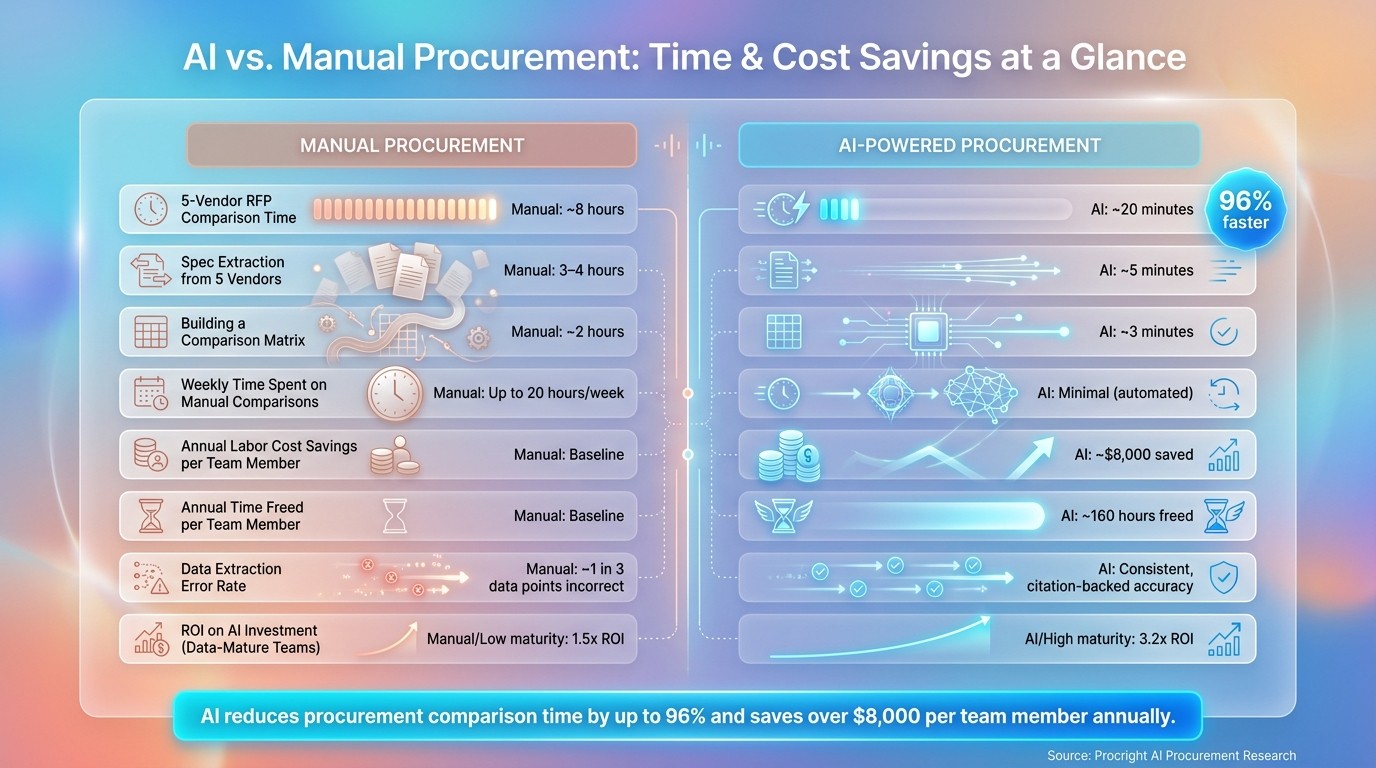
AI vs. Manual Procurement: Time & Cost Savings at a Glance
AI in Procurement: Use Cases with the Highest ROI in 2026
Key Product Comparison Challenges in Procurement
Procurement teams often face significant hurdles when trying to make sense of diverse product data. These challenges are compounded by fragmented information sources, making strategic sourcing even more difficult.
Fragmented and Inconsistent Product Data
Vendor data comes in all shapes and sizes - PDFs, Excel files, Word documents, emails, and even handwritten notes. Take this example: a component manufacturer handling a single steel forging RFQ received 14 supplier quotes across multiple formats, five different currencies, and four distinct incoterms. The result? The buyer spent an entire day manually reconciling the data.
These formatting inconsistencies don’t just slow things down - they make direct comparisons nearly impossible without extensive manual effort. This variability in data creates a shaky foundation for analysis, making it harder to even begin the strategic evaluation process.
Manual and Error-Prone Comparison Processes
Once procurement teams gather the data, they often resort to building manual comparison spreadsheets. For example, comparing five vendors across 30 specifications can take anywhere from 6 to 10 hours. Scale that up to 10 vendors and 50 specifications, and you’re looking at 15–25 hours of work. Worse yet, nearly one in three data points could be incorrect due to manual extraction errors.
This manual process eats up a huge chunk of the comparison cycle, leaving little time for actual strategic analysis. Without AI-driven tools to streamline these steps, inefficiencies grow exponentially with each additional vendor.
Difficulty Verifying Compliance and Specification Alignment
Even when data is organized, ensuring a product meets all requirements is no easy task. Important specifications are often buried in appendices or footnotes, making them easy to overlook during manual reviews. Additionally, performance claims - like efficiency ratings or throughput figures - are often based on inconsistent testing conditions, turning what should be straightforward comparisons into a guessing game.
Semantic gaps can also lead to missed details. For instance, a vendor might respond to a "24/7 support" requirement with "standard business hours support", and this subtle but critical difference could slip by unnoticed. These challenges emphasize the need for tools that can highlight discrepancies and misalignments in real time.
"Vendor datasheets are starting points, not verified facts - for high-stakes purchases, require third-party test reports or certifications." - Priya Sharma, Procurement Technology Lead, SpecLens
Limited Visibility Into Total Cost and Tradeoffs
It’s easy to focus on the unit price in a quote, but that number rarely tells the full story. Other factors - like installation labor, energy consumption, maintenance, consumables, and end-of-life disposal costs - can significantly impact a product’s total value. A product with a higher upfront cost might actually save money over its lifecycle, but manual evaluations often skip these long-term comparisons.
Bundled systems versus individual components add another layer of complexity. Estimating the labor for integration or identifying missing parts requires time and expertise that many teams simply don’t have. Without a full picture of costs and tradeoffs, procurement decisions risk being based on incomplete information, with hidden expenses surfacing only after the purchase.
How AI Addresses Product Comparison Challenges
AI simplifies the complex task of product comparisons by automating processes that often bog down procurement teams. It tackles challenges like fragmented data, human errors, and compliance gaps through three key functions: automated data extraction, real-time scoring, and compliance verification.
Automated Data Extraction and Normalization
AI systems can pull product data from virtually any format - PDFs, Word files, Excel sheets, or product URLs - and consolidate it into a single, cohesive comparison set. These platforms identify key technical fields like capacity, dimensions, and certifications, extracting the relevant values while attaching citations and confidence scores for transparency.
One standout feature is unit normalization. For instance, AI can convert pounds to kilograms or PSI to bar, ensuring all data aligns for accurate comparisons. This process slashes the time needed for manual comparisons - from around 8 hours to just 20 minutes, cutting time by 96%. Once normalized, the system scores and ranks products, enabling faster, data-driven procurement decisions.
Real-Time Product Scoring and Ranking
After normalizing data, AI uses scoring models to evaluate products across multiple criteria, such as price, technical specifications, delivery schedules, commercial terms, and risk factors. These rankings remain dynamic, meaning they adjust instantly as new vendor data is added or evaluation priorities shift. There's no need to rebuild or update spreadsheets manually.
One of AI's biggest strengths is its transparency. Every ranking is tied to specific data points and citations, making it easy to explain why one vendor outperformed another. Teams can also run "what-if" scenarios - like adjusting the weight of price versus lead time - to see how rankings change before making a final decision.
Compliance Verification and Risk Flagging
AI doesn’t just rank products - it ensures they meet compliance standards by mapping RFP requirements directly to vendor responses. It flags gaps where vendors fail to address specific requirements, which can pose significant risks. For example, if a vendor omits a critical specification, AI highlights this omission automatically.
Semantic analysis adds another layer of scrutiny. AI can detect when qualitative responses, like "available during standard business hours", don’t meet quantitative requirements, such as 24/7 support. These issues are flagged with color-coded risk indicators in the comparison matrix, so reviewers can spot them immediately without digging through footnotes. Additionally, every compliance claim is linked to a specific page in the source document, ensuring a reliable audit trail.
"The most dangerous specifications aren't the ones that fail to meet your requirements. They're the ones that aren't there at all." - Priya Sharma, Procurement Technology Lead, SpecLens
Integrating AI Into Procurement Workflows
AI's ability to standardize and analyze data can transform procurement processes without requiring a complete overhaul of existing systems. By acting as a specification intelligence layer, AI bridges the gap between intake/orchestration tools (like Zip or Tonkean) and source-to-pay platforms (like SAP Ariba or Coupa). This ensures vendor responses are properly evaluated, solving a common pain point in procurement workflows.
Harmonizing and Standardizing Product Master Data
For AI to deliver meaningful insights, your product data must be clean and consistent. AI simplifies this process by using predefined normalization rules to handle discrepancies in supplier data. It can automatically convert mismatched units, clean up inconsistent terminology, and validate identifiers, making integration with legacy systems much smoother.
A good starting point is a one-day data audit to assess three key metrics:
Spend visibility in analytics platforms (aim for over 85%)
Category code assignment (target above 90%)
Data freshness (less than 7 days old)
Organizations that meet these benchmarks before implementing AI achieve far better outcomes. For example, "Digital Masters" - teams with high data maturity - report a 3.2x return on AI investment compared to 1.5x for teams that skip this foundational step. Once your data is unified and reliable, AI can seamlessly assist in identifying the right products in real time.
Real-Time Product Discovery and Shortlisting
With clean, standardized data in place, AI can take over the search and shortlisting process. Procurement teams simply describe their needs in plain language, and AI translates those requirements into structured search criteria. It then scans supplier documents - whether PDFs, Excel sheets, product URLs, or Word files - and identifies products that match your specifications.
What used to take hours can now be done in minutes. For instance:
Extracting specifications from five vendors, which typically takes 3–4 hours, is reduced to just 5 minutes.
Building a comparison matrix drops from 2 hours to just 3 minutes.
This isn't just about saving time. By automating these tasks, procurement teams free up around 160 hours per team member annually, which translates to roughly $8,000 in labor costs per employee. This extra capacity can be redirected toward high-value activities like supplier negotiations and strategic sourcing.
Monitoring Market and Supplier Changes Continuously
Procurement success doesn’t end with initial comparisons. Market conditions, supplier specifications, and pricing can change rapidly. AI transforms supplier comparisons into a continuous operational workflow rather than a one-time task. It automatically refreshes catalog data, tracks commodity price fluctuations, monitors logistics constraints, and updates total landed cost models in real time.
When a preferred item goes out of stock or a supplier updates a key specification, AI flags these changes immediately and suggests approved alternatives to avoid disruptions. Teams relying on quarterly reviews risk basing decisions on outdated information. Continuous monitoring ensures procurement decisions remain accurate and aligned with current market conditions - all without adding extra manual work.
How Procright Supports AI-Driven Product Comparison
The workflows mentioned earlier - like data normalization, real-time shortlisting, and continuous monitoring - only work seamlessly when the platform is designed to handle the complexities of procurement. To tackle the manual, error-prone processes often seen in procurement, Procright brings together specification intelligence, automated discovery, and transparent AI supplier scoring in one AI-powered system. Let’s break down how Procright turns these features into practical solutions for procurement challenges.
AI-Based Specification Creation
Procright’s AI can create detailed specification checklists for any product category, giving teams a solid foundation for evaluating vendors. Already have an RFP or a specification document? Simply upload it, and Procright’s AI will map and compare vendor responses against your predefined requirements automatically. Without clear and complete specifications, comparisons can fall apart. By ensuring every vendor is evaluated against the same structured criteria from the beginning, Procright makes the process faster and more reliable.
Automated Product Discovery and Attribute Extraction
After specifications are established, Procright scans supplier documents in various formats - PDFs, Word files, Excel sheets, PowerPoint presentations, and even web URLs - to extract key technical attributes like capacity, dimensions, throughput, and power requirements. The platform goes a step further by normalizing units and standardizing terminology across all vendor data, ensuring a true apples-to-apples comparison no matter how suppliers format their information. This meticulous data extraction ensures compliance evaluations can be carried out with precision.
Transparent Compliance Scoring and Verification
One of Procright’s standout features is its approach to compliance evaluation. The platform aligns each RFP requirement with vendor capabilities, flags missing specifications, and automatically identifies non-compliant proposals. What sets it apart is its traceable scoring system - every score is tied directly to specific criteria and weightings, making it clear why a vendor received a particular score. This transparency eliminates guesswork, as the scores themselves provide built-in evidence that high-ranking products meet technical and regulatory standards. This level of detail is also critical for monitoring supplier risk over the long term.
Conclusion: Using AI to Improve Product Comparison in Procurement
Product comparison in procurement often feels like navigating a maze - slow, prone to mistakes, and riddled with challenges like fragmented supplier data, inconsistent formats, and manual spreadsheet headaches. Add compliance blind spots to the mix, and it becomes clear why teams struggle to confidently choose the right products. These hurdles don’t just waste time - they can inflate costs, increase risks, and compromise decision-making. That’s where AI steps in to simplify and improve the process.
AI takes on the tedious tasks: extracting specifications, standardizing units and terminology, scoring vendors based on clear criteria, and automatically flagging compliance issues. For example, it can slash the time needed for a 5-vendor RFP cycle from 8 hours to less than 20 minutes - a staggering 96% time savings. Plus, it can save over $8,000 per team member annually in labor costs. But speed isn’t the only benefit. AI ensures reliability by applying consistent, structured criteria to every vendor, giving procurement teams decisions that are not only faster but also defensible and easy to audit.
Platforms like Procright bring all these capabilities into one place. From AI-driven specification creation to automated compliance scoring, tools like this empower procurement teams to move beyond manual processes and embrace precision and efficiency by understanding the modern procurement lifecycle. AI isn’t some far-off innovation - it’s ready to transform procurement today.
FAQs
What procurement data should we clean up before using AI for comparisons?
Getting procurement data ready for AI-driven comparisons involves a few essential steps to ensure accuracy and consistency. Here's how to do it:
Standardize units, formats, and terminology: Align measurements, data formats, and terms across the dataset to avoid confusion during analysis.
Eliminate duplicates: Remove any repeated entries to prevent skewed results or redundant comparisons.
Complete key fields: Ensure critical details like supplier names and product specifications are fully filled out.
Validate category and variant mappings: Double-check that products are correctly categorized and variants are mapped accurately to prevent mismatches.
These steps create a solid foundation for reliable AI-powered product comparisons.
How does AI prove where each spec and compliance claim came from?
AI helps maintain traceability by directly connecting each specification or compliance claim to its original source in vendor documents. It offers source citations, precise page references, and confidence scores, making it simple for users to check and confirm the information.
How can AI help estimate total cost beyond the unit price?
AI looks at various factors such as freight, tariffs, duties, quality performance, lead times, and supplier reliability to evaluate the total cost. This detailed analysis allows procurement teams to gain a clearer picture of the total landed cost, leading to better-informed decision-making.