AI Product Scoring for Procurement: Guide
Traceable AI-assisted scoring for procurement: pass/fail gates, weighted rubrics, evidence-linked scores, normalized data, and audit trails.

If I want better procurement decisions, I need a scoring process that is clear, weighted, and tied to proof. The article’s main point is simple: I should set pass/fail requirements first, score only the vendors that pass, normalize data before ranking, and link every score to source material like PDFs, web pages, manuals, or video timestamps.
Here’s the short version:
I separate mandatory requirements from scored criteria
I use weights based on business priorities
I mark compliance as Yes, No, Partially, Not Found, or Contradiction
I check documentation instead of trusting vendor claims
I keep version control, owners, and audit records
I test the model in one category before using it more broadly
I track results with metrics like cycle time, score variance, and requirement match rate
A few numbers stand out. The article says AI-assisted reviews can cut a process from 16 weeks to under 7 days and reach up to 99% match accuracy when scanning web pages, PDFs, and videos. That matters because scoring is not just about ranking products and suppliers. It’s about showing why one product came out ahead and whether that choice holds up later.
If I had to boil the guide down to one rule, it would be this: no score should exist without a source.
Area | What I do |
|---|---|
Requirements | Split pass/fail items from scored items |
Scoring | Use fixed weights and clear rubrics |
Data | Convert pricing, units, and time periods to the same format |
Evidence | Cite docs, manuals, pages, or timestamps |
Governance | Assign owners and save each version |
Rollout | Pilot first, then standardize |
Measurement | Track speed, consistency, and post-award results |
The rest of the article explains how to build that process step by step without leaving the final decision to vendor claims or gut feel.
Build the Scoring Model
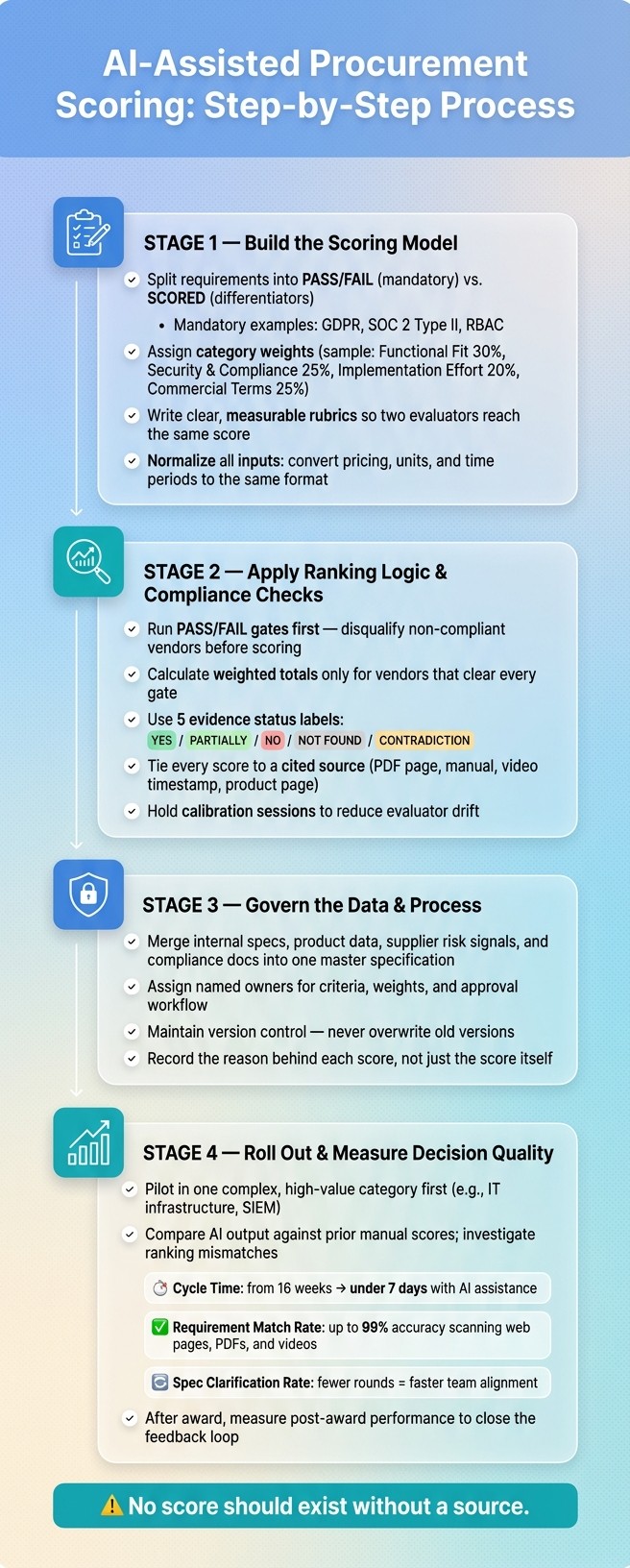
AI-Assisted Procurement Scoring: Step-by-Step Process
Once you’ve gathered the evidence, the next step is to turn it into a scoring model your team can use again and again. A good model does two things at once: it stays simple enough that evaluators apply it the same way, and it holds up if someone later asks, “How did you reach that decision?”
Define Mandatory Requirements and Scored Criteria
Start by separating disqualifiers from differentiators.
Mandatory requirements are pass/fail. A product either meets them or it’s out. Scored criteria, on the other hand, show how well a vendor fits your needs.
Mandatory checks often cover things like regulatory compliance, specific technical capacities, and security controls. That can include GDPR compliance, role-based access control (RBAC), or a named certification like SOC 2 Type II. Scored criteria usually cover areas where vendors can vary without being ruled out, such as total cost of ownership or support quality.
To keep reviews consistent, use the same labels for every mandatory check: "Yes", "No", or "Not Found." That sounds simple, but it matters. It cuts down on guesswork across product types and across evaluators. Each label should link back to evidence, such as a certification document, a technical spec sheet, a user manual page, or a video timestamp.
"A requirement written as 'enterprise-grade security' is an open invitation... vendors will fill the gaps with whatever makes them look compliant." - Procright
Assign Weights and Write Clear Scoring Rubrics
After your criteria are set, assign percentage weights based on actual business priorities. Group related requirements into categories, then give each category its share of the total score. Here’s a sample setup for an enterprise procurement review:
Category | Weight | Example Requirement |
|---|---|---|
Functional Fit | 30% | Meets all core operational requirements |
Security & Compliance | 25% | GDPR compliance and role-based access control (RBAC) |
Implementation Effort | 20% | Deployment timeline under 90 days |
Commercial Terms | 25% | Total cost of ownership within budget threshold |
Total | 100% |
Each category weight represents part of the full score. The requirements inside that category add up to its assigned percentage.
Score products line by line instead of leaning on vendor summaries. That’s where teams often get tripped up. If the rubric is too loose, two evaluators can read the same material and land in different places. Clear scoring bands fix that.
Swap vague wording for specific, measurable definitions at each score level. If a requirement can’t be scored the same way by two people working separately, it still needs work.
Normalize Inputs from Different Data Sources
Before you calculate any score, make sure the data is being compared on equal terms. Vendors rarely present information in the same format. One may quote monthly pricing, while another uses annual pricing. One spec sheet may use metric units, while another uses imperial.
Normalize pricing, units, and time periods before scoring so every product is judged on the same basis. And if a vendor’s documentation doesn’t address a requirement, mark it "Not Found". Don’t fill in the blanks for them.
Once the inputs are normalized, you can apply the same ranking logic across every product. This consistency is a hallmark of custom procurement workflows that reduce manual errors.
Apply Ranking Logic and Compliance Checks
Once your inputs are normalized, rank only the vendors that pass the mandatory gates. Weighted scoring helps you compare fit. It should never be used to paper over compliance problems.
Calculate Total Scores and Set Threshold Rules
Start with pass/fail gates. Then calculate weighted totals only for vendors that clear every gate.
Ranking Rule | When to Use It | Transparency Method |
|---|---|---|
Pass/Fail Gate | Regulatory, security, or legal requirements | "Yes/No" label tied to cited evidence |
Minimum Threshold | High-priority scored categories | Category floor before the composite score is calculated |
Weighted Average | Differentiating criteria across functional, commercial, and operational areas | Percentage weights documented in the scoring model |
This order matters. A vendor that fails a legal or security gate should not stay in the running just because its composite score looks good on paper.
Handle Ties, Outliers, and Evaluator Differences
After scoring, clean up close calls and reviewer drift before you lock the ranking.
For ties, compare the highest-priority requirements first. If one vendor performs better on preweighted critical requirements, that vendor wins the tiebreak. No subjective override needed.
Outlier scores need a different fix. If one evaluator scores a vendor much higher or lower than everyone else, don't smooth it over. Trace that score back to the cited source and sort out the gap first.
Calibration sessions help here. In these sessions, evaluators score a shared sample against the rubric before the full review starts. That step cuts down on drift. And when each score points to a cited source, like a PDF page or video timestamp, the discussion shifts from opinion to proof.
Verify Each Requirement Against Documentation, Not Vendor Claims
Vendor claims are the starting point, not the finish line.
"Vendors say a lot of things. Confirming which claims are actually supported by real documentation is the part that usually gets skipped - because it's slow and tedious." - Procright
Check every compliance item against actual documentation: product pages, technical manuals, PDFs, or videos. Don't rely on sales decks. Use clear status labels for each requirement so the record stays plain and easy to audit.
Evidence Status | What It Means | Impact on Score |
|---|---|---|
Yes | Direct evidence found in manuals, videos, or technical docs | Full points awarded |
Partially | Evidence suggests the feature exists but with limitations | Partial points; flag for manual review |
No | Documentation confirms the requirement is not met | Zero points; triggers disqualification if mandatory |
Not Found | No evidence in public or provided documentation | Treated as a gap; lowers rank and flags for urgent follow-up |
Contradiction | Vendor claim is refuted by their own technical documentation | High-risk flag; score reduction |
Tie each score to a cited source. Procright can help by reviewing specifications line by line, comparing products for compliance, and pulling evidence from web pages, PDFs, and videos. Store each cited source with the score so the team has a clean record for audit review.
"Vendors think buyers evaluate features. Buyers are actually evaluating risk." - Manuel Oothria Raj
Prepare Data and Govern the Process
After evidence checks, the next step is data governance: validate and clean inputs, clear ownership, and version control. Before anyone starts scoring, standardize the inputs, assign owners, and lock the model.
Collect and Clean the Right Procurement Data
Use the verified evidence set as the source for the master specification. The inputs that matter most usually fall into four groups: internal specifications, product data, supplier risk signals, and compliance documentation.
Internal specifications: past RFPs, stakeholder requirements, and current templates
Product data: data sheets, user manuals, web content, PDFs, and product videos
Supplier risk signals: financial records, regional support coverage, and market adoption
Compliance inputs: certifications, regulatory standards, and any legal requirements that apply
The most common failure point is fragmentation. One team has part of the spec, another team has a different part, and sometimes those pieces don’t match. If you merge everything into one consistent specification document before scoring starts, you cut down the risk of sending conflicting requirements into the model. AI can also flag missing requirements in the master spec before scoring begins.
Set Ownership, Version Control, and Audit Trails
Every part of the scoring model needs a named owner. That includes the criteria, the weights, the approval workflow, and any updates made over time. Without that setup, the model gets harder to keep consistent and harder to explain later.
Version control matters just as much. If criteria or weights change, keep the old version instead of replacing it. Then, if a procurement decision gets reviewed later, the team can see which version was active on that date and why a vendor ranked where it did.
"The future procurement winner will not be the vendor with the flashiest demo. It will be the vendor that can clearly explain the controls, the data, the verification process, the audit trail, and the real-world implementation path." - Joe Kramer, Parjana Engineering, Inc.
Don’t just record the score. Record the reason behind it too. If a higher-priced vendor was chosen because its logistics were more reliable, that context gives future teams and auditors the full picture.
Use AI Tools to Support Traceable Scoring
Traceability means every label should point back to a cited source. That could be a line in a manual, a timestamp in a product video, or a section of a technical web page.
Procright is built around that idea. It automates specification creation, scans product documentation from web pages, PDFs, and videos, and maps each compliance item to a cited source. The result is a centralized, auditable record that shows who reviewed each item, what evidence supported it, and how the ranking changed.
That changes the procurement team’s job in a useful way. Instead of spending hours chasing vendor clarifications, the team can spend more time looking at what the evidence means for the business. Once the process is traceable, pilot the model and compare the outputs against real procurement decisions.
With the data governed, the team can pilot the model on live procurements.
Roll Out the Model and Measure Decision Quality
Pilot, Validate, and Standardize the Workflow
Once governance is in place, test the model in one category first. Pick a complex, high-value area like IT infrastructure, SIEM solutions, or industrial equipment, where manual comparison has been the hardest.
Run the model on that category, then compare the output against prior manual scores built from the same rubric. If the rankings don’t match, dig into why. The issue usually comes back to one of three things: a missing requirement, a weak rubric, or bad data.
Rollout Stage | Primary Owner | Validation Check |
|---|---|---|
1. Specification Building | Stakeholders and procurement lead | AI flags missing requirements before scoring |
2. Product Discovery | Procurement analyst | Compare AI-discovered candidates against vendor-provided shortlists to ensure full-market coverage |
3. Line-by-Line Scoring | Procurement Lead | Verify that every compliance label is cited to a specific page or video timestamp |
4. Decision Defense | Audit and legal reviewers | Review the recommendation and evidence record for defensibility |
If the pilot performs well, write the workflow down and make it the standard process.
Track Metrics That Show Better Decisions
After the pilot is steady, check whether the workflow is improving speed and consistency. Start with evaluator score variance. If two evaluators run the same product through the model and get different results in a meaningful way, the rubric still needs work.
Then track three core measures:
Cycle time: Days from spec finalization to a ranked shortlist. AI-assisted workflows can bring a decision that usually takes 16 weeks down to under 7 days.
Requirement match rate: Share of scored products that meet mandatory requirements. AI comparison engines can reach up to 99% match accuracy when scanning web pages, PDFs, and video content.
Spec clarification rate: Number of clarification rounds before the spec is finalized. If that number drops, the team is aligning faster on the right requirements.
After award, keep measuring what happens next. Watch whether the highest-ranked products deliver on operating factors like logistics reliability and how fast the vendor fixes quality issues. That post-award data closes the loop. It shows whether the model is predicting performance in practice or just grading documents.
Conclusion: Core Rules for Reliable AI Product Scoring
Use what you learn from the pilot to lock the workflow. The rules stay the same at every stage: mandatory requirements come first, scoring applies only to qualified products, weights and rubrics must be explicit, and every compliance label needs cited evidence. Clean and normalize data before it goes into the model. Keep clear ownership, version control, and full audit trails.
Most of all, measure whether rankings lead to better outcomes over time. A scoring model that isn’t tied to post-award performance data is just organized guessing. The aim is simple: every decision should be traceable, every score should stand up to review, and the model should improve with each procurement cycle.
FAQs
How do I choose the right scoring weights?
Start by giving each item in your procurement specification its own level of importance. Don’t treat every line the same. Put more weight on the requirements that have the biggest effect on project success.
Use a clear system that lets you change how much each line item affects the final score. When you rank key requirements early, your compliance scores are more likely to reflect what your team actually needs, not what vendors say in marketing copy. Procright can help by mapping products against your criteria.
What should I do when evidence is missing or unclear?
Handle this at the specification stage before you move into product discovery. When requirements are incomplete, vendors have to guess. That leads to mismatched data and scoring that’s hard to compare, which can turn the whole process into a judgment call.
Procright helps you spot and fill technical gaps before you go to market. And if information is still missing during evaluation, it marks those gaps as not found instead of forcing a pass or fail. That keeps the process transparent, data-driven, and audit-ready.
How can I prove the scoring model is working?
Show it with transparency and traceability, not black-box summaries. Procright gives you an audit-ready record for every decision.
You can verify each compliance score by reviewing the direct citations behind it, like a technical manual, web page, or product video. And because scores are mapped item by item to your specifications, you can confirm that the AI’s logic lines up with your procurement needs.