Transparency in Compliance Scoring: Why It Matters
Traceable, explainable compliance scores reduce vendor risk, speed audits, and improve procurement decisions with auditable AI.
Opaque compliance scoring can lead to poor decisions, delays, and lost trust. Transparency fixes these issues by making scores clear, traceable, and actionable. Here's why this matters:
Hidden Risks: Opaque systems may overlook critical issues like regulatory violations or algorithmic bias.
Inefficient Decisions: Lack of clarity forces teams into time-consuming investigations.
Trust Issues: Without clear explanations, stakeholders and suppliers lose confidence in scores.
Regulatory Pressure: New laws, like the EU AI Act, demand auditable, transparent processes.
Key Benefits of Transparency:
Simplifies audits by linking scores to specific evidence.
Improves decision-making with clear explanations of risks.
Strengthens trust within teams and with suppliers.
Actionable Steps:
Use scoring models that document criteria, weights, and thresholds.
Ensure every score is linked to evidence (e.g., documents, certifications).
Regularly review and update scoring systems to reflect new risks or regulations.
Tools like Procright can help by making AI-driven scores traceable and easy to understand. Transparent compliance scoring isn't just about following rules - it's about enabling smarter, faster decisions that everyone can stand behind.
Transparency and Accountability in AI DecisionMaking | Exclusive Lesson
The Risks of Opaque Compliance Scoring
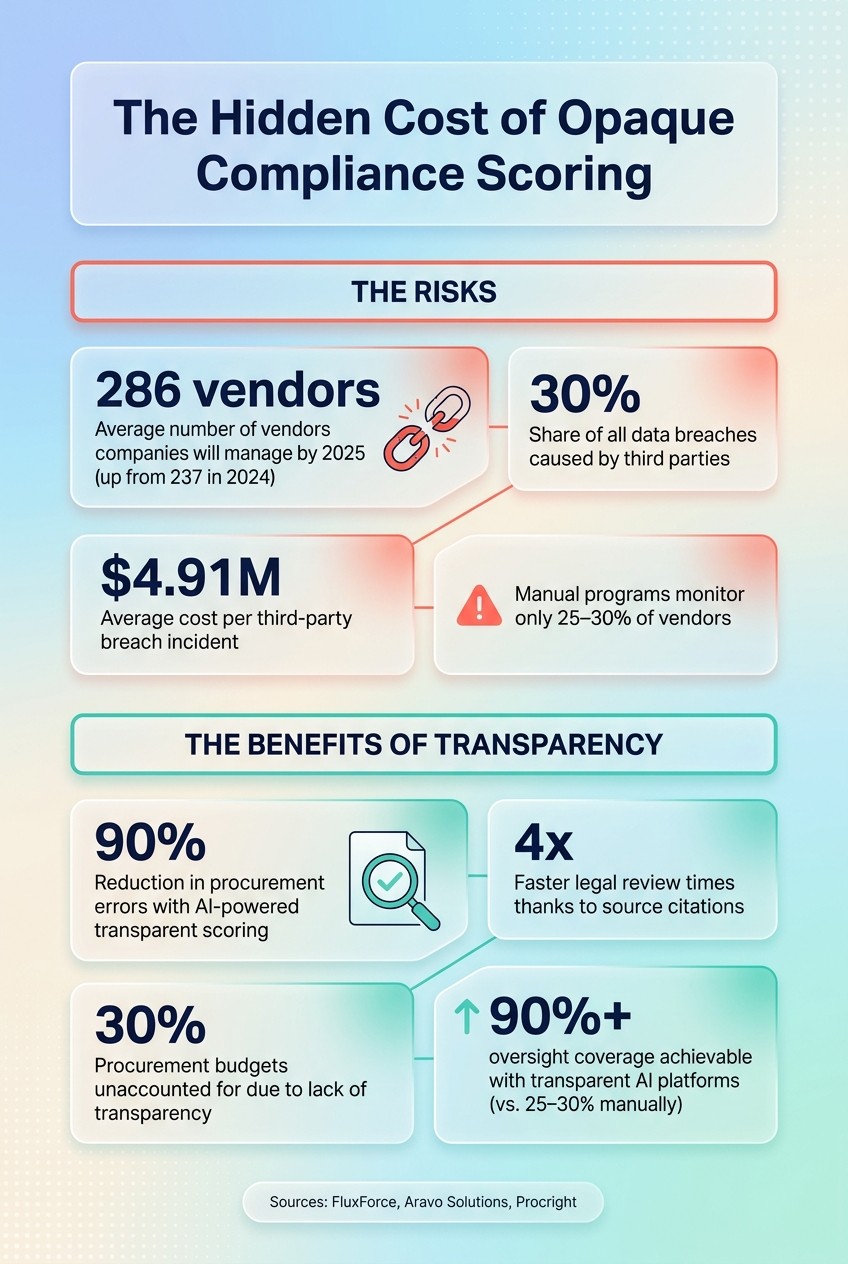
The Cost of Opaque Compliance Scoring: Key Stats & Benefits
When compliance scoring systems operate without transparency, the consequences can ripple across decision-making, stakeholder relationships, and financial outcomes.
Hidden Risks and Superficial Compliance
Opaque scoring models often hide critical risks beneath a polished surface. For instance, a supplier may receive a "low risk" rating, while serious issues like forced labor or human rights violations go unnoticed. This happens when black-box systems rely on incomplete data or fail to consider specific regional or industry nuances, highlighting the need for supplier risk monitoring with AI tools that provide real-time visibility. The result? A seemingly clean score that conceals potential hazards.
Algorithmic bias only makes matters worse. When these systems are trained on historical data - often skewed toward Western markets - they may systematically ignore suppliers in emerging regions due to limited digital records. These biases distort assessments, and without clear, auditable processes, such errors remain unchecked.
Poor Procurement Decisions and Escalating Risks
Opaque scoring also hampers effective decision-making. If a supplier is flagged, teams often can't discern whether the issue is legitimate or a result of flawed data. This leads to weeks of manual investigation - time that could be saved with a transparent system.
This challenge is becoming harder to manage as vendor networks grow. By 2025, companies are expected to oversee an average of 286 vendors, up from 237 in 2024. Managing opaque scores across such a vast network isn't just inefficient - it’s nearly impossible. The stakes are high, too: third-party breaches now account for 30% of all breaches, with an average cost of $4.91 million per incident.
"Without clarity into underlying data, logic, and governance, AI can quietly amplify risk rather than mitigate it, particularly in highly regulated environments where auditability and accountability are non-negotiable." - Daniel Philemon, Product Marketing Manager, Aravo Solutions
The lack of transparency not only slows response times but also damages trust - both inside and outside the organization.
How Opacity Erodes Stakeholder Trust
When compliance scores can’t be explained, trust falters. Internally, compliance teams hesitate to act on recommendations they can’t justify, and senior leaders may dismiss AI-driven warnings altogether, weakening the governance framework. Externally, suppliers receiving poor scores are left without actionable feedback to address concerns.
This lack of clarity often leads to interdepartmental conflict. Legal, procurement, and finance teams may interpret the same vendor data differently, causing delays and inconsistent decisions. A transparent scoring system, on the other hand, ensures a shared and auditable foundation, leveraging AI frameworks to solve procurement issues and prevent such breakdowns.
"Governance is not what you publish. It's what you do when challenged." - Jon Hansen, Procurement Insights
Why Transparent Compliance Scoring Leads to Better Outcomes
Opaque compliance scoring often creates more problems than it solves, but shifting to a transparent system can make a world of difference. When compliance scores are clear, traceable, and properly documented, they bring benefits across audits, risk management, and team collaboration.
Easier Audits and Greater Regulatory Confidence
Transparency simplifies audits. When every compliance score ties directly to specific evidence - like a clause in a contract, a page in a vendor document, or a flagged certification gap - teams can quickly track decisions without scrambling for proof.
"Auditors do not ask for dashboards. They ask for proof." - FluxForce
With regulations like the EU AI Act (fully in effect by August 2026), DORA, and US Interagency Guidance, organizations must now document how AI-driven supplier assessments are conducted and governed. Transparent systems not only meet these regulatory demands but also ensure procurement decisions remain defensible over time. This level of clarity naturally supports smarter, more proactive risk management.
Better Decisions and Stronger Risk Management
Transparency does more than flag risky suppliers - it explains why they’re risky. For instance, knowing whether the issue stems from missing certifications, delivery delays, or financial instability allows procurement teams to address problems more effectively.
This becomes even more critical as vendor networks grow. By 2025, companies were managing an average of 286 vendors. Traditional manual risk management programs typically monitor only 25–30% of vendors, but AI platforms with clear, explainable outputs can oversee more than 90%. This expanded oversight leads to smarter sourcing decisions and quicker responses to emerging issues.
More Trust and Better Collaboration
Transparent scoring doesn’t just improve audits and risk management - it also builds trust within teams and strengthens supplier relationships. When procurement, legal, and finance teams all rely on the same documented logic behind a score, internal disagreements are reduced, and a shared understanding of risk emerges.
Suppliers also benefit from this clarity. A low score accompanied by detailed feedback - such as missing documentation, expired certifications, or unresolved delivery issues - provides actionable insights. Instead of being left in the dark, suppliers know exactly what needs fixing. This fosters accountability and helps create stronger, more resilient partnerships over time.
"A 'risky' flag is only valuable when the triggering language, violated policy, and model confidence are clearly demonstrated." - Maya Chen, Senior SEO Content Strategist
Core Principles of Transparent Compliance Scoring
Creating a transparent compliance scoring system goes beyond just adding documentation. It demands thoughtful design choices, from how scores are calculated to how changes are monitored over time.
Clear and Explainable Scoring Models
A scoring model is only as credible as the logic behind it. Every criterion, weight, and threshold must be fully documented before any bids are opened. Locking in weights early helps eliminate the risk of bias caused by mid-process adjustments.
Clearly defined scoring scales are essential to avoid discrepancies among evaluators. Calibration sessions conducted before scoring begins ensure everyone is working from the same playbook.
"When a vendor asks why they lost, you point to specific scores against specific criteria. Not a vague 'we went in another direction.'" - ProcureKey
Normalization is another key factor. If vendors report performance metrics using inconsistent units or under varying conditions, comparisons become unreliable. Standardizing terminology and conditions ensures evaluations are consistent and fair - an apples-to-apples approach.
Finally, ensure every score is supported by traceable evidence, making the process fully auditable.
Traceable Evidence and Documentation
Each score should be linked to specific source material, not just a general reference to a vendor's submission. Click-through citations that lead directly to the source material streamline verification and strengthen accountability.
When a human overrides an automated score, that decision must also be documented. Using structured reason codes - such as "false positive due to parent-child vendor mapping" - turns individual judgment calls into organizational knowledge, supporting data-driven procurement decisions. This is especially vital for audits, where undocumented overrides can quickly become a liability.
The table below outlines five dimensions that help assess traceability and decision readiness:
Dimension | Scoring (0–4) | Description |
|---|---|---|
Coverage | 0 to 4 | Percentage of mandatory specifications present across all vendors. |
Normalization | 0 to 4 | Degree to which units, terminology, and conditions are standardized. |
Citation | 0 to 4 | Traceability of every value to a specific source document and page. |
Confidence | 0 to 4 | Verification of low-confidence AI-extracted values against the source. |
Decision-Readiness | 0 to 4 | Ability of the output to highlight gaps and provide clear recommendations. |
A combined score of 16 or higher indicates decision readiness, while anything below 12 suggests the comparison isn’t reliable enough to act on.
Governance and Regular Review
Transparent models and traceable data build trust, but they also need ongoing oversight. Regulations change, internal policies evolve, and vendor risks shift. Without structured governance, these changes can impact score calculations without anyone noticing.
Formal approval should be required for any model changes, with clear ownership assigned for business logic, technical updates, and audit responsibilities. As Jordan Ellis, Senior SEO Content Strategist, aptly put it:
"If nobody owns the model, nobody owns the risk." - Jordan Ellis
Monthly drift monitoring - tracking trends like field completeness, override rates, and false positives - helps identify performance issues much earlier than annual reviews. Additionally, mapping each scoring output to a specific policy or regulatory control ensures the system stays aligned with external requirements, not just internal assumptions.
Using AI-Powered Tools to Support Transparent Compliance Scoring
Making AI Scores Readable and Traceable
For decision-makers to act with confidence, they need to understand how scores are generated. This is a common challenge with AI-driven scoring - while the results may seem authoritative, the reasoning behind them often remains hidden. AI tools tackle this issue by replacing unclear scores with straightforward labels like "Yes", "Partially", "No", or "Not Found." Each label is directly linked to its source, such as a specific page in a technical document, a section of a user manual, or even a timestamp in a video. This approach directly addresses the "black-box" nature of many AI systems.
In addition, confidence scoring enhances accountability by flagging data with low confidence for further review, ensuring the reliability of the scores.
"A flag that says a clause is 'risky' is only useful if you can show which language triggered it, what policy or rule it violated, and how confident the model was when it made that call." - Maya Chen, Senior SEO Content Strategist
Such transparency allows platforms like Procright to establish practices that are easy to follow and verify.
How Procright Supports Transparent Compliance Scoring

Procright is designed to make procurement decisions traceable. Its AI evaluates specifications and produces scores, with each score linked to the exact source data that informed it. Users can prioritize specific requirements, ensuring that the final score reflects the most critical factors for a particular purchase instead of treating all criteria equally.
Procright also addresses inconsistencies by addressing common supplier scoring challenges by standardizing inputs when vendors submit data in different formats, units, or terminology. This ensures that comparisons across submissions are consistent and fair. Thanks to this approach, everyone involved - from junior buyers to external auditors - can easily follow the logic from the initial requirement to the final decision. This consistency integrates smoothly with ongoing compliance monitoring.
Using Scoring Data to Drive Continuous Improvement
Transparent scoring data creates opportunities for continuous improvement in procurement processes. When scores are traceable and well-documented, patterns start to emerge - like recurring gaps in vendor submissions, areas with consistently low-confidence extractions, or criteria that are frequently overridden.
AI-powered platforms enable oversight on a scale that manual methods simply can't match. As vendor counts grow - an increasingly common trend - manual reviews become impractical, and without continuous monitoring, compliance risks may go unnoticed until they escalate into major issues.
"Automation without explainability accelerates risk. Automation with explainability controls it." - Sahil Kataria, FluxForce
Conclusion: Building Trust and Accuracy Through Transparency
Key Takeaways
Opaque scoring systems can lead to poor decisions, failed audits, and a loss of trust from stakeholders. On the other hand, transparent scoring addresses these challenges by ensuring every score is explainable, every value is traceable, and every decision can be justified.
Research points to some compelling numbers: AI-powered transparent scoring reduces the risk of procurement errors by 90%, while source citations can cut legal review times by a factor of four. With 30% of procurement budgets often unaccounted for due to a lack of transparency, the financial impact is undeniable, especially when driven by auditable KPIs. This approach not only accelerates procurement processes but also builds trust across your organization.
"Transparency in procurement isn't just a compliance measure - it creates long-term strategic advantages." - Spendflo
These findings highlight clear opportunities for improvement.
Next Steps
Start by auditing your current scoring systems. If you find it impossible to trace or explain how a score was calculated, treat this as a pressing governance issue. Global regulations increasingly require auditable and well-documented risk assessments. To address this, consider adopting tools that offer features like explainability, traceability, and calibrated confidence scoring - such as those provided by Procright.
"Governance is not about being right. It is about being auditable." - Jon Hansen, Hansen Models
For teams ready to move beyond spreadsheets and embrace transparent, auditable data, Procright offers a straightforward solution. Transparent scoring isn't just about meeting compliance standards - it’s about making procurement decisions that your entire organization can confidently support.
FAQs
What makes a compliance score “transparent”?
A compliance score is considered transparent when it offers clear, auditable logic instead of vague or unclear outputs. Transparency relies on three key factors:
Inputs and Assumptions: The criteria and data points used must be clearly defined and applied consistently.
Orchestration and Reasoning: Every decision path and resolution should be documented for clarity.
Accountability and Traceability: There should be a detailed record of any changes made to the score over time.
Procright achieves this by automating compliance verification using AI. This approach allows for data-driven decisions that are easy to defend and explain.
How can we prove a score is backed by real evidence in an audit?
To ensure a compliance score is credible, tie every score directly to its source. Maintain a clear audit trail that includes document references, metadata, and the reasoning behind decisions. Tools like Procright can help by logging policy rules, model versions, and approvals, making the entire process transparent. This approach ensures that scores are not only traceable but also backed by trustworthy data for audits.
How often should we review and update our compliance scoring model?
Compliance scoring models need to move away from outdated, static annual reviews and embrace continuous, dynamic monitoring. Risks don’t wait for yearly check-ins - they change rapidly, making manual audits less effective over time. Automated, real-time monitoring keeps your data up-to-date and relevant.
Procright simplifies this process by delivering transparent compliance scores through ongoing analysis. This empowers teams to make better, faster decisions. To keep your model sharp, regularly assess key metrics, tweak thresholds, and update KPIs to reflect your organization’s shifting priorities.