Manual vs. Automated Procurement: Error Comparison
Manual procurement drives costly errors; AI-powered automation cuts error rates, shortens cycles, and saves significant costs.
Manual procurement processes are riddled with costly errors, while automation drastically reduces mistakes and saves money. Here's what you need to know:
Manual Procurement Issues:
47% of procurement errors come from manual data entry.
Correcting errors costs $53 per mistake on average.
Error rates in manual data transfers are 4%–8%, leading to 3–5% annual overspend.
Automation Benefits:
Reduces error rates to below 1%.
Cuts invoice processing costs from $13–$16 to $1.42 per invoice.
Improves efficiency by 25–40% and slashes cycle times.
Key Features of Automation:
Structured data intake to prevent missing information.
Automated three-way matching to catch discrepancies early.
AI tools for data normalization and anomaly detection.
Quick Comparison:
Aspect | Manual Procurement | Automated Procurement |
|---|---|---|
Error Rate | 4%–8% | <1% |
Cost Per Invoice | $13–$16 | $1.42 |
Invoice Processing Time | 8–10 days | 2–3 days |
PO Cycle Time | 10–18 days | 1–3 days |
Automation eliminates repetitive tasks, reduces errors, and saves money, making it a smart choice for data-driven procurement teams.
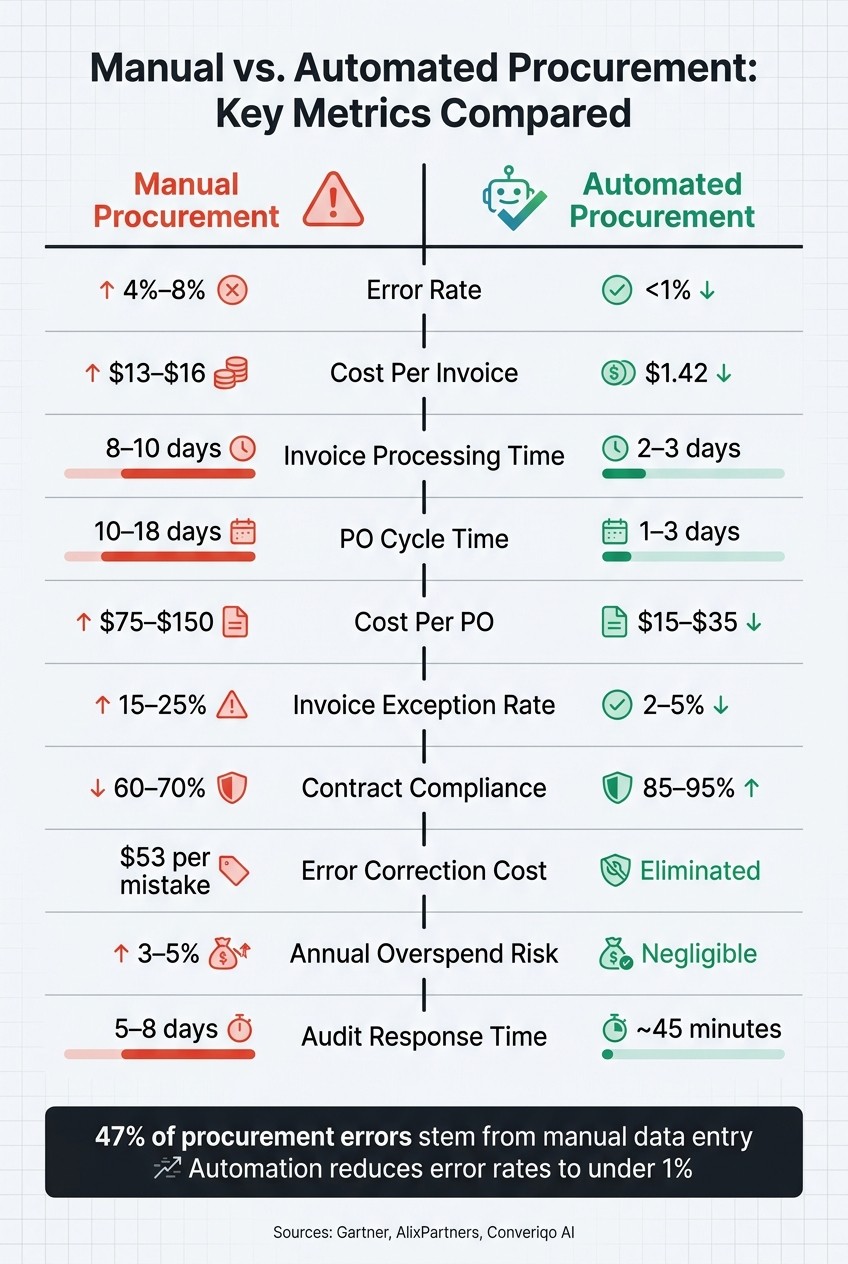
Manual vs. Automated Procurement: Key Metrics Compared
Errors in Manual Procurement
How Manual Procurement Works
In the U.S., procurement teams often rely on outdated tools like emails, Excel spreadsheets, and manual ERP entries to manage requisitions. The process typically involves extracting specifications from PDFs, entering data into spreadsheets, emailing suppliers, and comparing quotes manually. Each step is an opportunity for errors. Every time information is transferred, the risk of mistakes increases. These repetitive, manual tasks make errors almost inevitable.
Tanishka Raina, SEO Executive at Mobiloitte Technologies, sums it up perfectly:
"Manual vs. AI procurement differences show that manual methods are not just slower. It is harder to control, harder to audit, and harder to scale."
Where Manual Procurement Errors Come From
Manual processes are prone to predictable errors due to the way data is handled and transferred.
The most common issue? Data entry mistakes. These can range from a misplaced decimal in a unit price to transposing article numbers or entering incorrect quantities. Some errors are harder to spot. Specification mismatches happen when critical details - like material grades - are overlooked in dense PDF documents. Another headache is version confusion, where teams mistakenly quote against outdated Bills of Materials, leading to orders for obsolete or incorrect parts. Without real-time tracking, duplicate orders and redundant invoices can also slip through unnoticed.
The root problem lies in the manual transfer of data across disconnected tools - PDFs, emails, and screenshots - without automated checks to catch these issues.
How Manual Errors Affect Operations and Costs
The ripple effects of these errors can severely impact operations and budgets. For example, resolving specification mismatches and supplier disputes consumes 12–18% of total procurement labor hours. A single specification error - like ordering a 30-ton HVAC unit instead of the required 35-ton unit - can cost between $15,000 and $40,000 to fix.
On larger projects, the costs add up quickly. For instance, on a $50M construction project, manual tasks such as reviewing documents, preparing RFQs, and comparing quotes can take over 102 labor hours. This translates to $8,700–$11,200 in wages.
Beyond the immediate costs, manual errors also hurt visibility into spending. Teams often lose supplier insights, forcing new hires to start from scratch.
Rhea Kapoor, Head of Procurement Research at SpecLens, highlights the bigger picture:
"The 'savings' of sticking with manual processes are an illusion. The true cost - measured in errors, delays, talent loss, and missed opportunities - far exceeds the investment in modern procurement automation." To see how these errors can be eliminated, you can book a demo of our platform.
How Automation Cuts Procurement Errors
Core Features of Automated Procurement Systems
Manual procurement often depends on human memory and scattered tools, making errors a frequent issue. Automation tackles these challenges by embedding controls directly into the procurement workflow.
Some standout features make a big impact. Structured intake ensures that all necessary details - like category, budget, and purpose - are included before a request moves forward, preventing incomplete requisitions that can lead to confusion later on. Rule-based approval routing automatically sends requests to the right approvers based on thresholds like dollar amounts, cutting down on delays and avoiding missed escalations. Meanwhile, automated three-way matching compares purchase orders, goods receipts, and invoices to identify discrepancies before payments are made.
"The best first wins usually come from structured requisitions, approval workflow automation, and three-way matching automation." - Converiqo AI
These features shift procurement from a memory-driven process to one where built-in rules enforce accuracy and consistency at every step.
On top of these foundational tools, AI adds another layer of precision, catching subtle errors that manual processes often overlook.
How AI Prevents Errors in Procurement
AI goes beyond basic automation by addressing nuanced errors that even the most diligent manual reviews might miss.
One powerful capability is AI data normalization. Instead of manually retyping supplier data from PDFs, AI extracts and organizes this information into a standardized format. It can handle unit conversions - like switching horsepower to kilowatts - and reconcile differences in vendor terminology. This dramatically reduces error rates, ensuring consistent and accurate data. Anomaly detection takes this further by flagging unusual patterns, such as "price creep" when a quote deviates from historical trends, or spotting scope gaps where vendors may have left out key items - a subtlety often missed by human reviewers. These tools help minimize costly mistakes throughout the procurement process.
Another critical feature is the confidence-gated handoff model, which assigns a confidence score to unstructured inputs. Tasks with high confidence scores are processed automatically, while those below a set threshold (e.g., 0.9) are flagged for human review. This approach balances automation efficiency with human oversight, ensuring accuracy without sacrificing control.
"Procurement is the perfect entry point for AI agents: high data volumes, clear decision logic, and immediately measurable results." - Jamin Mahmood-Wiebe, Founder, IJONIS
How Procright Reduces Procurement Errors
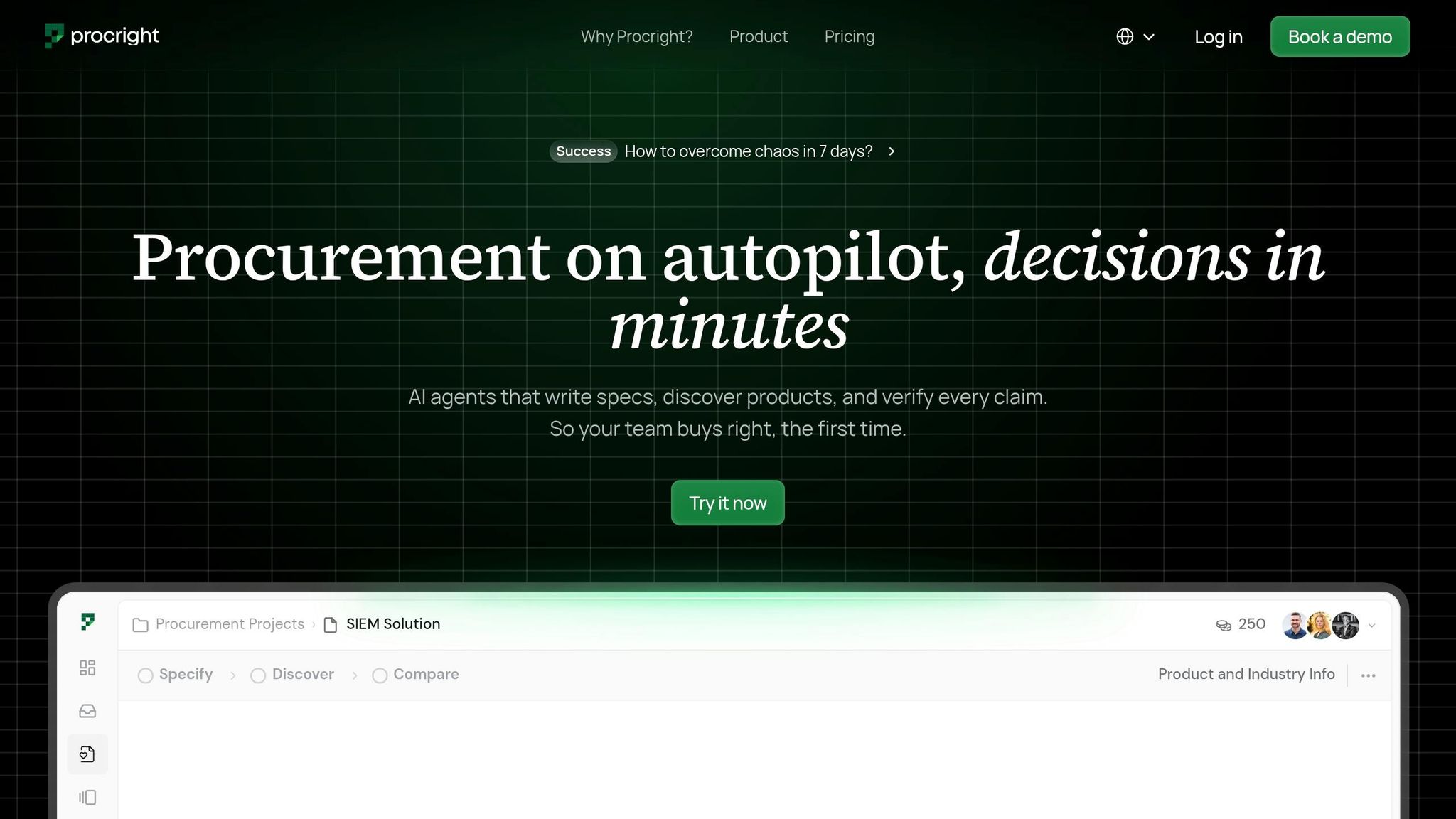
Platforms like Procright take these AI-driven techniques to the next level, offering even greater error reduction. One of the most expensive issues in procurement is mis-specifications, which often slip through manual processes. Procright tackles this by using AI to generate detailed, structured specifications right from the start. It automates data extraction from sources like websites, PDFs, and videos, eliminating the manual steps where most specification errors occur.
Procright also includes a product comparison engine that normalizes vendor data, ensuring teams compare equivalent offerings for compliance instead of mismatched specifications. Additionally, its built-in compliance verification assigns clear compliance scores, highlighting where vendors meet or fall short of requirements. This traceable and auditable system integrates seamlessly into an automated error reduction framework, addressing compliance issues early - before they escalate into costly problems.
Manual vs. Automated Errors by Procurement Stage
Key Procurement Stages and Their Error Types
Procurement errors tend to cluster around specific stages, making it easier to identify where interventions can be most effective.
In Requirements Intake, issues often arise right at the start. When intake is handled manually - via email or chat - critical details like manufacturer part numbers (MPNs), budget codes, or revision numbers are frequently omitted. These missing details can lead to confusion later on and may result in costly change orders. Moving to Supplier Selection and RFQs, the risks shift. Teams often manually copy line items from supplier quotes into spreadsheets, which opens the door to decimal errors, incorrect units of measure, or version mismatches. As CalcuQuote explains, "Manual data entry is where errors sneak in: decimal mistakes in the unit price, wrong MOQ copied, or lead time copied without the 'subject to stock' note."
PO Creation presents another challenge. Even with careful manual entry, transferring approved quote data into an ERP system can lead to a 5%–8% error rate, with typos in quantities or article numbers being common. Finally, Invoice Reconciliation is where mistakes become particularly expensive. Matching purchase orders, goods receipt notes, and invoices manually across different systems is slow, but you can streamline procurement from request to delivery and often results in duplicate payments or missed early-payment discounts.
Error Rate Comparison: Manual vs. Automated
The difference between manual and automated procurement processes is striking at every stage. For example, using AI-powered quote comparison tools can reduce data transfer errors from 5%–8% to under 1%, while slashing the manual effort required by 80%. Similarly, automation transforms invoice processing, cutting the time from 8–10 days down to just 2–3 days and reducing the cost per invoice from $13–$16 to as little as $1.42.
Procurement Stage | Manual Performance | Automated Performance |
|---|---|---|
Requirements Intake | Missing fields, unstructured inputs, and scope gaps | Forced field validation; structured intake ensures complete submissions |
Supplier Selection / RFQ | 5%–8% data transfer error rate; 45–60 min per request | <1% error rate; 80% reduction in manual effort |
PO Creation | 12–15 min per order; prone to re-entry typos | 90% automation rate; data flows directly from approved quote |
Invoice Reconciliation | 3.6% error rate; 8–10 days processing time | 92% automation rate; 95%+ matching accuracy; 2–3 days processing time |
Real-world applications back up these numbers. In 2026, Danfoss introduced an AI agent capable of reading incoming email orders, validating data against SAP, and autonomously handling over 80% of transactional decisions. This innovation saved five minutes per order and significantly reduced manual extraction errors. Bristol Myers Squibb achieved an even greater transformation by automating its RFP process, cutting the cycle time from 6–9 months to just 27 days - a reduction of over 90%.
The takeaway is clear: more manual touchpoints mean higher error rates, as detailed in our guide to the procurement lifecycle and AI. Automation not only accelerates processes but also eliminates many of the conditions that lead to mistakes in the first place. These measurable improvements highlight the financial and operational benefits of reducing errors through automation.
Measuring the Impact of Fewer Procurement Errors
Error Rate Benchmarks in Procurement
Manual procurement processes are prone to mistakes, with a documented 4% error rate in data entry. Almost half of these errors stem from manual data input. Additionally, invoice exception rates in manual setups range from 15% to 25%, and contract compliance typically falls between 60% and 70%.
Automation offers a stark contrast. AI-powered systems bring error rates down to less than 1%, reduce invoice exceptions to just 2–5%, and improve contract compliance to 85–95%. These improvements mark a fundamental shift in procurement accuracy and reliability, providing a clear picture of the cost-saving potential tied to error reduction.
What Error Reduction Means in Dollar Terms
Fewer errors lead to noticeable cost savings. Each manual invoice or purchase order error costs an average of $53 to identify and fix, while addressing duplicate payments can cost over $350 per incident. Processing costs also highlight the gap: manually handling an invoice costs $13–$16, compared to just $1.42 with automation. Similarly, processing a manual purchase order costs $75–$150, whereas AI tools bring that down to $15–$35.
"Gartner data shows manual processes cause 3–5% annual overspend due to errors and inefficiencies." - Gartner
For a company handling 2,000 invoices monthly, a 4% error rate at $50 per correction translates to approximately $4,000 in avoidable monthly expenses. This figure excludes the costs of duplicate payments or missed early-payment discounts. AlixPartners estimates that sticking with manual sourcing methods can leave 1–2% of EBITDA unrealized each year.
Metrics to Track After Switching to Automation
To measure the impact of automation, start by documenting baseline metrics like error rates, cycle times, and cost-per-transaction figures before implementation. These benchmarks will help demonstrate the return on investment.
Post-implementation, focus on metrics such as invoice exception rates, cost per purchase order, purchase order cycle time, and contract compliance rates. Another key indicator is the straight-through processing (STP) rate, which measures the percentage of transactions completed without human intervention. During the early stages, monitor AI confidence scores to ensure the system is properly tuned to your workflows.
Metric | Manual Benchmark | Automated Target |
|---|---|---|
Invoice Exception Rate | 15–25% | 2–5% |
Cost per PO | $75–$150 | $15–$35 |
PO Cycle Time | 10–18 days | 1–3 days |
Contract Compliance | 60–70% | 85–95% |
Audit Response Time | 5–8 days | ~45 minutes |
Beyond individual metrics, tracking overall spend under management (SUM) provides a broader view of procurement efficiency. Increasing SUM from 50% to 95% can raise indirect spend savings from 1–5.8% to 10.6%, offering direct benefits to your budget.
These data points and performance metrics clearly illustrate the value of reducing procurement errors with AI-driven automation. The financial and operational improvements over manual processes are hard to ignore.
Procurement processes SHOULDN'T be manual
Conclusion
Traditional procurement methods come with a hefty price tag due to frequent manual errors. With a 4% data entry error rate, organizations face significant overspending, compounded by the high cost of correcting these mistakes. On top of that, manual processes often lead to a 3–5% annual overspend, thanks to duplicated efforts and missed opportunities - all while relying on outdated tools like spreadsheets and email systems.
Automation offers a game-changing alternative. By leveraging AI-powered systems, error rates drop to under 1%, and invoice processing costs plummet from $13–$16 to as little as $1.42 per invoice. These systems not only minimize errors but also deliver a full return on investment in just a few months.
"The question isn't whether you can afford to automate. It's whether you can afford not to." - Rhea Kapoor, Head of Procurement Research, SpecLens
For procurement teams aiming for precision and efficiency, Procright stands out as a trusted solution. It simplifies specification creation, streamlines product discovery, and ensures compliance verification - achieving levels of accuracy and visibility that manual processes simply can't match at scale.
FAQs
What procurement steps should we automate first to cut errors fastest?
To cut down on mistakes fast, begin by automating high-volume, rule-based tasks that are especially vulnerable to manual data entry errors. A key starting point is structured requisition intake - standardizing data at the outset helps stop errors from rippling through later steps. Another area to prioritize is three-way matching (comparing purchase orders, delivery notes, and invoices), which is often a hotspot for errors. Automation tools like Procright can simplify these workflows while offering transparent, data-backed compliance scoring to keep everything on track.
How do we calculate ROI from fewer procurement errors and exceptions?
To figure out ROI, you can use this simple formula:
ROI = ((Total Benefits - Total Investment Cost) / Total Investment Cost) * 100
This will give you the percentage return on your investment.
Estimating Savings from Error Reduction
Start by calculating the total cost of errors. Multiply your annual transactions by the error rate (e.g., 4%) and the average cost of fixing each error. For instance:
10,000 transactions/year
Error rate: 4%
Cost per error: $50
If you reduce errors by 78%, the savings can be substantial. Don’t stop there, though - factor in additional savings like avoided penalties, expediting fees, and losses from OTIF (On-Time, In-Full) margin issues. This provides a more complete picture of the financial benefits.
How much human review is still needed with AI-driven procurement automation?
Human involvement is crucial when it comes to high-stakes decisions or tasks that require deep institutional knowledge. While automation efficiently manages routine processes, oversight becomes indispensable for areas like financial approvals, onboarding new suppliers, or situations where AI confidence scores drop below acceptable levels. Tools like Procright step in to streamline complex tasks such as creating specifications or performing compliance checks. By automating these processes, teams can dedicate their energy to strategic decision-making while maintaining accountability through predefined risk triggers or legal obligations in procurement workflows.