Real-Time Spend Analytics: Procurement Insights
Live, AI-driven spend analytics gives procurement teams real-time visibility to cut costs, speed decisions, and reduce risk.
Real-time spend analytics transforms procurement by delivering live insights into spending, helping teams act quickly to prevent budget overruns and reduce waste. Unlike outdated batch reporting, this approach captures every transaction as it happens, enabling better financial control, faster decisions, and improved risk management. Key highlights include:
Live Spend Monitoring: Tracks commitments, approvals, and invoices in real time.
Cost Savings: Companies with top spend visibility save up to 7.8% on purchase costs.
AI-Driven Accuracy: Boosts spend categorization accuracy to 95–99%.
Faster Reporting: Cuts reporting times from weeks to minutes.
Risk Reduction: Flags issues like duplicate payments or unusual invoices instantly.
With tools like AI classification and API integrations, procurement teams can shift from reactive reporting to continuous oversight, ensuring smarter, faster decisions and better financial outcomes.
Key Benefits of Real-Time Spend Analytics in Procurement
Better Spend Visibility and Control
Real-time spend analytics gives procurement teams a live, unified view of where every dollar is going - spanning supplier invoices, corporate cards, travel expenses, and beyond - all tied to a centralized chart of accounts. This isn't just about seeing the numbers; it's about acting on them.
Platforms take this visibility to the next level by issuing automated alerts. For example, if a department head is nearing 80% of their budget, the system flags it immediately. Similarly, it can catch duplicate payments or unauthorized vendors in real time. This is often achieved through approval automation, which eliminates manual handoffs. This proactive approach helps stop off-contract, or "maverick", spending, which can cost 10%–20% more than compliant purchases. Instead of discovering these issues during an audit months later, teams can address them as they happen.
One often-overlooked area is P-cards and expense reports. Ignoring these can leave 10%–20% of total spend completely untracked, which undermines the entire analytics process. By including these elements, organizations can tighten their control over spending and set the stage for meaningful cost reductions.
Cost Savings and Budget Adherence
The financial benefits of real-time analytics are clear. Companies with top-tier spend visibility save 7.8% of their purchase costs, compared to just 3.7% for those with low visibility. These organizations also see a procurement ROI of 13.6x, far exceeding the 5.2x ROI achieved by lower-visibility counterparts.
Take Compass, a real estate technology company, as an example. They transitioned from using manual Google Sheets to a spend intelligence platform. Tony Brita's team managed 118 projects and achieved $12.7 million in savings, surpassing their $10 million target.
"As management came to the procurement team and said, what kind of savings have you driven for the organization? We now had a tool... to be able to deliver." - Tony Brita, Director of Strategic Sourcing, Compass
AI-powered classification is another game-changer. It boosts spend categorization accuracy from the 60–75% range seen with manual methods to 95–99%, giving teams a stronger foundation for budget tracking and supplier negotiations. This also slashes analysis cycle times by over 50% and reduces the time analysts spend on data prep from roughly 80% to less than 20%. The result? Faster decisions and a sharper focus on strategic priorities.
Faster Decisions and Risk Reduction
Speed is where real-time analytics shines. For 67% of Chief Procurement Officers, "speed of execution" is the biggest challenge. Real-time data helps solve this by cutting procurement cycle times from 30 days to as few as 3, thanks to the elimination of manual data entry.
With speed comes better risk management. If there's a sudden spike in a spending category or an unusually large invoice from a new vendor, teams can act in hours instead of weeks. As Mita Gupta, EVP and Business Unit Head at WNS Procurement, explains:
"Disruption is happening in real-time, so teams need real-time intelligence to make fast, informed decisions based on what's truly happening today – not just what happened in the past."
This shift toward what some call "resilience-first procurement" is gaining traction. Instead of focusing solely on cost, leading organizations are prioritizing how quickly they can respond to price hikes, supplier issues, or geopolitical disruptions. Real-time analytics provides the agility needed to navigate these challenges effectively.
How AI Is Making Spend Analytics Smarter for Procurement | GEP
Research Findings on Real-Time Spend Analytics

Traditional vs. AI-Powered Real-Time Spend Analytics: Key Metrics
Key Performance Metrics from Real Implementations
AI-powered real-time spend analytics are delivering impressive results. Organizations using these tools report 6%–12% annual procurement cost savings, far outpacing the 2%–4% savings achieved with traditional, ad hoc methods. Additionally, compliance violations drop by 30% when AI-driven spend monitoring is in place. Reporting speeds have improved significantly, shifting from days or weeks to just hours or minutes, and analysis cycle times have been cut by over 50%.
Here's a side-by-side comparison of key metrics between traditional methods and AI-powered real-time analytics:
Metric | Traditional | AI-Powered Real-Time |
|---|---|---|
Classification Accuracy | 60–75% | 95–99% |
Annual Cost Savings | 2–4% | 6–12% |
Analyst Time on Data Prep | ~80% | <20% |
Reporting Speed | Days to weeks | Hours to minutes |
Compliance Violations | Baseline | 30% reduction |
Amy Hillcox, Senior Research Director at The Hackett Group, emphasizes the broader impact of AI integration:
"The focus is shifting to redesigning processes, roles and decision-making so AI can deliver measurable value, not just incremental efficiency."
These metrics aren't just theoretical - they're backed by real-world success stories.
U.S.-Based Examples and Case Studies
Several U.S. companies have demonstrated how AI-powered spend analytics can transform procurement operations.
A Fortune 300 food and beverage manufacturer teamed up with ProcureAbility to implement PureSpend analytics across $28 billion in spend. The system achieved an impressive 99.6% sustained categorization of supplier master data, giving more than 100 users access to real-time dashboards. These tools helped prioritize data-driven procurement decisions effectively.
Another example comes from a $5.9 billion specialty vehicle manufacturer that partnered with YCP Supply Chain in March 2026. They classified $1.4 billion in annual spend across 237,000 SKUs with 98% accuracy. This project revealed 15%–20% price variances for identical parts across business units - issues that had gone unnoticed under quarterly reporting. Reporting times were also slashed from weeks to minutes.
International Flavors & Fragrances (IFF), a consumer goods company, collaborated with KPMG to deploy an AI-driven source-to-pay platform across 110+ manufacturing facilities. Within six months, they identified $43 million in value generation and uncovered an additional $35 million in potential savings. These results not only covered the cost of implementation but also shifted the team's focus from routine tasks to strategic initiatives.
"With KPMG's guidance, we've moved from a fragmented procurement landscape to an integrated, data-driven operation. This transformation has not only generated tens of millions in savings but has also empowered our teams to shift from tactical tasks to strategic value creation." - Robert Freney, VP, Global Procurement COE, IFF
Technology Behind Real-Time Spend Analytics
Data Integration and Live Processing
Traditional spend management systems often operated on fixed schedules, leading to delayed insights. But with API-first integrations, platforms like Coupa can now connect directly to ERP systems such as SAP ECC, cutting data latency from hours to mere seconds.
Cloud-native tools, like Delta Lake, take this a step further by consolidating ERP transactions and unstructured data (e.g., contracts) into a unified source. This setup allows for uninterrupted spend tracking and a more detailed analysis without the delays typical of older systems. The result? A seamless data flow that sets the groundwork for smarter, faster decision-making.
AI and Machine Learning in Spend Classification
AI models such as XGBoost and Random Forest have revolutionized spend classification, achieving accuracy rates of 95–99%. Natural language processing (NLP) further enhances this process by standardizing supplier names - for instance, recognizing that "Acme Co" and "ACME Corp" refer to the same vendor. This prevents fragmented spend data and ensures a more cohesive analysis.
Meanwhile, anomaly detection models like Isolation Forest actively monitor transaction patterns, flagging issues such as duplicate invoices or off-contract purchases in real time.
"The ultimate advantage for procurement leaders will be the ability to have an up-to-date and accurate view of their spending every day, rather than waiting for quarterly reviews." - Tredence
For those just starting, a simpler taxonomy with around 30 categories is a practical first step. This approach helps AI models achieve over 97% accuracy more quickly, especially when combined with weekly analyst reviews to validate the more uncertain classifications.
Self-Service Dashboards and Embedded Analytics
Once robust data pipelines and AI-driven classifications are in place, the next step is making insights accessible. Self-service dashboards allow procurement professionals to query spend data in plain English, delivering instant, permission-specific answers - no SQL required.
This shift enables teams to move from reactive, quarterly reporting to real-time oversight. For example, they can quickly spot opportunities like identifying when different departments are purchasing the same SKU from various vendors at different prices. As Alex Idan, Procurement Group Manager at Fiverr, noted:
"Opstream dramatically reduced the manual overhead in our company, enabling our procurement operations to be more efficient than ever before." - Alex Idan, Procurement Group Manager, Fiverr
For organizations handling high transaction volumes, daily data refreshes are now the baseline, with hourly or near-real-time updates becoming the gold standard for time-sensitive decisions. It’s no surprise that 53% of Chief Procurement Officers (CPOs) now list spend analytics and dashboarding as their top generative AI application. These tools empower teams to act decisively, improving spend management and cutting waste across operations.
How Procright Supports Real-Time Spend Analytics
High-quality data is the backbone of self-service dashboards and AI tools, especially in real-time spend analytics. One costly issue in this area is specification errors. For example, when procurement teams mistakenly choose a non-compliant vendor or the wrong product, these errors often lead to unexpected spending variances. Addressing these mistakes early on is crucial.
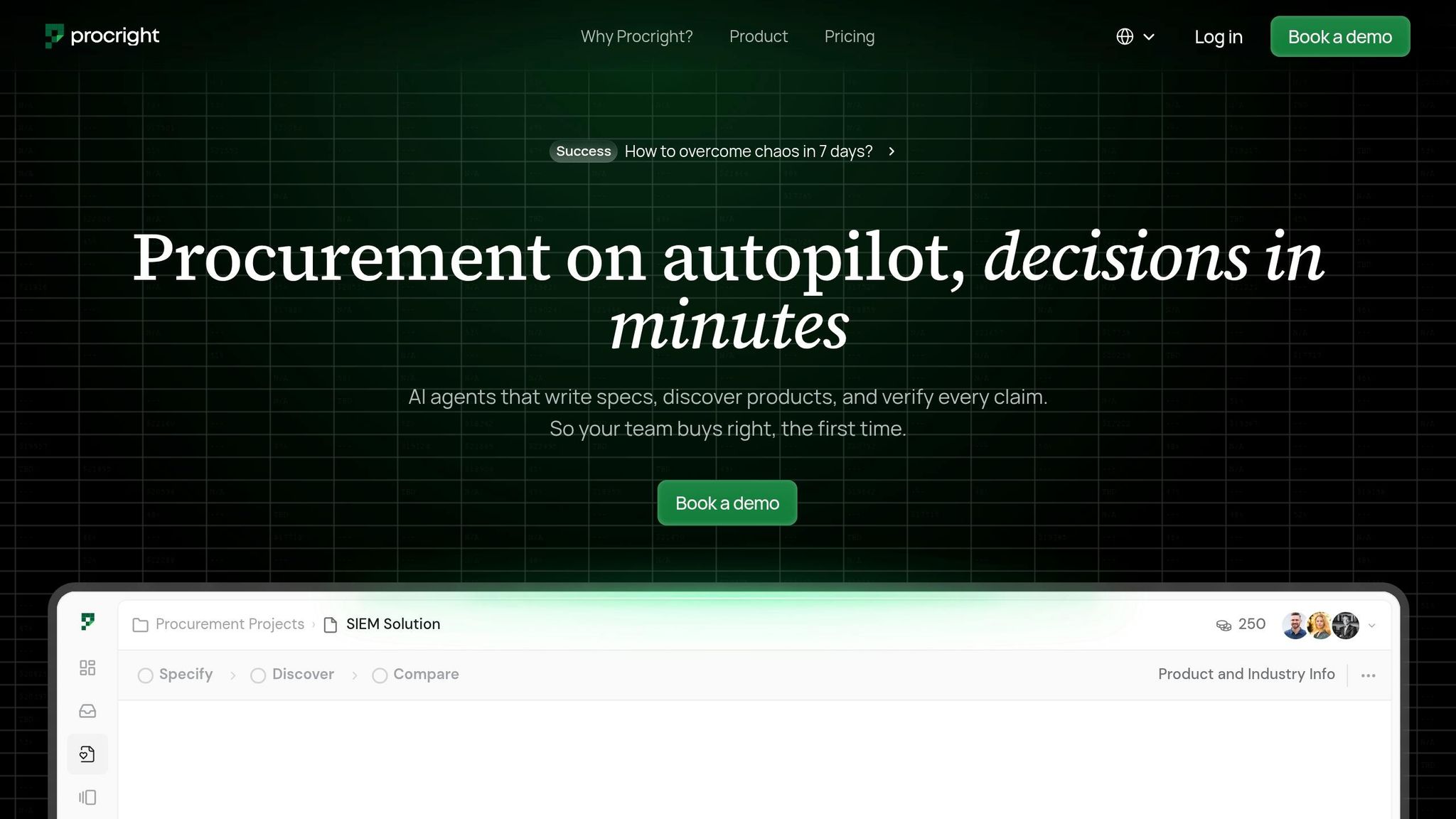
Procright solves this problem at its root. Its AI agents automatically create technical specifications by spotting missing requirements. By using industry-specific templates, it cuts specification errors by an impressive 90%.
Once the specifications are complete, Procright's AI comparison engine steps in. It evaluates products against each requirement by pulling data from sources like web pages, PDFs, and even video content. The engine assigns a transparent compliance score - "Yes", "Partially", "No", or "Not Found" - and links it back to the original documents for an audit trail. This system ensures procurement teams can make confident, data-driven decisions while maintaining data accuracy throughout the process.
Gartner highlights the impact of AI-driven spend monitoring, noting it can reduce compliance violations by about 30% and cut recovery costs in half.
"The most effective procurement teams will be those that successfully integrate AI's analytical power and decision automation with human insight and expertise." - Olaf Komitsch, Chief Procurement Officer, Energie Baden-Württemberg AG
Procright goes even further by enhancing upstream quality controls, which fine-tune real-time spend dashboards. It offers tools like Product Maturity Scores and Market Acceptance Rates to assess supplier reliability. These controls help create cleaner dashboards with fewer anomalies and off-contract purchases. The result? A 90% reduction in procurement errors and a significant cut in research, comparison, and specification time - from 30 days to just minutes.
Conclusion and Key Takeaways
Real-time spend analytics is reshaping procurement by going beyond traditional month-end reports. With live visibility into spending patterns, procurement teams can quickly spot unusual spikes, prevent budget overruns, and make timely sourcing decisions. For instance, platforms that manage spend in real time have been shown to improve budget forecast accuracy by 31% and cut period-end close times by 28%.
However, visibility alone doesn’t drive results. As Mita Gupta, EVP and Business Unit Head at WNS Procurement, highlights:
"The faster insights are translated into action, the more effective procurement can be to drive resilience, growth, and innovation beyond traditional cost-saving metrics."
The real challenge lies in turning insights into action. According to Gartner, procurement teams typically capture only 64% of the potential value from analytics, leaving a considerable portion untapped.
Another critical factor is ensuring high-quality data upstream. Issues like inaccurate specifications, non-compliant vendor choices, and technical gaps can derail procurement outcomes. This is where Procright steps in, combining real-time analytics with AI-driven tools to automate specification creation and compliance checks. By doing so, it reduces procurement errors by up to 90%. This approach reflects a broader move toward continuous, proactive management in procurement.
FAQs
What data is needed for real-time spend analytics?
To achieve real-time spend analytics, organizations require a unified system that brings together procurement, finance, and expense management. This system should consolidate key data sources such as corporate card transactions, travel expenses, invoices, and approved purchase orders.
A critical step in this process is standardizing and cleaning data - for instance, ensuring supplier names and cost centers are consistent across systems. APIs play a vital role here, enabling real-time integration to keep data accurate and synchronized. This allows businesses to power live dashboards and generate AI-driven insights. Procright simplifies this process by automating the creation of specifications and verifying compliance, ensuring smoother operations.
How can we quickly achieve accurate spend categorization?
AI-powered procurement platforms can simplify the process of spend categorization by automating it. These tools pull data from various sources, such as ERPs, invoices, and purchase orders, and use machine learning to assign transactions to the appropriate categories in your taxonomy - all in real time.
To boost accuracy, it's a good idea to incorporate human oversight, especially for classifications where the AI isn't confident. By reviewing and correcting these cases, your team provides valuable feedback that helps the AI refine its performance over time. This creates a system that gets faster and more dependable as it learns.
What alerts should procurement teams set up first?
To create a forward-thinking procurement strategy, focus on setting up alerts for spending anomalies, supplier performance concerns, and policy compliance breaches. These alerts can help you stay ahead of potential issues and make informed decisions.
Here are some key triggers to consider:
Spending spikes: Flag instances where category spending surpasses forecasts or trends by a specific percentage.
Supplier instability: Monitor for red flags like delays, unexpected price increases, or signs of financial trouble.
Maverick spend: Identify purchases made outside of approved contracts or company policies.
Duplicate activity: Catch duplicate invoices or detect unusual purchasing patterns.
Tools like Procright can assist by offering compliance scores and insights based on data, helping you refine and strengthen your procurement strategy.