Transparent Comparisons: Benefits for Procurement Teams
AI-driven, citation-backed comparisons reduce errors, speed evaluations, and ensure audit-ready traceability in procurement.
Transparent comparisons simplify procurement by using clear, traceable data to evaluate vendors and products side by side. Unlike manual vs. automated procurement methods prone to errors, AI tools automate tasks like data normalization, compliance checks, and scoring, ensuring every decision is backed by verifiable sources. This approach reduces errors, saves time, and improves compliance, making procurement processes more efficient and reliable.
Key Takeaways:
What They Are: Transparent comparisons rely on clear, criteria-driven evaluations with traceable data points.
Why They Matter: They reduce errors, standardize processes, and simplify compliance by linking every decision to its source.
How AI Helps: AI automates data normalization, scoring, and compliance checks, cutting manual effort by up to 95%.
Results: Teams save time, reduce costs, and improve accuracy, with error rates dropping significantly.
This article explores how AI-powered tools enable transparent comparisons, their benefits for procurement teams, and practical steps to adopt them.

AI-Powered Transparent Procurement: Key Stats & Benefits
How AI Powers Transparent Product Comparisons
Automated Specification Normalization
Procurement often gets tricky because vendors describe identical products in wildly different ways. For example, one supplier might call it a "500HP Motor", while another labels it "Drive Unit, 500 Horsepower." These inconsistencies make accurate comparisons a headache and increase the chances of errors. AI steps in here with semantic normalization, using natural language processing (NLP) to recognize that these varying terms refer to the same product. This eliminates the need for tedious manual mapping and enables precise, apples-to-apples comparisons.
AI goes further by handling mathematical and financial normalization. It can, for instance, convert "per box of 10" pricing into a per-unit cost or standardize multiple currencies into one base currency by syncing with live financial feeds. The result? A clean, uniform dataset, even when proposals come in all sorts of formats. Studies reveal that this kind of automation slashes data entry time by 90–95% and boosts extraction accuracy to over 98%, compared to the 60–70% accuracy typical of manual methods.
Once the data is standardized, AI can objectively score and rank products based on the criteria you set.
Criteria-Based Scoring and Ranking
Accurate and consistent evaluation is critical for reducing errors and ensuring compliance. AI achieves this through criteria-based scoring. By defining criteria and assigning weightings - say, performance at 40%, cost at 30%, and support at 20% - organizations can eliminate bias and ensure uniform evaluations.
AI also flags potential red flags automatically. For example, if a mandatory specification is missing or if a vendor’s bid is shockingly low - say, 50% below the average - the system identifies it as a possible misunderstanding of the scope. This proactive approach ensures nothing slips through the cracks.
Audit-Ready Comparison Records
AI doesn’t stop at scoring; it creates audit-ready records that make decision-making more transparent. By extracting and normalizing data, AI links every data point to its original source, including the exact page and section in the vendor’s document. Imagine clicking on a value in a comparison matrix and instantly jumping to the corresponding section in the vendor's PDF - that’s how seamless it becomes.
Each record is assigned a confidence score, with low-confidence items flagged for human review before finalizing the comparison. This ensures that critical data gets an expert’s attention while significantly cutting down the time spent creating comparison matrices. In fact, legal and compliance reviews can be completed up to four times faster, as every claim is already tied to a verifiable source.
AI in Procurement: Use Cases with the Highest ROI in 2026
Research-Backed Benefits of Transparent Comparisons
Studies show that transparent, AI-driven comparisons not only minimize errors but also help standardize procurement processes by automating product specification creation.
Fewer Errors in Procurement Decisions
Procurement mistakes often stem from undocumented assumptions. When reviewers manually map vendor specifications to requirements, subjective decisions can go unrecorded, turning assumptions into perceived facts.
Unit mismatches are another common issue. For instance, differences in storage IOPS block sizes or varying payload assumptions for EV ranges can skew comparisons, even if the data itself is accurate. Automated normalization tackles these inconsistencies before they reach decision-makers. With AI-assisted workflows, what used to take 8 hours of manual effort can now be condensed into just 20 minutes of documented analysis.
This reduction in errors also bolsters compliance by ensuring that overlooked specifications are addressed.
Stronger Policy and Regulatory Compliance
AI tools shine a light on silent omissions - mandatory specifications that vendors fail to address. Automated gap analysis highlights missing details and vague promises like "available in a future release".
These compliance benefits stretch beyond internal policies. For example, a study on hospital procurement revealed that sharing peer purchasing data led to price drops of 3.9% for high-cost physician preference items and 1.6% for commodities. This improvement stemmed from reducing information asymmetry between buyers and suppliers. Another study on employee purchasing behavior found that peer observability significantly increased adherence to proper purchasing norms:
"Observed employees' preferences for compliance with the social norm of 'appropriate purchasing behavior' explain our data well." - Ruth Beer, Ignacio Andres Rios, and Daniela Saban
These regulatory advantages help lay the foundation for uniform practices across diverse teams.
Consistent Practices Across Teams and Locations
When evaluation criteria vary across teams, it weakens procurement outcomes. Standardized evaluations not only reduce errors and improve compliance but also create a unified process. Rhea Kapoor, Head of Procurement Research at SpecLens, summed it up well:
"If procurement has not agreed on what matters before opening vendor documents, every reviewer applies their own implicit weights and the team spends the cycle litigating the criteria instead of evaluating the vendors."
A centralized comparison framework resolves this by creating a single source of truth - shared criteria, standardized units, and consistent terminology - before any vendor documentation is reviewed. For example, in 2023, Robert Bosch GmbH introduced a "Digital Procurement Workspace" across its global operations. This centralized "Procurement Information Space" consolidated purchasing data that had previously been siloed across departments. The result? More consistent decision-making and better knowledge sharing among distributed teams. Using structured ranking tools in such frameworks can cut ranking position variance by 84% and increase decision stability sixfold.
How Procurement Tools Deliver Transparency
AI-powered procurement tools bring clarity and fairness to the process through three key mechanisms:
Data Normalization and Structured Capture
Vendor submissions often come in a mix of formats - PDFs, Excel sheets, or even product page URLs. AI procurement tools can handle all of these simultaneously, treating them as part of a unified dataset. They also align similar terms, like matching "500GB SSD" with "SSD-500-SATA", so comparisons are accurate and meaningful.
Differences in units, such as kilowatts versus horsepower or gigabytes versus gibibytes, can throw off evaluations. Automated normalization steps in to standardize these units and terms, cutting down 20–40% of misleading discrepancies. This streamlined approach helps procurement teams make quicker, better-informed decisions.
Rhea Kapoor, Head of Procurement Research at SpecLens, highlights the importance of this process:
"The unit and terminology normalization step is the most-skipped - and the most damaging when missed."
Once the data is standardized, rule-based engines can evaluate compliance consistently, creating a foundation for transparent decision-making.
Rule-Based Compliance Verification
With standardized data in place, compliance engines can apply consistent rules across all vendor responses. These rules reflect sourcing policies, financial guidelines, and regulatory standards, ensuring every supplier is judged on the same criteria.
The results are clear-cut: each requirement is either met, partially met, not met, or entirely ignored. Ambiguous responses, like "available in a future release", are flagged for attention. Every compliance outcome is linked to a specific rule and its source document, creating a transparent, auditable record. This level of traceability ensures decisions can withstand regulatory or internal scrutiny.
Explainable Scoring and Decision Justification
Transparency doesn’t stop at compliance. Explainable scoring ensures every decision is backed by clear evidence. Each extracted value is directly tied to its source - down to the exact sentence or page in the vendor’s document. This makes it easy for decision-makers to verify data without sifting through entire files.
AI tools also assign confidence scores to extracted data, flagging low-confidence entries for human review. This keeps expert judgment central to the process. For legal teams, this feature can speed up reviews by up to four times, as they can focus on specific clauses instead of re-reading entire documents. Stakeholders across departments - finance, legal, leadership - can trace every step of the decision-making process, from initial requirements to final rankings, ensuring full transparency throughout procurement.
Procright: Transparent AI Procurement in Practice
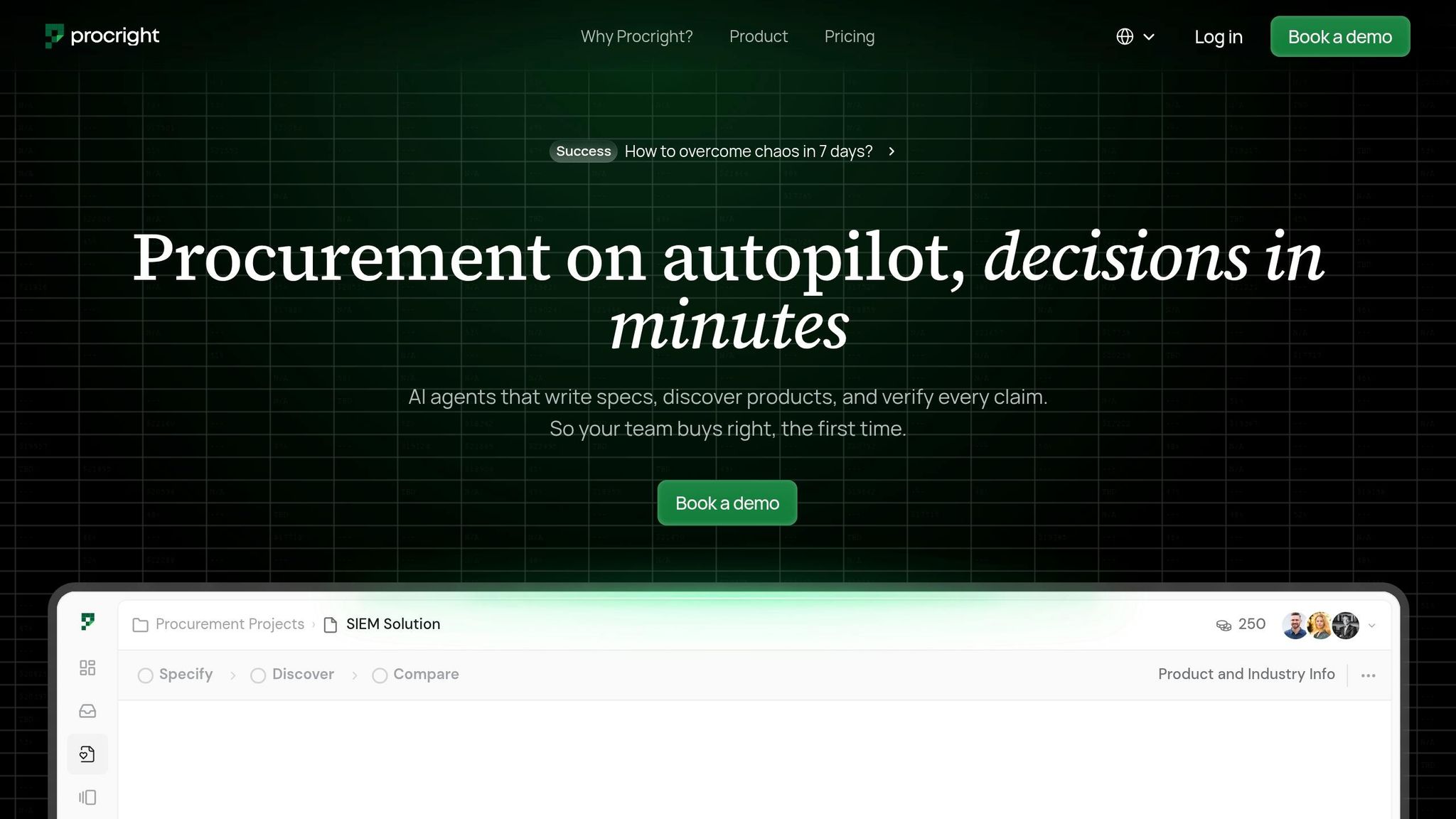
The tools and strategies outlined earlier - like data normalization, rule-based compliance, and explainable scoring - are brought to life through Procright, an AI-driven procurement platform designed to prioritize transparency at every stage.
AI-Driven Specification Creation
Procright showcases how AI can transform procurement by addressing one of the biggest challenges: incomplete specifications. Gaps in specifications often lead to errors, but Procright's AI agents tackle this by scanning a wide range of sources to combine scattered details into a single, standardized document. The platform also enhances specifications by aligning them with industry standards. Through real-time collaboration, teams from engineering, legal, and finance can contribute seamlessly. Procright further simplifies the process with its library of templates tailored to specific industries, cutting specification errors by 90%. This comprehensive approach ensures a solid foundation for precise, side-by-side product evaluations.
Product Discovery and Side-by-Side Comparisons
After finalizing the specifications, Procright's AI comparison engine takes over, evaluating products based on each specific requirement rather than just their main features. The engine assigns a maturity score and a technical match percentage to each product, offering procurement teams a clear, AI supplier scoring and ranking. This system has proven especially effective in managing complex projects, where hundreds of requirements are analyzed. Teams can even assign different weightings to requirements, ensuring the final scores align with their priorities. These detailed rankings simplify the process of verifying compliance, saving time and effort.
Automated Compliance Verification and Scoring
Procright categorizes compliance results into clear labels: "Yes", "Partially", "No", or "Not Found", removing any guesswork about a product's suitability. Each compliance match is tied directly to its source through clickable links, compressing what used to take weeks of manual research into just minutes. Despite the automation, expert oversight is maintained, and the records are audit-ready. This transparency is vital for monitoring supplier risk throughout the procurement lifecycle. For example, during an evaluation of ESET products, Procright flagged that ESET Protect only partially met requirements for "exploit prevention" and "file quarantine." While "file quarantine" wasn't explicitly documented, the platform identified related security capabilities and provided direct links for verification. Procright reports a 99% accuracy rate in matching technical requirements.
Practical Steps for U.S. Procurement Teams
Updating Policies and Workflows
Start by examining your current Source-to-Contract (S2C) process. Before diving into vendor documents, establish clear priorities by defining must-have versus nice-to-have specifications and assigning weights to each. This approach eliminates what researchers call "fuzzy criteria", where unclear standards cause delays and invite bias.
Once your criteria are set, integrate AI-driven template-based comparisons for data extraction and matrix generation into your workflow. For organizations in highly regulated industries like healthcare, defense, or finance, ensure your procurement tools meet SOC 2 Type II certification standards and use AES-256 encryption to safeguard sensitive data. These measures aren't just best practices - they're essential for maintaining compliance and audit readiness. By implementing these updates, you create a transparent system that aligns with AI-driven comparisons and regulatory requirements.
Preparing Data and Governance Structures
To make accurate comparisons, your data needs to be clean and consistent. Vendor submissions often come in various formats - PDFs, spreadsheets, or email attachments - so standardizing them into a unified schema is critical. This schema should include key details like vendor names, contract IDs, renewal dates, and clause categories.
Equally important is establishing strong governance practices. Assign data stewards to oversee the accuracy and regular updates of vendor master data. Define clear thresholds for human involvement, such as when legal review is required for contract deviations or when certain spending levels allow for automated decisions. Strong governance not only improves data quality but also ensures decisions are transparent and traceable. As Alex Morgan, a Senior SEO Content Strategist, aptly noted:
"If your AI cannot show the exact clause, dataset row, or policy rule behind a procurement recommendation, it is not ready for production use in a compliance-sensitive environment."
With standardized data and governance structures in place, you're set to focus on performance monitoring and continuous improvement.
Tracking Results and Improving Over Time
After updating workflows and establishing governance, measure your success by tracking key performance metrics. Focus on metrics like error rates, compliance scores, and cycle times. Teams that automate vendor specification analysis have reported cutting comparison times from about 8 hours to just 20 minutes per RFP cycle - a 96% time reduction. This time savings translates to approximately $400 per comparison, which can add up to more than $8,000 in annual labor savings per team member.
Another critical metric is the AI override rate - the frequency with which humans adjust AI-generated recommendations. A high override rate could indicate that your scoring thresholds or data inputs need fine-tuning. By monitoring this consistently, you transform your procurement process into a dynamic system that evolves and improves over time.
Conclusion: What Transparent Comparisons Mean for Procurement Teams
The research makes one thing clear: a lack of transparency in procurement can be costly. Processing a single purchase order costs organizations between $14 and $54, with higher expenses often tied to data entry errors and the rework they demand. For instance, managing a 500-line RFQ across six vendors can involve 2,500–4,000 manual data entries - each one a chance for mistakes. Transparent comparisons eliminate this guesswork by relying on verifiable, citation-backed data.
The financial pressure underscores the importance of dependable, transparent systems. Transparency fosters trust by directly linking every piece of data to its source, making decisions easy to justify. Legal teams can quickly review specific clauses, CFOs can validate spending decisions without extra meetings, and auditors can access an instant, traceable record instead of piecing one together later.
"Citation is the single dimension that distinguishes audit-grade procurement comparisons from plausible-looking summaries." - Rhea Kapoor, Head of Procurement Research, SpecLens
But trust isn’t the only benefit. Transparent processes also deliver tangible financial and operational improvements. For U.S. procurement teams juggling multiple locations or strict regulations, consistency is as crucial as accuracy. Studies show that 30% of procurement budgets go untracked due to a lack of transparency. AI-powered, standardized comparisons address this by creating a unified, reliable source of truth for all teams.
In short, transparent comparisons reduce costs, minimize errors, and reinforce both compliance and trust. The move toward this approach is already happening. By 2026, 43% of procurement organizations plan to implement AI procurement tools, nearly doubling adoption rates from the previous year. Teams embracing structured, explainable comparison processes today will be better prepared to scale, maintain compliance, and make decisions they can confidently stand by. Transparent, AI-driven comparisons aren’t just an improvement - they’re a necessity for modern, efficient procurement.
FAQs
What makes a comparison “transparent” in procurement?
A transparent procurement comparison provides a clear, auditable process while ensuring an apples-to-apples evaluation of options. It starts with predefined criteria, making it easier to measure vendors against the same standards. Vendor submissions are carefully checked for completeness, and all data is converted into consistent units and terms for straightforward analysis. Each value is linked back to its original source with precise, page-level citations. Plus, any data flagged as uncertain is marked for further review. This approach minimizes mistakes and ensures decisions are grounded in trustworthy, accurate information.
How do AI tools keep comparison data audit-ready and traceable?
AI tools make audit readiness and traceability straightforward by connecting comparison data directly to its original sources. Every value in a comparison matrix is tied to specific documents, including page numbers and exact quotes. This click-through traceability means stakeholders can instantly verify claims with ease. On top of that, a digital record of revisions, calculations, and source mappings ensures procurement teams can produce detailed, audit-grade reports that meet the standards of compliance and finance departments.
What steps should my team take to adopt transparent comparisons safely?
To approach transparent comparisons with care, begin by clearly defining your requirements. Differentiate between must-haves and preferences, and label any uncertainties as "unknown." Use consistent units and terminology across the board. Next, compile supplier specifications into a uniform matrix, highlighting any missing information. Maintain traceability by linking all values back to their original source documents. While AI can assist, don't depend on it entirely - use the matrix to identify gaps, document any assumptions, and ensure that final decisions are reviewed and approved by a human.