Ultimate Guide to Data-Driven Procurement Decisions
Data-driven procurement turns clean data and AI into measurable cost savings, stronger supplier resilience, and faster sourcing decisions.
Procurement is no longer just about managing costs and contracts - it’s now a data-driven powerhouse transforming how businesses operate. By leveraging real-time data, AI, and analytics, procurement teams can cut costs, mitigate risks, and improve supplier relationships. Here’s what you need to know:
What is Data-Driven Procurement? Using live data and AI to replace guesswork, enabling smarter decisions at every stage - from sourcing to payments.
Why It Matters: Poor data leads to inefficiencies, missed opportunities, and risks. High-quality data improves visibility, reduces disruptions, and ensures compliance.
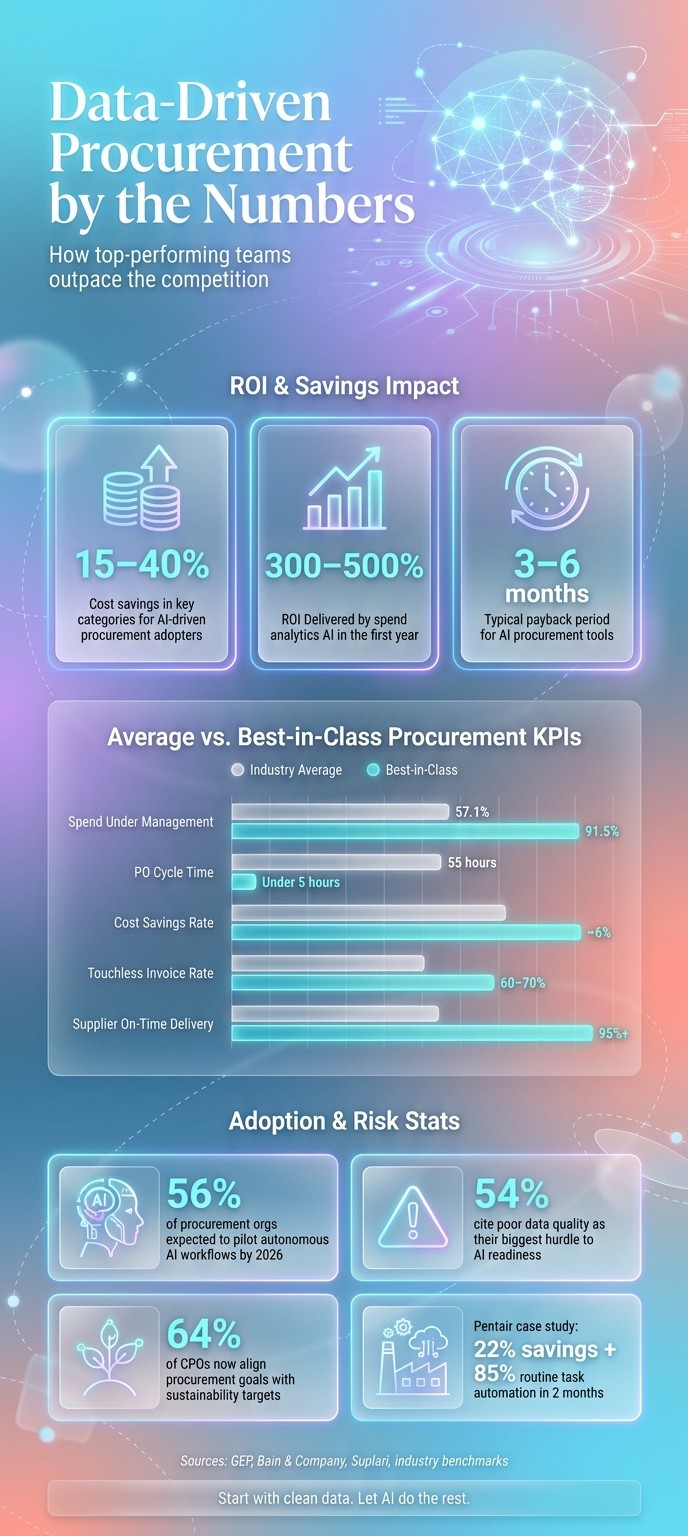
Key Metrics to Track: Focus on cost savings, supplier performance metrics, and operational efficiency. For example, top-performing teams manage 91.5% of spend and cut PO cycle times to under 5 hours.
Role of AI and Analytics: AI uses predictive analytics for supplier risk, automates compliance, and optimizes supplier selection. Predictive tools help forecast demand and avoid disruptions.
Steps to Success: Align procurement goals with business priorities, ensure clean data, integrate tools like Procright, and regularly track performance.
Bottom Line: Companies using data-driven procurement save 15–40% in key areas and gain a competitive edge. Start small, focus on data quality, and let AI handle repetitive tasks while you focus on decisions that drive results.
Data-Driven Procurement: Key Stats & Benchmarks
The Basics of Data-Driven Procurement
Key Procurement Data Sources
Effective procurement decisions rely heavily on robust data. Organizations typically draw insights from four main data types: spend data (captured from purchase orders, invoices, and payment records in ERP and AP systems), supplier performance data (tracking delivery reliability, quality scores, and service metrics), risk and compliance data (including supplier financial health, geopolitical risks, and ESG scores), and contract data sourced from contract lifecycle management (CLM) systems.
External market data, such as commodity price indexes or benchmarking reports, adds crucial context for negotiations. Without this external perspective, procurement teams risk entering negotiations unprepared. Ensuring the accuracy and governance of all this data is a critical next step.
Data Quality and Governance
Good decisions start with good data. For data to be useful, it must be complete, consistent, and up-to-date. A staggering 54% of organizations cite poor data quality and fragmented systems as their biggest hurdle to AI readiness by 2026.
Maintaining data quality requires ongoing governance. Assigning Data Stewards to oversee specific areas - like spend categories, supplier records, or contract terms - helps ensure accuracy and accountability across procurement, finance, and IT teams. A practical goal is achieving 95% or higher completeness in required fields and updating master data within 30 days of any changes.
"Data quality isn't IT's problem. It's everyone's problem." - Mark Jancola, CTO, Suplari
Standardizing data categorization is equally important. Frameworks like UNSPSC or eCl@ss allow organizations to align data across different systems, making comparisons possible. For instance, Cengage applied over 1,800 classification rules across four ERP systems, achieving a 99.6% spend classification accuracy rate on $840 million in spend spanning 14 currencies.
Procurement Metrics and KPIs to Track
Once data is clean and properly governed, the next step is identifying the right metrics to measure. Procurement KPIs generally fall into four categories:
Cost metrics: Such as cost savings rate and total cost of ownership.
Operational metrics: Including PO cycle time and invoice processing time.
Supplier performance metrics: For instance, on-time delivery rates and defect rates.
Strategic metrics: Covering areas like ESG scores and spend under management.
For example, the median requisition-to-PO cycle time is 55 hours, but best-in-class teams reduce this to under 5 hours. When it comes to spend management, the average organization actively manages 57.1% of total spend, while top performers manage 91.5% - and every dollar brought under management typically results in 6%–12% savings.
KPI | What It Measures | Benchmark |
|---|---|---|
Spend Under Management | % of total spend actively managed | Best-in-class: 91.5% |
PO Cycle Time | Requisition to approved purchase order | Best-in-class: ~5 hours |
Cost Savings Rate | Savings achieved vs. baseline spend | World-class: ~6% |
Maverick Spend Rate | Purchases made outside approved channels | Lower rates indicate fewer inefficiencies |
Supplier Defect Rate | Substandard units per million tested | Measured in defects per million (DPM) |
With clean, well-managed data, procurement teams can drive operational improvements and strategic gains, reinforcing the broader data-driven approach discussed throughout this guide. Establishing baselines is essential to track progress after implementing new tools or processes.
Tools and AI in Procurement Analytics | Technology Insights of Purchasing (Episode 4b)
Using Analytics and AI in Procurement
With clean data and clear KPIs, analytics and AI can reshape procurement strategies, turning raw information into actionable insights.
Descriptive and Diagnostic Analytics
Descriptive analytics focuses on summarizing past performance - like analyzing spend by category, vendor, or business unit. Diagnostic analytics, on the other hand, digs deeper to answer "Why did it happen?" For instance, if packaging costs spiked 15% last quarter, diagnostic tools can reveal whether it was due to a price hike or unapproved vendor purchases.
These two methods work together to identify inefficiencies that might otherwise remain hidden. Take maverick spending as an example - it often costs 10% to 20% more than purchases made under contract. Diagnostic analytics can flag off-contract buys, duplicate suppliers, and price inconsistencies, enabling companies to save up to 20% through stronger negotiation positions and better spending controls.
A helpful tool in this process is the spend cube, which examines data across three dimensions: what is being purchased, who it's being purchased from, and which business unit is making the purchase. This approach highlights consolidation opportunities that traditional reports might overlook.
These insights pave the way for predictive analytics, which focuses on anticipating future needs and risks.
Predictive Analytics for Demand and Risk Forecasting
Predictive analytics shifts procurement from being reactive to proactive. Instead of just analyzing past problems, it uses historical data, market trends, and external signals to forecast what’s likely to happen next - whether it’s a surge in demand, a price hike, or a supplier nearing financial trouble.
For example, AI models can analyze indicators like late payments or legal filings to predict supplier distress up to six months in advance. This early warning allows procurement teams to identify backup suppliers and reduce the risk of disruptions. Supply continuity has become the top priority for procurement teams in 2026, surpassing cost reduction.
Predictive tools also help on the cost front. By integrating commodity pricing feeds and market indexes, these tools can suggest locking in contracts ahead of anticipated price increases, replacing guesswork with data-backed decisions.
"AI cannot compensate for weak governance, fragmented data, or broken processes." - Bain & Company
These forecasts naturally feed into smarter supplier management strategies.
AI-Driven Supplier Selection and Order Allocation
Traditionally, supplier selection has relied on manual processes like reviewing RFPs and scoring spreadsheets - methods that can be inconsistent and time-consuming. AI has revolutionized this process. Advanced platforms can evaluate supplier bids within hours, scoring them against predefined criteria such as cost, delivery reliability, quality, and ESG commitments.
By building on predictive insights, AI-powered tools bridge the gap between forecasting and actionable sourcing decisions. For instance, in early 2026, a global agricultural company used AI to develop supplier negotiation strategies, including target pricing and structured scripts. The result? 3% to 5% direct savings and a 90% reduction in the time required to create category strategies.
"AI agents evaluate availability, delivery speed and fulfillment history before making a purchase. Supply chains that can't keep up will be deprioritized." - Kristin Ruehle, Sourcing & Procurement Managed Services Lead, Accenture
The best results come from a human-in-the-loop (HITL) approach. This means letting AI handle repetitive, data-heavy tasks while humans focus on strategic decisions and high-stakes trade-offs. This balance ensures organizations can achieve lasting benefits from AI adoption in procurement.
A Step-by-Step Framework for Data-Driven Procurement
A structured framework is key to making advanced analytics and AI practical in procurement.
Aligning Procurement Goals with Business Objectives
To maximize impact, procurement metrics should mirror core business priorities like improving margins, ensuring supply continuity, or meeting sustainability goals. By directly mapping KPIs to these priorities, procurement decisions align with the broader, data-driven strategy.
For instance, if resilience is a focus, metrics like AI-driven supplier risk scores and On-Time Delivery rates become more crucial than simply tracking spend volume. Similarly, if sustainability is a primary goal, measuring ESG supplier coverage should take center stage. In fact, 64% of Chief Procurement Officers now align procurement goals with enterprise sustainability targets.
A frequent challenge is inconsistent metric definitions across teams. For example, when procurement and finance define "savings" differently, conflicting reports can undermine credibility. Establishing a unified semantic layer - a shared set of definitions for key metrics - ensures everyone relies on the same data. This foundational step creates a smooth path for integrating tools and tracking progress effectively.
Integrating Data and Selecting the Right Tools
Once objectives are clear, the focus shifts to ensuring the necessary data is both accessible and reliable. Start with a data audit to unify sources and identify gaps. Choose tools that integrate seamlessly with your existing tech stack to minimize manual data consolidation. Clean and normalize data to maintain consistency across metrics. Similar initiatives have shown success in streamlining data integration.
When choosing tools, prioritize platforms that can handle increasing data volumes while offering user-friendly interfaces for non-technical team members. For example, Procright simplifies this process by automatically pulling and analyzing data from diverse sources like web pages, PDFs, and other documents, reducing the manual effort required to consolidate supplier and product information.
With reliable, integrated data in place, the next step is to monitor performance and continuously refine strategies.
Tracking Performance and Driving Continuous Improvement
Clear goals and integrated data form the foundation, but regular performance reviews are critical to maintaining progress. Use dashboards to provide tailored insights for different roles: CFOs can focus on financial alignment, category managers on cycle times and spend, and CPOs on risk and resilience.
The table below highlights key benchmarks to evaluate procurement performance:
KPI | Best-in-Class | Significance |
|---|---|---|
Spend Under Management | 91.5% | Reflects procurement’s strategic influence |
PO Cycle Time | Under 5 hours | Reduces bottlenecks and boosts agility |
Touchless Invoice Rate | 60–70% | Cuts processing costs and minimizes errors |
Supplier On-Time Delivery | 95%+ | Enhances supply chain resilience |
Cost Savings Rate | ~6% | Demonstrates procurement's financial impact |
These benchmarks provide a practical starting point for assessing your procurement function. Regular review sessions close the feedback loop, ensuring that metrics remain aligned with shifting business goals. These reviews also highlight areas for improvement, helping procurement strategies adapt to new challenges and opportunities.
Technology and Ethics in Procurement Decision-Making
Procurement Analytics and Data Visualization Tools
Modern procurement analytics have come a long way from static spreadsheets and outdated monthly reports. Today’s platforms can automatically classify spending, track supplier risks in real time, and pinpoint contract leakage with over 95% accuracy - far outperforming older systems that hovered around 70–80% accuracy.
One major advancement is self-service analytics, which allows non-technical users to interact with data in plain language. For example, someone could ask, “Which suppliers delivered the most savings last quarter?” without needing a data analyst to generate a report. This approach makes insights accessible to everyone in the procurement process, not just data specialists.
But it’s not just about having the data - it’s about presenting it effectively. Role-specific dashboards are particularly effective: CPOs benefit from high-level summaries and trend analyses, while category managers need detailed supplier data they can explore to identify root causes. For U.S.-based teams, combining visual dashboards with narrative AI summaries - short, written explanations of trends and their causes - can dramatically speed up decision-making.
AI procurement tools like Procright streamline this process further by automatically extracting and analyzing data from sources like web pages and PDFs. This eliminates much of the manual effort involved in consolidating supplier and product information into a single, actionable view.
"AI is shifting procurement analytics from reactive reporting to proactive intelligence." - Robert Dyer, Procurement Advocate, Suplari
These advancements in analytics pave the way for tackling the ethical challenges that come with AI-driven procurement.
Bias and Explainability in AI-Driven Decisions
AI tools, while powerful, can unintentionally perpetuate biases hidden in historical data. For instance, if past procurement decisions favored certain supplier types, regions, or pricing structures, AI models trained on that data may repeat those patterns. Regular algorithmic audits are crucial to catch these issues and ensure fair evaluation of suppliers.
Explainable AI (XAI) helps address concerns about AI’s “black box” nature by clarifying which data points influenced decisions - whether it’s supplier scoring or contract issue flags. This transparency allows teams to review and validate AI outputs before acting on them.
However, AI should complement, not replace, human judgment. Complex negotiations and ethical considerations still require human oversight. By keeping people in the loop, organizations can ensure AI supports sound, ethical decision-making.
"AI cannot compensate for weak governance, fragmented data, or broken processes. Leaders are modernizing their architecture and operating models while accelerating AI deployment." - Bain & Company
Compliance and Regulatory Considerations
Fairness and transparency aren’t just ethical priorities - they’re becoming legal requirements. Procurement teams must navigate a fast-changing regulatory landscape, especially in the U.S., where new rules are emerging. For instance, Executive Order 14365 (set for December 2025) aims to unify AI policies nationwide, replacing the current patchwork of state-level regulations.
Federal contractors face additional scrutiny. Proposed GSA rules (GSAR 552.239-7001) would require contractors to disclose all AI systems used in contract performance - not just those directly sold to the government. A recent example highlights the stakes: in February 2026, the Department of Defense flagged AI company Anthropic as a national security risk for refusing to adjust its Claude model. This led to a ban on using Anthropic’s technology in DOD contracts. Such incidents underscore the importance of auditing AI tools - including third-party components embedded in existing software - to ensure compliance with "American AI" sourcing rules.
At the state level, California’s AB 2013 (effective January 1, 2026) requires transparency about the data used to train AI models. Below is a summary of key compliance areas and actions procurement teams should prioritize:
Requirement | Key Consideration | Action to Take |
|---|---|---|
AI Disclosure | Disclose all AI systems used in contract performance | Audit your full AI tool stack, including embedded components |
Data Segregation | Government data must not mix with commercial data | Enforce strict data segregation |
Neutrality | AI outputs must avoid ideological bias | Review model configurations for unintended biases |
Incident Reporting | Report AI security incidents to CISA within 72 hours | Establish rapid-response cybersecurity procedures |
IP Rights | Government may claim ownership of "Custom Developments" | Clearly define background IP in all agreements |
Inefficiencies in contract management - like inconsistent clause standards and manual reviews - can cost up to 9% of annual revenue. AI-driven tools address this by providing the detailed, auditable data needed to demonstrate compliance in contract reviews and negotiations. These regulatory shifts highlight the growing importance of data integrity and ethical AI practices in procurement.
Conclusion and Key Takeaways
Data-driven procurement isn’t some far-off goal - it’s a game-changer right now. Companies that move away from gut-based decisions and outdated manual processes toward clean data, strong governance, and AI-powered tools are consistently outpacing their competitors. The stats speak for themselves: early adopters of AI in procurement report cost savings of 15–40% in specific categories, and spend analytics AI often delivers a 300–500% ROI in the first year, with payback periods as short as 3–6 months.
The good news? You don’t need to overhaul everything overnight. Take Pentair, for example. They implemented an AI-driven sourcing platform for indirect procurement in just two months. The results? A 22% savings in their first year and automation of 85% of routine sourcing tasks. Starting small with a high-impact use case can build momentum and prove the value of these tools before scaling up.
Of course, none of this works without a solid foundation. High-quality, centralized data and strong governance are non-negotiable. Cengage showed how powerful this can be: by unifying their data across four ERP systems and 165 countries, they achieved a 99.6% spend classification accuracy rate and gained real-time insights into price trends and supplier performance. These examples reinforce the importance of the core principles highlighted throughout this guide.
"Data-driven procurement isn't a future trend. It's a current advantage. Organizations that embrace analytics don't just gain efficiency - they build resilience." - GEP
Technology amplifies these gains, turning good data and governance into actionable insights. Tools like Procright take on the heavy lifting - extracting, analyzing, and comparing supplier and product data - so teams can focus on making strategic decisions rather than drowning in manual tasks. As AI continues to evolve, with 56% of procurement organizations expected to pilot autonomous workflows by 2026, the gap between early adopters and laggards will only widen. The organizations investing in data, governance, and technology today are setting themselves up to thrive in the face of whatever challenges lie ahead.
FAQs
What data should I centralize first for procurement analytics?
Start by bringing together data on spending, supplier performance, and contract management into one central hub. This means pulling information from various tools, systems, and spreadsheets to break down silos and create a unified view. With all your data in one place, you can spot trends, keep costs in check, and evaluate supplier risks more effectively. This consolidation not only sets the stage for advanced analytics, like predictive modeling, but also helps ensure your procurement strategies stay on track.
How do I measure ROI from AI in procurement?
To figure out the ROI of using AI in procurement, start by pinpointing the specific challenges AI is helping to solve. Then, track the benefits it brings in areas like cutting costs, minimizing risks, or boosting efficiency. For example, compare key metrics before and after implementing AI. Look at things like reductions in maverick spending, better payment term optimization, or the impact of automating manual tasks. Finally, convert these improvements into financial results that align with your organization's goals to clearly assess the ROI.
How can I prevent AI bias in supplier scoring?
To address AI bias in supplier scoring, several strategies can make a big difference. Start by rebalancing training data to ensure it includes a diverse and representative sample. This helps the AI system learn from a broader range of scenarios, reducing skewed outcomes.
Next, adjust scoring factors to avoid overemphasizing criteria that might unintentionally introduce bias. By carefully evaluating and tweaking these factors, you can create a more balanced scoring process.
Another key step is conducting regular audits of the AI model. These audits help uncover and correct any hidden biases, ensuring the system stays fair over time.
Finally, implementing fairness evaluation techniques can further refine the system, reducing bias and boosting the accuracy of AI-driven decisions. Together, these measures create a more equitable and reliable supplier scoring process.