Why Data-Driven Supplier Comparison Matters
Use structured supplier data, automation, and scorecards to cut errors, speed onboarding, and improve compliance.
Choosing suppliers based on outdated methods like phone calls and informal quotes is risky in today’s complex procurement landscape. A data-driven approach ensures decisions are backed by accurate, measurable information, reducing errors, improving compliance, and saving time. Here's why this matters:
Manual processes waste time: Teams spend up to 73% of their time on repetitive tasks like chasing data.
High error rates: Manual systems lead to 20–50% errors, causing compliance failures and audit risks.
Fragmented data: Supplier records across multiple systems lead to delays and inefficiencies.
Compliance gaps: Expired certifications or unnoticed risks increase regulatory exposure.
A better way forward? Use structured data, automated tools, and standardized AI supplier scoring to streamline evaluations. This reduces risks, improves decision-making speed, and ensures consistent, objective results. Tools like Procright can centralize data, automate compliance checks, and provide traceable, defensible decisions.
Key benefits of data-driven supplier comparison:
Reduces duplicate records from 10–20% to less than 1%.
Cuts supplier onboarding time from 10–15 days to 4–6 days.
Improves compliance oversight and minimizes risks by up to 55%.
Switching to a data-driven approach transforms procurement into a more efficient, reliable, and scalable process.
Leveraging data, analytics, and AI to inform strategic decision making in procurement
Problems With Manual Supplier Comparison
Manual supplier comparison is a time-consuming, costly process that comes with plenty of risks. Many procurement teams don’t fully grasp the extent of these losses until problems like late payments or compliance failures rear their heads.
Fragmented Data and Disorganized Records
Supplier data is often scattered across multiple platforms - emails, PDFs, SharePoint, and ERP systems - without a clear system for organization or ownership. This forces teams to spend hours hunting down basic information that should be readily available.
The lack of standardization compounds the problem. For instance, one system might list a supplier as "Kraft", while another refers to it as "The Kraft Heinz Company." This leads to duplicate records, misaligned purchase orders, and delayed payments. Issues like free-text name fields, inconsistent tax IDs, and non-standard country codes only make accurate comparisons more challenging.
"When you add up the time your team spends compiling spreadsheets, chasing certification data, Googling for new suppliers, and manually formatting reports, it's not just inconvenient - it's expensive. These activities drain resources that could be spent on strategic initiatives." - Neeraj Shah, Founder and CEO, Supplier.io
Inadequate Compliance and Risk Oversight
Manual compliance processes are inherently reactive, not proactive. Without automation, certifications tied to safety, quality, or ESG standards can expire unnoticed, leaving gaps in oversight. Organizations often miss critical renewal timelines or fail to identify suppliers flagged on debarment lists, such as those maintained by the FDA. As Katja Mailykke Schmidt from Stibo Systems points out, "Without knowing who your suppliers are and the organizations that they roll up to, your company might be at risk for non-compliance."
Moreover, manual systems rarely track essential updates, like changes to a supplier’s bank details or the last time a certificate was verified. This lack of traceability poses serious risks during audits.
Slow and Inconsistent Evaluations
Without a standardized evaluation process, every supplier assessment becomes a standalone effort, making decisions inconsistent and hard to replicate. Many organizations rely on 6 to 10 different systems to manage supplier data, often without a single source of truth. When one supplier has conflicting risk classifications across Procurement, Finance, and Legal, trust in the data erodes, slowing down decision-making.
"Manual supplier data is not merely inconvenient. It is a structural risk to operations, compliance, reputation, and strategy." - ProcureKey
These inefficiencies highlight the importance of adopting a more structured, data-driven approach to supplier evaluations, one that minimizes risk and streamlines decision-making.
Benefits of Data-Driven Supplier Comparison
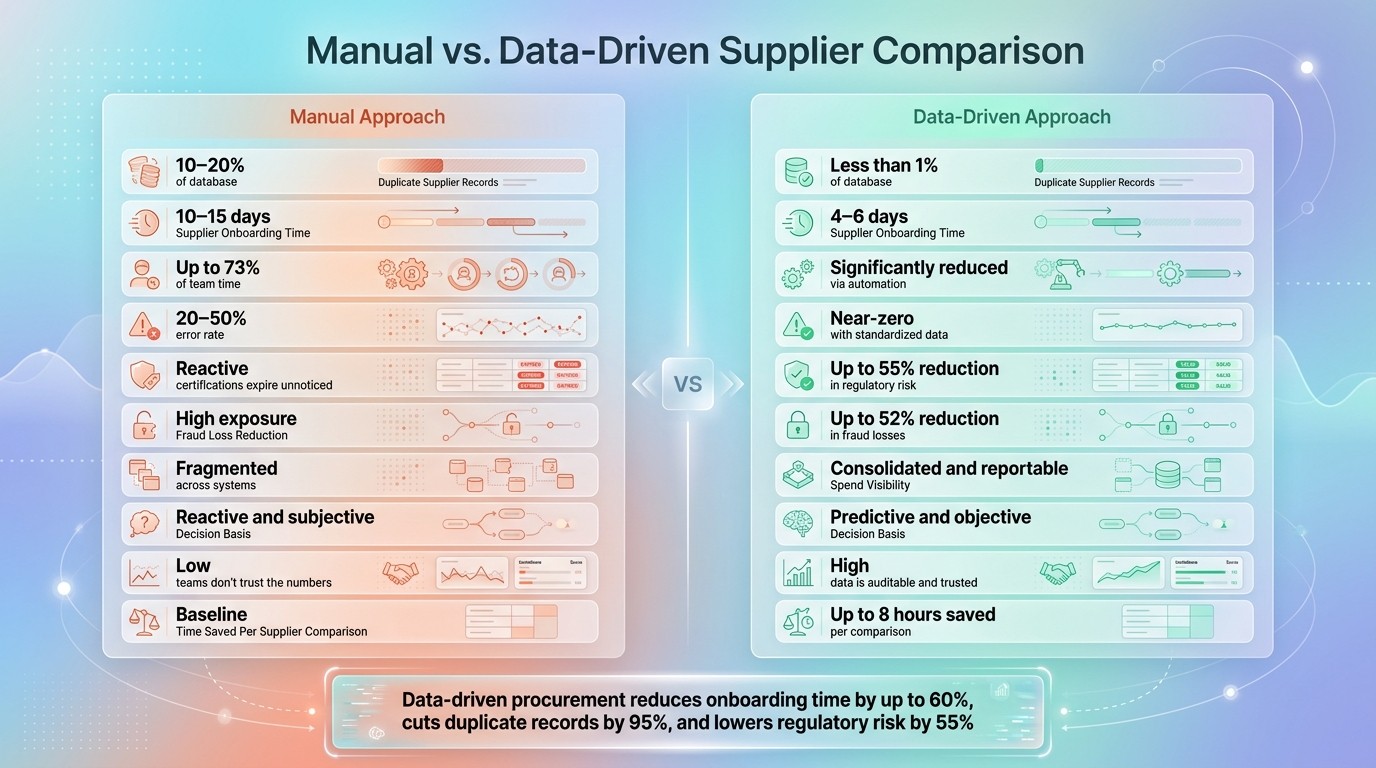
Manual vs. Data-Driven Supplier Comparison: Key Metrics
Switching from manual supplier comparison to a data-driven approach is more than just a convenience upgrade - it directly impacts cost savings, minimizes risks, and accelerates decision-making.
Fewer Errors Through Standardized Data
Manual methods often lead to inconsistent and duplicated supplier records, which can cause significant inefficiencies. In fact, duplicate records can account for 10–20% of a supplier database in manual systems. Data-driven solutions, however, reduce this to less than 1% by matching supplier identities with verified legal entities and government records.
Standardized data eliminates the need for manual checks, saving both time and resources. As Supplier.io explains: "Every time a team member has to manually verify a supplier's legal name, validate banking details, or clean up conflicting records, the organization absorbs a cost that shouldn't exist."
Better Compliance and Risk Control
A data-driven approach shifts compliance efforts from being reactive to proactive. Automated systems constantly monitor certifications and flag potential issues before they escalate.
This proactive monitoring can reduce regulatory risks by up to 55% and cut fraud losses by 52%. Additionally, these systems provide insight into corporate hierarchies, helping organizations identify hidden dependencies - like when seemingly separate suppliers are actually part of the same parent company. Such insights are often missed with manual processes.
Faster and Repeatable Evaluations
Manual evaluations are time-consuming because each assessment starts from scratch. Data-driven systems streamline this process by using standardized scorecards. This reduces supplier onboarding time from 10–15 days to just 4–6 days, ensuring evaluations are both faster and more consistent.
As GEP notes: "It's not about replacing people with data. It's about equipping teams with accurate information, so they can make faster, sharper decisions."
This efficiency aligns with the broader trend of adopting data-driven procurement decisions.
Objective and Transparent Supplier Decisions
One standout advantage of data-driven comparisons is their ability to reduce subjectivity. Weighted scoring models ensure that every supplier is evaluated using the same criteria, reducing the influence of personal bias or incomplete information.
Decisions backed by documented scores, verified data, and traceable sources are easier to justify and defend. Procurement teams move from subjective choices to data-backed decisions, building trust with Finance, Legal, and leadership teams.
Metric | Manual | Data-Driven |
|---|---|---|
Duplicate supplier records | 10–20% of database | Less than 1% |
Supplier onboarding time | 10–15 days | 4–6 days |
Spend visibility | Fragmented across systems | Consolidated and reportable |
Decision basis | Reactive and subjective | Predictive and objective |
Analytics confidence | Low - teams don't trust the numbers | High - data is auditable and trusted |
How to Set Up Data-Driven Supplier Comparison
You've seen how data-driven comparisons can minimize errors and risks - now let’s dive into building that process. Understanding the benefits is one thing, but putting it into action is where the magic happens. The best part? You don’t need to overhaul your entire procurement system overnight. These three steps will cover most of the groundwork.
Set Clear, Measurable Evaluation Criteria
Before diving into supplier comparisons, establish clear, measurable criteria that align with your business goals. Whether your focus is on cutting costs, improving delivery reliability, or achieving specific sustainability milestones, having well-defined benchmarks is key.
Start by using a weighted scoring model that evaluates five key areas: quality, delivery, cost, service, and compliance. Adjust the weight of each category depending on the specific spend category you're assessing. This structure reduces inconsistencies and speeds up decision-making, eliminating many of the pitfalls of manual processes.
Two essential rules to incorporate right away:
Use binary pass/fail gates for non-negotiable requirements like safety certifications or financial stability before applying weighted scores.
Set clear performance benchmarks. For example, top-tier suppliers should achieve an on-time delivery (OTD) rate of 95% or higher and maintain a defect rate of 1–2% or lower.
Consolidate and Normalize Supplier Data
Even the most sophisticated scoring model won’t work without clean, accurate data. A common issue? The same supplier might appear multiple times in your vendor database under slightly different names or tax IDs. This kind of fragmentation makes meaningful comparisons nearly impossible.
To solve this, follow these four steps:
Cleanse: Standardize names, addresses, and formatting across records.
Match: Align records to verified legal entities.
Enrich: Add additional data, like corporate hierarchy, ESG signals, and risk metrics.
Verify: Assign confidence scores based on the reliability and freshness of the data source.
The goal here is a single, trusted supplier profile that all teams can rely on. This not only reduces errors but also strengthens compliance oversight.
"The conversation has shifted from 'should we fix supplier data?' to 'we can't do anything else until we do.'" - Supplier.io
Use Scoring Models and Automation Tools
With your criteria set and your data cleaned, automation can take over the heavy lifting. Modern procurement tools can directly pull metrics from ERP and procurement systems, saving you time and effort. In fact, automation can save as much as 8 hours per supplier comparison. Plus, organizations that use structured vendor scorecards report a 15–25% reduction in supply chain risks.
A Signal-to-Action model is especially useful here. It alerts teams to performance shifts or compliance issues in real time using AI-driven monitoring. Tools like Procright can automate tasks like specification analysis, compliance checks, and side-by-side scoring.
"A vendor scorecard isn't just a report card for your suppliers; it's your primary tool for strategic alignment, proactive risk mitigation, and driving continuous improvement." - David Chen, Senior Procurement Analyst, SpecLens
To make the most of this process, segment your suppliers into tiers - Strategic, Approved, Conditional, or At-Risk. This helps guide decisions on resource allocation, improvement initiatives, or even supplier exits. Sharing scorecard results directly with suppliers can also foster collaboration, turning the process into more than just an internal ranking exercise.
Up next, discover how Procright simplifies these steps even further.
Using Procright for Data-Driven Supplier Comparison
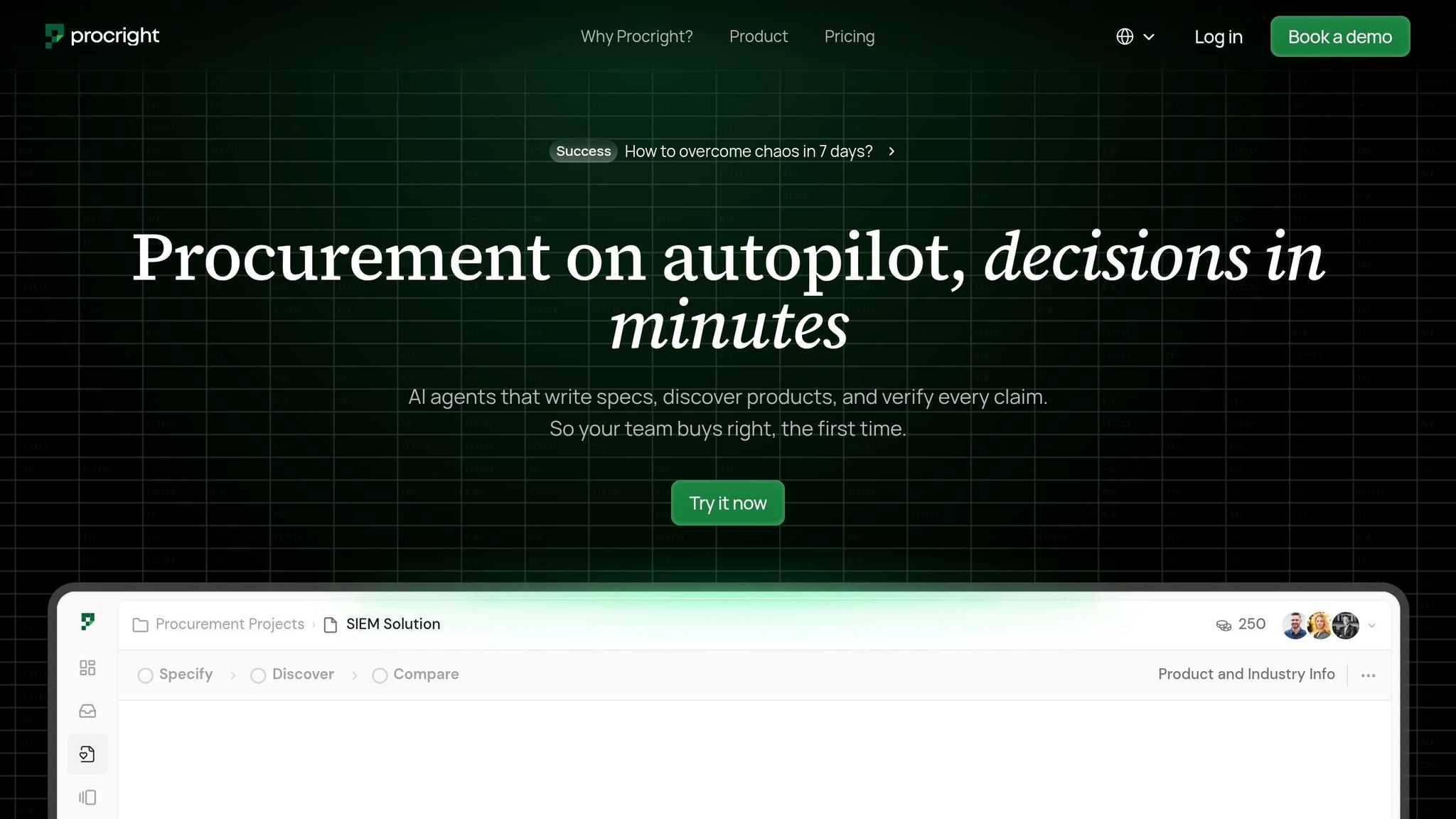
Procright is designed as a comprehensive solution that simplifies criteria setting, data cleaning, and scoring models. This streamlined approach helps centralize data, ensures compliance, and supports well-documented, defensible decision-making.
Centralizing Supplier Data and Specifications
Supplier data often arrives in various formats - PDFs, detailed Excel files, or even email chains. Procright's AI-powered Document Intelligence can transform this scattered data into a structured format in just 90 seconds, compared to the 6 hours it typically takes manually. This eliminates the inefficiencies caused by fragmented data.
A standout feature is Semantic Matching, which identifies and unifies similar items described differently - for example, recognizing that "500HP Electric Motor" and "Drive Unit, 500 Horsepower" refer to the same product. This capability ensures a clean, side-by-side comparison of line items, removing the need for manual reconciliation.
Once all supplier data is centralized, ensuring compliance becomes the next priority.
Automating Compliance Verification
Procright uses OCR-based document verification to extract and validate information from certifications, tax forms, and contracts. It then cross-references this data against compliance databases automatically. This approach addresses the inefficiencies of slow, manual compliance checks. It's worth noting that 80% of organizations experienced a supply chain–related security incident between 2023 and 2024.
Procright goes beyond one-time compliance checks by offering continuous, dynamic risk scoring. This feature updates in real time as new data becomes available, monitoring factors like delivery performance, quality standards, and regulatory compliance. Early warning signals are triggered when vendor behavior changes or financial risks emerge, giving teams the opportunity to act before issues escalate.
"An AI model that is compliant today may drift into non-compliance tomorrow after a retraining cycle." - TrustArc
Supporting Clear, Defensible Decisions
Procurement decisions often require detailed documentation and audit trails. Procright's visual heatmaps make it easy to spot performance gaps, using green and red gradients to highlight top and bottom performers as well as statistical outliers.
Each decision is backed by a confidence score, which evaluates the authority of the data source and its freshness. Additionally, a dual-validation algorithm ensures 99.9% accuracy for critical financial data. This level of precision means that when auditors or stakeholders question why a particular supplier was chosen - or rejected - the reasoning is already documented and traceable.
Conclusion
Examining the pitfalls of manual supplier comparison alongside the benefits of a data-driven approach makes one thing obvious: change is necessary. Manual processes not only waste time but also damage trust. As Supplier.io aptly states: "Bad data doesn't just cost money to maintain. It costs procurement its credibility with finance, with leadership, and with the business stakeholders it's supposed to serve."
A data-driven approach eliminates guesswork by relying on structured, verified information. This shift doesn’t just reduce selection errors - it ensures compliance, creates clean records, and supports decisions that can stand up to scrutiny. Procurement teams move from being reactive to becoming proactive contributors to business growth.
Procright equips procurement teams with the tools they need to centralize supplier data, automate compliance checks, and produce defensible decisions. By consolidating fragmented data, verifying compliance automatically, and offering confidence scores along with audit-ready documentation, Procright helps teams make faster, more reliable decisions - without the burden of manual work.
With increasing regulatory demands, the growing influence of AI, and heightened expectations from leadership, procurement teams must prioritize accurate, traceable, and up-to-date data. Those who embrace these tools and practices are better positioned to handle disruptions, meet compliance needs, and negotiate from a place of strength.
FAQs
What supplier data should we standardize first?
Start by standardizing supplier names, addresses, tax IDs, and classification attributes. Prioritize suppliers who are high-spend, strategic, or high-risk. This ensures your data is accurate and complete - critical for making informed decisions and minimizing procurement risks.
How do we set fair weights in a supplier scorecard?
To create fair weights for a supplier scorecard, start by pinpointing the key performance categories that matter most - such as quality, delivery, cost, compliance, and innovation. Once you've identified these, assign weights to each category based on how strategically important they are to your organization. Make sure the weights add up to 100%.
Stick to a consistent rating scale, like 1–5, to evaluate suppliers. And whatever you do, avoid adjusting the weights halfway through an evaluation period. This keeps the process clear, fair, and aligned with your company's goals, making it easier to base decisions on solid data.
How can we prove a supplier decision during an audit?
Maintaining accurate, current, and traceable supplier data is crucial for demonstrating supplier decisions during an audit. Key factors include verifying compliance, validating ownership, and conducting risk assessments. These efforts should be backed by documented, reliable records to ensure transparency and accountability in procurement processes.