How AI Enhances Data-Driven Team Decisions
AI speeds analysis, aligns teams, and preserves decision audits to improve procurement outcomes and reduce cycle time.
AI helps procurement teams make better data-driven decisions, align faster, and keep a clear record of why a choice was made.
If I had to sum up the research in one line, it’s this: AI is most useful when it helps teams sort messy data, compare options in one place, and track the reason behind each decision. The article points to results like 60%+ productivity gains, up to 5x ROI, 40% lower cycle times, and 3% to 5% savings in some cases.
Here’s the short version of what matters:
Decision quality: AI spots patterns across supplier data, contracts, market signals, and risk inputs.
Team alignment: AI gives people the same brief, the same inputs, and the same side-by-side view.
Audit trail: AI logs assumptions, trade-offs, compliance checks, and supplier choice reasons.
What to track: cycle time, savings, compliance rates, negotiation throughput, and documented decision records.
What must be in place: clean data, clear rules, and human review for high-impact choices.
A few numbers stand out:
90% cut in strategy development time in one case
23% lower software spend in another
29.5% of teams reported better compliance through predictive monitoring
49% of organizations regularly audit AI outputs
92% of CPOs are assessing GenAI, but only 37% have piloted or deployed it
Area | What AI changes |
|---|---|
Analysis | Reviews large, messy inputs and scores options |
Collaboration | Gives teams shared context from live data |
Governance | Stores the why behind a decision |
Risk | Flags gaps, mismatches, and compliance issues |
Limits | Still needs clean data and human judgment |
So if you want the plain answer: AI does not make the decision for the team. It helps the team make a better one with less delay and more proof.
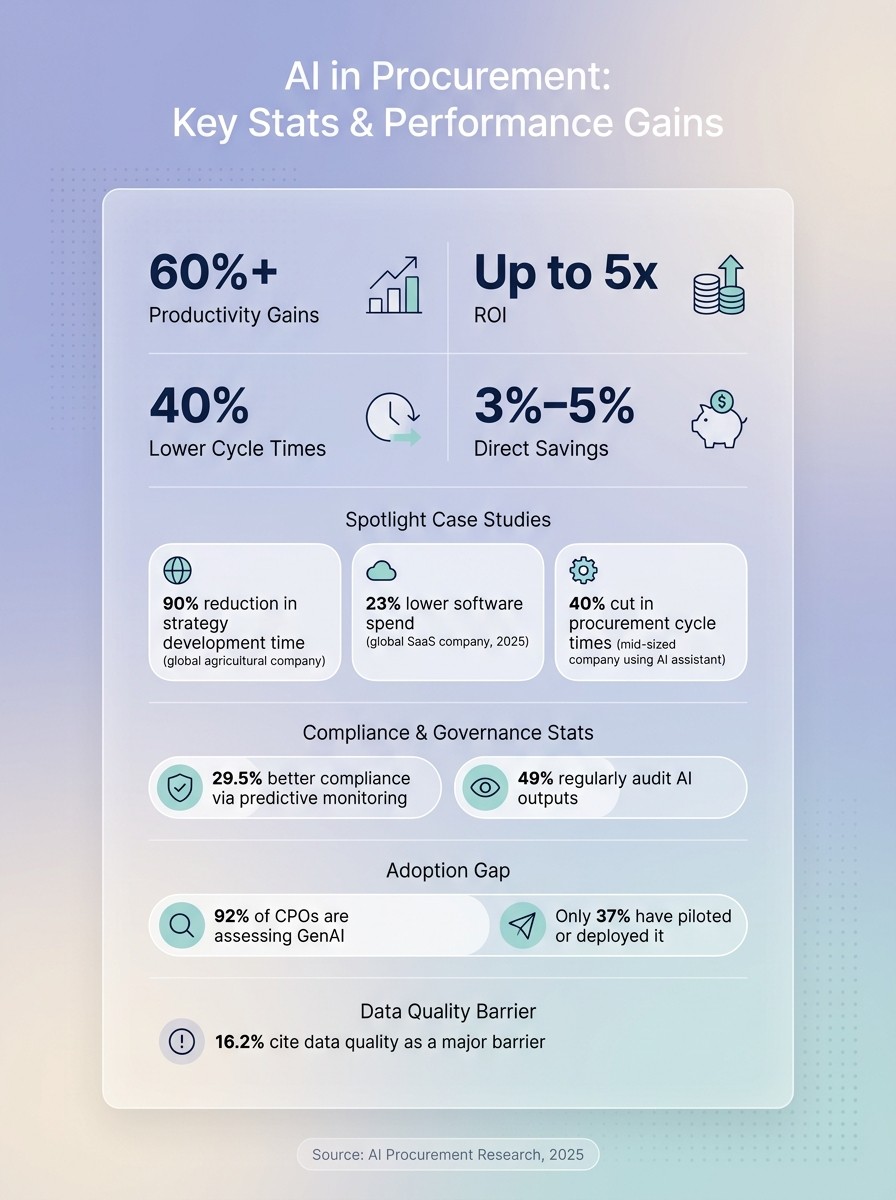
AI in Procurement: Key Stats & Performance Gains
How AI Makes Procurement Work Faster (and Smarter)
How AI Improves Data-Driven Team Decisions
Research shows AI helps procurement teams make better decisions in three main ways: sharper analysis, faster shared context, and stronger decision records. Studies report productivity gains of 60% or more and ROI increases of up to 5x. Those gains come from a few clear changes in how teams work day to day.
Better Decision Quality Through Pattern Detection and Prediction
AI helps teams make better calls in supplier selection, compliance review, and category strategy by scanning large, messy datasets and pulling out the signals that matter. It tracks demand forecasts, supplier performance, market shifts, and supply chain risks in real time, so teams can act early instead of scrambling after the fact.
One global agricultural company used AI to generate negotiation strategies and target pricing. The result: strategy development time dropped by 90%, and the company saw 3% to 5% direct savings.
AI decision frameworks can also use large language models to score options across cost, quality, and risk. They apply weighted AI supplier scoring, compliance, and trade-off review. In plain English, that means teams can run structured, explainable evaluations even when the right domain expert isn’t in the room.
Faster Collaboration With Shared, Real-Time Data
AI doesn’t just help with analysis. It also helps everyone work from the same live data. AI-native platforms surface insights directly inside the tools people already use, which cuts down on the confusion that comes from scattered information.
A mid-sized company used an AI assistant to triage routine purchase requests and answer internal questions. That cut cycle times by 40%. More importantly, it gave teams extra room to check insights, handle edge cases, and use human judgment where it counts.
More Repeatable and Auditable Team Decisions
Once the analysis is done and the team is aligned, AI helps preserve the full decision trail. In many procurement teams, key decisions end up buried in an inbox or stuck in someone’s memory. AI changes that by recording the why behind a decision, not just the what.
AI-supported workflows create decision traces - structured records of trade-offs, assumptions, supplier selection rationale, and compliance checks applied. That makes audits easier and gives teams a record they can reuse the next time a similar decision comes up.
What AI Communication Tools Change in Procurement Workflows
AI communication tools cut down procurement prep by pulling specifications, bids, emails, spreadsheets, and compliance documents into inputs a team can act on. The first step is simple: summarize the source material before anyone joins the meeting.
Summarizing Specifications, Bids, and Compliance Documents
NLP tools scan vendor proposals and compliance documents, pull out requirements, and flag missing details and mismatches before review. Instead of making each person dig through raw files and come to their own read, the team gets a summary up front.
These summaries are often called decision briefs. They bring the recommendation, evidence, assumptions, and risk guardrails into one place. That matters because the review starts from a shared document, not five different interpretations of the same stack of PDFs.
Once the documents are condensed, teams can compare options faster and with less rework.
Structuring Supplier and Product Comparisons for Team Review
AI tools standardize evaluation criteria across fragmented inputs and score options against cost, performance, and compliance requirements in a single review view. Put plainly, they turn scattered vendor data into one side-by-side comparison the team can actually use.
That shift changes the meeting itself. Instead of arguing over whose spreadsheet is right, people can focus on trade-offs: lower cost versus better performance, or faster delivery versus tighter compliance fit.
The payoff can be large. In 2025, a global SaaS company used AI-based supplier analysis to consolidate vendors, which led to a 23% drop in software expenses and cut sourcing cycle times in half.
That workflow is what procurement platforms like Procright operationalize.
How Platforms Like Procright Put Research Into Practice
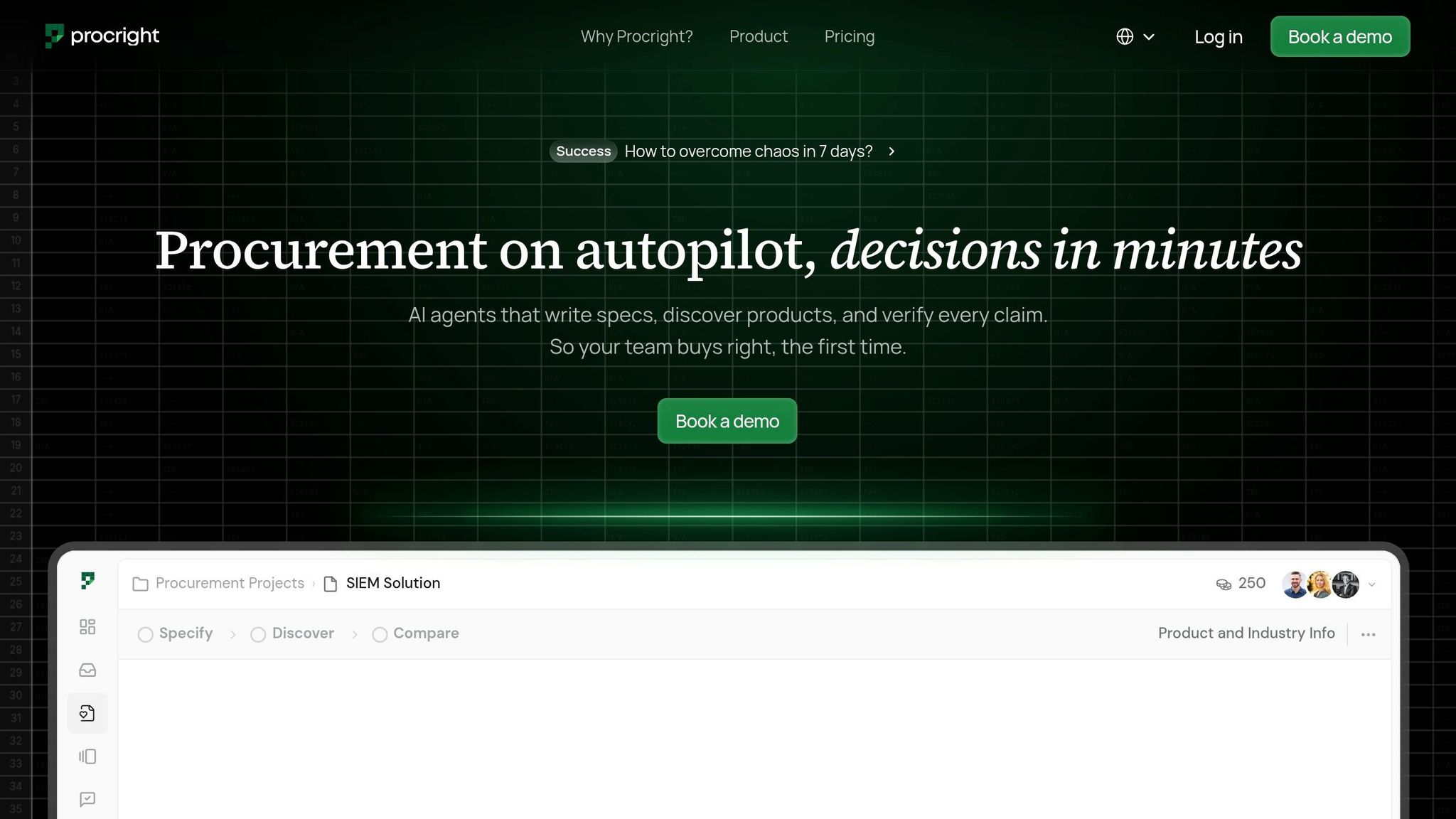
Teams tend to make better decisions when AI handles document processing and comparison structuring, while people make the final call. Procright is built around that model. It automates specification creation, standardizes product comparisons, and generates clear compliance scores so teams can assess options on equal footing.
It also shows the source data behind each score. That gives everyone the same starting point for discussion and review.
How to Measure AI's Impact on Team Decision-Making
Metrics That Show Whether AI Is Improving Decisions
Measure AI with a before-and-after baseline, not gut feel.
Once AI is part of the workflow, teams need proof that it helps people make better calls. The easiest way to do that is to compare performance before and after rollout. At the team level, track metrics like decision cycle time, savings, compliance monitoring, and negotiation throughput in sourcing.
One metric teams often miss is the documented decision trail. If your team can't explain why a supplier was chosen, that's a governance gap, not just a paperwork issue. And even if the numbers look good, those gains don't mean much if the data is messy or the review path is vague.
Data Quality, Governance, and Human Oversight Requirements
Research points to the same pattern: AI tends to magnify weak processes. So before teams try to measure impact, they need clean inputs and clear ownership.
That means:
standardized supplier naming
consistent category structures
centralized spend documentation
Without that groundwork, people stop trusting the same decision brief.
Data quality is only part of it. Explainability also matters. Teams are more likely to use AI-generated scores when they can see the logic behind them. Research also shows that 49% of organizations regularly audit AI outputs and decisions to maintain reliability. Governance should spell out which tasks AI can draft or score, and which still need human review, such as strategic trade-offs, complex negotiations, or ethical judgments.
Research-Backed Benefits, Challenges, and Preconditions: A Comparison Table
Use these measures to separate actual performance gains from rollout noise.
Factor | What research shows | Implications for procurement teams | Data or governance preconditions |
|---|---|---|---|
Faster decisions | 90% reduction in strategy cycle time | Teams handle higher volumes and respond faster to market shifts | Standardized workflows and clear decision criteria |
Broader analysis | AI scans thousands of global risk signals in real time | Better supply resilience and more competitive sourcing options | Centralized spend documentation and API integrations |
Improved compliance | 29.5% of teams report better compliance through predictive monitoring | Reduced value leakage and lower regulatory risk | Defined rules for human-in-the-loop validation |
Data quality gaps | 16.2% of executives cite data quality as a major barrier | Poor data leads to unreliable outputs or errors | Clean, normalized supplier and item master data |
Explainability gaps | Trust depends on transparent scoring logic and rationale | Teams may reject AI recommendations they can't interpret | Structured frameworks with auditable output logs |
Conclusion: What Teams Should Take From the Research
Key Takeaways
Across the research, three outcomes stand out: better decisions, faster alignment, and stronger auditability. AI does its best work when it supports human judgment with more context, faster review, and repeatable decisions.
That shift matters. Procurement teams should spend less time on manual execution and more time validating insights, handling exceptions, and using judgment where it counts.
Three things shape whether AI improves procurement decisions:
Clean data
Audit trails
With those guardrails in place, teams can turn procurement data into shared action. Procurement is a strong fit because AI can turn spend, pricing, and risk data into decision-ready context. Procright puts this into practice by automating specification creation, product comparison, and compliance scoring.
The adoption gap is still wide: 92% of CPOs are assessing GenAI, but only 37% have piloted or deployed it. A smart place to start is one recurring decision. Set the evidence and approval rules up front, then scale from there.
FAQs
How does AI improve team decisions?
AI helps teams make better decisions by turning data, context, and human judgment into a process they can track and measure over time. Instead of relying on gut feel or scattered notes, teams can work from a clearer system that keeps improving with use.
It also takes repetitive work off people’s plates. That includes tasks like specification creation, product discovery, and compliance verification. In plain terms, AI handles a lot of the heavy lifting so teams can spend more time judging trade-offs and making the final call.
Platforms like Procright do this by checking specifications against transparent data and then showing compliance scores and rankings. The result is less guesswork and more consistency. Teams can move faster on procurement decisions while still backing those choices with verifiable evidence.
What data is needed before using AI?
Before using AI for procurement team decisions, make sure your data is clean, aligned, connected, and governed.
That means pulling together complete structured fields, current spend and transaction data across business units and systems, and the context behind each decision. This includes budgets, invoices, purchase orders, approvals, and goods-received details.
You’ll also want historical data and the right internal standards or specs in the mix. If those pieces live in different places or don’t match up, AI can miss the bigger picture and point your team in the wrong direction.
When should humans override AI recommendations?
Humans should step in when AI recommendations touch strategy, ethics, or gray areas that a system can’t sort out on its own.
Manual review also makes sense when the AI’s reasoning isn’t clear, when a recommendation clashes with budget limits that weren’t part of the workflow, or when the data is missing, stale, or incomplete. Human judgment matters when something simply doesn’t pass the smell test or when a decision carries long-term risks that sit outside the AI’s field of view.