AI in Procurement: Risk Assessment Use Cases
AI spots supplier, contract, and compliance risks early, cuts review time, avoids disruption costs, and enforces clear data and governance.
AI helps procurement teams spot supplier, contract, and compliance risk before it turns into delays, bad awards, or audit trouble. In the cases covered here, teams cut supplier review time from 4.2 hours to 1.1 hours per supplier, avoided $5.5 million in disruption exposure, reduced expired compliance documents by 70%, and moved some contract reviews from five days to same day.
If I boil the article down, the message is simple:
Supplier scoring works best when data is clean and feeds update often.
Live monitoring helps teams act on delivery, credit, cyber, and news signals sooner.
Contract review helps flag risky clauses and route only the hard cases to legal.
Compliance scoring gives buyers a source-linked pass/fail view before award or onboarding.
Governance matters more than the model once teams roll this out across the business.
What I’d want to know right away is this: AI is most useful where volume is high, manual review takes too long, and mistakes cost money. But it only holds up when each alert has an owner, each score links back to the source file, and people still review high-impact decisions.
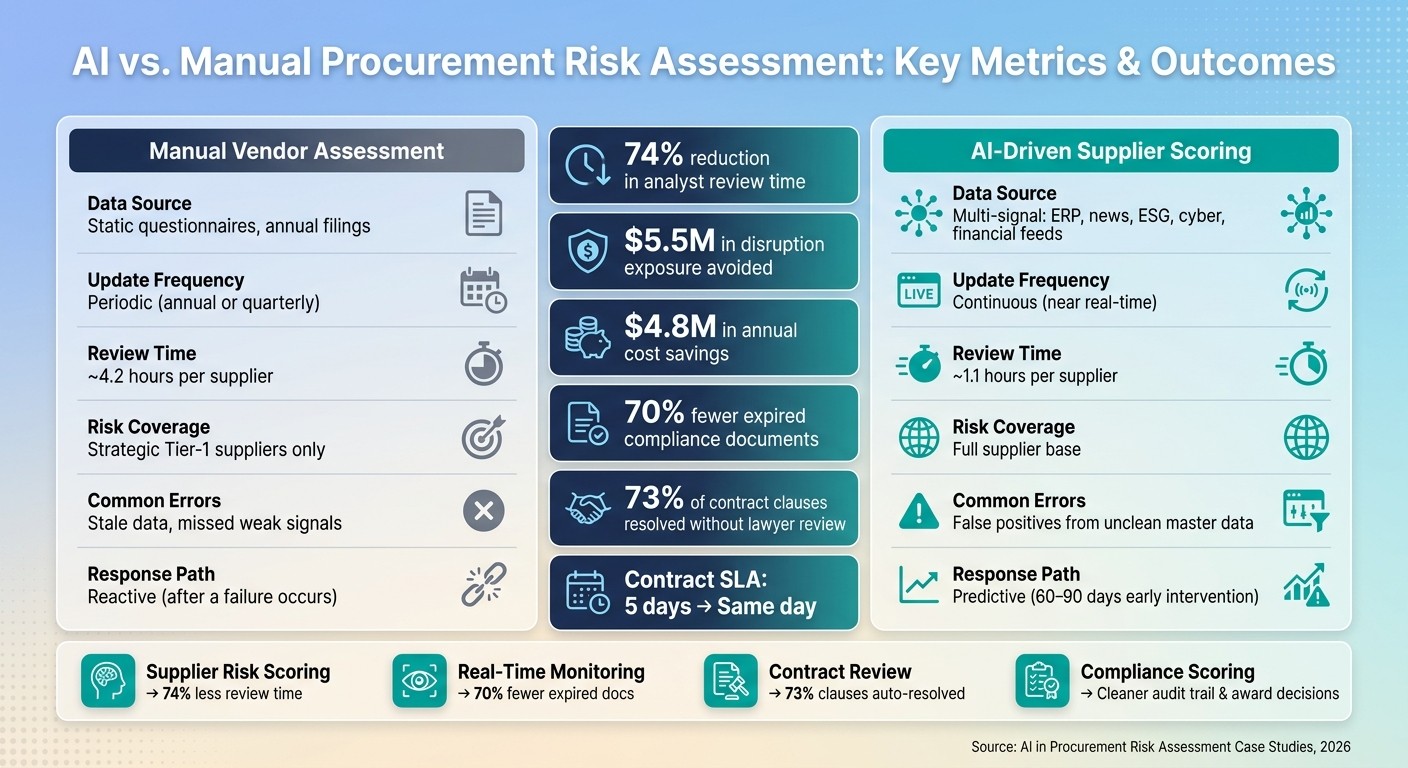
AI vs. Manual Procurement Risk Assessment: Key Metrics & Outcomes
AI in Procurement & Supply Chain Risk Management | Analytics and Supplier Intelligence | Uplatz
Quick Comparison
Use case | What AI checks | Main output | Example result |
|---|---|---|---|
PO history, delivery data, filings, sanctions, cyber, credit | Risk score and early-warning flags | 74% less review time; $5.5 million exposure avoided | |
Delivery misses, media, rating changes, document status, recalls | Alerts based on set thresholds | 70% fewer expired documents | |
Contract review | Clauses on indemnity, liability, breach notice, privacy | Clause flags and fallback language | 73% of clauses handled without lawyer review |
Compliance scoring | Certificates, policy docs, terms, requirement matrices | Pass/fail checks and 0–100 score | Better audit trail and cleaner award decisions |
In short: this is not about replacing buyers, risk teams, or legal. It is about giving them earlier signals, less manual sorting, and a cleaner record of why a supplier passed, failed, or needed follow-up.
Case Studies: Supplier Risk Scoring and Vendor Due Diligence
Case Study: Spotting Supplier Instability Before Contract Award
In early 2026, a Tier-1 electronics manufacturer expanded risk monitoring from 600 suppliers to 2,400 after cleaning up master data and adding an AI copilot. The team pulled together internal signals like purchase order history and delivery performance with external inputs such as financial filings, sanctions, and cyber ratings. That gave them continuously updated risk profiles for each vendor.
In the first quarter alone, the AI flagged 41 suppliers as rising-risk cases. After review, 28 of those were confirmed as real concerns. The company avoided two major disruption events tied to an estimated $5.5 million in combined risk exposure. It also negotiated $4.8 million in annual cost savings by reopening contracts early. On top of that, analyst review time fell from 4.2 hours per supplier to 1.1 hours per supplier, a 74% drop.
That matters because supplier instability is only one part of the picture. The next pressure point often shows up earlier, during bid-stage compliance, where predictive analytics for supplier risk can flag issues before they escalate.
Case Study: Comparing Vendors Against Specification and Compliance Requirements with AI
AI can take in vendor submissions and the original specification, line up claims against stated requirements, flag gaps, and produce transparent compliance scores for each vendor.
This is where manual shortlisting starts to crack. Vendors submit files in different formats, use different wording, and often describe the same thing in completely different ways. Procright can ingest vendor submissions and the original specification, map claims to requirements, flag gaps, and generate transparent compliance scores. The result is an auditable shortlist built on evidence instead of judgment.
Manual Review vs. AI-Driven Supplier Scoring
The table below shows the shift in review effort, coverage, and response speed.
Feature | Manual Vendor Assessment | AI-Driven Supplier Scoring |
|---|---|---|
Data Sources | Static questionnaires, annual filings | Multi-signal: ERP, news, ESG, cyber, financial feeds |
Update Frequency | Periodic (annual or quarterly) | Continuous (near real-time) |
Review Time | ~4.2 hours per supplier | ~1.1 hours per supplier |
Risk Coverage | Strategic Tier-1 suppliers only | Full supplier base |
Common Errors | Stale data, missed weak signals | False positives from unclean master data |
Response Path | Reactive (after a failure occurs) | Predictive (early intervention, 60–90 days ahead) |
There’s a catch here: AI scoring only works well after master data cleanup. If supplier records are duplicated or entity names don’t match, false positives pile up fast. Teams that deduplicate records and reconcile entity names first tend to get better results and more analyst trust. One manufacturer cut supplier master data staleness from 14% to 1.8% before scaling its model.
Case Studies: Real-Time Third-Party and Compliance Monitoring
Case Study: Monitoring Supplier Risk Signals in Near Real Time
One-time vendor checks only give you a snapshot. AI-enabled continuous monitoring follows missed deliveries, adverse media, credit downgrades, and other risk signals in near real time.
That matters for a simple reason: when risk starts to climb, alerts can send those suppliers to analysts before disruptions spill into day-to-day operations.
In many cases, delivery performance shifts before credit risk shows up on paper. So teams now treat on-time delivery as a leading indicator, not just a logistics KPI.
The same alert setup works in regulated procurement too. In that setting, the problem may not be late shipments. It may be missing paperwork.
Case Study: Compliance Oversight in Public-Sector or Regulated Procurement
A U.S. food manufacturer used AI agents to manage FSMA compliance. The agents automatically tracked vendor submissions and followed up on missing HACCP plans and Certificates of Analysis (COAs). The result was a 70% reduction in expired documents and a 35% reduction in supplier onboarding cycle time.
In federal procurement, AI also tracks milestone delivery and documentation completeness to meet FAR/DFARS audit requirements.
Risk Signals, Alerts, and Procurement Response Paths
Signals by themselves don't do much. Each one needs a clear next step, or the alert just sits there.
AI-Detected Signal | Risk Category | Automated Alert / Threshold | Procurement Response |
|---|---|---|---|
Negative media spike (e.g., labor or environmental issues) | ESG / Reputational | 3+ mentions of labor or environmental issues in 30 days | Trigger ESG audit; request corrective action plan |
Missed delivery milestones / quality failures | Operational | >10% variance from SLA over 2 weeks | Pause new POs; activate contingency sourcing |
Credit rating drop / new UCC filings | Financial | 2-notch downgrade by major bureau | Financial health deep-dive; adjust payment terms |
Expired SOC 2 or ISO certificate | Compliance | Auto-notify vendor 30 days before expiration; escalate at 5 days before expiration | Pause new POs until the document is uploaded |
FDA warning letter or product recall | Compliance / Quality | Immediate alert on public filing | Deactivate vendor for new orders; initiate containment |
Cybersecurity breach or incident alert | Cybersecurity | Trigger immediate reassessment | Security review; possible service restriction |
Set alert thresholds with risk owners before go-live. That helps cut low-value alerts and makes adoption smoother.
Case Studies: Contract Review and Compliance Scoring with AI
Once a risk shows up, the next step is simple: does the contract pass review or not?
Case Study: Using NLP to Flag Risky Clauses in Supplier Contracts
Contract review takes time. And when teams are under pressure, they skim. That’s when risk slips through.
Legal and procurement teams often have to move through stacks of supplier agreements fast. In that kind of setup, it’s easy to miss a risky indemnity term, a weak liability cap, or a missing data protection clause.
In May 2026, a $4 billion specialty chemicals manufacturer put a Claude Opus 4.7-based AI system in place to handle the first review of lower-value supplier contracts, meaning agreements under $500,000. The team built a 19-clause taxonomy covering indemnity, liability, breach notice, and data protection. As a result, 73% of clauses were resolved without lawyer review, and SLA went from five days to same-day review. After four weeks of prompt tuning, the false-positive rate dropped from 34% to 8%.
The system flagged playbook deviations, including breach notice windows longer than 72 hours or missing DPAs, and then suggested approved fallback language. That helped the team keep negotiations moving without pulling legal into every small change.
AI handles the first-pass volume. Legal handles the exceptions.
That same review logic can also support supplier compliance scoring before award.
Case Study: Supplier Compliance Scoring for Defensible Decisions
Scoring supplier compliance usually means pulling certificates, contract terms, and policy documents into one auditable view. AI can then validate procurement documents against a requirements matrix and return pass/fail results with source-linked evidence for each requirement.
A compliance score should reflect a few core checks:
document completeness
valid certifications
policy alignment
In practice, teams often use a 0–100 scale to show whether a supplier is ready to onboard or still needs follow-up.
Risk Dimensions and AI Outputs in Contract and Compliance Review
The table below shows how AI turns contract and compliance inputs into procurement decisions.
Risk Dimension | Input Data for AI | AI Output / Signal | Likely Procurement Decision |
|---|---|---|---|
Legal & Financial | MSAs, SOWs, liability clauses | Flagged non-standard indemnity or low liability caps | Renegotiate or require insurance uplift |
Compliance | Pass/fail status; documentation completeness score | Approve or block onboarding | |
Operational | SLA matrices, uptime commitments | Normalized performance benchmarks vs. requirements | Approve or adjust service credits |
Financial Health | Credit ratings, debt loads, D&B feeds | Liquidity / bankruptcy probability score | Reject or seek secondary source |
Reputational | News sentiment, sanctions lists, incident logs | Sanctions exposure or ESG event alerts | Reject or trigger deep-dive audit |
Security / Privacy | Breach notice windows, encryption standards, sub-processor lists | Control adequacy score; policy alignment flag | Approve (≤72h notice) or reject (missing DPA) |
To keep the audit trail intact, link each score back to the exact clause, page, and file version.
Implementation Lessons and Conclusion
Across the supplier, monitoring, and contract-review cases, the same pattern showed up again and again: clean data, clear thresholds, and human oversight made AI usable at scale.
What Successful Teams Had in Place Before Scaling AI
The teams that made this work didn’t start with the model. They started with the basics: clean supplier data, steady naming rules, and connected ERP, CLM, and SRM feeds.
They also defined risk in plain terms and gave each team a clear job. Procurement owned sourcing workflows. Compliance and risk teams owned thresholds and escalations.
Just as important, AI stayed in an advisory role. People still reviewed high-impact actions like supplier disqualification or re-classification, which kept the process audit-ready.
AI Implementation Stages: From Pilot to Enterprise Rollout
That base usually grows in three stages.
Stage | Data Readiness | Governance | Model Use | Expected Business Impact |
|---|---|---|---|---|
Pilot | Clean data for 50–100 top vendors | Procurement-led; manual review of AI outputs | Intake triage and questionnaire automation | Faster RFP/DDQ response times |
Category Rollout | Category ERP and quality data integrated | Shared ownership: procurement and risk teams | Automated scoring for high-risk categories | Reduced onboarding time per category |
Enterprise Adoption | Full ERP, CLM, SRM, and external signal integration | Model retraining schedules and board reporting | Dynamic routing and payment holds for high-risk cases | Efficiency gains and disruption cost reduction |
Enterprise rollout is where many teams run into friction. In most cases, the problem isn’t the tech. It’s governance. Refresh cycles for critical suppliers should shift from annual reviews to every 30–90 days, and escalation rules need to be written down before the model goes live.
Conclusion: The Most Useful AI Risk Assessment Use Cases in Procurement
Supplier scoring, real-time monitoring, contract review, and comparing products for compliance works best as one operating model, not four separate tools.
AI does its best work where volume is high, manual effort eats up time, and mistakes cost real money. One Tier-1 electronics manufacturer expanded risk coverage from 600 to 2,400 suppliers while cutting analyst review time from 4.2 hours to 1.1 hours per supplier. That’s a 74% drop, along with $5.5 million in avoided disruption costs within six months.
The results are there, but they rest on the groundwork. As Dr. Marcell Vollmer, Supply Chain Executive & Former CPO, put it:
"Risk management must be embedded into the very fabric of category strategy. If your risk assessment occurs only after the supplier is chosen, you are managing the crisis, not the risk."
At enterprise scale, governance - not the model - turns into the main bottleneck. Procright brings AI-driven specification creation, product discovery, and compliance verification into a single workflow, helping teams make data-driven, reliable procurement decisions by analyzing specifications, comparing products, and providing transparent compliance scores. The teams that get the most from these systems aren’t the ones with the fanciest models. They’re the ones where every score links back to evidence, every decision has an owner, and every risk signal feeds the next review cycle.
FAQs
How clean does supplier data need to be?
Supplier data doesn't need to be perfectly clean before you can use it. Modern AI platforms, including Procright, can take messy, scattered inputs and turn them into structured, reliable insights.
They do this by analyzing specifications, comparing products, and generating transparent compliance scores. That gives procurement teams a way to make data-driven decisions based on traceable, documented evidence.
Which procurement risks should AI monitor first?
AI should first monitor risks by combining day-to-day operating data with real-time signals. That gives teams continuous oversight instead of relying on a once-a-year review that can miss what changed in the meantime.
Start with a few core areas:
Financial and operational stability: delivery shortfalls, invoice payment exceptions, and signs of financial distress
Compliance and regulatory status: expiring certifications, insurance, and tax documents
Contractual variance: deviations from standard terms or agreed service levels
How much human review should stay in the process?
Human review should remain a key part of procurement as the final layer of oversight for governance and compliance.
AI can take care of repetitive work like document extraction, questionnaire scoring, and compliance checks. But people should still define risk objectives, set risk appetite, and make final approvals. That keeps human input focused where it matters most.