AI Tools for Smarter Procurement Decisions
Compare six AI procurement platforms across decision support, data visibility, compliance, and workflow to fix your biggest process bottleneck.

If your procurement process is slowing down, the fix depends on where it breaks. This comparison shows six tools side by side: Procright, Sievo, Scoutbee, Icertis, Zip, and Coupa.
Here’s the short version:
Procright fits teams that need automated product specifications before buying
Sievo fits teams that need cleaner spend data and budget tracking
Scoutbee fits teams that need to find and screen suppliers
Icertis fits teams that need tighter contract review and clause tracking
Zip fits teams that need intake and approval control at the start
Coupa fits large teams that want one system across source-to-pay
The article compares each tool on four points:
Decision support - helps you choose the right item or supplier
Data visibility - shows spend, supplier, or contract data in a usable way
Compliance insight - flags policy, contract, or risk issues
Workflow fit - supports approvals across teams like Legal, IT, and Finance
A few numbers stand out right away:
Procurement teams now manage 50% more spend per employee
Sievo reports $20 million in added savings per $1 billion analyzed
Zip has processed more than $500 billion in spend
Coupa says customers average 8.1% savings on total spend
Procright says it can cut a 16-week spec process to under 7 days
If I boil the whole piece down to one point, it’s this: don’t pick the tool with the most features; pick the one that solves your biggest delay first.
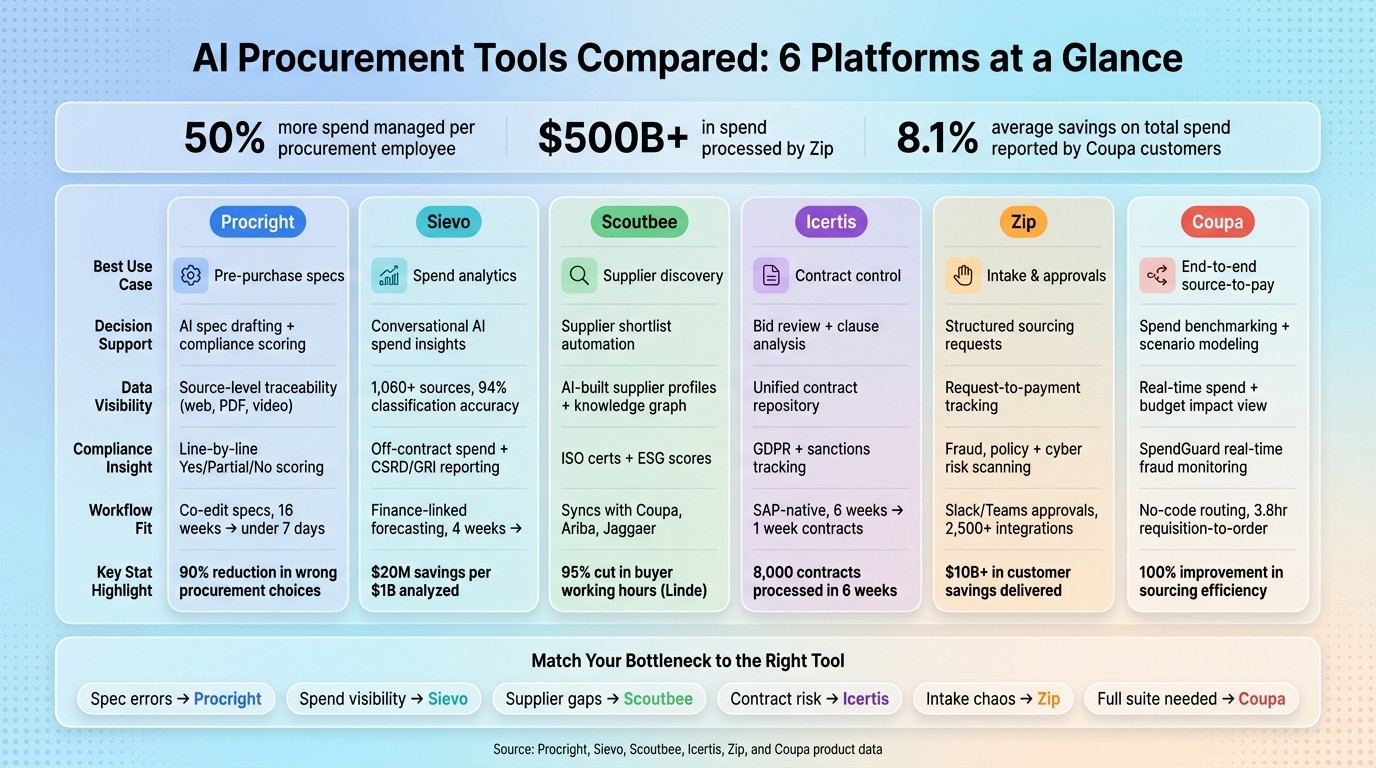
AI Procurement Tools Compared: 6 Platforms at a Glance
The Most Useful AI Tools for Procurement Professionals
Quick Comparison
Tool | Best use case | Decision support | Data visibility | Compliance insight | Workflow fit |
|---|---|---|---|---|---|
Procright | Pre-purchase specs | Builds and checks requirements | Links claims to source files | Compare products for compliance efficiently by scoring each requirement line by line | Supports shared spec review |
Sievo | Spend analysis | Turns spend data into actions | Cleans and classifies ERP data | Tracks off-contract spend and reporting needs | Links procurement work to finance planning |
Scoutbee | Supplier discovery | Builds supplier shortlists | Maps supplier data from many sources | Checks certifications and ESG data | Syncs with Coupa, Ariba, and Jaggaer |
Icertis | Contract control | Reviews bids and contract terms | Pulls contract data into one place | Flags clause and performance gaps | Works well with SAP-heavy teams |
Zip | Intake and approvals | Turns requests into structured workflows | Tracks requests from intake to payment | Flags fraud, policy, and cyber issues | Routes approvals in Slack and Teams |
Coupa | End-to-end source-to-pay | Benchmarks spend and models sourcing choices | Shows spend and budget impact in one system | Covers sourcing, buying, invoicing, and risk |
Use this as a fast filter: spec problem, spend problem, supplier problem, contract problem, intake problem, or full-suite problem. That’s the easiest way to read the rest of the article.
1. Procright
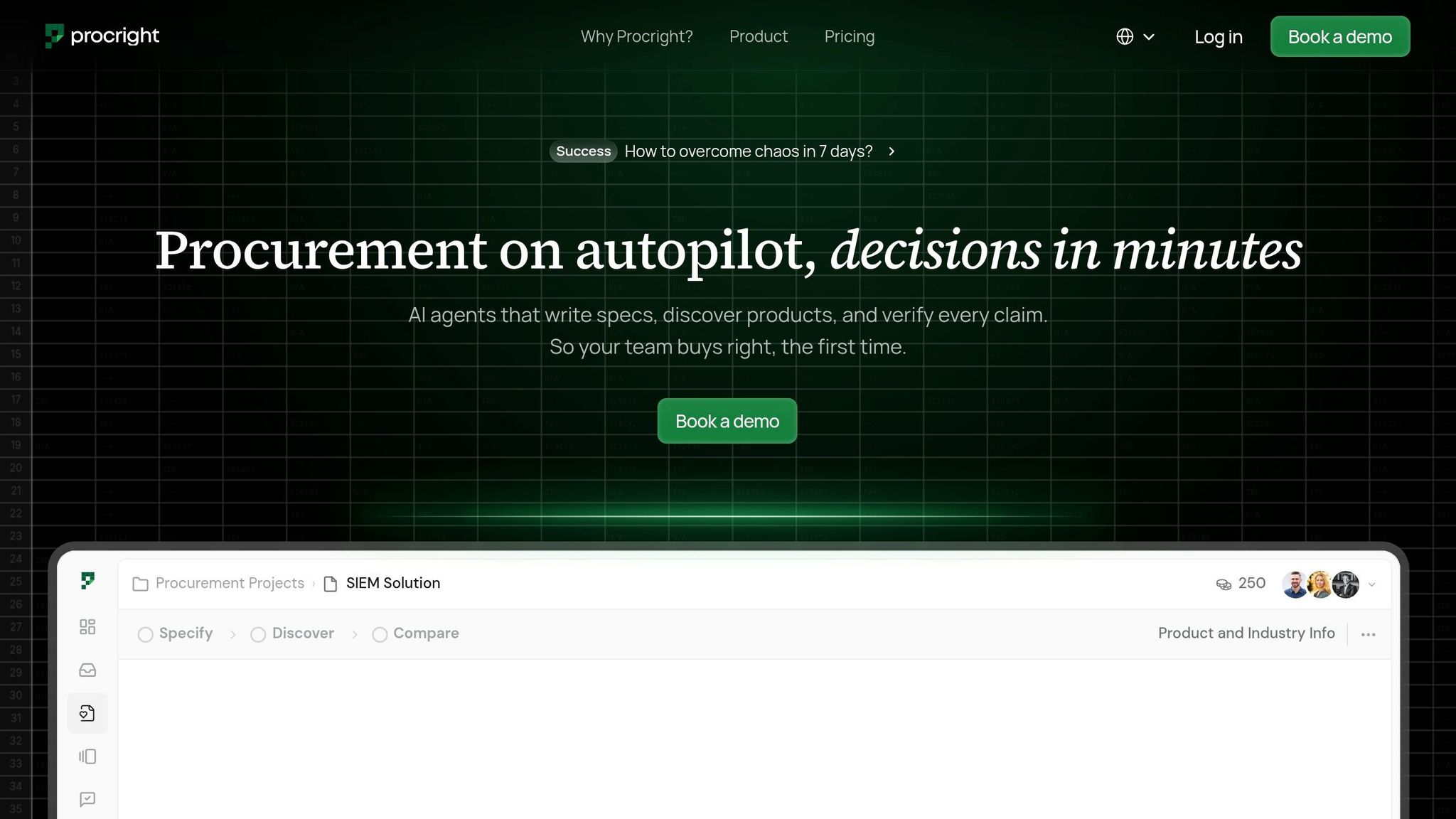
Procright is an AI-powered procurement platform built for the pre-purchase stage. It helps teams make better calls before a purchase order is raised. At its core, Procright turns early-stage requirements into purchase criteria that teams can check and verify.
Decision Support
Procright uses AI agents to draft technical procurement specifications from scratch or improve ones your team already has. It does this by spotting missing technical requirements and filling in gaps that could lead to a bad buying decision later.
It also adds product maturity scores and supplier reliability data. According to Procright, this cuts the risk of making the wrong procurement choice by 90%. That same base also helps with cleaner data checks in the next stage.
Data Visibility
The platform scans web pages, PDFs, and videos, then maps that information back to your requirements with source-level traceability. In plain English, every compliance score points to a specific source, such as a manual, a web page, or even a video timestamp.
That matters because teams can compare options based on proof, not hunches. Procright also shows market acceptance rate and local support coverage, which helps teams judge market fit and regional support. When every claim links back to a source, compliance review gets a lot easier.
Compliance Insight
Procright scores each line item in a specification as Yes, Partial, No, or Not Found. That gives teams a much clearer view than a basic pass/fail check.
Each match links back to a cited source document, which creates an audit trail. Teams can also assign importance levels to specific requirements, so the AI puts more weight on what matters most. The result: teams can approve, reject, or revise requirements faster, with less decision risk.
Workflow Fit
Teams can co-edit specs, merge split PDF or DOCX files, and use industry templates to cut specification errors and cycle time.
Procright says it can shrink a 16-week process to under 7 days. That can make a big difference when teams need fast, auditable decisions before spend moves forward.
2. Sievo
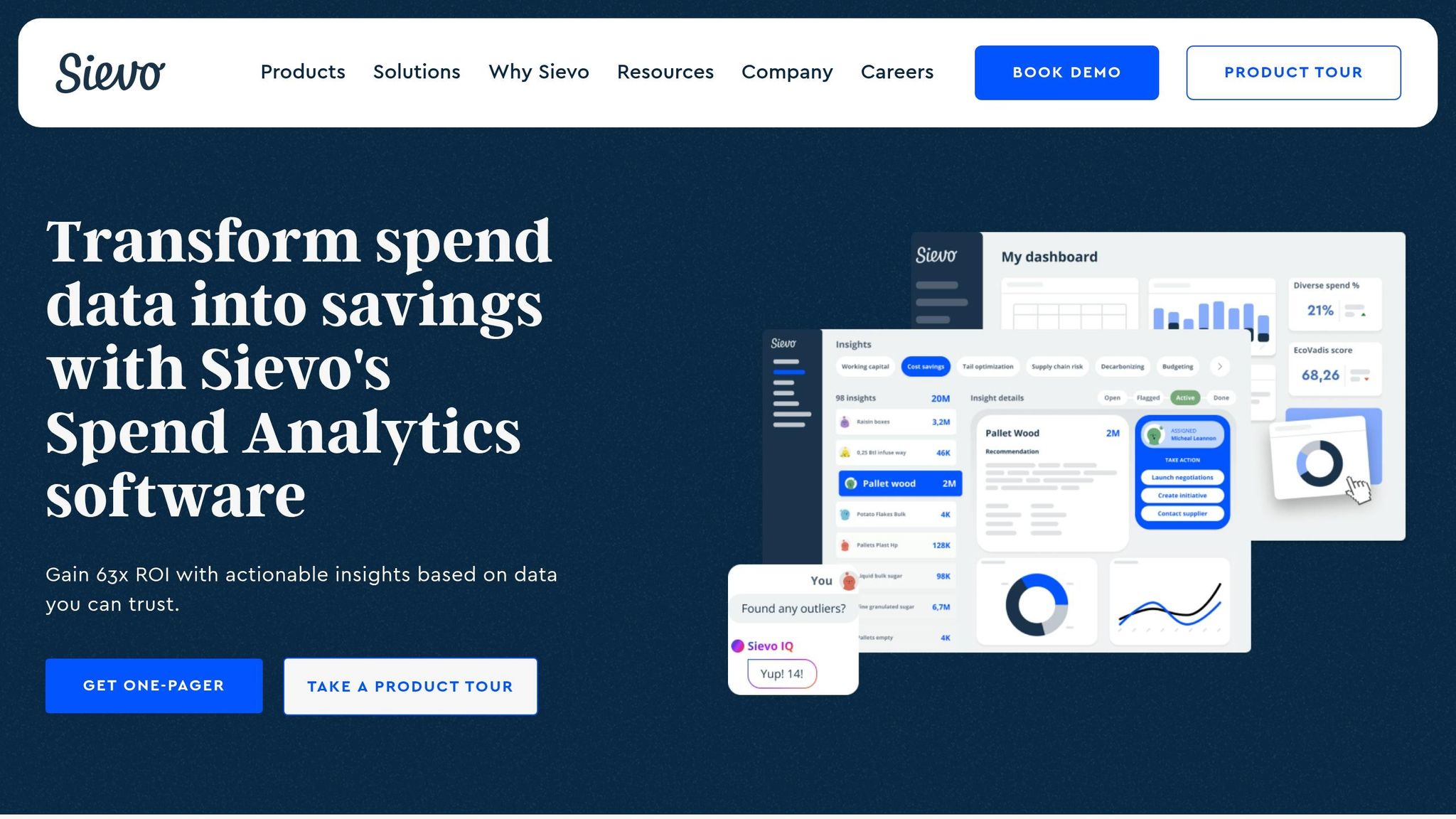
Sievo is a spend analytics and forecasting platform built for procurement and finance teams. It stands out when a team needs to turn spend data into action, not just pile up reports. Across the four criteria, Sievo leans hard into analysis, forecasting, and follow-through.
Decision Support
Sievo’s conversational AI assistant, Sievo IQ, answers plain-language spend questions and can turn insights into supplier emails, tasks, or negotiations.
The business impact numbers are hard to ignore. Sievo reports an average of $20 million in incremental savings for every $1 billion of spend analyzed, and users see an average 63x return on investment.
Data Visibility
Sievo pulls data together from more than 1,060 sources and 2,700 active integrations across ERPs, P2P systems, and finance systems. Its AI classification engine reports 94% accuracy with 98% coverage at the most detailed category level.
Its AI harmonization layer also helps clean up messy ERP data. In practice, it typically removes 6% to 23% of duplicate material codes across ERP systems, which helps teams spot volume-bundling opportunities that might otherwise stay buried.
Compliance Insight
Sievo tracks contract coverage to flag off-contract spending and uses real-time collaboration for compliance and automates reporting for frameworks like CSRD, CBAM, and GRI. It also enriches supplier data with financial, geopolitical, and legal risk scores, plus sustainability metrics such as Scope 3 emissions and SBTi targets.
Deutsche Telekom reported that sustainability tracking became 50x faster after adopting Sievo's ESG tools.
Workflow Fit
Sievo connects savings initiatives with financial projections. That link matters because procurement gains don’t mean much if finance can’t model them clearly.
The time savings here are pretty striking. Becton Dickinson cut its forecasting cycle from 4 weeks to 1 week after implementation. MediaMarktSaturn reduced data analysis time by 90% - what used to take an hour now takes five minutes.
The platform also includes scenario modeling to stress-test budgets against market volatility and currency fluctuations.
3. Scoutbee
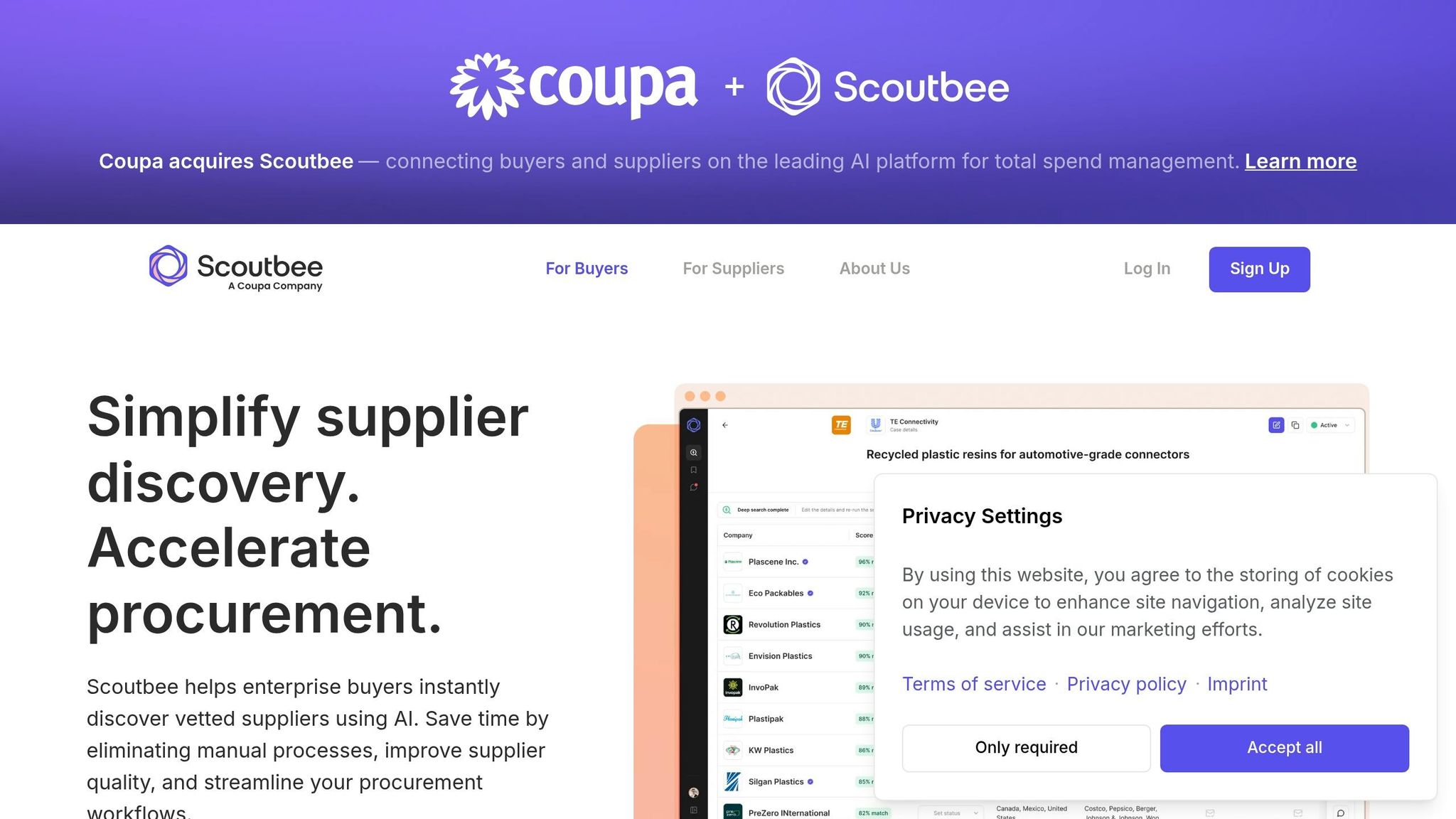
Scoutbee helps procurement teams compare suppliers and products by automating discovery, outreach, and data collection. In plain English, it helps teams build qualified supplier shortlists in days instead of months. That makes it most useful at the very start of sourcing, when speed matters and the team needs a solid shortlist before the process moves forward.
Siemens AG is a good example. In April 2025, Siemens used Scoutbee across 18 business units to complete 94 sourcing projects, identify 6,893 suppliers, and evaluate 283 quotations, while cutting procurement workload by up to 90%.
Scoutbee can also support innovation scouting. On top of that, it helps teams flag supplier risks and bottlenecks before they turn into disruptions.
Data Visibility
Scoutbee uses AI to scan public and third-party sources and pull data from company websites, trade publications, regulatory filings, and certification databases. It then turns that information into structured supplier profiles. Those profiles can include revenue, employee count, location data, and technical capabilities.
A knowledge graph layer links those data points so teams can see how entities connect. That makes it easier to spot single-source dependencies, which can become a problem fast if one supplier goes down.
The platform also supports natural language queries. So a category manager can ask where the business has single-source suppliers for a given component and get a direct answer.
Compliance Insight
Scoutbee tracks major certifications, including ISO 9001, ISO 14001, and IATF 16949. It can also identify certified diverse suppliers during discovery. ESG data and sustainability scores are built into supplier profiles, which helps teams factor compliance into sourcing decisions from day one.
There is one catch: data completeness is weaker for suppliers in Southeast Asia and South America than for suppliers in North American and European markets.
Workflow Fit
Scoutbee is now built directly into the Coupa platform, including the Coupa Supplier Portal and Coupa Navi AI agents. Discovered profiles sync automatically and can pre-fill up to 80% of required onboarding data. It also connects with SAP Ariba and Jaggaer.
Linde Engineering used Scoutbee to identify 567 suppliers and build an 8-supplier shortlist in minutes, cutting buyer working hours by 95%.
Once the shortlist is ready, the next step is deciding how contracts lock in the agreed terms.
4. Icertis
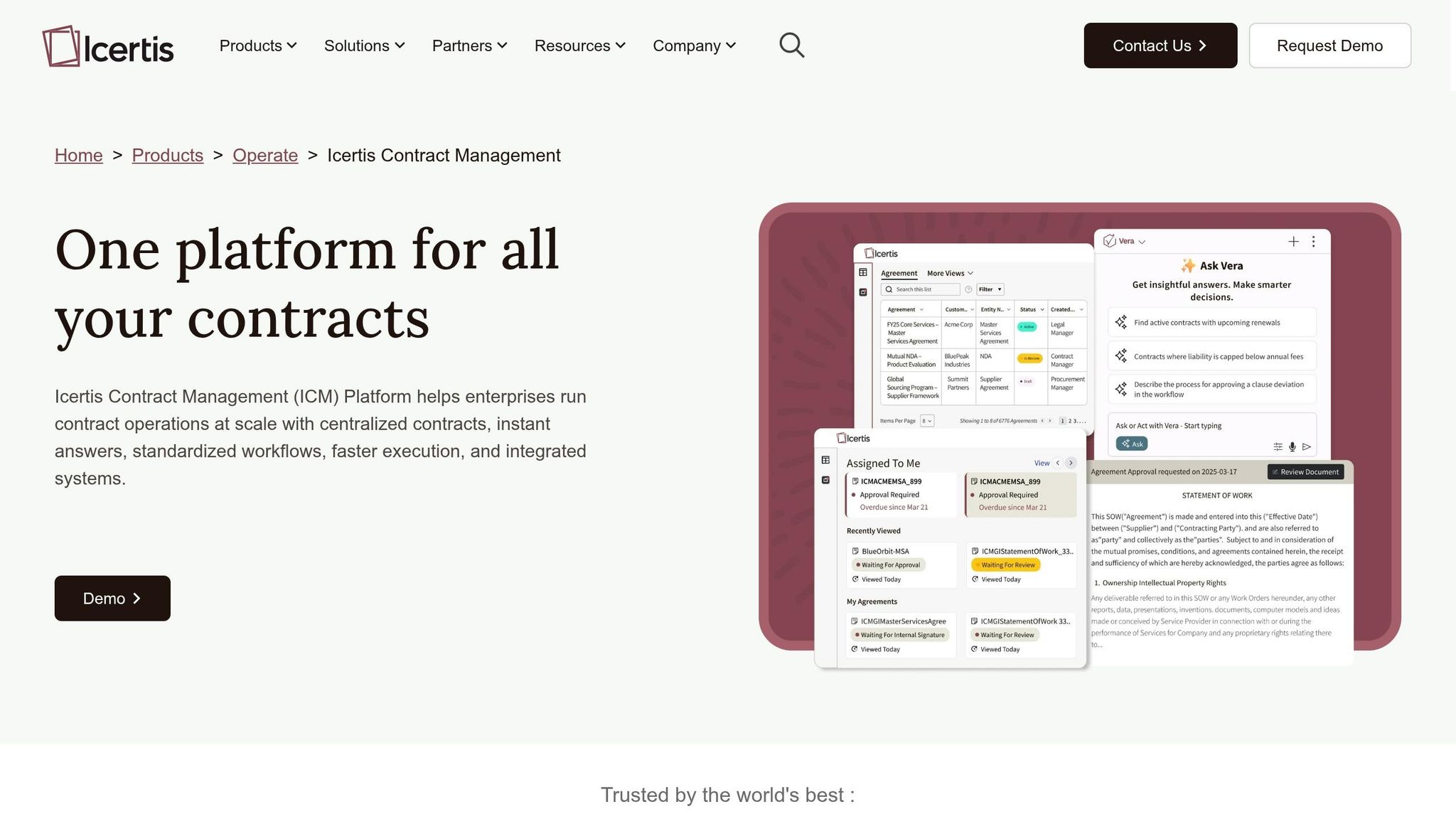
Once sourcing is in place, contracts become the next point of control. Icertis is a CLM platform that turns contract data into searchable, usable records.
That matters more than most teams think. Organizations lose an average of 9% of annual revenue because of poor contract management, and 40% of executives spend more than 10 hours per week reviewing contracts by hand.
Decision Support
The Scenario-Based Award Optimizer reviews supplier bids against business rules like price benchmarks, regional risk reduction, and vendor diversity. Then it recommends the best award allocations.
The Vera Insights Agent does something much simpler on the surface, but just as useful in practice: it lets teams ask plain-language questions across their contract portfolio and find relevant clauses and payment terms.
Data Visibility
Icertis turns unstructured contract documents into searchable records and keeps agreements, metadata, PDFs, and images in one repository.
That means teams don't have to dig through scattered files just to answer basic questions. In one example, a global pharmaceutical company used Vera AI to process 8,000 legacy supplier contracts in six weeks, pulling out risk flags that would have taken 18 months of manual legal review.
Compliance Insight
The platform automatically identifies and escalates non-compliance issues by comparing contract terms with actual performance data. It also tracks regulatory requirements such as GDPR and sanctions during drafting.
The Vera Fulfillment Agent keeps an eye on commitments like:
Service credits
Delivery dates
Implementation timelines
That gives teams a way to track whether contract promises are being met after signature, not just during review.
Workflow Fit
Icertis is the only SAP Solution Extension for CLM, with native integration into SAP Ariba and real-time tracking of spend against commitments. For companies already deep in the SAP stack, that's a big deal.
Mercedes-Benz cut its average contract turnaround time from 6 weeks to 1 week after implementation.
Implementation often takes 6 to 12 months and starts at around $150,000 per year. So this isn't a light lift. But for large teams dealing with heavy contract volume, it shifts contract terms out of static review and into day-to-day execution.
5. Zip
Zip sits at the very front of procurement. It handles intake first, then routes requests and approvals across ERP systems like NetSuite, SAP, and Workday. That setup makes it a strong fit for teams that want tighter control before sourcing or contracting starts.
Decision Support
Zip uses AI agents to turn plain-English purchase requests into structured sourcing requests. The Competitive Research Agent brings in market insight, while the Price Negotiation Agent checks pricing against past benchmarks. In plain terms, it turns early intake into a controlled, trackable workflow.
Zip has processed more than $500 billion in spend and helped customers deliver over $10 billion in savings. Dollar Tree used the platform to line up internal processes with sourcing policy and achieved $125 million in total savings.
Once a request is structured, the next step is simple: can the team trust the data behind the choice?
Data Visibility
Zip logs each request at intake and follows it through approval all the way to final payment. That gives teams a clear view of request-level spend by department, category, vendor, or GL account before approval happens. Canva reported a 70% drop in procurement cycle times after rolling out Zip.
Compliance Insight
Zip scans intake requests for fraud, non-compliance, and cyber exposure before a contract gets signed. It also builds a searchable request-to-approval audit trail for SOX and internal approval compliance.
"Global compliance loves this tool. All of our regulators and compliance teams love Zip because everything is trackable and they can see everything they need." - Roselle Lagunzad, Director of Procure-to-Pay, Coinbase
Workflow Fit
Zip connects with more than 2,500 integrations. It also supports approvals in Slack and Microsoft Teams, so people can review and act without jumping between tools. At LiveRamp, 99% of transactions now run through Zip. Zip also runs AI-driven supplier risk checks faster than manual review.
From there, approved requests move into contract management and downstream execution. This transition is a critical phase in the modern procurement lifecycle.
6. Coupa
Once contract control is in place, the next step is execution across sourcing, purchasing, invoicing, and supplier risk. Coupa pushes that control across the full source-to-pay process in one system, from sourcing through invoicing and supplier risk.
Decision Support
Coupa's AI uses $10 trillion in transactional data from a network of more than 10 million buyers and suppliers. That kind of scale gives teams stronger spend benchmarks and better category planning.
Teams can model supply chain scenarios, test disruption risk, and optimize for cost, risk, and ESG. In sourcing decisions for complex categories like logistics, Coupa's constraint-based optimization looks at supplier capacity, service levels, and pricing at the same time.
Customers report average savings of 8.1% on total spend. A Forrester study also found that large enterprises using Coupa can see a 100% improvement in sourcing and spend reporting efficiency.
Data Visibility
Coupa brings together direct and indirect spend, including inventory, contingent labor, and project services. Real-time budget meters show how each requisition affects available funds before approval.
Top teams using Coupa AI insights have reported 40% faster decision-making, and analysis cycle times have been cut by up to 70%.
Compliance Insight
Coupa's SpendGuard™ monitors behavior across users and suppliers in real time. It flags errors, suspicious spend, and fraud before payment.
Contracts sit in a central repository and are enforced automatically at the point of purchase, so negotiated discounts are applied without extra manual checks. On the supplier risk side, the platform automates monitoring across information security, anti-bribery, and GDPR requirements, with real-time alerts when a supplier's risk rating changes.
Workflow Fit
Coupa guides employees toward preferred products and compliant buying channels. Its shopping-style interface helps with adoption and cuts down on training.
"In our selection process, it became very clear around usability studies that Coupa had an enhanced user experience compared to other platforms." - Robert Christmas, Financial Director, AstraZeneca
Top teams have cut requisition-to-order cycle times to 3.8 business hours and increased pre-approved spend to 96.1%. Coupa also connects with SAP, Oracle, NetSuite, Workday, and Microsoft Dynamics through pre-built connectors. Its no-code setup lets teams adjust approval routing without IT support.
That makes Coupa a strong fit for teams that want one system for both decision support and policy enforcement.
How Each Tool Performs Across the Four Key Criteria
Here’s Procright at a glance across the four criteria.
Use this scorecard to compare Procright’s value across the four decision criteria.
Tool | Decision Support | Data Visibility | Compliance Insight | Workflow Fit |
|---|---|---|---|---|
Procright | AI-driven specification creation and technical compliance scoring; Product Maturity and Market Acceptance scores | Specification data plus automated source analysis from web pages, PDFs, and videos | Item-by-item verification with direct source links | Real-time collaboration; industry-specific templates |
Procright is built for the pre-purchase stage, where specification quality and product fit shape downstream risk. Its AI-driven scoring, source-level traceability, and collaboration tools give teams a clear, auditable path from requirements to a purchase decision.
If your team needs to build, review, and approve specifications before buying, Procright handles that part well.
Next, review the pros and cons to weigh these strengths against the tradeoffs.
Pros and Cons
This table gives you a side-by-side look at each tool’s main upside, main drawback, and where it fits best. Use it to compare every platform across the same four decision points used above: decision support, data visibility, compliance insight, and workflow fit.
Tool | Pros | Cons | Best For |
|---|---|---|---|
Procright | AI-driven spec drafting, source-backed compliance scoring, and clear requirement verification | Does not cover post-transaction spend analytics or executive spend dashboards | Pre-purchase specification and compliance verification |
Sievo | 94%+ classification accuracy; 98%+ classification coverage; customers report an average of $20M+ in incremental savings for every $1B analyzed | Built for spend analysis, not spec drafting | Budget visibility and spend analytics |
Scoutbee | Deep supplier discovery; helps teams find credible vendors beyond household names; supports faster response to supply chain disruptions | Covers supplier discovery, not the full procurement cycle | Supplier discovery and supply chain diversification |
Icertis | Detailed clause analysis, full contract lifecycle control, and risk detection | Requires integration with other tools for full procure-to-pay coverage | Contract clause review and contract risk management |
Zip | Fast intake, simple routing, and tighter control over request flow | Not a replacement for deep spend analytics or sourcing tools | Intake and routing for decentralized organizations |
Coupa | Broad source-to-pay coverage with large-scale benchmark data | High implementation complexity; can be overkill for narrowly scoped procurement needs | Large enterprises seeking a unified source-to-pay platform |
The next step is to match that level of depth to the stage where your process loses the most time or control. The conclusion connects these tradeoffs to the right tool fit based on team size and procurement maturity.
Conclusion
Each tool in this article fixes a different procurement pain point. The best pick depends on where your process stalls, not on which platform has the longest feature list.
Use this quick map to line up each tool with the procurement problem it handles best.
Biggest bottleneck | Best fit |
|---|---|
Specification errors and compliance gaps | Procright |
Spend visibility and budget classification | Sievo |
Contract extraction and risk analysis | Icertis |
Intake-to-procure orchestration | Zip |
Enterprise-wide source-to-pay coverage | Coupa |
A team dealing with vague or half-finished pre-purchase specs needs a different kind of help than a team trying to classify spend across a large operation. The same logic carries through the rest of procurement: tie the tool to the bottleneck, whether that issue sits in decision support, data visibility, compliance review, or custom procurement workflows fit.
Pick the platform that fits the problem, and procurement starts pulling its weight.
FAQs
How do I identify my biggest procurement bottleneck?
Map your procurement workflows to see where things keep getting stuck. Pay close attention to high-friction points, such as:
requests that come in without clear business context
approvals that happen outside set workflows
budget, purchase order, and invoice data spread across different systems
Also watch for too much manual drafting, guesswork caused by missing details, and revision loops that eat up time and budget.
What should I evaluate before choosing an AI procurement tool?
Before you pick an AI procurement tool, get clear on where you need help in the buying cycle and what problem you’re trying to fix.
That could mean:
Lowering costs
Reducing risk
Improving compliance
This step matters because not every tool does the same job. Some help with sourcing. Others focus on approvals, supplier risk, or spend analysis. If you skip this part, it’s easy to buy software that looks good in a demo but doesn’t help your team day to day.
It also helps to look at your current tech stack early. In most cases, integration with your ERP and accounting systems should be near the top of the list. If the tool can’t connect well with the systems you already use, data gets stuck in silos, and teams end up doing extra manual work.
Data quality matters too. AI tools are only as good as the data they use. So check that the platform runs on reliable data, not messy or incomplete inputs that lead to bad outputs.
And one more thing: make sure the tool fits into daily workflows. It shouldn’t sit off to the side as a standalone reporting tool that people check once in a while. The best tools support the way your team already works and make common tasks easier.
Can AI improve procurement decisions without replacing human review?
Yes. AI can help teams make better procurement decisions while people stay in charge. It helps by speeding up research, bringing forward objective data, and cutting down admin work.
For example, Procright automates specification creation and product discovery. So instead of starting from scratch, teams can review reliable, transparent data. That gives procurement professionals more time to focus on strategy, final approvals, and the kind of judgment software can't handle on its own.