Common Procurement Template Issues and Fixes
Fix vague specs, inconsistent formats, and outdated clauses with controlled templates, scoring rules, requirement IDs, and AI checks.

Bad procurement templates waste time, create supplier confusion, and lead to hard-to-defend awards. If I had to boil this down, I’d say most template problems come from just three things: missing requirements, inconsistent formatting, and old compliance language.
Here’s the short version:
If specs are vague, suppliers fill in the blanks their own way.
If units, terms, or fields don’t match, bid comparisons break down.
If scoring rules are loose, rankings get easier to challenge.
If old clauses stay in place, compliance risk grows.
If AI checks templates before release, teams can catch these issues early and save 15–25 hours per RFP.
A few numbers stand out:
66% of RFP text may be reused from past events
30%–50% of RFIs come from document errors, omissions, or unclear language
One RFI can cost about $1,080
Manual gap review can take 20–40 hours
Teams often spend 40–60 hours per RFP cycle with generic templates
What fixes it? I’d focus on a controlled template library, fixed scoring rules, requirement IDs, validation rules, and AI checks for missing fields, vague wording, and compliance gaps.
That’s the core point of this article: don’t patch each sourcing event one by one - fix the procurement lifecycle by improving the template system first.
The RFP Process | A 20-Step Guide for Modern Procurement Teams
The Most Common Procurement Template Problems
These issues usually show up in three places: requirements, consistency, and scoring.
Incomplete Specifications and Unclear Requirements
Vague terms like "enterprise-grade", "high-speed", or "standard support included" sound fine on paper. But they don't give suppliers a clear, measurable target.
Take "standard support." In many cases, vendors read that as the bare minimum: 9-to-5, Monday-Friday coverage.
Templates also often leave out fields that have a direct effect on cost and fit, including physical dimensions, power requirements, operating voltage, weight, and compliance certifications. When those details aren't there, each supplier fills in the blanks in their own way. That makes it harder to compare products for compliance efficiently and can mask major risks.
Gap Type | Potential Consequence |
|---|---|
Missing performance spec | Equipment fails to meet throughput needs |
Absent compliance cert | Regulatory violations or deployment delays |
Unlisted compatibility spec | Integration failures with existing systems |
Omitted environmental rating | Equipment failure in specific operating conditions |
Missing warranty detail | Unexpected maintenance and total cost of ownership increases |
Another problem tends to hide in plain sight: hidden requirements. These are critical conditions buried in scope narratives or appendices instead of sitting in one central requirements section. Conditional requirements are easy to miss too, like extra security controls that apply only if a vendor proposes a cloud-based solution.
Inconsistent Templates Across Teams and Categories
When each department builds its own version of a template, things drift fast. This often happens because teams lack automated category and sector detection to standardize their approach. Terms change. evaluation logic shifts. Similar purchases end up being judged in different ways.
Units of measure are a common trouble spot. If one team uses one unit base and another uses something else, a quote can look far cheaper - or far more expensive - than it is unless the data gets normalized first. Specification misalignment can drive project costs up by 15%–20%.
That kind of fragmentation slows everyone down because teams have to clean up terms and units before they can even compare bids.
Outdated Compliance Clauses and Weak Scoring Models
Compliance language often gets copied from one event to the next, even when the risk profile or standards have changed. And during audits, missing information is often treated as non-compliance. For example, a compliance certificate without an expiration date is usually read as expired.
"The more sophisticated your comparison looks, the less anyone questions what's inside it - weighted scores, conditional formatting, and auto-ranking don't reduce errors, they reduce scrutiny." - ImageToTable.ai
That's the trap. A scorecard can look polished and still be wrong. One transposed number in a price cell can skew the final ranking.
AI can catch these issues before the template reaches suppliers.
How AI Addresses Procurement Template Problems
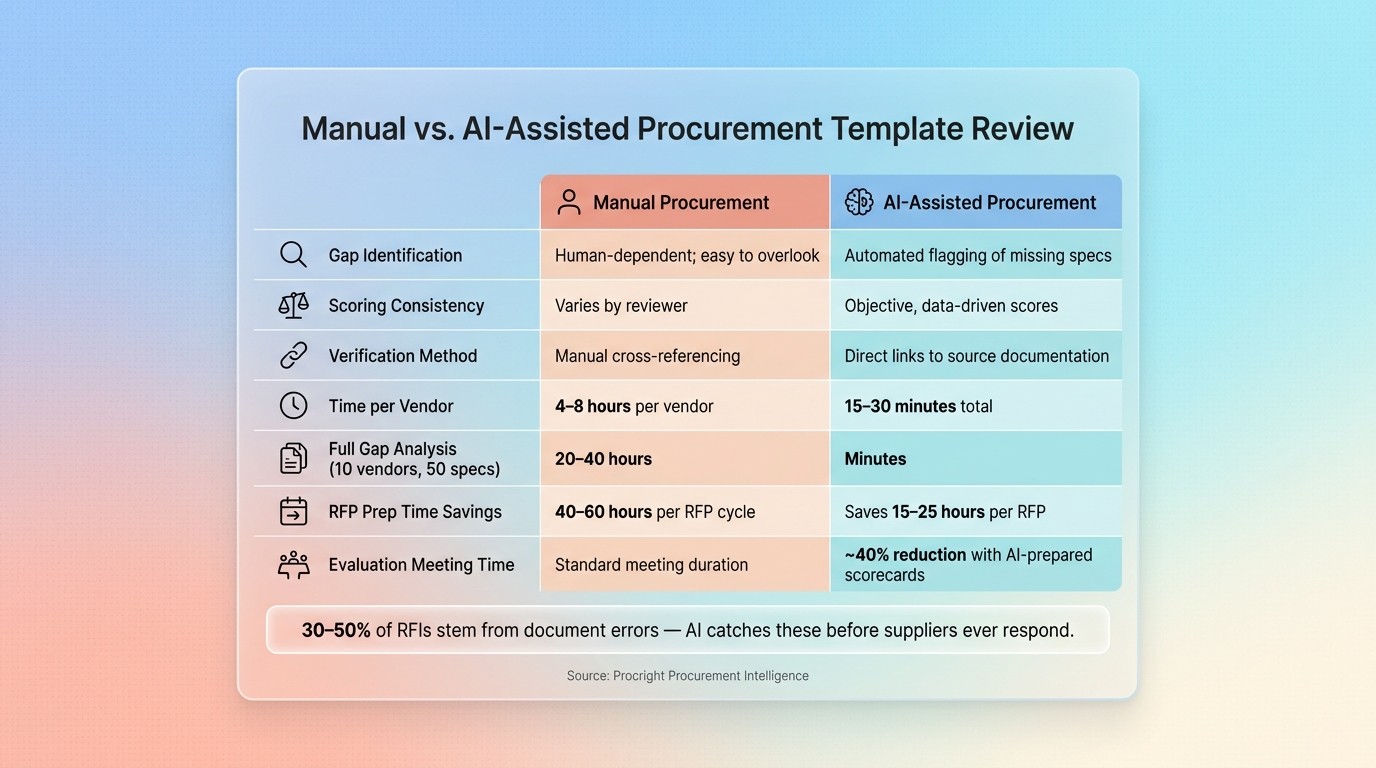
Manual vs. AI-Assisted Procurement: Time, Cost & Accuracy
AI can catch template issues before suppliers ever see them. It spots missing fields, vague wording, and mismatched terms by reviewing the full document instead of relying on manual spot checks. Then it turns those findings into rules the template can follow going forward.
AI Detection of Missing Fields, Vague Language, and Inconsistent Terms
AI reviews templates against past sourcing documents and industry-specific libraries to find gaps. If a required technical detail is missing, the system flags it automatically.
It also flags vague wording. Terms like "high-speed" or "efficient" get replaced with measurable language. So instead of "high-speed", a template might say "50,000 events per second". That gives reviewers something clear to assess.
On top of that, AI pulls out specifications and standardizes inconsistent terms into one controlled template. That means less back-and-forth during review. Manual gap analysis for a 10-vendor response to a 50-specification RFP usually takes 20–40 hours, while AI can do the same work in minutes.
Structured Templates With Category-Specific Logic
Static templates treat every purchase the same. AI-driven templates don't. They use category-specific logic to separate mandatory requirements from optional ones based on spend size, risk level, or product category.
For U.S.-based procurement teams, this also helps keep units and pricing in sync. Imperial and metric measurements can be handled the same way across documents, and pricing can stay in USD, which makes comparison tables much easier to review.
Once the template is set up this way, scoring becomes more consistent. Suppliers get clearer requirements, and teams spend less time answering clarification questions.
Automated Compliance Checks and Transparent Scoring
When supplier responses arrive, AI matches each response to the template requirements automatically. It checks whether each requirement is met, partly met, or missing, then produces a documented compliance score for each vendor.
A big reason this works is source transparency. Platforms like Procright link each compliance finding back to the exact page or timestamp in the vendor's source documents. Procright does this across the full specification lifecycle - from initial requirement creation and product discovery to final compliance scoring - so teams can make data-driven procurement decisions.
Compliance Check | Manual | AI-Assisted |
|---|---|---|
Gap identification | Human-dependent; easy to overlook | Automated flagging of missing specs |
Scoring consistency | Varies by reviewer | Objective, data-driven scores |
Verification method | Manual cross-referencing | Direct links to source documentation |
Time required | 4–8 hours per vendor | 15–30 minutes total |
Industry-specific AI templates reduce procurement errors and cut RFP prep time.
How to Fix and Govern Procurement Templates
How to Fix Generic or Legacy Templates
Once AI flags the gaps, the next job is governance. That’s what stops the same problems from showing up again. The fixes here deal with the three failure modes already covered: missing requirements, messy formats, and old compliance language.
Start by auditing recent sourcing documents against actual outcomes. Look for template drift, such as missing requirements, vague wording, and repeat clarification triggers. If a prompt is fuzzy, tighten it up with quantified, testable language. For example, replace “describe your approach to efficiency” with “detail how you will reduce processing time from 4 hours to under 30 minutes”.
Each line item should also get a unique requirement ID. That keeps every requirement traceable from the solicitation all the way through the scoring matrix. And if you’re still relying on Word and Excel, that’s often where things go sideways. Structured forms with validation rules help prevent transcription mistakes and unit-of-measure errors.
How to Build a Controlled Template Library
Fixing the wording inside a template helps, but it doesn’t solve the source problem on its own. You also need control over the template itself.
A controlled library means one governed system, not a shared folder stuffed with old files. One person or team should own the master version, and version control should log and show all material changes. Templates should be grouped by category and risk level.
The core template should keep pre-approved legal clauses and mandatory compliance questions fixed. Category teams can still adjust weightings or add custom questions, but only inside approved limits.
It also helps to connect templates to a shared clause library. That way, if one legal or commercial clause changes, the update flows across every template that uses it. Review template performance each quarter with metrics like vendor clarification volume and rework hours per opportunity. Done well, this leads to fewer clarifications, cleaner side-by-side comparisons, and award decisions that are easier to defend.
How to Improve Evaluation Consistency With Standard Scoring Matrices
Template control falls apart fast if scoring is still loose.
When evaluators don’t share one standard, scores tend to drift toward personal preference instead of documented criteria. The fix is pretty plain: define weighted criteria, pass/fail gates, and exact score definitions before opening responses, then lock them. Using AI-prepared scorecards can cut time spent in evaluation meetings by about 40%.
Here’s where old scoring setups usually break and what a governed model looks like instead:
Issue | Old Approach | Revised Approach | Expected Outcome |
|---|---|---|---|
Vague requirements | "Describe your approach to efficiency." | "Detail how you will reduce processing time from 4 hours to <30 mins." | Measurable, testable deliverables |
Unit mismatch | Prices entered without stated units | Mandatory UOM column + normalization formula (e.g., Price/Unit) | Accurate price comparisons |
Scope gaps | Comparing only the numbers provided | Adding a "Scope Exclusions/Assumptions" column for every supplier | Identification of hidden costs like freight or labor |
Template drift | Copy-pasting from the last project's file | Central library with version-controlled, approved blocks | Compliance with current legal and ESG standards |
Subjectivity | Evaluators use gut feel or loose 1–10 scales | Fixed scoring ranges with predefined score definitions | Defensible, audit-ready scoring |
Procright supports structured evaluation with transparent compliance scores and automated compliance verification, which helps keep scoring consistent from requirements through award.
Conclusion: What Better Procurement Templates Deliver
The pattern is plain: most procurement mistakes start with template gaps, uneven language, and old clauses. Bad templates lead to misread requirements, out-of-date terms, and scoring that shifts from one document to the next. The fix isn’t to patch each RFP by hand. It’s to fix the template.
That’s where AI helps before suppliers even respond. It flags missing fields, sharpens vague wording, and checks compliance before release. For procurement teams, that can save an average of 15–25 hours per RFP.
Still, automation does its best work when governance keeps templates up to date. A controlled template library, paired with version control and approved language, keeps quality steady across teams and over time. Procright automates specification creation, compliance verification, and transparent scoring.
The payoff is simple: faster sourcing, fewer clarifications, cleaner comparisons, and awards you can defend.
FAQs
How do I know if our procurement templates are causing avoidable RFIs?
Watch for old or fuzzy requirements that force vendors to ask follow-up questions. You’ll often see the same red flags pop up: frequent substitution requests, gaps between specifications and drawings, or trouble getting vendors to submit capability information that matches up cleanly.
Procright helps cut down that back-and-forth. It automates complete, compliant specifications and checks requirements against market data, which helps close the technical gaps that can lead to extra revisions and field conflicts.
What should be standardized first in a procurement template library?
Start by standardizing the intake process and the core data points first. A controlled intake flow helps teams gather the main requirements before drafting starts, which cuts down on back-and-forth later.
That intake should include:
company and contact information
standardized request formats
pre-approved legal and commercial clauses
evaluation criteria and weightings
mandatory compliance questions
When these inputs are set from the start, drafting moves with fewer delays and fewer surprises.
When should AI review a template during the RFP process?
AI should review a template after your team writes the solicitation using its own expertise and institutional knowledge. Its job is to act as a reviewer, not a drafter.
Before publication, AI can flag unclear requirements, category-specific inconsistencies, and evaluation criteria that don’t line up with supplier requests. That helps teams avoid time-consuming addendums later.
Procright supports this process by identifying missing requirements, checking compliance, and helping teams prioritize critical items.