Predictive Analytics for Supplier Risk Management
Predictive analytics helps procurement spot supplier financial, operational, ESG, geopolitical, and cyber risks early.

Supply chain disruptions are costly and inevitable. Predictive analytics helps procurement teams move from reacting to problems to anticipating them. By analyzing historical and real-time data, it identifies risks like financial instability, late deliveries, or compliance violations before they escalate, helping to reduce procurement errors common in manual processes.
Key takeaways:
80% of companies faced supply chain disruptions in 2024, with average profit losses of 42% over a decade.
Predictive models use signals like credit scores, shipment delays, and geopolitical risks to flag potential issues early.
Tools like Procright automate compliance tasks and improve decision-making efficiency.
Companies using predictive analytics report up to 15% cost reductions and faster disruption response times.
To implement predictive analytics, start with accurate data, focus on high-risk areas, and integrate insights into your procurement workflows. This approach reduces disruptions, improves compliance, and strengthens supplier strategies.
ML-Driven Supplier Risk Score Analytics | AI for Business
Types of Supplier Risks Predictive Analytics Can Address
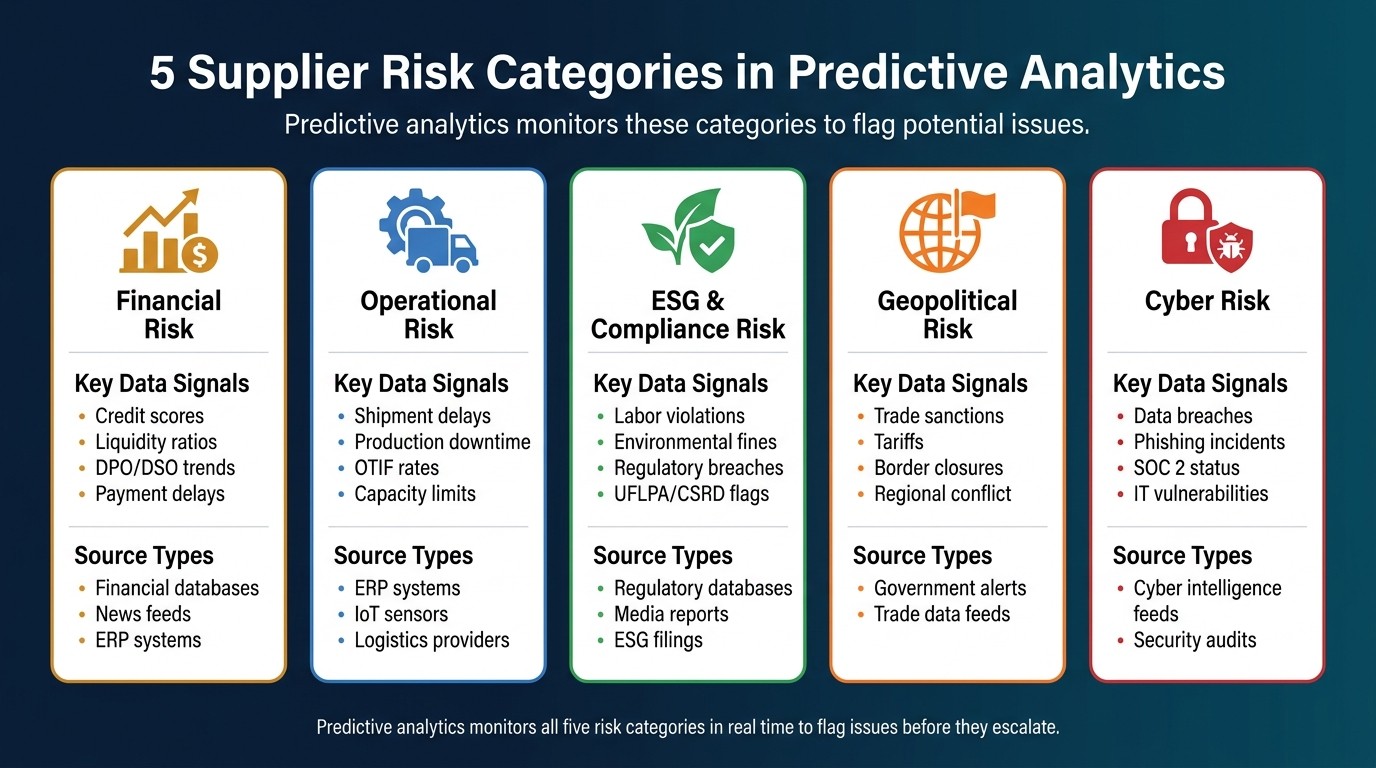
5 Supplier Risk Categories: Key Signals & Data Sources
Supplier risk involves a mix of threats that can strike all at once. Pinpointing what to monitor is the first step in creating a system that flags potential problems early.
Common Categories of Supplier Risk
Supplier challenges typically fall into five main categories, with financial risk being the most pressing. Indicators like rising days payable outstanding (DPO), falling credit scores, or a worsening debt-to-equity ratio can hint at insolvency. Operational risks, on the other hand, cover issues such as late deliveries, production stoppages, or capacity limits - problems that might start as small hiccups but can escalate into major disruptions.
ESG (Environmental, Social, and Governance) and compliance risks are gaining attention, especially with regulations like the UFLPA and CSRD mandating ongoing monitoring. Geopolitical risks focus on trade sanctions, tariffs, or regional unrest that could suddenly disrupt supply lines. Lastly, cyber risks - which are often overlooked in procurement - include data breaches and IT vulnerabilities that could disrupt operations or expose sensitive information.
"Risk management must be embedded into the very fabric of category strategy. If your risk assessment occurs only after the supplier is chosen, you are managing the crisis, not the risk." - Dr. Marcell Vollmer, Supply Chain Executive
To address these risks, specific data signals are required. Here's how they break down:
Risk Category | Key Data Signals | Source Types |
|---|---|---|
Financial | Credit scores, liquidity ratios, DPO/DSO, payment delays | Financial databases, news feeds, ERP |
Operational | Shipment delays, production downtime, OTIF rates | ERP, IoT sensors, logistics providers |
ESG & Compliance | Labor violations, environmental fines, regulatory breaches | Regulatory databases, media reports |
Geopolitical | Trade sanctions, tariffs, border closures, regional conflict | Government alerts, trade data |
Cyber | Data breaches, phishing incidents, SOC 2 status | Cyber intelligence feeds |
Data Sources Used for Risk Identification
Internal systems like ERP and supplier relationship management (SRM) platforms are treasure troves of information. They store historical spend data, on-time delivery metrics (OTIF), quality trends, and contract details. Finance systems can also provide payment behavior data, which might highlight early signs of financial instability.
External sources fill in the gaps. These include financial databases, commodity price indices, sanctions lists, ESG filings, adverse media reports, and IoT or logistics data from freight carriers. A case in point: the 2020–2022 semiconductor shortage, which showed how hidden sub-tier dependencies could lead to massive revenue losses.
Identifying the right data is only the beginning. The next step is preparing it for use in predictive models.
How to Prepare Data for Risk Models
Predictive analytics thrives on well-prepared data. Raw data from various systems needs to be standardized - this ensures, for example, that delivery metrics from your ERP align with logistics data from freight partners. Skipping this step can lead to inconsistent model outputs.
Feature engineering plays a key role by turning raw data into actionable insights. This involves identifying variables that signal risk, such as cost fluctuations, sustainability ratings, or delivery trends, and formatting them as inputs for the model. For unstructured data like news articles or social media posts, large language models (LLMs) can extract relevant signals while filtering out irrelevant noise. Clustering techniques can also group related incidents to avoid duplicate alerts. Consistent data normalization is critical to maintaining reliable risk scores, as unreliable results can undermine confidence in the entire system.
Building Predictive Models for Supplier Risk
Selecting the right modeling approach is crucial. Your choice determines the types of risks you can identify and how quickly you can respond to them.
Predictive Modeling Techniques for Supplier Risk
Different risk scenarios require tailored tools. Logistic regression offers a quick and interpretable starting point for supplier risk scoring. For monitoring trends over time, time-series models like ARIMA are great for capturing seasonal patterns in metrics such as lead times and fill rates. These models can help detect gradual declines before they escalate into major issues.
For identifying unusual behaviors, such as irregularities in invoices, anomaly detection methods like isolation forests or autoencoders are effective. When dealing with more complex, nonlinear relationships, gradient boosting models like XGBoost and LightGBM shine with their high predictive accuracy. For example, in a study within the electric vehicle sector, an XGBoost model achieved an AUC of 0.851 and an F1 score of 0.928, showcasing its ability to handle real-world supplier data effectively.
Graph and network analysis is another powerful tool. It maps supplier connections, including shared sub-suppliers and logistics hubs, to measure the ripple effects of disruptions. This approach is especially useful for identifying hidden vulnerabilities, such as single points of failure.
"The automotive industry must shift from reacting to disruptions to preventing them. AI-powered early warning systems are now essential." - Rolf Janssen, Partner, Roland Berger
Once you’ve chosen the right techniques, defining clear inputs and outputs becomes essential for generating actionable risk assessments.
Inputs and Outputs of Supplier Risk Models
After selecting the modeling methods, it’s vital to establish clear inputs and outputs to guide decision-making. Inputs typically fall into two categories:
Internal operational data: Metrics like on-time delivery rates, defect rates, and lead time variability.
External signals: Data such as credit scores, news sentiment, geopolitical risk indices, and port congestion information.
Strong feature engineering plays an important role here. Creating features like rolling averages for lead times or network centrality scores can significantly improve model performance.
On the output side, effective models provide dynamic risk scorecards that update in real-time. These scorecards quantify risk probabilities and can trigger automated actions - such as initiating alternate sourcing or escalating issues to a category manager - when risk thresholds are breached. Companies using AI-powered models report a 50–70% reduction in the time required to identify and evaluate disruption impacts.
Validating and Monitoring Predictive Models
A model that works well today might struggle tomorrow as market conditions, supplier behaviors, and data patterns evolve. That’s why continuous validation is critical.
To ensure reliability, use five-fold cross-validation and back-test the model against historical disruptions. Simulate shocks to stress-test its performance under extreme conditions. Pair these efforts with explainability tools like SHAP or LIME. These tools help break down the factors influencing risk scores, enabling procurement teams to understand the rationale behind each recommendation and take informed action.
Ongoing validation also involves connecting models to live ERP and logistics data streams, scheduling regular retraining, and assigning accountability to prevent model drift. This continuous monitoring strengthens proactive risk management. However, human oversight remains indispensable - AI outputs should guide decisions, not replace human judgment, especially for high-stakes calls like supplier disqualification.
How to Integrate Predictive Analytics into Procurement
A Phased Approach to Implementation
Bringing predictive analytics into procurement works best when done step by step. Jumping in all at once often leads to confusion and inefficiency, so it's important to follow a structured approach.
The first step? Build a solid data foundation. As one expert put it:
"Poor data in, noisy predictions out. Before you deploy Predictive AI for Supplier Risk, clean up duplicate supplier master data."
This means consolidating supplier records from systems like ERP and QMS, as well as external sources like credit ratings, ESG scores, and news feeds. Combining this data into a clean, unified system helps avoid many pitfalls that can sink analytics projects.
Once your data is in order, focus on areas where predictive analytics can make the biggest difference. Start with high-risk or high-value areas - like single-source dependencies, components with long lead times, or high-spend categories. Run a pilot program in one of these areas to test the accuracy of your models against real-world outcomes. After validating the results, integrate the predictive insights directly into your existing procurement processes - such as sourcing, contracting, or ordering - rather than relying on a separate dashboard. By embedding these insights into your workflows, you’ll make them actionable. In fact, by 2026, it’s expected that 60% of procurement teams will use predictive analytics to cut supply disruptions by half.
Once the analytics tools are in place, the next focus should be meeting compliance and governance requirements.
Compliance and Governance Considerations
In the U.S., procurement teams face strict regulations like the Uyghur Forced Labor Prevention Act (UFLPA). Since June 2022, U.S. Customs and Border Protection has seized 65,707 shipments valued at $3.91 billion under UFLPA enforcement. Industry-specific standards also play a big role, such as FDA validation for life sciences, IATF 16949 for automotive, AS9100 for aerospace, and SOC 2 Type 2 for data security. These rules shape what predictive models need to monitor and how their outputs should be documented. Just as clean data is critical for analytics, strong governance ensures the insights lead to compliant and defensible decisions.
Frameworks like ISO 31000 and COSO ERM offer general guidelines for managing risk, but as Ivalua points out:
"it's up to individual procurement teams to operationalize those processes using technology and automated workflows."
This involves embedding automated controls at every stage of the procurement process. For example:
Use risk-based segmentation during the intake process.
Apply anomaly detection to flag unusual bids during sourcing.
Leverage clause libraries when drafting contracts.
Implement three-way matching for invoicing.
Conduct AML (anti-money laundering) checks before payments.
Governance should also be tiered. For example, sole-source semiconductor suppliers need closer monitoring than routine office supply vendors. And while automation is helpful, human oversight remains critical for high-stakes decisions, such as disqualifying or reclassifying suppliers.
"AI performs best alongside human judgment; the way you orchestrate automation determines how much value you actually capture." - Assembly Industries
Using Procright to Automate Risk Management Tasks
Procright takes automated controls a step further by simplifying compliance tasks. One of the most time-consuming parts of supplier risk management is verifying whether a vendor's claims about their product match your technical requirements. Procright tackles this challenge head-on. Its AI agents generate accurate drafts of technical specifications aligned with industry standards and cross-check vendor claims against source documents like user manuals, technical guides, and compliance certificates.
The platform assigns a Compliance Score to each product or vendor, backed by a transparent audit trail of the source documents used to generate the score. This feature eliminates guesswork and ensures compliance with regulatory and internal standards. Procright also provides additional metrics, such as a Product Maturity Score and Market Acceptance Rate, helping procurement teams assess whether a product is risky or well-established in the market. For teams managing large supplier portfolios, these tools reduce manual effort and catch potential compliance issues early on.
Conclusion: Using Predictive Analytics to Manage Supplier Risk
Key Takeaways
Predictive analytics is transforming how procurement teams address supplier risk. It shifts the focus from reactive problem-solving to proactive planning. Instead of scrambling to fix issues after they disrupt operations, procurement teams can identify potential risks months in advance and take action to prevent costly consequences.
The data speaks for itself. Companies using predictive tools can reduce procurement costs by up to 15%, enhance spend visibility by 35%, and achieve 20–25% improvements in sourcing efficiency. Even more compelling, the average company loses around 44–45% of its annual profits to supply chain disruptions over a decade. These numbers highlight the value of investing in predictive analytics.
But the benefits go beyond cost savings. Predictive analytics also boosts compliance and decision-making confidence. Continuous, transparent risk signals - rather than sporadic annual audits - allow procurement leaders to make quicker, well-informed decisions. As Dr. Marcell Vollmer, Supply Chain Executive and Former CPO, has pointed out, integrating risk assessment into category strategy from the outset is essential. Treating risk evaluation as a priority, rather than an afterthought, not only reduces costs but also strengthens procurement strategies for the future.
Next Steps for Procurement Teams
To get started, focus on a high-risk area - like a single-source component, a long lead-time item, or a supplier with significant spend. Pilot predictive modeling in this area. Make sure your data is accurate, set clear risk thresholds, and integrate predictive insights into your custom procurement workflows with tools such as Procright. The objective is to enhance human decision-making with reliable data during every sourcing decision.
FAQs
What data do I need to start predicting supplier risk?
To assess supplier risk effectively, you need to blend internal data - like delivery performance, lead times, defect rates, payment history, and audit results - with external data such as financial health scores, geopolitical news, commodity price trends, weather patterns, and ESG ratings. Tools like Procright make this process easier by automating compliance checks and analyzing specifications, so your procurement decisions are backed by precise, reliable data.
How do I set risk thresholds and actions in procurement workflows?
To establish risk thresholds and corresponding actions, start by creating quantitative risk scores. These scores should consider factors like financial stability, compliance history, and performance metrics. Once set up, tools like Procright integrate automated playbooks directly into your workflows. If a risk threshold is breached, the system automatically initiates pre-defined actions - such as conducting compliance reviews, approving suppliers, or suggesting alternative suppliers. Procright keeps these processes transparent by relying on clear, data-backed compliance scores.
How can I keep supplier risk models accurate as conditions change?
To keep supplier risk models accurate as conditions change, it's crucial to move away from static, periodic reviews and embrace continuous, data-driven updates. This means regularly updating predictive models with fresh data, combining internal metrics like delivery performance with external factors such as market trends. Tools like Procright simplify this process by automating compliance checks and providing dynamic risk scoring. This approach ensures your risk models reflect the latest business realities, not outdated information.