Dynamic Policy Updates vs. Static Policies
Balance static governance with dynamic, workflow-based policy updates to improve auditability, speed, and compliance in procurement.
In this article
If your procurement rules change often, static policy files will lag behind. In most cases, I’d use dynamic policy updates for day-to-day checks and keep static policies for top-level rules that need formal sign-off and a fixed record.
Here’s the short version:
Static policies live in PDFs, manuals, SharePoint pages, or fixed ERP settings.
Dynamic policy updates run as rules inside the workflow, so checks happen at the time of request, supplier review, and approval.
Static policies are easier to archive and point to later, but they often depend on people to read and apply them correctly.
Dynamic updates cut manual checking and can improve speed, audit logs, and rule accuracy if the data and system links are in place.
The article’s core point is simple: most U.S. procurement teams will do best with a hybrid setup.
A few numbers make the gap clear:
62% of organizations face procurement audit issues tied to manual policy updates.
Automated compliance work can improve accuracy from 78% to 93%.
Process time can drop from 7 days to 1.5 days.
Audit readiness can improve by 40% with policy update automation.
In weak enforcement setups, about 29% of indirect spend can end up off-contract.
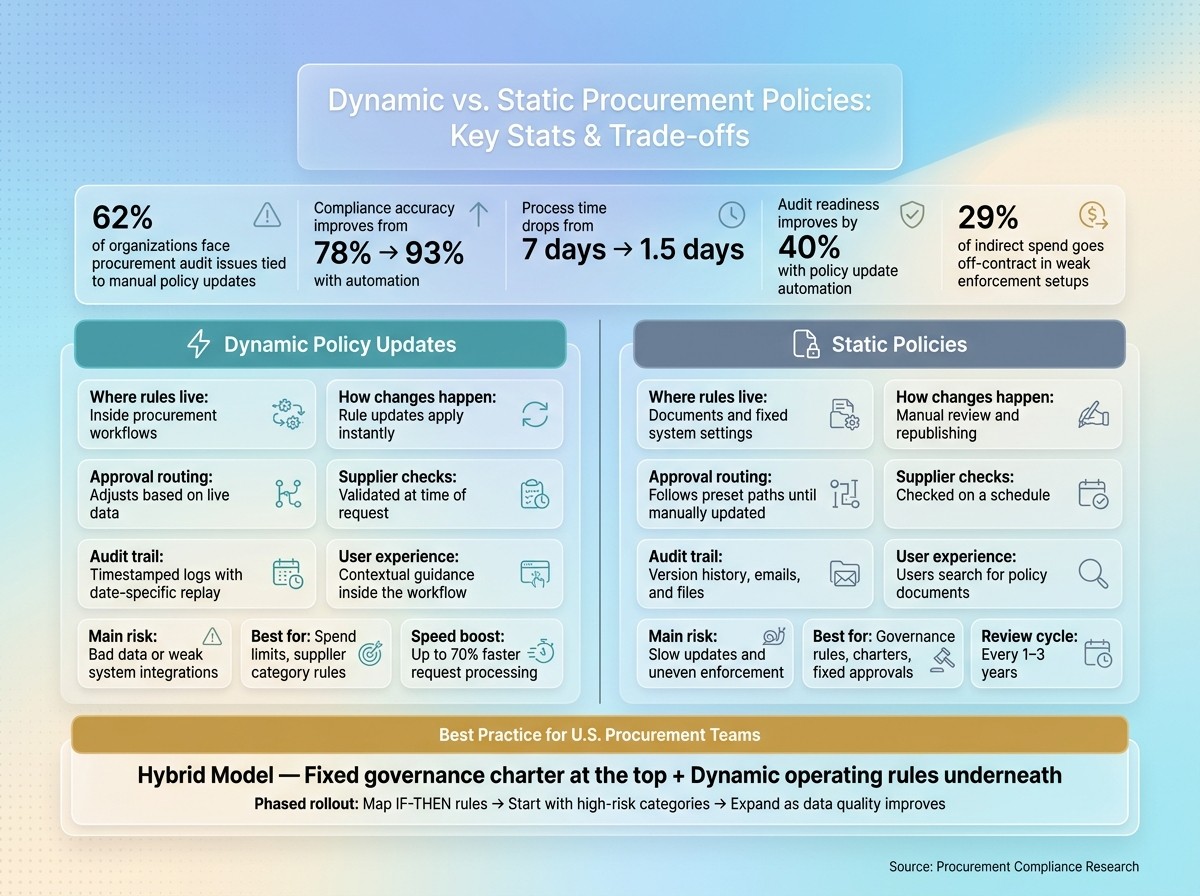
Dynamic vs. Static Procurement Policies: Key Stats & Trade-offs
Quick Comparison
Criteria | Dynamic Policy Updates | Static Policies |
|---|---|---|
Where rules live | Inside procurement workflows | Documents and fixed system settings |
How changes happen | Rule updates apply at once | Manual review and republishing |
Approval routing | Changes based on live data | Follows preset paths until someone updates them |
Supplier checks | Often checked on a schedule | |
Audit trail | Timestamped logs and rule replay | Version history, emails, and files |
User experience | Guidance appears in the workflow | Users search for policy documents |
Main risk | Bad data or weak system links | Slow updates and uneven enforcement |
Best use | Spend limits, supplier checks, category rules | Governance rules, charters, fixed approvals |
My takeaway: static policies give you control at the document level, while dynamic policies give you control at the decision point. If you need both audit history and day-to-day enforcement, a mixed model makes the most sense.
How Static Policies Work in Procurement Compliance
In day-to-day procurement work, static policies usually live in documents or fixed system fields. In U.S. teams, that often means a PDF manual, a policy register, or approval thresholds hard-coded into an ERP system. That setup explains the tradeoff: static policies are dependable, but they move slowly.
Common Formats and Update Cycles
Most static procurement policies set spend thresholds and supplier approval rules in documents that need a manual review chain before any change goes live. A revision often passes through Procurement, Finance, Compliance, Legal, and a governance approval step before publication. Organizations generally review static policies every one to three years. That lag can leave approvals, supplier checks, and spend limits out of step with current conditions.
Strengths: Stability, Predictability, and Clear Sign-Off
In steady environments, that slower pace can help. When rules stay the same for long stretches, a well-written policy is easy to version, easy to audit, and easy to explain with dated documents. If an auditor asks what a spend threshold was 18 months ago, the dated policy provides a clear record. That kind of stability also makes training simpler. New team members can read the policy, walk through it with a manager, and understand what the company expects.
Limits: Slow Response and Manual Enforcement
The same fixed setup turns into a problem when rules, risks, or thresholds shift fast. Static documents can't correct themselves. Someone has to notice the gap, draft a change, and move that revision through the approval process before the policy matches current conditions again.
Enforcement is the other weak spot. Most static systems depend on employees confirming that they read a document, not on an automated check that the rule was followed. That's where compliance drift starts, and it's a common source of costly procurement errors. Only 27% of Chief Compliance Officers believe their function has a formal process to identify and incorporate legal and regulatory changes into policies. In plain terms, static updates usually happen after the fact, not as part of a steady process.
Dynamic policy updates solve these delays by enforcing changes inside the workflow.
How Dynamic Policy Updates Work in AI-Powered Procurement
Dynamic policy updates apply rules inside the procurement workflow. When risk scores, regulations, or budget thresholds shift, the system uses the new rule right away - when someone submits a purchase request, picks a supplier through category and sector detection, or triggers a budget check.
The key difference comes down to two things: how rules are written and how current data gets to them.
Core Capabilities That Enable Dynamic Updates
At the center of this is rule logic the system can execute on its own. Instead of burying a policy in a PDF, the rule is written like this: IF spend > $50,000 AND category = "Professional Services" THEN route to CFO. The system reads that logic and acts on it without waiting for a person to translate the policy into action. That keeps governance in step with the workflow instead of trailing behind it.
What makes this dynamic is the data feed. Rather than checking a fixed list, the system queries a live data source at the exact moment the rule runs. So if a supplier’s certification expired yesterday, the system can catch it today. Every rule change and exception is logged automatically.
AI text analysis can also flag old terms and surface regulatory language that needs to be added.
Day-to-Day Benefits in Procurement Work
You see the impact in speed and accuracy. Continuous compliance automation can cut process duration from 7 days to 1.5 days while improving accuracy from 78% to 93%.
Approval routing also shifts in real time. If a supplier’s compliance risk score changes, the system reroutes the next purchase request automatically. No one has to step in manually. Low-risk requisitions move through faster, while high-risk or unusual requests get flagged on the spot.
Of course, those gains don’t come from automation alone. They depend on good data and clear governance.
Requirements: Data Quality, Governance, and Integration
Dynamic enforcement relies on clean master data, named policy owners, strong cross-functional governance across Legal, Finance, IT, and Procurement, and live ERP integration. Without integration, dynamic enforcement just makes stale data move faster.
That’s the tradeoff: faster enforcement on one side, tighter governance discipline on the other. The next question is where that extra governance work pays off.
Dynamic Policy Updates vs. Static Policies: Side-by-Side Comparison
The biggest differences show up when rules change, auditors want proof, and employees need help while they’re making a request. That’s where the gap between static and dynamic policy models gets hard to ignore.
Responsiveness, Compliance Accuracy, and Risk Control
This gap is hard to miss. Static policies tend to fall behind because every change has to move through manual review. Dynamic policies work inside the workflow, so updates are enforced right where decisions happen: during request submission, supplier risk assessment, and approval routing.
Dimension | Dynamic Policy Updates | Static Policies |
|---|---|---|
Regulatory Response | Real-time detection of regulatory changes | Manual review and slow distribution via memos |
Compliance Accuracy | 93% accuracy via automated validation | 78% accuracy; prone to interpretation errors |
Supplier Risk | Real-time validation of supplier status and risk scores before a request progresses | Periodic manual checks; higher risk of off-contract spend |
The numbers tell the story. With static policies, 62% of organizations run into procurement audit issues tied to poorly managed manual policy updates.
Speed helps, of course. But when review time comes, audit traceability is often what makes or breaks an automation program.
Auditability, Governance, and Complexity
This is where the structural split becomes easiest to see. If an auditor asks which rule was active on a certain date, teams using static policies usually have to piece the answer together from emails, old files, and version histories. Dynamic systems handle that very differently. A date-specific replay of the active rule set lets auditors verify the exact logic that applied at that point in time. Automating policy updates also improves audit readiness by 40%.
Dimension | Dynamic Policy Updates | Static Policies |
|---|---|---|
Audit Trail | Immutable, timestamped logs with date-specific replay | Manual version history; scattered email approvals |
Logic Structure | Machine-readable IF-THEN rules | Ambiguous language such as "reasonable effort" |
Governance Model | Statement-first; atomic, independently versioned requirements | Document-centric; single static documents |
Conflict Resolution | Automated priority and precedence scoring | Manual debate between Legal and Procurement |
Put simply, static documents leave more room for backtracking and debate. Dynamic rule systems make the decision path visible from the start.
Productivity and User Experience
Dynamic systems cut friction by showing the right guidance at intake, during approval, and when exceptions come up. Instead of forcing users to hunt through policy files or wait on a specialist, the workflow gives direction in the moment it’s needed. That changes the day-to-day experience more than most teams expect.
AI-powered intake management can process requests and approvals up to 70% faster than older interfaces. On the other side, about 29% of indirect spend in organizations with weak policy enforcement ends up off-contract.
Dimension | Dynamic Policy Updates | Static Policies |
|---|---|---|
Cycle Times | Up to 50% faster P2P and revision cycles | Days or weeks waiting for manual sign-offs |
User Guidance | Contextual risk cues and simplified guided buying | Dependence on specialist interpretation |
Resource Use | Procurement experts focus on strategy, not violations | Category managers spend hours chasing exceptions |
Searchability | Semantic search across all policy requirements | Manual keyword search in file shares |
Dynamic updates save time because they remove manual enforcement. Instead of chasing policy violations after the fact, teams can steer requests before they turn into problems. Those tradeoffs shape how organizations move from fixed policy documents to workflow-based enforcement.
Using Dynamic Updates with Procright and Choosing the Right Approach
How Procright Supports Dynamic Policy Enforcement
This comparison starts to matter when policy checks show up inside the actual workflow.
Procright builds compliance checks into specification review. It compares each requirement against the source content and labels the result as Yes, Partially, No, or Not Found. Each result links back to the source, so teams can see where the decision came from. Users can also prioritize critical requirements first. According to Procright, teams can save up to 30 days in research, comparison, and specification work.
Policy updates also need two things before they spread across the business: clear ownership and a solid business case.
A Step-by-Step Path from Static to Dynamic Policies
A phased rollout makes the move from static to dynamic policies easier to handle.
Map policies into machine-readable IF-THEN rules.
Start with high-risk categories.
Add more rules as data quality and integrations get better.
Bring in owners from Legal, Finance, IT, and Procurement early. In practice, most teams end up with a hybrid setup: fixed governance rules at the top, with dynamic operating rules underneath.
Conclusion: When to Use Each Approach
Static policies still fit core governance principles that need executive sign-off, long-term stability, and clear accountability. Dynamic updates work better for operational thresholds, vendor lists, and category-specific compliance checklist logic that need to shift as the business changes.
Once ownership is set, the operating model gets easier to standardize. For most U.S. procurement teams, a hybrid model is the most practical path: keep the governance charter fixed, and let operational rules update on a continuous basis. That gives organizations the stability needed for audits and the flexibility needed for day-to-day decisions.
FAQs
When should a team use a hybrid policy model?
A hybrid policy model works best when an organization needs the clarity and auditability of static policies and the speed of AI-enhanced enforcement.
This setup is especially useful when some systems need stable, compliance-friendly rules, while large, cloud-heavy, or fast-changing environments need dynamic monitoring, real-time insights, and human oversight for high-impact decisions.
What data is needed for dynamic policy updates to work well?
Dynamic policy updates work best when the system turns messy text into a structured data model. That means pulling out clear conditions, actions, and variables and turning them into rules the system can evaluate.
It also needs rich semantic models that reflect the business context around those rules. In plain English, the system has to understand relationships, hierarchies, and how different parts connect. On top of that, it needs a steady flow of context data, such as real-time usage patterns, external conditions, and updated regulatory mappings.
How can teams move from static policies to dynamic rules?
Teams can make this shift by moving away from passive documents and turning policy into encoded, machine-readable logic. The first step is to map current rules, approval thresholds, and regional differences. From there, those rules can be turned into dynamic logic that changes with live data, like spend, risk, and category.
Procright helps make that possible with automated compliance checks, continuous audit trails, automated routing, and real-time validation. Instead of sitting still until the next annual review, policies can respond to what’s happening in day-to-day operations.
Related Blog Posts
Try it on a real buy
Bring one category. Watch where the flags land.
We use a little analytics to see which pages actually help. Nothing else, no ad trackers.