10 Challenges in Cross-Team Procurement
Cross-team procurement breaks when data is scattered and ownership is fuzzy — fix intake, decision rights, and shared records with AI.

Cross-team procurement breaks when too many people review one purchase in too many places. That leads to slow approvals, off-process buying, duplicate tools, and risk that shows up late. In the article, I found the same pattern behind all 10 issues: scattered data, fuzzy ownership, weak intake, and reviews that run on different schedules.
Here’s the short version:
Teams want different things. Finance wants cost control, IT wants security, Legal wants lower contract risk, and end users want the tool now.
No one owns the full path. That creates delays, rework, and side deals with vendors.
Requirements come in half-finished. Then procurement has to patch specs together from emails, PDFs, chats, and spreadsheets.
Spend data is split across systems. So duplicate spend, unused licenses, and policy issues stay hidden too long.
Compliance checks happen too late. That turns a purchase delay into an audit or contract problem.
Departments move at different speeds. One team is urgent, another needs 10 business days.
Too many tools mean too many handoffs. And handoffs are where requests stall.
Many requesters don’t know the process. So they submit weak requests or buy outside the process.
Teams stick to old habits. Even after a new workflow is set up.
Complex vendor comparisons take too long by hand. A large RFQ can mean 2,500 to 4,000 manual entries.
A few numbers make the problem plain:
Off-process spend can reach 20% of indirect procurement costs.
About 52% of SaaS subscriptions in the average enterprise are unsanctioned by IT.
Up to 30% of SaaS licenses go unused.
Automated approval flows can cut cycle time by up to 60%.
Manual bid leveling that takes 3–5 business days can drop to 2–4 hours with AI.
My takeaway: if you want procurement to move faster, don’t just add reminders. Fix intake, set decision rights early, run reviews in parallel, and keep all teams on one record.
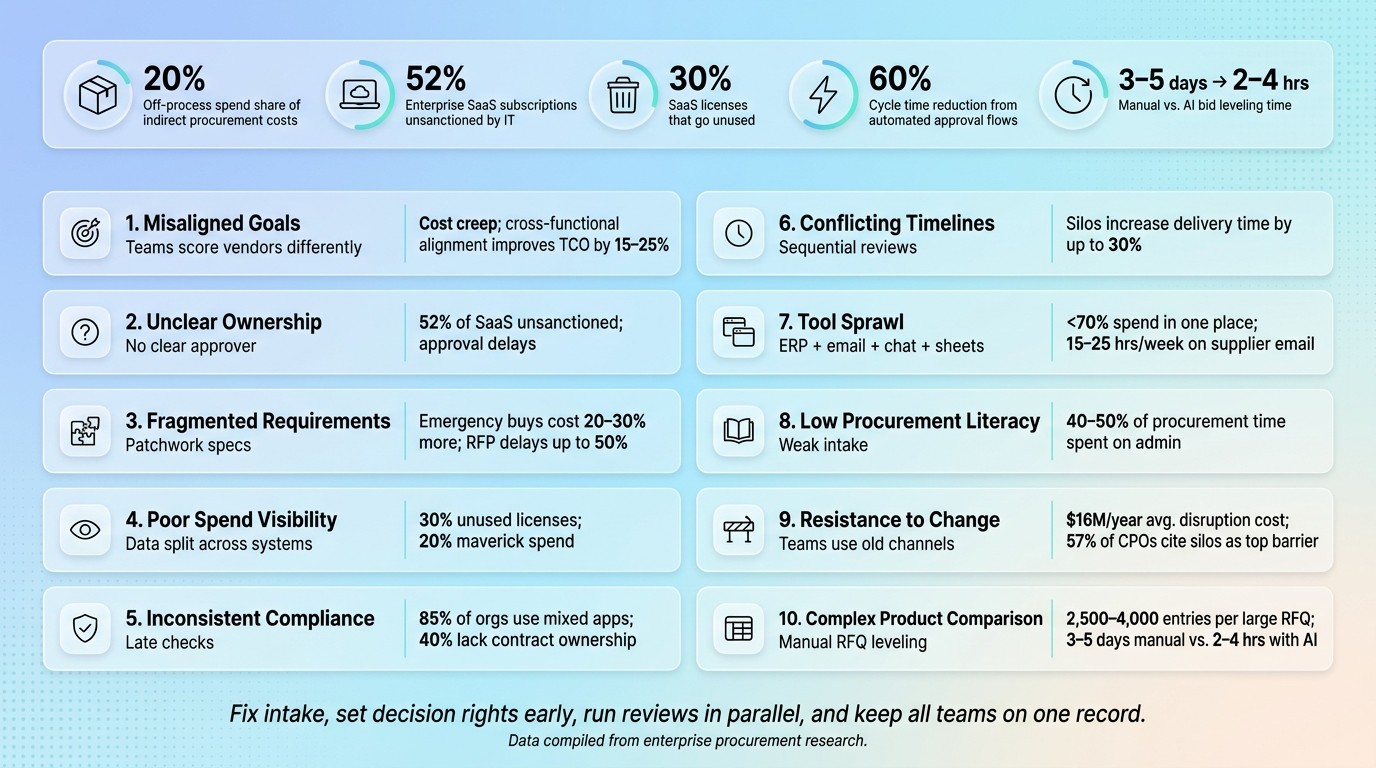
10 Cross-Team Procurement Challenges: Key Stats & Impact
Quick comparison
Challenge | What goes wrong | Main result | Best AI use |
|---|---|---|---|
Misaligned goals | Teams score vendors by different rules | Friction and cost creep | Shared scoring and spend view |
Unclear ownership | No clear approver or process owner | Approval delays | Auto-routing and audit trail |
Weak specs | Rework and bad vendor fit | Guided intake and spec extraction | |
Poor spend visibility | Data sits in many systems | Maverick spend and waste | |
Uneven compliance | Checks happen late or not at all | Audit and legal risk | Rule checks at intake |
Conflicting timelines | Reviews happen one by one | Project delays | Parallel routing |
Tool sprawl | Email, chat, ERP, and sheets don’t match | Lost context and duplicate work | One workspace |
Low process knowledge | Requesters submit poor requests | More admin work | Templates and guided forms |
Siloed behavior | Teams keep using old channels | Low adoption | Central comments and approvals |
Hard product comparison | Large RFQs take too much manual work | Slow, uneven decisions | AI scoring and source-backed comparison |
If I had to sum up the article in one line, it would be this: cross-team procurement slows down when each team works from a different version of the purchase.
Why Cross-Team Procurement Breaks Down
These breakdowns usually come from a few repeat patterns.
Most cross-team procurement falls apart because each team chases its own goals instead of the company's. A short-term project call might fix an immediate need, but it can also leave behind duplicate tools, overlapping contracts, and split ownership across the business. That tug-of-war gets even harder to sort out when procurement data lives in different places, requiring AI-driven data validation to maintain accuracy.
Fragmented data slows decision-making. Procurement details often sit across multiple systems and inboxes, and key fields like compliance certifications or delivery dates may be missing. As Kiril Kavardzhikov, Procurement Manager at Payhawk, put it:
"When you say optimize, the first word that comes to my mind is visibility, because you cannot optimize something that you don't know what exactly it is."
Without one shared record, ownership gets murky fast.
If no one clearly owns procurement specifications, vendor communication, or evaluation records, decisions stall. Finance may not even see the purchase until the invoice shows up. That kind of ambiguity might seem manageable at first. But as an organization grows, it stops being a small irritation and starts dragging on the business.
Growth also puts pressure on informal approval paths. More reviewers, more paperwork, and more regulated purchases push decisions directly onto the project timeline. At scale, routine approvals can turn into bottlenecks.
Who Is Involved and What Each Team Cares About
Cross-team procurement pulls in procurement, finance, IT, legal, operations, compliance, and end users. Each team looks at the same purchase from a different angle. That’s why alignment needs to happen early. If it doesn’t, friction tends to show up later.
These priorities shape every downstream decision, from requirements to approval speed.
Stakeholder | Primary Focus | Key Concern |
|---|---|---|
Procurement | Vendor selection, negotiation | Competitive pricing, contract terms |
Finance | Budget, cash flow | TCO, payment terms (e.g., net-60), ROI |
IT / Security | Technical fit, security | |
Engineering | Specs, performance | Technical evaluation, quality standards |
Legal | Contract risk, liability | NDAs, liability, CCPA compliance |
Operations | Continuity, delivery | Delivery schedules, minimal workflow disruption |
Compliance | Audit, regulatory compliance | Regulatory standards, supplier audits |
When those concerns don’t line up at the start, they usually come back later as unclear ownership, missing requirements, and slow approvals. And the tension is pretty easy to see.
Operations wants fast onboarding, while Legal needs time to review contracts.
Finance pushes for the lowest price, while Engineering argues for the option that best fits the technical spec, often requiring teams to compare AI specification tools to find the right fit.
IT wants standardized platforms, while end users want niche tools that match how they work.
Those priorities shape who reviews the purchase, what gets approved, and how fast the deal moves. That’s why shared criteria matter before vendors are even contacted.
Cross-functional sourcing improves total cost by 15–25% when teams look at the full business impact instead of optimizing for one department’s metric.
The next sections show how these competing priorities create the most common procurement breakdowns.
1. Misaligned Goals and Procurement Priorities
Misaligned priorities can turn procurement reviews into drawn-out negotiations instead of clear decisions. Cross-team procurement tends to slow down when each department is pushing for a different outcome - cost, risk, speed, or technical fit - without a shared way to judge options. When there’s no common set of criteria, every review becomes a back-and-forth, vendors get mixed signals, and approvals drag.
The business cost isn’t small. Off-contract spending - purchases made outside official channels when teams get fed up with slow processes - accounts for roughly 20% of a company's indirect procurement costs. On the other hand, cross-functional sourcing that gets stakeholders aligned around shared criteria can improve total cost outcomes by 15% to 25%.
The fix starts before evaluation. Set shared criteria and non-negotiables early. That means documenting what each department cannot compromise on - security, legal, budget, and performance - before vendor outreach begins. Procright helps by weighting key requirements and making trade-offs clear during evaluation. Shared priorities help, but decisions still stall when ownership is fuzzy.
2. Unclear Ownership and Decision Rights
Once priorities line up, the next place things often fall apart is ownership.
If no one knows who has the final say, procurement slows to a crawl. Requests get sent to the wrong person. Different teams may even negotiate with the same vendor on their own, which weakens buying power and leads to mismatched contract terms. When ownership is fuzzy, a purchase that should move can sit for months.
Late input from Finance, Legal, or IT creates a mess too. Teams have to go back, rework details, and wait through another round of approvals. In some cases, the purchase gets blocked after people have already spent time on it. That kind of delay pushes frustrated employees to buy software outside the normal process. Roughly 52% of SaaS subscriptions in an average enterprise are unsanctioned by IT, often because no one clearly owns intake and review well enough to catch them.
A common approval path includes:
Finance
IT/security
Legal
Final executive approval
The problem usually isn’t the number of approvals. It’s the handoff between them, and the fact that ownership isn’t clear.
AI can help by sending requests to the right stakeholders based on category and sector detection, department rules, or set thresholds, while keeping a clear log of who reviewed what and when. That audit trail cuts down on the classic “I thought you were handling it” problem that drags deals out.
The fix is simple on paper, even if teams often skip it: document who owns intake, specs, sourcing, legal review, and final approval, then make that visible to everyone involved. Even then, requests can still stall when the requirements coming in are incomplete.
3. Fragmented Requirements and Incomplete Specifications
The trouble usually starts at intake. When teams send details through separate emails and spreadsheets, you rarely end up with one clean specification. You get a patchwork version instead, and the sourcing team has to stitch it together by hand.
One group sends compatibility needs. Another adds compliance notes. Finance shares budget limits. Someone else flags timing. Without a shared intake process, those pieces never turn into a single working spec.
That creates a costly mess. Incomplete specifications can push companies into emergency supplier buys that cost 20%–30% more and delay RFP cycles by as much as 50%. And if Legal or IT joins after the scope has already been set, rework is often next in line.
AI can help by pulling structure into the process early. Platforms like Procright can identify missing requirements, extract structured specifications from unstructured sources like PDFs and emails, and flag scope gaps before evaluation starts. industry-specific templates can cut specification errors by up to 90%. That means fewer back-and-forth cycles and cleaner RFQs going out to vendors.
The payoff is simple: one specification the whole team can work from. That leads to fewer rework cycles and cleaner vendor comparisons. But a clean spec alone isn't enough. Teams still need shared spend data to check scope against budget and risk.
4. Poor Visibility Into Spend and Procurement Data
When finance, procurement, IT, and AP all work in separate systems, the full spend picture gets lost. Each team sees a slice of the story, but no one sees the whole thing. And without real-time visibility, budget overruns may not show up until weeks or even months after the money is already committed.
That hits each team in its own way. Procurement may miss off-contract buying. Finance may spot budget issues too late. IT may keep paying for tools no one uses. AP may spend extra time sorting through invoice issues by hand.
The spillover is expensive. Poor visibility can lead to duplicate software, unused licenses, manual invoice work, and maverick spend. Nearly 30% of SaaS licenses in typical organizations go unused because there’s no central view. Maverick spending, meaning purchases made outside approved channels, can quietly make up about 20% of a company’s indirect procurement costs.
At a higher level, the data problem doesn’t stop with day-to-day purchasing. Teams capture only 64% of analytics value, which leaves a 36% gap. And when companies fix transparency issues across finance, procurement, and suppliers, they can unlock savings of 11%–20%.
AI helps by pulling ERP, supplier, and spreadsheet data into one live view. It can dedupe supplier records and flag duplicate invoices, pricing variance, and policy violations in real time. That matters because a shared view means procurement, finance, IT, and AP can work from the same data instead of separate snapshots.
With spend visible in real time, the next issue is keeping that spend compliant.
5. Inconsistent Compliance and Risk Management
When compliance checks happen unevenly, gaps open up between procurement, legal, IT, and finance. Risk doesn’t disappear in those gaps. It just sits there until someone notices it at the approval stage. And by then, the issue isn’t just a slow process. It’s audit exposure.
So the problem isn’t only that rules are missing. It’s that there’s no clear control over when those rules are applied and how they’re enforced.
The data makes that pretty clear. 85% of procurement organizations use a combination of different applications, which creates a compliance gap where risk can slip through the cracks. On top of that, 40% of organizations lack clear ownership over contract responsibilities, leaving contract risk with no clear owner.
Shadow IT is one of the clearest signs that control has broken down. 52% of SaaS subscriptions in the average enterprise are unsanctioned by IT. At the same time, cyber threats tied to digital procurement, including invoice fraud and data breaches, doubled to 26 attacks per month in 2025.
The answer is simple in theory: move compliance checks before purchase approval, not after. Post-approval reviews often lead straight to audit findings.
AI can help by enforcing compliance directly inside the intake workflow. That means non-compliant requests can be flagged or blocked before they move forward. It can also log approvals and communications with a timestamp, which creates a clear audit trail if questions come up later.
For example, Procright can flag policy violations before approval and show a clear compliance score. And implementing automated contract management systems alone can reduce legal exposure by 40%. That’s a strong case for applying the same checks across every team.
Even then, approval is only part of the story. Requests can still get stuck when teams move on different timelines.
6. Conflicting Timelines and Project Schedules
Even when ownership and requirements are clear, timing can still throw the whole deal off track. One team needs an answer now. Another needs time for contract review, security checks, or budget sign-off. That’s where things start to drag. Teams simply work on different schedules.
Organizational silos can increase project delivery times by up to 30%. In most cases, the reason is pretty simple: teams get pulled in one by one instead of all at once. Each group reviews the request on its own timeline, so the project ends up spread across multiple calendars. And when a team joins too late, the purchase often gets pushed back into review again.
"The later you loop in procurement, the less they can do to help." - Hugo Britt, Procurement Writer
The better move is to run reviews in parallel instead of in sequence. AI-driven workflows can send requests to the right stakeholders at the same time. Automated approval workflows can cut procurement cycle times by as much as 60%, while real-time dashboards let every team see the current status of the request. Procright helps by keeping specification reviews, compliance checks, and product comparisons in one place.
Bring procurement and IT in at kickoff, not after a vendor has already been picked. Set service-level agreements for review times, with clear response windows. Shared deadlines can help, but they often fall apart when teams still talk in separate tools and scattered threads.
7. Tool Sprawl and Disconnected Communication Channels
Cross-team procurement often bounces between the ERP, spreadsheets, email, ticketing systems, and chat. When that happens, handoffs get missed, work gets duplicated, and approvals drag out. Ownership ends up scattered, and people lose track of who’s doing what.
"When the headcount grows, you start to lose that shared awareness... More and more teams become more autonomous. They decide to purchase something on their own. So nobody has the full picture anymore." - Kiril Kavardzhikov, Procurement Manager, Payhawk
You can see the cost in plain terms: lost time, broken records, and updates that don’t match from one system to the next. Companies keep less than 70% of spend data in one central location. On top of that, procurement teams spend 15–25 hours a week handling supplier email instead of doing higher-level work.
A shared workspace cuts through a lot of that mess. Procright keeps specification analysis, product comparisons, and compliance verification in one place, so every stakeholder works from the same record. With one workflow, purchasing cycles can shrink by as much as 50%.
A good place to start is simple: trace where requests get entered again, where approvals slip into side conversations, and where data falls apart across systems. That shows you what a single intake workflow needs to fix. And once those cracks start to show, another problem usually follows: teams don’t have one clear procurement playbook.
8. Low Procurement Literacy Across Departments
A lot of procurement delays begin before procurement even sees the request.
When employees don’t know the sourcing rules, compliance steps, or how to write a clear spec, intake slows to a crawl. Procurement then ends up cleaning up issues that should’ve been stopped at the start.
That ripple effect hits every team. Legal gets pulled into late contract fixes. Finance spots overruns after the money is already committed. IT ends up dealing with unsanctioned software - about 52% of SaaS subscriptions in a typical enterprise are unsanctioned by IT. At the same time, procurement teams spend 40% to 50% of their time on admin coordination instead of sourcing work.
At the center of it is vague intake. “ASAP” doesn’t mean the same thing to every department, and many requests show up without the context needed to move forward. So procurement has to guess, follow up, or fill in the blanks. And when the process feels unclear or slow, employees often go around it. That’s how maverick spend creeps in, and it can make up up to 20% of a company’s indirect procurement costs.
The fix starts at intake. Requesters need guardrails before a weak request lands on procurement’s desk. Procright does this with template-based comparisons and automated specification creation that walk people through what’s needed - without expecting them to know procurement inside and out. Built-in compliance verification flags policy issues at the request stage, not after a contract has already been drafted.
That means fewer back-and-forth cycles, cleaner specs, and approval timelines that can drop from weeks to 48 hours.
9. Resistance to Change and Departmental Silos
Even a better procurement process can fall apart when teams stick to their own tools and routines. Spreadsheets, email, and informal Slack threads often keep buying outside the shared workflow across procurement, finance, IT, legal, and operations. That makes it harder to line up approvals, ownership, and vendor selection.
"Stakeholders are becoming increasingly time-pressured, busy, and just want to - want to handle it themselves, which creates a real friction within the organization." - Tom Mills, Head of Procurement, Procure Bites
This kind of siloed work is the top barrier for 57% of CPOs. It also costs organizations an average of $16 million per year in direct procurement disruptions and plays a big part in stalled transformation efforts. The result is slower approvals and more buying outside approved channels.
A lot of resistance doesn't look dramatic. Teams may nod along during rollout, then quietly keep using the old way.
"Change resistance is more than reluctance - it's a silent threat to the value of procurement integration." - Conrad Snover, CEO, ProcureAbility
AI can cut the friction that leads teams to bypass the shared process. It can route requests, run policy checks, and pull data into one place without extra manual work. Procright gives teams a single place to create specifications, compare products, and verify compliance, so everyone works from the same record.
That shift matters. Organizations that move to an integrated workflow can reduce requisition-to-PO cycle times by as much as 60%. Once teams start using one workflow, the next challenge is more specific: comparing complex products against the same set of criteria.
10. Difficulty Comparing Complex Products and Solutions
Even when teams line up on requirements, the hard part often starts after that: comparing complex options in a clean, consistent way.
When a purchase includes lots of requirements and several stakeholders, vendor reviews can bog down in a hurry. Engineering looks at functional fit. Finance looks at budget and total cost. Legal looks at contract terms and liability. Each group is looking through its own lens, so side-by-side comparisons can drift. And once that happens, even a solid buying process starts to slow.
That gap costs time and money. A 500-line RFQ across six vendors can mean 2,500 to 4,000 manual entries, and every single one creates room for mistakes. Scope exclusions that no one caught early can show up later as costly rework. On top of that, people can only compare a small set of options well before decision quality starts to slip. So teams often stop short of the best fit simply because the process gets too hard to manage.
The time difference is hard to ignore. Manual bid leveling for a complex RFQ usually takes 3–5 business days. AI-driven platforms can shrink that to 2–4 hours. AI can also review thousands of supplier configurations at the same time and cut the risk of choosing the wrong procurement option by as much as 90%.
This is where AI helps most: it makes scoring compliance risks more consistent across every option. Procright reviews specifications line by line, checks vendor claims against source materials, and assigns clear compliance labels - Yes, Partially, No, or Not Found - with direct source links to back each call. That gives the team one shared, evidence-based record instead of a patchwork of spreadsheets, emails, and opinions.
How AI Addresses Cross-Functional Procurement Friction
All ten challenges trace back to the same root issue: fragmented information, unclear ownership, and inconsistent processes slow teams down and push costs higher. AI helps by tackling that shared friction head-on. The fix isn't a pile of disconnected tools. It's one workflow that ties together intake, routing, visibility, compliance, and evaluation.
The biggest change AI brings is this: procurement becomes a structured workflow instead of a messy chain of emails, spreadsheets, and side conversations. AI standardizes intake, so every request starts from one complete record of the procurement lifecycle rather than scattered details spread across different systems.
From there, AI takes on the coordination work that often gets dropped or delayed. Guided approval workflows route requests to the right stakeholders based on value thresholds, risk level, and department policies. That cuts down on ownership confusion and keeps decisions moving without constant manual follow-up. On the spend side, real-time dashboards show spend drift before it turns into a budget problem. The same workflow also helps legal and security reviews happen at the right point, instead of showing up late and slowing everything down.
Compliance and product comparison, which are often some of the toughest parts to manage by hand, also get better with AI. Automated compliance checks flag policy violations or security risks in real time. Multi-criteria scoring pulls input from engineering, finance, and legal into a single, evidence-based ranking. Procright supports this by helping teams discover matching products and verify vendor claims with transparent source links and compliance scores.
Next is a quick challenge-to-solution snapshot.
Challenge-to-Solution Snapshot
This snapshot pairs each challenge with the AI feature that tackles it most directly.
# | Challenge | Main Business Impact | AI Capability |
|---|---|---|---|
1 | Misaligned Goals & Priorities | Budget overruns and friction | Shared spend visibility - real-time dashboards that line up budget, risk, and timing |
2 | Unclear Ownership & Decision Rights | Approval delays | Workflow Routing - automated routing sends requests to the right stakeholder |
3 | Fragmented Requirements & Incomplete Specifications | Rework and incorrect orders | Spec Automation - guided intake standardizes requirements upfront |
4 | Poor Visibility Into Spend and Procurement Data | Maverick spend, duplicate payments, and unused licenses | Spend Visibility - automated categorization and entity resolution across systems |
5 | Inconsistent Compliance and Risk Management | Audit risk and legal liability | Compliance Scoring - AI-driven vendor vetting and risk assessment |
6 | Conflicting Timelines and Project Schedules | Project delays and missed renewals | Workflow Routing - pipeline management to sync procurement with project schedules |
7 | Tool Sprawl and Disconnected Communication Channels | Data silos and manual reconciliation effort | Single data view - connects ERP, CLM, and sourcing data in one view |
8 | Low Procurement Literacy Across Departments | Policy violations and errors | AI-Powered Intake - guided buying flows help non-procurement users follow approved channels |
9 | Resistance to Change and Departmental Silos | Low tool adoption and manual errors | Centralized communication - centralized comments and approvals |
10 | Difficulty Comparing Complex Products and Solutions | Poor vendor fit and overpayment | Product Comparison - AI comparison of pricing and contract terms |
Next, the role-vs-concern table shows who owns each issue.
Role-vs-Concern Table
This table boils down the main approval concerns by function. Unlike the earlier role overview, this version shows the specific issues that shape approval.
Role | Primary Priority | Key Risk | Main Approval Concern |
|---|---|---|---|
Procurement | TCO, supplier stability, negotiation leverage | Vendor lock-in, supply chain fragility | Competitive bidding, ESG compliance, contract design |
Finance | Budget alignment, cash flow, ROI | Budget overruns, maverick spend | Payment terms, funding availability, renewal costs |
Operations | Speed of delivery, business continuity | Supply chain disruptions, operational downtime | Delivery schedules, capacity, implementation timeline |
IT / Security | Cybersecurity, system integration | Shadow IT, data breaches | SOC 2, ISO 27001, data privacy, SSO requirements |
Engineering | Technical specs, performance | Technical obsolescence, specification mismatch | Feature set, API availability, co-development potential |
Legal / Compliance | Risk mitigation, regulatory adherence | Contractual loopholes, GDPR/CCPA fines | Indemnification clauses, NDAs, Master Service Agreements |
These concerns shape how each team looks at risk, cost, and fit. Procurement may focus on contract structure and supplier exposure. Finance is often looking at budget pressure now versus renewal pain later. IT / Security will zero in on data handling and access controls, while Engineering cares about whether the product will do the job without forcing awkward workarounds.
That difference in framing matters. A vendor that looks strong to one group can look weak to another for a completely different reason. So approval isn't just about the final sign-off. It affects vendor selection from the start.
Use these concerns as inputs in a weighted scoring model, not as separate veto points. The next step is to assign weight to each concern so teams can compare vendors inside one shared decision framework.
Criteria Weighting Example for Vendor Decisions
Once the team agrees on the core requirements, the next step is simple: use data-driven supplier scorecards so every vendor gets judged on the same scale. Without that, procurement can bog down fast. One team looks at price, another focuses on security, and someone else cares most about implementation. Before long, the process turns into a department-by-department debate.
A weighted model fixes that by setting the scoring rules before vendor comparisons begin. Everyone works from the same framework, which makes the final call easier to defend.
Start with the non-negotiables. Then assign weights to the rest. That helps keep the review from sliding into a price-only argument.
The example below turns competing priorities into one shared decision record.
Criteria | Weight | Measure | Owner |
|---|---|---|---|
Total Cost of Ownership (TCO) | 30% | 3-year cost, implementation fees, and renewal increases | Finance / Commercial Analyst |
Performance & Uptime | 25% | 99.99% uptime, system integration, and reference checks | IT / Technical Lead |
Compliance & Security | 20% | SOC 2 Type II, ISO 27001, data privacy, liability caps | Legal / Risk |
Implementation Complexity | 15% | Migration timeline, internal resource hours, API availability | Project Manager / IT |
Support Quality | 10% | 24/7 support, training credits, and a dedicated account manager | End-User Representative |
Cost has the biggest weight at 30%, but it doesn't decide the outcome by itself. A lower-cost vendor still needs to meet the bar for compliance and performance. If a team chases savings alone, it's easy to make short-term calls that miss renewal increases, inflation, and risk trade-offs.
This is where AI can help in a practical way. Procright can analyze vendor specs, surface compliance scores, and compare products against the same criteria in one place. That makes trade-offs easier to see. One vendor may look stronger on cost but weaker on risk. Another may be a better match for the required security standards.
Use the same weights throughout the vendor review so each stakeholder scores against the same criteria.
Conclusion
Across all 10 challenges, one pattern stands out: most cross-team procurement failures come down to coordination. The trouble usually shows up at handoffs, when approvals, specs, and risk checks all move on different schedules. That gap can lead to an average 11% contract value leakage after signature.
AI cuts rework and delays by giving every team the same specs, the same compliance scores, and the same vendor records. Procright does this by automating specification creation, surfacing compliance scores, and centralizing vendor comparisons. The result is simpler decisions, made faster, with a clearer paper trail behind them.
The goal is not perfection. It is repeatability.
FAQs
What causes cross-team procurement delays?
Cross-team procurement delays usually come down to organizational silos, scattered communication, and no single place to manage the work. Finance, legal, and operations often move on separate tracks, using disconnected tools instead of a shared workflow.
That leads to fuzzy ownership, missed input early in the process, weak visibility, manual approvals, and poorly defined requirements. The result is more internal back-and-forth, more audit risk, and time-consuming spec revisions.
Procright helps by automating specification creation and compliance verification.
How can AI improve procurement workflows?
AI makes procurement work less manual and less slow. It handles repetitive tasks and gives teams data they can use to make better calls.
Procright helps teams write clear, compliant specifications by spotting missing requirements and suggesting technical details that should be included.
It also checks those specifications against product data from sources like PDFs, videos, and websites, then shows transparent compliance scores. That cuts down on manual research, lowers the risk of poor choices, and gives teams more time to focus on strategy.
What should teams fix first in procurement?
Start by getting procurement and finance on the same page. Both teams need to work from the same data, the same timelines, and the same definition of value. If that alignment is missing, decisions get messy fast.
Next, centralize and govern procurement data. When data is scattered across systems, teams, and spreadsheets, decision-making gets weaker and AI has less to work with.
Then turn to the silos between teams. That’s often where progress stalls. Procright can help here by automating specification creation and giving teams transparent, data-driven compliance scores.